your your project management assignment in this class this is largely what Milestone one is based on so defining the projects obviously very important and we have to take it from not only saying what your project is but break it down into smaller more obtainable goals and pieces that you can like a framework that you can add some meat to if you will so kind of a skeleton that we can build upon so there are five general steps for collecting project information they are listed here and we're going to break them down throughout this slideshow so
step one Define the project scope step two establishing project priorities step three creating the work breakdown structure you'll see that abbreviated as WBS step four integrating the WBS with the organization step five coding the WBS the work Breakdown schedule um excuse me structure for the information system so how does it fit within your existing organization so let's talk about step one defining the project scope the project scope is a definition of the end result or mission of your project and a product or service for your client or customer so your end user this defines the
results to be achieved they need to be specific tangible and measurable um and we talked a bit about that in a previous chapter about smart goals being specific and measurable and achievable and you know have a time frame and the more you break this down the more you get into the detail I've already got some questions from students hey how detailed we should we be here as detailed as possible because that's going to make your project um uh more obtainable and more well sellable to whoever it is that needs to approve it so what's the
purpose of a project scope statement is to clearly Define the deliverables for the end user so what are you trying to achieve with this project the direct focus of the project purpose throughout the life of the project for the customer and its per and its project participants so it's like okay you have a team of five people uh what is person one two three four five doing within this project and then what are they doing next week and what's your schedule for this and what are going to be the cost all right um the purpose
of the end of a project scope statement is to be published and used by the project owner and project participants for planning and measuring project success now there's a checklist to a project scope um it's one through eight here uh project objective product scope description justification deliverables milestones and I've used that language throughout this course in terms of what needs to be achieved technical requirements limits limits and exclusions and acceptance criteria what results are acceptable for the good or service you're trying to produce um project scope uh scope statements are short one to two page
summary of the key elements of the scope of the project followed by extended documentation of each element so you do get into the details it's also referred to as statements of work cells sows's um there's a project Charter it's a documentation that authorizes the project manager to initiate and lead the project we're just assuming you've been you know chartered to do this project in our class we're mimicking that what would happen our corporate world this often includes a brew scope description as well as such items as risk limits business case spending limits basically some parameters
from which you can do your um your project including how you can compose your team um there is can be issues of scope creep it's a tendency for project scope to expand over time to get bigger and bigger bigger usually by changing these requirements above specifications and priorities so sometimes now we have something in Academia called syllabus creep and with every semester we think I should put this on my syllabus and then before we know it our syllabus is like 40 pages long so you have to guard against that you have to do the same
thing when you're doing a project so you have to be really careful careful that you stick within your scope and don't start expanding into areas that have nothing to do with your original goal uh five of the most common causes of scope creep poor requirement analysis you get way too broad you don't drill down not involving users early enough we've talked about that in class a little bit about you've got to get out in front of your end user you can't hide your business idea you can't hide your project idea you need to talk to
them from day one because there might be something you're thinking about doing that nobody wants to buy um there might be something you're thinking about doing that just does not have a market underestimating the project complexity you get way too broad that's what I'm always in all my classes saying hey get specific a lack of Change Control and gold plating I.E giving you features that well you don't really need it doesn't have to be fancy but it does need to be a good idea that's well thought out step two establishing project priorities three major criteria
trade-offs that a project manager has to manage are cost and that's the monetary budget time that's the one thing you can never get back so make sure you have a schedule and performance so what is your actual scope so again if you get too broad and you don't drill down exactly where you want to be that can mess up your priorities you can start trying to be too wide and you end up turning on a project in the end to your supervisor that you know is very has a lot of breadth but no depth whatsoever
a project manager can manage the project trade-offs by completing a priority Matrix for the project and identify which criteria is as follows constrained that's the original parameter is fixed so that's why when you set your goals you stay there enhance a Criterion that should be optimized so let's say if we have a constraint of five project objectives of the five what are the one and two we one or two that we really want to enhance and then accept the Criterion that is tolerable not to meet the original parameter so that kind of your your secondary
things the reading does a better job of going more in depth here than I am in this limited lecture so I expect you to complete that reading as well jumping on to step three creating a work breakdown structure now this is something you'll see a lot of in this class moving forward work breakdown structure is a WBS it's a hierarchical outline of the project with different levels of detail it identifies the products and work elements excuse me involved in a project what needs to be done right defines the relationship of the finer final deliverable the
actual final project to its sub deliverables and in turn the relationship to the work packages basically this is breaking down your work from Big scope to to you know nitty-gritty what does each person do and why do they do it serves as a framework for tracking costs and work performance we'll look at a graphic um here in a few slides it makes this a little more apparent it's best suited for design and build projects that have tangible outcomes rather than process oriented projects although I would say processes is great if you can add some structure
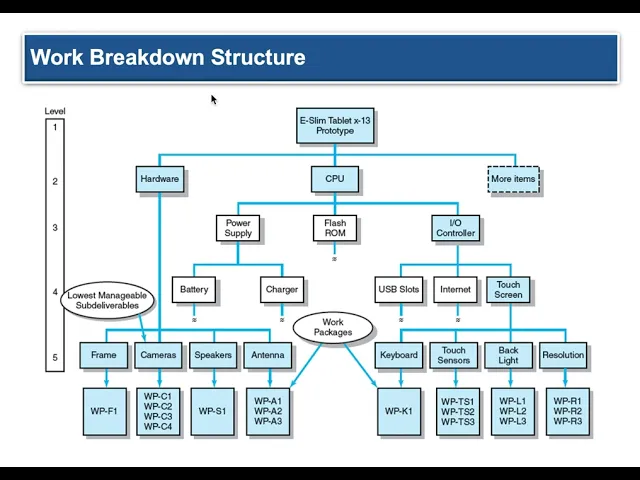
to them as well now this is kind of this is the the one I was just referencing but this just breaks it out so basically at a higher level level one you have the project so like what you would like to do with this complete project you say okay to do that we need some deliverables here are the major things we need to do to do those deliverables we need support so we need sub deliverables and then we have a lowest sub deliverable which is like the day-to-day so as you can see here we're moving
down on organization and and you'll you'll see it here in a second there's there's a few slots to go um the cost account once you start you know the biggest challenge in a project is putting cost to it but once you get your head out of the clouds and um you know you have this one business project you want to do for a corporation but once you start breaking these things down it gets a lot easier to assign costs when you put things in very simple terms and I'll I'll show you what what I'm talking
about here in a second I promise and then you can break down the work down here that says hey here are the things that we need to do okay it's breakdown group work packages by the type of work within a deliverable and allows assignment responsibility to an organizational unit basically it makes an idea have goals yes but then objectives yes but to meet your objectives you have to do these handful of things that starts to become people's jobs and when people can do their jobs then it can support the overall project goal so how WBS
work breakdown structure helps the project manager the insurance project managers that all products and work elements are identified there's no surprises it integrates the project within the current organization so think organizational chart and how do we fit in there is this you know a special project is this a matrix we've talked about that previously in class and establishes a basis of control this facilitates the evaluation of cost time and Technical performance what are these things that we have to do on the day-to-day as we break it down in the organ in the organization over the
life of the project this affects how many people you need to hire how many people you need to assign to the project Etc provides management with information appropriate to each organizational level allows them to lead with strategy it helps project managers to plan schedule and budget the project this helps in the development of the organizational Breakdown schedule now this is something that we're going to integrate in with the w BS is called the OBS organizational breakdown structure which assigns project responsibilities to organization units and individuals without even knowing it you've been doing this all along
hey you take this part of the this Milestone you take this part and I'll do this part it provides the opportunity to roll up or sum the budget in actual costs and through smaller work packages into a larger work elements and ultimately a price tag on how much the Project's going to cost it defines communication channels and assists in the understanding coordinating of many parts much like most the courses I teach I'm just trying to get you to think and within that you need a structure to help you think and organize your thoughts so ta-da
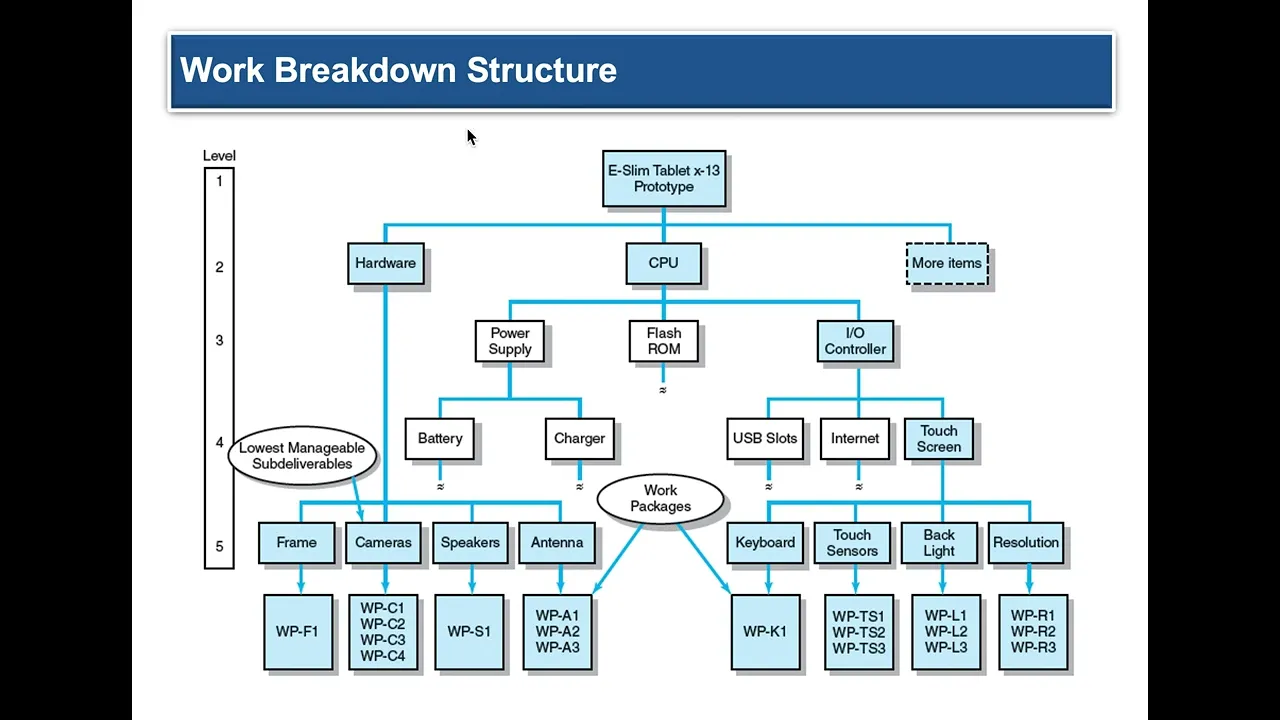
um remember how we said hey we started the top with this big idea okay and then this is some kind of tablet that the reading uses and I'll let you get any more get some more information there so we had level one we go up here level one the project then we have deliverable sub deliverables lowest deliverables cost account work packages we're working to that structure here okay so this tablet that we need to produce we need to you know prototype it's got Hardware it's got a CPU which can include software or you know well
CPU wouldn't that be the functional stuff the operations of it and then more items maybe software or whatever the hardware you need a frame you need cameras you need speakers you need antenna okay then you need all these components to make a frame cameras speakers and antenna power supply need a battery than a charger flash ROM you need this component i o controller so USB Internet touch screen that type of thing these are extra features so you need a keyboard touch sensors back black it's going to say black light those are cool but no backlight
to your screen and then a resolution so that you can see it you need all these components so everybody's like hey I want to make a tablet well you got to break it down everything you need and then you find people who can provide in suppliers so you can put these things together then you design how you manufacture them and then you you have a quality control and then you start to add the big pieces all together and they all come together and then you have a tablet okay see the idea here is here we
want this output what are the inputs we need well you got to build the bridge here you gotta you know I tell you what I just had an idea if I start seeing stuff like this these types of work brick structures breakdowns in your Milestones oh that's going to result in some good points for you just the hint if you're actually watching this lecture you should be and doing the reading so a work package it's the lowest level of the WBS so it's down here okay it's lowest level a work package lowest level of the
WBS is short dur duration task that has a definite start and stop Point consumes resources and represents costs so as you break things down these are high ideas like hey I don't know how much this tablet's going to cost just guess no no start down here how much does it take to put all this together and then you end up with your costs and then you add profit margin to that and you know what to charge for it um so it's the lowest level the WBS the work package that is shortest duration you got to
use your resources and it has costs should not exceed 10 work days or one reporting period so in general this should be something that you can take care of pretty quickly okay uh should be independent of other work packages as a project so what this looks awful lot like an org chart right all right so you have like CEO types up here directing their VP types here uh who's working with their manufacturing heads here who then passes it down to the engineers who then passes it down to the workers okay so each one of them
is independent in their work packages the basic unit used is used so when you break this down now you can plan schedule and control the project you know what you need to be able to do the frame you know what you need to be able to do the keyboard you know what you need to get the right resolution so you what you need to do is take your projects and come up with a structure like this and break it down and listen if you can come up with something like this you could write for days
on it these Milestones are going to take care of themselves and this is kind of like the outline to your paper so each work package in the WBS defines work like what are we doing identifies the time to complete the work how long is it going to take it identifies the time phase budget to complete the work package how much is it going to cost identifies the resources needed to complete the work package okay how you know how much how much of this input are we going to need see how it breaks it down like
hey we need more input for the camera we need more input for the backlight uh keyboard's pretty straightforward frame is pretty straightforward yeah so identify as how many resources we're going to need identify as a single person responsible for the unit Works who's going to oversee it identifies monitoring points for measuring progress how well is it how well is it managed okay step four integrating the WBS with the organization this is where we take the WBS and add the OBS which is the organization breakdown structure you're like hey man this is a lot of acronyms
get used to it man corporate American Business everything's acronyms WS WPS rather plus OBS the OBS organization breakdown structure depicts how the firm has organized to discharge the work responsibility you guys have organized as a group to take care of your group projects provides a framework to summarize organization unit work performance identifies the organization units responsible for work packages and ties the organizational unit to cost control accounts again we start breaking things down it gets a little easier to put some costs on it pardon me went back went too far forward uh and ties the
organizational unit to the cost control accounts the intersection of of a working package an organization unit creates a project cost point and cost account that integrates work and responsibility basically you're breaking it down to make it simple even though this does not look simple so you have the WBS right here one through five this is what we were just looking at and remember up here you know we broke these down into inputs and what they needed here is your project management Matrix here so you have your organization let's say you have someone on this team
that's working on a tablet works in design quality control production and Outsourcing like all these little components up here how much let me go back here a second how many do we need to Outsource how many can we make in-house you can do the same thing with your projects I don't care what they are you can break this down into a matrix now this leads us into in the book does a pretty good job of breaking this down a little further and if you look at it imagine you had five rows here and that was
each member of your team who's going to be focusing on frame what do we need to get cameras remember how cameras had more inputs look at this they have more there well remember backlights had more input so look at that keyboards are pretty straight right so it's pretty inexpensive frame was pretty straight all right it's pretty like one unit right one input well with cameras you had more and backlight you had more you have different components of your project that are going to be more complex and harder to do um a you need to be
able to define the scope of your project B the different parts of your project see who's going to do your project and D how many you know resources are going to need to pour into each part so it's going to take a little bit of thought but you know what that's the point of college it's a little bit of work step five coding the WBS um work breakdown structure or schedule for information systems so this is the final step like how do we integrate at WS coding system to fines the levels and elements of the
WBS involved organization elements the work patch packages needed the budget and cost information and allows the report to be Consolidated any level of the structure so if you break the thing down let's imagine the project is making a peanut butter and jelly sandwich okay well pretty much the title gives away the ingredients and the instructions you need peanut butter you need jelly and you need bread are we just importing or Outsourcing rather the jelly is it grape jelly how do they make the jelly are we just buying are we making it ourselves okay peanut butter
are we growing the peanuts ourselves if not where are they coming from are we just buying the peanut butter from someone where are you buying it from how much does it cost you can get a cost of peanut butter making it or just buying it you can get a cross with jelly making or just buying it same thing with bread then who's putting the peanut butter and jelly that is your project together how much total does it cost what kind of profit do you want to make add that to your total cost and there's the
price of your bb and J so if you think about it in that terms basically everybody is making a peanut butter and jelly it's just that your inputs are different okay so you've got human labor you've got the raw inputs are you making those raw inputs if so how much does that cost are you just buying all these things pre-made putting it together does that give you a cost savings does it cost more so you got to break things down all right where are we um coding basically means like in the reading goes in this
much longer than I want to do on this particular lecture but it means breaking it down and allowing every level of the structure to or understand fully what it's going to take to produce this product WBS dictionary provides detailed information about each element of the WBS in other words each element bread peanut butter jelly what kind of tools do you need to put together are we going to put it on a plate do we need a butter knife we're going to cut the Jugger in half if so how much does that cost us in manufacturing
uh not to get overly simplistic but I like using simple examples to explain how you manage anything within business and you know whether you're making a BMW a wedding business or a restaurant that sells upscale peanut butter and jellies there's a lot of the same inputs now process breakdown structure PBS is used to for process oriented projects we kind of went into that when we're talking about making a sandwich there it's often referred to as a waterfall method in the software industry you know there's a lot of service in the software industry and then you
produce an intangible product that's been downloaded but there's a lot of physical inputs that it takes just like we were talking about making a tablet you have to do the same thing to make Microsoft Word this is a process oriented project uh is a project that has a final outcome as a product of a series of steps and phases you need to Define what those steps and faces are that's what I'm looking for in these projects and the project that evolves over time with each phase affecting the next phase so they're dependent upon one another
think about an assembly line what gets done first what gets done next what get done's in the middle then what gets done three-fourths of the way through and what is my final project what does it look like and how much does it cost to produce and that tells me as a manager whether or not I should invest in this project the project is driven by performance requirements and not by plans and blueprints we're not building a house here we're making a peanut butter and jelly sandwich if that helps you now here's something that you guys
have already been talking about it's a responsibility Matrix RM it's also called a linear responsibility chart you're in a group of five people it summarizes the task to be accomplished and who is responsible for What on the project dividing conquer right many hands make light work uh it lists all the project activities and participants responsible for each activity and clarifies the interfaces between units and individuals that require coordination it provides a mean for all participants in the project to view their responsibilities and agree upon their assignments those things should be pretty balanced if you have
somebody doing all the work and they're going to slay you on the peer review and that's going to hurt your overall grade clarifies the extent or type of authority exercised by each participant you guys need to get together and say who's doing what okay so let's say you're in a group with Richard Dan Dave Linda and Elizabeth okay R means you're primarily responsible for this Richard identifies Target customers and develops a draft questionnaire and he finalizes the questionnaire Dan's gonna pilot test it but he's also going to work on the results and prepare a draft
s means support so Richard is going to support Dan as is Dave and Linda going to support Dan on preparing the final draft of the report or excuse me preparing the draft of the report so the rough draft and then Richard's gonna be in charge of with the support of Dave of finishing the final report now each one of your Milestones has different steps and I've tried to keep them around five so that you know if you're in a group of five um that allows you to divide things very evenly so Dan's primary here um
on about three things Dave is supporting a lot of stuff but then primarily responsible for input response data that must be something that's hard to get it's like these things are pretty straightforward that's why he's got four r's and one s but it sounds like to me they want Dave to focus on the input response data so Gathering data that might be something that's pretty hard if he's got the 1R same thing with Linda who's going to physically receive and monitor the return questionnaires but then supported by and support in other areas Elizabeth's responsible for
printing the questionnaire mailing labels and mailing the questionnaires and then supporting the receipt of the data so each person has response responsibilities and support this is how you know group projects A to Z should be organized people should have primary responsibilities and then other people support them yet you know they they all have something that they're carrying their weight on Project communication plan uh the dress is the following question so what information needs to be collected and when who will receive this information what methods will be used to gather and store information what are the
limits if any on who has access to certain kinds of information and when will the information be communicated and how will it be communicated steps for developing a communication plan stakeholder analysis identify your target group information needs what's the project status reports whether to deliver Bill deliverability deliverable issues changes in scope if something changes you get through there do you have regular team meetings is there gating decisions we talked about in a previous lecture of like going through these Gates before a project moves forward um I would encourage you each to have a response a
responsible party and a support person who follows up and says this isn't good enough you didn't do hard enough work on here you need to go back we can't turn this in or you you've slacked on your part needs to be better you need accountability Partners can we accept the request to changes are there action items can we create a milestone report you're better in this class sources of information where does this information come from dissemination modes hard copy email teleconferencing SharePoint variety of database sharing programs how are you going to organize it uh the
responsibility and timing sorry about that um determine who will send out the formation and when who's going to turn in your project all right let me go ahead and tell you something if I see something in your Milestones it looks like this that you've got a responsibility Matrix and if I see something looks like this or this I'm gonna be a sucker for your paper it's gonna get a high Mark listen that's a 30 000 foot view of chapter four defining a project you cannot skip the reading you cannot skip your responsibilities I'll catch you
in chapter five