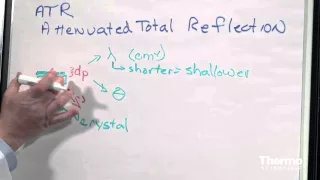
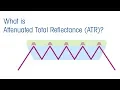
[Music] FTIR has proven incredibly beneficial in the laboratory and is a well-established technique however sample prep can be arduous and time-consuming in order to obtain high quality spectra that can answer the users questions ATR or attenuated total reflectance is one such sampling technique used to obtain high-quality data of both liquids and solids after a sample comes in contact with a crystal light is sent into the crystal below a certain angle known as the critical angle when the light is kept at or below this angle it bounces through the crystal and is collected on the other
side information about the sample is gathered through the interaction of an evanescent wave and the sample this evanescent wave is a standing wave that occurs at inflection points of the propagating light after interaction with the sample it carries the chemical information along with it to the detector this evanescent wave is key to how ATR is able to provide the user vibrational or chemical information about the sample of interest this wave penetrates into the sample a given amount and is dictated by several things this depth of penetration is important because it is related to your path
length there are two main variables that penetration depth are dependent on first is the wave number being used because penetration depth varies with wave number it is not constant across the whole spectrum being collected the depth of penetration increases the lower your wave number is this will mean that Peaks down by 400 wave numbers will have a higher peak intensity than the peaks at 4000 wave numbers when compared to a transmission experiment the second variable is the difference between the refractive index of the crystal and the sample a crystal like germanium with a higher refractive
index will have a lower depth of penetration than something like Diamond there are other variables that can affect the penetration depth but they are not usually accessible to the typical user so they won't be discussed here as stated earlier penetration depth is important because it is effectively your path length and based on beers law the larger the path length the higher the absorbance is in an ATR accessory there are typically multiple bounces where the evanescent wave penetrates into the sample in these cases the real path length is the sum of each of these interactions or
bounces in other words the higher the number of bouncing ATR has the larger the path length the better sensitivity it will have even with this variability ATR makes for an amazingly consistent sampling technology because these variables are always the same this allows ATR to return consistent data results time after time and accounts for the immense popularity of this sampling technology for more information head to mt comm slash ATR [Music]