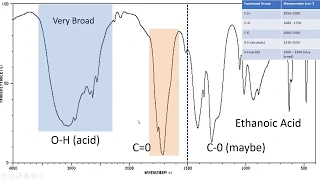
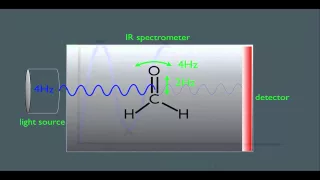
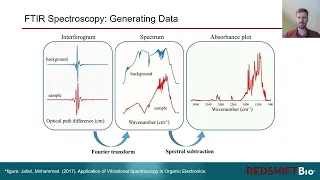
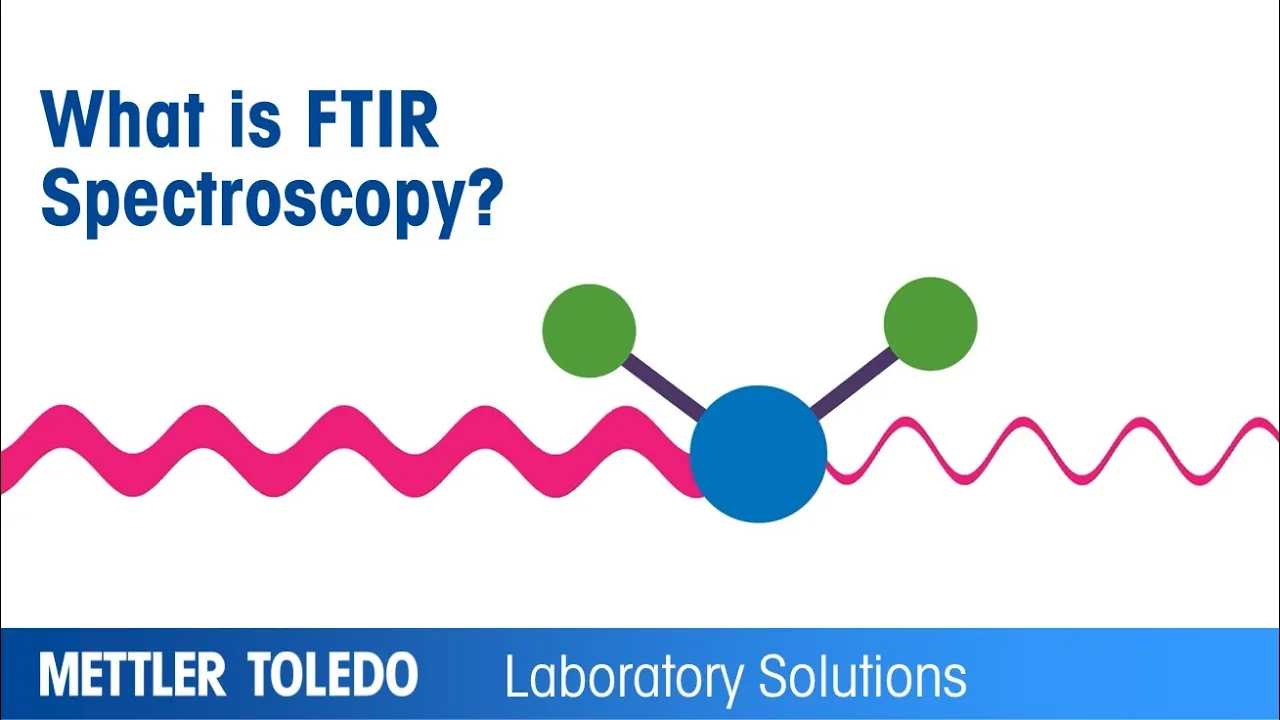
[Music] fourier transform infrared spectroscopy or ftir is an analytical technology used in industry and academic laboratories to understand the structure of molecules and the composition of molecular mixtures ftir spectroscopy uses modulated mid infrared energy to interrogate a sample the infrared light is absorbed at specific frequencies directly related to the atom to atom vibrational bond energies in the molecule when the bond energy of the vibration and the energy of the mid-infrared light are equivalent the bond can absorb that energy different bonds in a molecule vibrate at different energies and therefore absorb different wavelengths of the ir
radiation the position or frequency and intensity of these individual absorption bands contribute to the overall spectrum creating a characteristic fingerprint of the molecule since ftir spectroscopy produces signals that are specific to the type of molecular bonds or functional groups it is the ideal tool to measure the making and breaking of chemical bonds during a reaction coupling ftir spectroscopy with attenuated total reflectance or atr increases the utility of this technology by providing a means to monitor reactions in situ and in real time measurements via atr ftir eliminate the need to manually sample the reaction for offline
analysis making it possible to determine in real time key reaction characteristics such as initiation endpoint reactive intermediates kinetics and mechanistic information ftir spectroscopy is fundamentally a qualitative or relative measurement technology but can also produce quantitative measurements of important reaction components ftir follows the beer lambert law a equals abc where the molar absorptivity a and the path length b are essentially fixed and therefore constant so the absorbance that a vibrational frequency for a specific bond is directly proportional to the number of this specific bond or concentration once calibrated much like that for hplc each measurement by
the ftir instrument will be quantitative for the reaction components it was calibrated to measure now real-time quantitative information can be obtained throughout the duration of the reaction which can be used as control variables for conditions such as add the next reagent cool or heat and even end the reaction for more information go to mt.com ftir [Music]