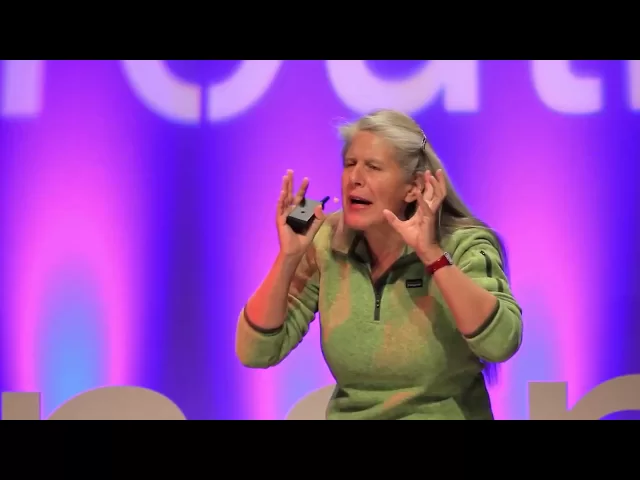
Transcriber: Helene Batt Reviewer: Denise RQ Thank you everyone. I have brought for you a human brain. So this is a real human brain.
When I look at this brain, I am reminded that we are neurocircuitry. We are neurocircuitry, and every ability we have is because we have cells that perform that function. We know more about the human brain than we've ever known before.
We've learned things in the last 10 to 20 years --most of your life span-- that has completely shifted the way neuroscientists think about this organ and our relationship with it. When I was in school back in the 80s, we were taught that the brain cells you were born with are the brain cells you'll die with, and you are not going to get anymore along the way. We do know that our brain is capable of growing some new neurons, and this is neurogenesis.
We are capable of growing new neurons, particularly in response to trauma. In addition, neuroplasticity, is the ability of our brain cells to rearrange who they are communicating with. What this means, is that the brain you woke in with this morning, is not identical to the brain that you are going to take home with you tonight.
In addition, we understand that we are capable of mindfulness. Mindfulness is our ability to observe the neurocircuitry we are running inside of our heads. But on top of simply observing in our neurocircuitry, we are capable of changing our thoughts and changing our brain.
We have the ability to pick and choose what's going on inside of our heads. We typically run three types of neurocircuitry. We think thoughts, we stimulate emotions and feel emotions, and we run physiological responses to what we are thinking and what we are feeling.
I have the ability to think a thought, stimulate an emotional circuit, and then run a physiological response to what I am thinking. From the moment I think of a thought that stimulates my anger circuit, to the time that I run my physiological response where I down noradrenalin into my blood stream, it flashes through me and flashes out of me. From the beginning of the thought, to the time when my blood is clean of that chemistry, takes less than 90 seconds.
I called this the 90-second rule. How many of you have the ability to stay angry for longer than 90 seconds. What you are doing, is you are rethinking the thought that is restimulating the anger circuit, which is restimulating the physiological response, and we can stay mad for days.
The bottom line is, I am neurocircuitry. We are neurocircuitry. My neurocircuitry is my neurocircuitry, and you do not have the ability to stimulate and trigger my circuitry without my permission.
You cannot make me angry, unless I stick my trigger out there for you to pound on and stimulate my neurocircuitry. If I give you the power to trigger my neurocircuitry, then I have given you my power. And if I give you my power, then I become vulnerable to you through manipulation, through advertising, through marketing.
through peer pressure and through abuse. Bottom line is, we are neurocircuitry. We are these incredible celled brain filled with these beautiful cells.
So how does it work? Stimulation streams in through our sensory systems. It integrates and organizes as it passes up the spinal cord, and it aims for the outer portion of our brain, the cerebral cortex.
The cerebral cortex is divided into two different groups of cells. Our outer layers, for a higher cognitive thinking, and our inner layers, for emotion. So information streams in through our sensory systems, and it aims directly for the inner group of cells of our limbic system.
And the cells in the limbic system are asking the question, moment by moment, "Am I safe? " "Am I safe? " I feel safe when enough of the information streaming in through the sensory systems feels familiar.
When the world feels familiar, my amygdala is calm, and I feel safe. The interesting thing is that as information comes in and it stimulates my limbic system, my limbic system then sends that information throughout my nervous system, including my higher cortex. What this means is that, although many of us may think of our cells as thinking creatures who feel, biologically, we really are feeling creatures who think.
We are feeling creatures who think; and this becomes significant in the way we live in the external world. Information streams in, goes straight to the amygdala; the amygdala says how much feels familiar, and if it feels familiar, then I feel calm. When I feel calm, the cells right next to that, the hippocampus, turn on and they are capable of learning and memory.
But let's say that, all of the sudden, the building starts to shake. [If] that happens, your amygdala goes unfamiliar, "Alert, alert, self preservation! ", you bolt out the door, shut down the hippocampus and don't care what I have to say anymore, right?
A great example about the relationship between the amygdala and the hippocampus, is test anxiety. We all know what it feels like to have that knot inside of our belly and then our throats get tight and our brains feel like they are going to explode, everything is moving so fast: "Alert, alert, panic, panic, anxiety, anxiety, oh my gosh! " But the secret here is that I have a higher cortical thinking.
I have the ability to consciously choose: "OK, I have other circuits I can run, I can turn on my higher cortical mind, I can bring my mind to the present moment, I can look around, take new pictures, I can see I am safe, I am safe, and I am not going to die. It's just an exam and I've prepared for it and I know some of these answers. " If my amygdala would just calm enough so that I could access that information in my hippocampus, then I could answer the questions.
So this is what's going on. Everything that has anything to do with anything is our relationship between the amygdala and the hippocampus. This is really important news; big news, big news, we didn't know this.
My generation, and generations before me, we did not know about the 90-second rule, and we did not understand the neurocircuitry of the brain. So, all you have to do, is open up the newspaper and you will see someone has killed someone because someone's amygdala was on alert. Somebody's divorcing somebody because somebody did not feel safe.
Everything has something to do with the amygdala, and I think we should all wear shirts that say, "I love my amygdala. " (Laughter) "I love my amygdala. " What is going on with the teenage brain?
How many of you have had a parent or an adult say something like this to you in the last few years: "I just don't recognize you anymore. What happened to my little angel? " How many of you have had that?
There is a biological reason for that. How many of you have had a parent or an adult say something like: "I don't understand you! You used to love to do this all the time, I bought you this but you don't use it, I don't get it, what's going on?
" There is a biological reason for that. How many of you have had a parent or an adult saying something to you like: I'm just really not very comfortable with your new friends. " Yeah!
There is a reason for that. We are biology. So, what's going on?
We are born with twice as many neurons as we are ever going to use. Isn't that nice we are born with an abundance of cells? And then, the next two to three years, the neurons that are stimulated will connect with other neurons in neurocircuitry, and the cells that are not stimulated, will die away.
And then, for the next couple of years, ten years or so, I'm pretty much about me, right? It's all about me, little Jill. I got this new body, I am trying to figure out how to get the body to work, eventually, it's going to hop, skip and jump, and then, I am going to learn about communication.
How to pick a voice out from background sound, how to make sound, how to place meaning on sound. Then, I am going to get socialized with little people my size, and my siblings and the adult world, but, it is pretty much all about me. Then, you put me in school, where I will learn more about communication, about spelling, reading and writing.
I'm going to learn about mathematics and abstract thinking. And if I am lucky, I am going to be exposed to music, the arts and technologies and all kinds of interesting things that will stimulate me. But ultimately, it's all about me.
Well, somehow, our one obligation to our species as a biological creature, is reproduction. So somehow, we have to get ourselves out of the 'me-me-me' into the, "Oh, aren't you cute? " (Laughter) In order to do that, during the pre-puberty years, the brain goes through what we called an exuberance of the dendritic connections inside of our brains.
And these little people, if you know them couple years right before puberty hits, they are really, really smart, little sponges looking for information. They are curious about everything, they want to know, and how they want to know why, and just want to understand it all. Then, their bodies are prepared for puberty.
And then puberty comes. And with puberty comes several major shifts. One of the first ones is we are going to go through a major physical growth spurt.
When we are going through a major physical growth spurt, our entire body changes. It changes and it's not as agile, so our amygdala is on a little bit of alert, which is interesting, but it's a little bit of alert, "What's going on? " And on top of that, then we are going to have our hormonal systems, they are going to start flowing through our body, and with that are going to come all kinds of mood swings and all kinds of interesting behaviors.
On top of that, there is going to be what we called a pruning back. A pruning back of 50% of the synaptic connections inside of our brain. We literally lose half of our minds.
(Laughter) We literally lose half of our minds. "How does that feel? " "Unfamiliar, unfamiliar.
I used to know all this stuff, it isn't there anymore. I used to be interested in these things, I used to look like something. I used to hang out with them, now I am hanging out with this".
And then on top of it, on top of it: "Oh, my gosh, unfamiliar, unfamiliar! " We are going to grow testosterone receptors on our amygdala. And when that comes: aggression!
I feel a little aggressive. (Laughter) There are biological reasons for the teenage years. There is biology underlying everything you're feeling, everything you're thinking, and everything you are experiencing.
The last portion of the brain to come totally aligned, is the prefrontal cortex. The prefrontal cortex is responsible for things including our ability to plan ahead. It's our impulse control.
It's our ability to understand the consequences of our behavior. It's the appropriateness of our behavior. So when our parents are looking at us, and we are bigger than they are, and it's all unfamiliar for everyone in the house, what's going on?
I haven't reattached my prefrontal cortex yet. There is a biological reason. The beauty, the wonderful thing about the teenage years, is you have literally lost half your mind.
Which half have you kept? The one that you are going to use. You are going to walk, to talk, to socialize, to do these things.
My best advice to any teenager, is whatever you are good at when you were young, that you want to do in your 20s, 40s and 80s, do it throughout your teenage years. The teenage years is the time for you to tend the garden of your mind. It's your opportunity for you to pick and choose who and how you want to be when you get older.
We technically become biological adults at the age of 25. It's when the long bones in our body stop growing long. We are adults, development is over, and the brain is now established.
My advice to all parents is keep them alive till 25. (Laughter) Keep your kids alive till they are 25. And to all of you teenagers, keep them alive until 25; nurture the beautiful cells inside your brain until you are 25, and then you will have this gorgeous adult brain then you get to figure out what you want to do with, later.
So bottom line here, we are feeling creatures who think. We are feeling creatures who think. Living in a left brain dominant society, where we value what we think over what we feel, and where we reward people for what we do rather than who we are.
We care about the "me" rather than the "we," we focus on personal gain, rather than community, we care about profits rather than people. We strive for authority rather than equality, we seek differences rather than similarities, we are competitive rather than compassionate, we are judgmental rather than forgiving. We are very left brain versus right brain.
But we know that we have a choice. Our left brain dominant society is using up our natural resources, and we are heating up the planet. We are in the middle of a major global crisis.
On top of this, our left brain dominant society is eroding our self-value. We are in pain, because the world does not care about what we feel and who we are, it cares about what we do and what we think, which is not the basis of our biology. We are in the middle of a major mental health crisis, where at least 25% of the people in the [United] States are suffering from some type of serious mental illness, and then you throw on top of that a whole bunch of people who have addiction.
We are in pain, so what do we do? We mask our pain with all kinds of things that we can get addicted to. And virtually, this just is not very healthy for these gorgeous cells inside our brain.
The teenage brain is at the most vulnerable time of our existence, because it is this time for planting the seeds and planting who and how you want to be in the world. When I experienced my stroke and I lost my left brain, and I shifted into the consciousness of my right mind, where I felt peace and euphoria, what gave me the courage to come back, was that I pictured a world that was filled with beautiful, peaceful, compassionate, loving people. I pictured a world filled with people who knew that they could pick and choose who and how they want to be in the world.
You are that population. You are those people. You have the ability to pick and choose who and how you want to be in the world.
I believe that those of you who are willing to create a conscious relationship with your brain, you will be the leaders who will help guide humanity back toward mental health, and you will be the game changers who help bring our planet back to balance. This is your brain. This is your brain.
This is your instrument. This is your tool. And this is your power.
What are you doing with your power? (Applause) Thank you!