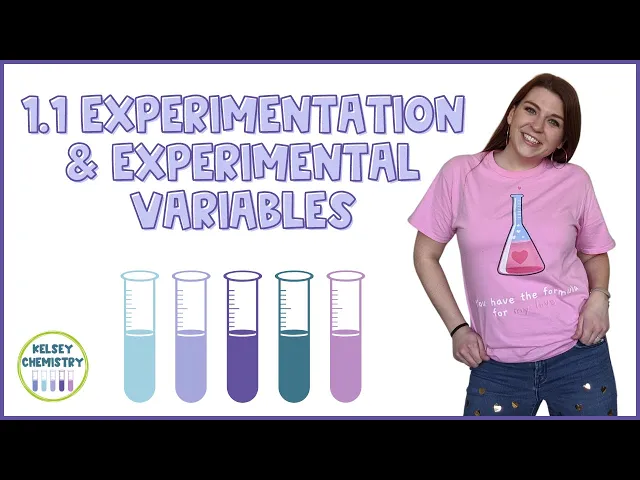
hey there welcome to the first lesson in chemistry this is unit one where we are going to be studying measurement and tools of the chemist sounds kind of boring but this is maybe the most important unit this is how chemists not only take their measurements but also how they communicate their measurements and how they account for error when they're reading each other's experiments and reading each other's data so today we are going to ease into things we're going to talk about experimentation um specifically we're going to talk about EXP Al variables and the difference between
the independent and dependent variable when we're doing experiments so I prompt you with the question of the day when I'm finish reading make sure to pause and think about it it says you're trying a new type of tea when you take the first sip you decide you don't like it and you add some milk and sugar you take a second Sip and yum it's delicious how can you know for sure what made the tea so great so you can do it again tomorrow remember to pause so truthfully there is really no way to know what
made the tea so delicious it could be the milk it could be the sugar or it could be both and the reason you don't know for sure is because you've added both of the ingredients to the tea before taking a sip uh had you added just the sugar and maybe the next day you add just the milk and then the third day you do the milk and the sugar then you would have three days worth of data to determine what you actually like in your tea I can tell you that but um it's very good
to experiment with this kind of stuff because um my husband for a very long time was drinking coffee light and sweet and if you ever watch the Barista make a coffee light and sweet they add a lot of sugar to it and he liked the coffee but realized that um once he saw them making the coffee and saw how much sugar was in it he decided that he could learn to love coffee without that much sugar in it so this is something that uh you couldn't know for sure because you've added a bunch of stuff
all at once and what made it so delicious it kind of depends all right to start things off science is the description that leads to an understanding of our environment or the world around us which includes measurements we need to take measurements we need measurements because it helps us to communicate with other scientists the things we're seeing that maybe they aren't seeing because they're not near us with us they might even be across the entire planet so it's important that we take measurements to kind of ensure that everybody is understanding what's going on if I
had discovered a brand new animal you would want to know what color it was and how big it was and maybe what it ate and how much it ate and those are things that I would try to measure I would say um you know it's it's orange it's 5 feet tall it is furry it has polka dots and as I'm describing this to you you should be able to paint a picture in your head it has four legs that's even a measurement I've counted the number of legs counting is a measurement so we need measurements
to help us to describe things because if I just told you this animal is tall is it tall like a giraffe or is it tall Like A Mir cat it kind of depends so we have some tools in chemistry that help us to take measurements first off is this baby right here on the left called graduated cylinder a graduated cylinder measures volume and volume is the amount of space that something takes up so this is measuring the amount of space that this water takes up and the unit we typically use for volume in chemistry is
milliliters occasionally we will use liters we'll talk more about that in another video this right here uh is just called graduated because each of these lines is considered a graduation this ruler is also graduated we don't use rulers often in chemistry but if we do use a ruler we're going to measure in centimeters this right here is a digital thermometer notice it's measuring in Celsius that is super important we only measure in Celsius or kelvin in chemistry we do not use the Fahrenheit scale I don't prefer digital thermometers I don't know what it is um
I prefer the classic thermometers I prefer a classic thermometer I don't really know why the digital ones are typically more accurate because you don't have to read them and take a guess at the measurement but I I just like a classic thermometer they used to be filled with Mercury but we know now that mercury causes brain damage so we don't often use them um this one instead is filled with DED alcohol and in my case it's dyed green and this little piece on top is just a little chunk of rubber so that when I put
this down on the table uh this piece prevents it from Rolling off the table like your pencils May roll off the table all the time um and the way that it works is that when this bulb is in something that's hot the alcohol that's in here expands and it climbs up the tube and then you would read the measurement whoa all good um when this bulb is in something cold the alcohol is going to contract so it's going to come all together and that is going to shrink the level of the alcohol inside the thermometer
and it's going to drop down and then we'll read the temperature this reads in Celsius and it reads up to 150 Celsius most of our tools have limits for instance this graduated cylinder can only measure to 100 so if I needed to measure 100 milliliters I would measure uh I'm sorry if I had to measure 150 milliliters I would measure to the 100 pour this out into perhaps a beaker and then I would measure to the 50 add that to the beaker and then I would have 150 can't do that with a thermometer but you
can do it with a ruler in fact you've probably done this with a ruler plenty of times so if this comes up um and you need more of a volume than your tool can measure that's usually a okay you just kind of use the same ruler method on your graduated cylinder thermometers unfortunately don't have that capability and neither do scales sometimes it kind of depends on what you're measuring this uh it's not really a scale it's technically called a balance very tiny differences on the balance I prefer the digital because who wants to sit there
with a triple beam balance they're not very fun or easy to use and they take a lot of calibration these also in a lab setting in a in a really Hightech lab where you're going to have awesome equipment this will have um a little glass plastic piece which kind of acts like a level if you've ever used a level to like hang a picture to tell you that your nails are going in straight and not crooked a very high-tech balance is going to have one of those and the bubble is supposed to sit right in
the crosshairs of that level and when that happens it tells you that your balance is not lopsided your table is flat your floor is flat your counter's flat whatever it is and um your balance therefore is calibrated you probably don't have that on whatever balance you're using your kitchen balance is usually not that sensitive although mine is I picked it up the other day and it told me that my balance was unstable so I couldn't use it I had to set it down and make sure that it was not wobbly most often in a chemistry
lab a high school chemistry lab or in your kitchen you're going to have your balance reading to the tenth place I am going to replace mine to get mine to read to the hundred's place because the more Precision the better your measurements um some of the cheaper ones only measure to the whole number which is not super accurate um if you're doing it just for like food or measuring baking it's probably not a big deal but if you're going to do it in chemistry with some detailed experiments you are probably going to want a balance
that reads more than just to the whole number my favorite part about the balance is the tear button t a r e this is super cool let's say that we needed 200 gram of flour for a recipe you don't want to just dump 200 grams of flour on top of this balance because it's going to fly all over the place the fan can you know the air conditioning can kick on your family member walks by and creates a little gust of wind that's going to blow all of your flower all over the kitchen maybe you're
just a mess like me um so what we can do is put a bowl on the balance and then hit the tear button and instead of reading the weight or the mass rather of the bowl the tear button makes the balance read zero so it looks like the bowl is invisible and then when you add flour to the Bowl you can get it to up to 200 gram and at that point it will only be measuring the flour it won't be measuring the bowl so this is really great for number one keeping your balance clean
especially if you're doing this um like if you were getting really specific with the types of foods you were eating and how many grams of protein you were eating in a day um if you were measuring like how many ounces of meat we going into a recipe you don't really want want to put raw meat on a scale or a balance that can have a lot of uh hazards and build up a lot of germs and that could be really yucky if you do it on a plate a bowl and you hit the tear button
to make that dish look invisible then that dish can just be washed and you don't have to worry about damaging the balance same thing works in chemistry we'll do it with a beaker and then we add some sample to a beaker and we can make the beaker look invisible with the tear button now a lot of balances have a maximum usually it's 500 G or 1,000 G which is a kilogram kind of sort of like a pound and those um can sometimes be split the same way you can split a measurement on a ruler or
with a graduated cylinder if you are measuring something that you can separate like if you were scooping in flower and you hit the maximum you can set that aside and then do a second measurement and add the two together now I'm sure you've done the scientific method over and over again every single school year but it's fine um we're going to do a quick Breeze over because you've done it a few times every time we are doing some type of science experiment we're working with a hypothesis which is an educated guest this happens because of
that and then we're going to test it we test it in an experiment which is going to be organized and we're going to write stuff down and when we write down and the things we write WR down are going to be observations and measurements so if we go back to my new discovery of an animal the observation is that it's orange and it has polka dots the measurements would be that it has four legs and it's 5 feet tall counting counts as a measurement so we're going to write all this stuff down so that we
can translate it and um share our information with Scientists all over the world that's kind of the point then we are going to take those observations and measurements write them up into a beautiful document called a lab report and we are going to report our results most of the time our experiments are not going to become theories and laws because we're a high school chemistry class that's not really the way that we are designed to work but if you pursue science as a career and you are practicing this for a very long time you could
come up with a the or a law there's a very small difference between a theory and a law both of them are considered fact a theory is words that explain a fact and the law is the math that explains a fact so we have the theory of gravitation that everything attracts everything else by the force of gravity that's a really broad brush over of it a physics teacher could give you a far better definition but it's just things attract to each other based on their mass and then the law would be the universal law of
gravitation which is a mathematical equation that you can plug numbers into and effectively find out the force of gravity between two they call them bodies the body can be um this thermometer and this pen have some amount of gravitational attraction but it can also be them being attracted to the Earth and the Earth being attracted to the moon and the moon to the earth and vice versa so that would be the law is the math that explains what's happening now the question is how do we make a good experiment there are a few things that
go into a good quality experiment first is that we're working under controlled conditions meaning that we're not doing this in a weird place we're not doing it at the top of a mountain where it's windy and we can't control how much wind is blowing or temperature changes we are going to do this in a lab setting or in your kitchen where you can control the temperature you can control uh to some extent the humidity we're not going to do an experiment and do half of it in the desert and half of it in Antarctica that
just wouldn't make sense we want our conditions to be controlled as much as possible number two we want our um experiment to be able to be duplicated or replicated really what this means is that if I do an experiment and I write down every little detail of what I did I can send that to Paris or I can send it to Tokyo or I can send it to South I can send it anywhere in the world and as long as that scientist had the same materials that I did then they should be able to do
the same experiment and get the same results it really comes down to me being able to write down what I did and make it super thorough so that it's easy for them to understand what I did and do the exact same thing if you think of a recipe it's really like that you don't want the recipe to say uh let's say we're making a cake mix all the ingredients and put it in the oven for 40 minutes what order the do the ingredients need to be mixed together what temperature do I set the oven those
are things that you would need to know in order to know how to bake the cake so we want our experiments to be well written so that people can translate them so that they can do them at home wherever they are in the world finally number three predictions aligned with experimental results this one is true for 99% of us we want our results to make sense with the world around us so really what this means is that if I predict that um this pen is going to fall when I drop it it did um that
that makes sense I'm going to make a prediction and it's going to align with my experimental results for most of us this is true because we are doing experiments that have already been done before we are doing experiments for us to learn when full-time career scientists do experiments they do it because they're trying to discover something new that has never happened before sometimes what they will do is um replicate somebody else's experiment learn from that and then take it one step further and and try to discover something new for them their predictions a lot of
the time may not align with their experimental results because they are stretching boundaries but for us high school chemistry students it is going to um more or less align you're going to make a prediction and it's going to make a lot of sense because we are just really starting our science careers here so um the predictions are going to make sense with what we know about the world around us I am not going to be the 40 billionth person to drop a pen but the first person to have their pen float away on Earth different
things happen in outer space so I have a practice question that we're going to um run through and we're going to find all of the variables of this experiment so we have this experimental question how does the amount of sugar affect student performance on a timed multiplication test there are a few parts of this question that we are going to dissect for an experiment first is called the independent variable and that is the thing that we are testing that's what we kind of want the answer to in our question we then have the dependent variable
which is the thing that we're going to measure in chemistry often we're going to use some tools in some experiments you are going to count as your form of measurement and in other Sciences you'll use other tools to measure this is primarily what we use in chemistry we're also going to have some controlled variables which are things that we are going to hold constant for comparison so if we're thinking back to the tea we would want to use black tea every single day or green te every single day you can't just change the type of
T all of a sudden because that's what that was not we were testing we were testing milk and sugar being the flavor factors in our tea so we want to make sure that also we are drinking tea at the same temperature we don't want to have hot tea one day and cold tea the next day because that's not what we were testing if that's what we want to test we can make a different experiment but here we're testing the milk and sugar okay so in this experimental question what is the independent variable how does the
amount of sugar affect student performance on a timed multiplication test what is the independent variable or the thing that we test pause to answer the independent variable is the amount of sugar we are going to change the amount of sugar between the students on a timed multiplication test next up what is the dependent variable or in other words the thing that we measure the dependent variable what we're measuring is going to be the student performance or the grade that they get on the test now this again not a measurement that we're going to use a
ruler or a balance for but we're going to score the tests with an answer key and a red pen and that counts as a measurement as silly as that may sound it is something that we can quantify we're going to give them a score it's going to be a percentage perhaps the number correct divided by the total number turn that into a percent we're going to get their their score on the test and what are some control variables what are some of the things that we are going to hold constant so that we can compare
student performance there's a lot of things we're going to hold constant we're going to make sure that all of the kids are being tested on the exact same question we don't want some kids doing the two times tables and other kids doing the sevens we want them to have the same amount of time to take the task we want the sequence of the test questions to be the same and this is something that you may not have thought of but as a teacher I think of a lot there is some psychology and I don't really
understand it but if the first test question is easy most of the kids feel confident about the test because the first question they're like okay I got this let's rock and roll but if the first question stumps them and it's really tough then it immediately just kicks them in their confidence and they're not excited for this test and they feel really demoralized so we want to make sure that all of the kids are getting the questions in the same order and all of the kids need to eat something um so we're going to feed them
different amounts of sugar some kids are going to have no sugar and then a little sugar and then a lot of sugar and those are going to have measurements maybe you know 0o 10 and 40 grams of sugar and we are going to make sure that they have the same amount of time after they eat so if we feed them and then they take the test in 2 minutes or they take the test in 30 minutes it's going to matter I'm going to run through these first three questions so that you can kind of figure
out what you know and what you don't know so I would take a minute to pause this and take down those first three questions and find the independent the dependent and the control variables all right question one a study was done to find if different tire Treads affect the braking distance of a car so the independent variable the thing that we test is going to be the tire Treads each of the cars is going to have a different tread to the tire the dependent variable or the thing that we measure is going to be the
braking distance and to do this we would use probably a tape measure lastly the controlled variables are going to be the type of car the mass of the car the road you don't want to do one of these on a dirt road and one of them on a paved Road and finally the weather weather conditions um anybody who's driving knows that the road is a little slippery when it's wet and it's very slippery when it's icy or slushy so we want to make sure that every test is done when the road is the same it
can be dry it can be wet it doesn't matter as long as it's the same for all of the cars for question two it says the time it takes to run a mile depends on the person's running speed the thing we're testing is there speed and we are going to measure the time that it takes them to run and then our control are going to be all of the conditions that we want to keep the same so that we can compare these people and their running speeds so we want them to run the same distance
we want them to be in the same type of shoes nobody should be running in flip-flops and another person in you know running shoes and then we want their running conditions to be the same we want everybody either running indoors or outdoors and if they're Outdoors we should keep an eye on the weather conditions and the humidity and the temperature and all those and um if they're indoors they should be on the same type of treadmill okay lastly question three it says the height of a tomato plant depends on the amount of water they receive
so the thing that we are testing is the amount of water if they get a little water a lot of water or no water at all we want to check on their height and their growth so the dependent variable what we will measure is their height how much they grow and again we're going to measure that with um probably a ruler we're going to measure in centimeters and then the controls are sunlight the quality of the soil we want them to be the same type of tomato plant there's so many types of tomatoes so we
want to make sure that they're the same type of tomato plant and we want to grow them in the same season we don't want to grow some in the spring and others in the fall we want everything to be the same across the board aside from the water this ensures that water explains the difference in height water is the only explanation for a difference in height and that is where the independent and the dependent variable um and that is where the controls come in in clutch they're super important all right thanks for hanging out with
me thank you for learning independent and dependent variables feel free to drop any of your questions in the comment section subscribe so you don't miss tomorrow's lesson and I'll see you there bye