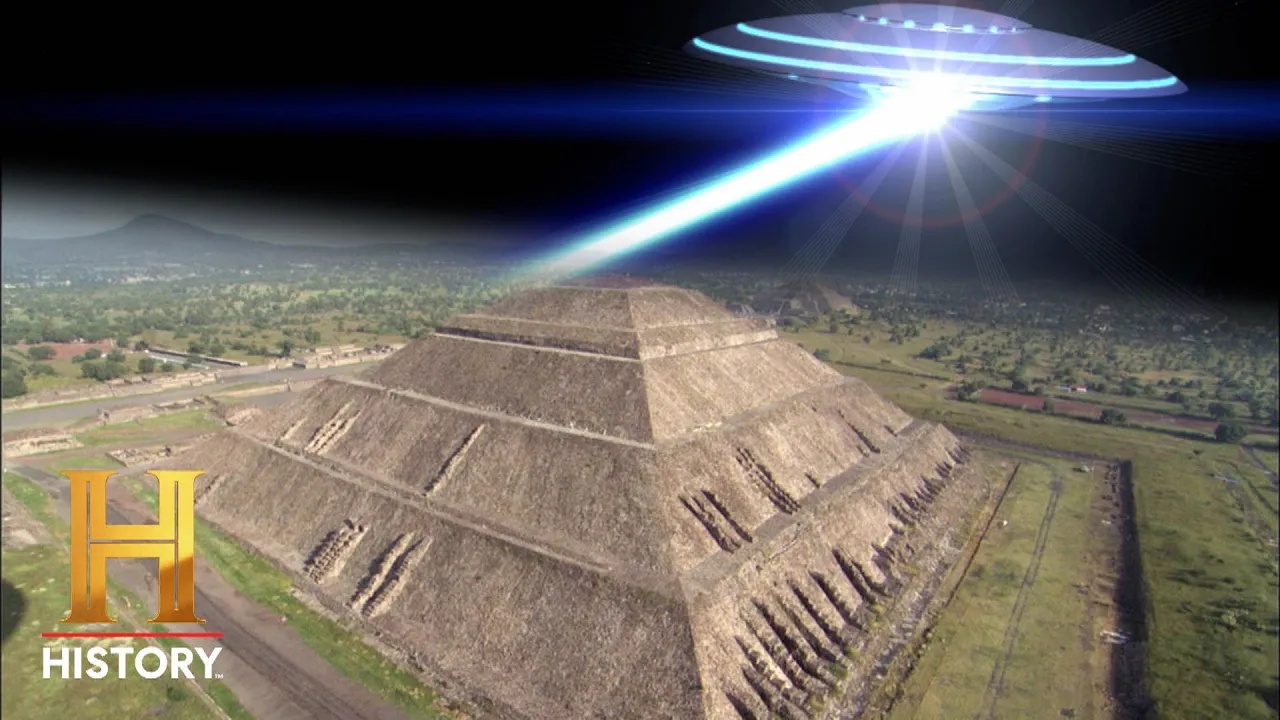
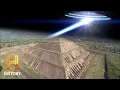
Central Mexico, 35 miles north east of Mexico City. Here in a highlands plateau lies the enormous archaeological site of the ancient city of Teotihuacan. Established around 100 BC and lasting until its fall between the seventh and eighth centuries, Teotihuacan was one of the largest cities in the ancient world with over 150,000 inhabitants at its peak.
When you enter the city, you're immediately struck by that modern layout of the city. You have a street of the dead that goes for miles, along which you have all of the major ceremonial architecture, including some of the largest buildings ever erected in the new world. NARRATOR: According to scholars, the advanced design of Teotihuacan suggests that ancient builders had knowledge not only of architecture but of complex mathematical and astronomical sciences.
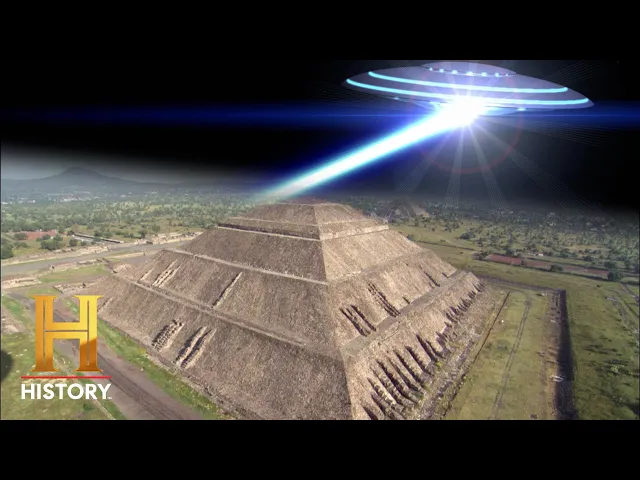
From the air, the city's layout strangely resembles a computer circuit board with two large processor chips, the Sun Pyramid and the Moon Pyramid. Researchers have also found numerous and remarkable similarities to the Great Pyramids of Egypt. PHILIP COPPENS: When we look at these buildings, we find the same mathematics incorporated into them than what we find in the Great Pyramid and the surrounding pyramids of the Giza Plateau.
ARLAN ANDREWS: The Great Pyramid of Khufu at Giza and the Sun Pyramid at Teotihuacan apparently have about the same base, almost 750 feet square. GIORGIO A. TSOUKALOS: The base perimeter of the Pyramid of the Sun is four pi times its height.
In Giza, it's two times pi its height. Essentially, the Pyramid of the Sun is exactly half as tall as the Pyramid of Giza. Teotihuacan is created according to a specific layout.
The Temple of the Sun, the Temple of the Moon, and the Temple of Quetzalcoatl are in the same layout as Orion's Belt, which is basically the formation which these three pyramids of Giza Plateau have been laid out into as well. NARRATOR: Might the design and layout of Teotihuacan be comparable to that of Giza because of similar influence by extraterrestrial visitors as ancient astronaut theorists believe? When you have similar pyramid complexes like the ones at Teotihuacan and the ones at Giza, you have to kind of think that, yeah, the same builders, the same designers are behind these giant complexes.
[dramatic music] NARRATOR: But perhaps the most intriguing aspect of Teotihuacan is the finding by archaeologists of the extensive use of mica embedded in numerous structures, a mineral only found 3,000 miles away in Brazil. JOEL PALKA: It's found in all buildings, housing complexes, temples, and along the roads. It's found everywhere.
ANDREW COLLINS: These mica sheets were probably transported from thousands of miles away from Brazil. That's the nearest source. Now why would you want to do that?
Because they were obviously not there for decoration because you couldn't see them. RICHARD BERGGREEN: Mica has some electrical properties that make it very good for being an insulator. It resists the transmission of electricity.
It's also very good at being able to be stable at high temperatures so that it can be used in furnace windows and oven windows. It is clear, so you can see through it. And at the same time, it stands up to the temperature and electrical discharges.
PHILIP COPPENS: So we know that they must have had a very specific and good reason to incorporate it. And the only possible reasons really why they would be doing this is because somehow it was part of some technology. NARRATOR: Recently, archaeologists have also discovered large quantities of mica crystals in a subterranean chamber as well as in several shafts that run beneath the Avenue of the Dead.
GIORGIO A. TSOUKALOS: There is an underground shaft that goes from the mica chamber in direction of the Pyramid of the Sun. So is it possible that this mica chamber contains some type of an energy-producing device, a power plant that fed some of the other pyramids?
It is possible. DAVID CHILDRESS: There's many similarities between the pyramids of Teotihuacan and the pyramids at Giza. Both have inner chambers.
It's thought by some that the Great Pyramid itself was a massive microwave generator, literally sending a beam up to a satellite or powering some other kind of spacecraft or installation. We could have had the same thing happening here at Teotihuacan.