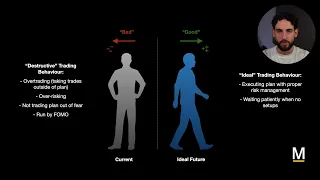
Every trader knows they should stick to their trading plan, but in the heat of the moment, it all goes out the window. Why? Because you're running on emotion, not on execution.
In this video, I'm giving you the exact psychological fix that I give to my six and seven figure traders to help them rewire this pattern so you can finally stop sabotaging your edge and start building consistent profitability. Now, I want you to comment below your biggest trading psychology challenge. I want to offer you some insights.
Let's start by talking about why you break your trading plan. And if we understand why you break your trading plan, we can then put an actionable fix in place to manage this. The reason you break your trading plan and the only reason you break your trading plan is because it's a coping mechanism.
And usually it's a coping mechanism for a state of fear or anxiety or an unwanted state. So the reason you deviate from your trading plan is because it's a coping mechanism for the fear you're experiencing at that point in time. Now anthropologically thousands of years ago our ancestors were faced with two main fears, two main distresses.
It was the gaining of the predator, the gaining of the negative, or it was the loss of prey, the loss of the positive. You see, if our ancestors were in the wild and they had a predator attack them and they gained a predator, that would mean death. And so too, if our ancestors lost prey, if they lost their dinner, eventually it would mean starvation and death.
So from an anthropological perspective, it was the gain of the negative and a loss of the positive that drove fear. It was the two main distresses of a human being. Now, we have that same hardwired response within us.
And human nature never gets rid of old things. It just builds new layers on top. So we're battling that same response, that same fear response of gaining the negative and losing the positive.
But our form has changed. We're no longer trying to avoid a saber-tooth tiger or try and chase a rabbit or whatever to eat food. The prey and the negative is now a trading loss or it's the loss of money or it's the loss of opportunity that we perceive that money is going to give us.
And the positive is now money or a funded challenge or status and recognition or a percentage or an R or hitting your take profit or that sensation and that feeling you get when you win. This is the new form of our prey and our positive that we're seeking after. And what I explained before is our new form of the predator, the negative we're trying to avoid.
So although we have this crystal clear plan of our entry, our exit, and our risk management, it's still the fear of gaining this and the fear of losing this that if left unmanaged is stronger than our sticking to our trading plan and drives the inability to stick to our trading plan. Because if we have a trading plan here that shows us exactly what to do and when to do it, but the fear of gaining the negative comes in, that fear, if left unmanaged, is now stronger than the rational thought of sticking to our trading plan. We're going to default out of fear to avoid the pain.
Or if we have this strong positive addiction in that moment, we really want to capture something that we created in our mind and that's left unmanaged. If that becomes stronger than the rational thought of sticking to your trading plan, then the fear of missing out and the fear of losing the positive is going to take over and we're going to deviate from our trading plan. So all deviation from our trading plan is a coping mechanism for fear.
The fear of gaining the negative or the fear of missing out on the positive or the fear of losing the positive. All the above. So, as a trader, if we're sitting at our desk and we see a position and we see that position setting up and it kind of aligns with our trading plan, then what happens in our mind?
We create all these positive ideas. We think, "Ah, this trade's going to get me funded. This trade is going to make me a certain amount of money.
This trade is going to make me a certain amount of percentage. This trade, I'm going to post my profit in my community, and my social status is going to increase. Or this trade is going to help me pay rent.
or this trade is going to help me buy a new car or get a new watch. And what we do is in our mind, in the virtual market, in our mind, we create all these expectations and benefits we think we're going to get from the outcome of that trade. We're not even in the trade yet, but we create this narrative and this story about what we think we're going to get from the market and we project that onto the market.
And what ends up happening is now we've associated all these benefits to that trade. And what happens? We now fear missing out on that trade.
But it's not really the trade we fear missing out on. It's all those positive benefits and expectations we've stuck to that trade that I just mentioned. The dollar, the percentage, the paying of rent, the status, the car, the watch, the impressing of friends, whatever it may be.
We now fear missing out on those. No trader ever fears the missing out of price and price action and price moving a certain direction until they associate a certain outcome and certain benefits to that price moving in that certain direction. And what's interesting is when we're associating pleasure to price moving up, for example, because we're trading, someone's taken the other side of our trade, so they're associating benefit to price moving down.
So we don't actually fear missing out on the price itself. We fear missing out on the things we've associated to price moving that direction. Which is good news because now if we learn to manage what we associate to trades, we can now manage our fear and we can stick to our trading plan because the only reason we deviate from our trading plan is a coping mechanism because of fear.
If we learn to manage that fear, we learn to stick to our trading plan. So there's the fear of missing out on all these positive expectations. There's a fear of when we're in a trade losing all these things we think we're going to get.
So we cut trades early. We don't stick to our management. Or when we're in a trade, we're now fearing we we've just entered.
We now fear the gain of a loss and we don't want to experience a loss again. It was really painful in the past. We don't want to experience that again.
So guess what we do? We scratch a position. We get out for break even or price moves slightly into draw down towards our stop loss and we scratch the position out of fear of gaining that negative.
We don't stick to our trade management. And then we come back the next day and we see price played out perfectly. We just created this narrative in our mind of gaining this predator and this loss.
And because of the fear of that, the fear was greater than our rational mind sticking to our trading plan. And the fear took over and we made a fearful, irrational decision. We deviated from our trading plan and our management.
So the only reason we break our trading plan is because it's a coping mechanism for fear. If we learn to manage the fear, we learn how to stick to our trading plan. And guess what?
The only reason fear is there in the first place is because we're expecting a certain positive outcome. We're expecting a certain gain. So if we learn to manage our expectations and our benefits and the outcome, we learn to manage fear and subsequently we stick to our trading plan.
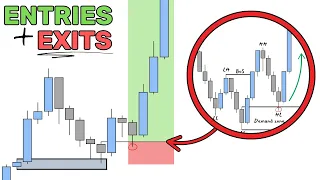
We no longer break our trading plan because the only reason we break our trading plan is because it's a coping mechanism for fear. So next time you're about to trade and you see a market opportunity presenting itself, what I want you to do is follow this simple process. I want you to be very clear on your entries and your exits based on your trading plan.
And I want you to map that out and draw it on the charts and see it and know the exact rational game plan you're going to take to ensure you stick to your trading plan. Now, what you have to focus on doing once you've done that is now managing fear so you don't deviate from that. So, the way you manage the fear of missing out, the fear of loss, and the fear of the gain of the negative is to identify all the greeds and the benefits and the expectations you're associating to that trade.
Maybe it's a certain dollar amount. Maybe it's a certain percentage. Maybe it's certain social status and raising your social value in a community.
Maybe it's that sensation, that feeling of being in a winning trade. You want to identify just before you're entering into that trade, just about you're about to place that trade, identify all the greeds, all the benefits, all the positive outcomes, all the expectations you think being in that trade is going to give you and write them all down really quick. And then what I want you to do now that you're aware that you're imposing greeds onto the market and greeds and expectations on the outcome of the trade, I want you to go in there and ground those greeds and remind yourself that nobody has any idea of what's happening in the market.
There are millions of factors influencing price. Who am I to think that I can expect price to move in this direction exactly how I want it to move and get all these things from the market? There are millions of other participants trading the markets.
They all have different ideas. They all want their things. Who am I to think that on this individual trade I can get what I want?
And you're humbling yourself and you're grounding yourself. And then you remind yourself that, you know what, I don't need to be right on this individual trade. I just need to stick to my trading plan and my edge because if I do that over a large sample space, I'm going to be profitable.
So, you remind yourself that who am I to think that I can get everything I want from the market right now on this individual trade. It's unpredictable. The individual outcomes unpredictable.
But if I stick to my trading plan over a 100 trades, I know I'm eventually going to approximate my edge. I'm going to be profitable. So, you're identifying all your greeds.
You're grounding your greeds with realistic thinking and facts. And now, you're also broadening your perspective to remind yourself that nobody knows what's going to happen on the individual trade. And you don't have to be right today.
The trade doesn't have to be a win today. It could be a loss. And you know what?
There's no point getting depressed over a loss because it's just compensating for past wins or compensating for future wins to give me my monthly and yearly average, my edge. And there's no need to get elated over wins today because that's just compensating for past losses and future losses to give me my monthly and yearly edge, my return. So, I want to broaden my perspective and get out of this narrow thinking that I have to win today.
All you have to do today is take the pressure off your shoulders. You don't need to win. All you need to do is just stick to your trading plan.
If you do that over a large sample space, you will be profitable. Now, traders, I put this full complete process into a step-by-step tool. That's exactly what I give my six and seven figure traders.
And this tool I'm making available to you completely free. It's the first link in the description and the link in the first comment. It's the bulletproof your trading mindset tool 2.
0. I want you to go in there and download that tool. It's completely free and I want you to use it for the next 30 days before every single trade you take and let me know what type of a difference that has in your trading.