I wake up at 4:30 am every day. We started from scratch. We started with a buggy and a horse.
I started with a house up there. It's already fallen. .
. We lived there. But then we came to live here.
Renata was born in this house. Was Renata born in this house? Yes.
-She was born in the hospital. -Come on! There's a small room and another bathroom.
A little bedroom. . .
How dark! Are you afraid? NELSON MICHAEL BASSO - RENATA'S FATHER RENATA BASSO - STUDENT It is my father and my mother's room.
When she came, the doctor asked if we had noticed anything. I had not noticed she was. .
. You can see her pictures as a child. She was quite plump.
. . A little boy.
Then she said, "If you can afford it, today there's a lot of. . .
I won't promise she'll go to college, become a doctor. . .
I will not promise that. But they are very smart. " I said, “I want to do whatever I can do for her.
" She was very sick. She could not lift her own weight. She was four months and weighed about 3/4 kg.
She had a heart condition. She. .
. She was sick at the hospital with double pneumonia. We thought we were going to lose her.
But thank God, we won. She is 18 years old. She's better than I am.
-Her heart and everything else. -Yeah. Just food is easier.
She will talk about the churches and cooking. When they came from Italy, the Italians received the land in quantity. It was the 4th place that Italians came to live in.
At first everything was very difficult. The teachers were not very prepared. They didn't demand from her.
Sometimes she fled. We passed by and saw her standing in front of school wall. We went there to say RENATA'S ELEMENTARY SCHOOL they had to force her to stay in the classroom.
ROSANE BASSO - RENATA'S SISTER We talked a lot at home too. LEANDRO CASARIN - RENATA'S BROTHER-IN-LAW She had to stay in the classroom. LEANDRO CASARIN - RENATA'S BROTHER-IN-LAW Education, in my opinion, has three fundamental dimensions of democratization.
Democratizing of access, which is the guarantee that everyone can go to school. The democratization of management, JOSÉ C. DE AZEVEDO - EDUCATION SECRETARY-RS which is the one that allows JOSÉ C.
DE AZEVEDO - EDUCATION SECRETARY-RS the members of a school community to be treated as individuals, JOSÉ C. DE AZEVEDO - EDUCATION SECRETARY-RS participating, having a voice and opportunity. .
. And the most difficult thing to democratize, which is the democratization of access to knowledge. -Is the prom on the 13th?
-Yeah! -At night? -Yeah!
-Will they have good food? -Yeah! There'll be snacks first.
-And then what? -Then comes the dinner. -We'll eat twice then?
-Yes. -First, the cocktail. -Oh.
. . -We'll have a party in December.
-Where? -In the barracks. -Yeah?
-Sure! -Will you invite me? No, it's just for barracks personnel.
-Oh. . .
-It's in the spa. You could invite me! We've never treated her as if she had a problem making her different from others.
We've never seen it like that. We've educated and pressured her like a normal child. Rogério has done a lot for her.
My daughter. . .
My maid. . .
She helped her, you know? When I saw the lessons. .
. I'm almost illiterate. So, for me it's difficult.
I've been through a lot of hardships because I didn't go to school. We thought of putting Renata in a private school. But private schools didn't accept her.
And they're not ready. At the time there was no special educator. We would need a tutor.
Paying for school and a tutor makes no sense. This is not inclusion. The more the debate goes on, the more concrete experiences exist in the public school, I think the more embarrassment it will cause, and the more appeal it will cause so all institutions begin to work in a more natural way with the inclusion of people with disabilities.
Ready! 1042 STUDENTS 67 DISABLED IN A REGULAR CLASSROOM You can get out. 1042 STUDENTS 67 DISABLED IN A REGULAR CLASSROOM -Okay?
-Yeah! -Good class. -Thank you.
Coronel Pilar is a very traditional school in the city. It's one of the oldest that we have. And it's handled special education since 93.
Actually there were special classes, but from 93, the first inclusion happened: a student with visual impairment ROBERTA FORGIARINI - REGIONAL EDUCATION COORDINATOR-RS because of a principal, Professor Paulo. ROBERTA FORGIARINI - REGIONAL EDUCATION COORDINATOR-RS He believes that the student has to be in a regular school with others. It was a great opening, a great opportunity of the public service to provide PAULO B.
PORTELLA-FORMER PRINCIPAL OF CEL PILAR SCHOOL something that did not exist. PAULO B. PORTELLA-FORMER PRINCIPAL OF CEL PILAR SCHOOL It was the first school that accepted this challenge.
Guys! Come on in! It was really a challenge because we had nothing.
We went out in search of things within the soul, within the heart. For a long time there was no such commitment to teach people with disabilities. Today we have this commitment.
I realize that there was a change. Out of need and the understanding we have of disability. It's not just being in the school.
It's being within the school with quality. I think this inclusion was important for Renata because she learns to interact with people different from her. RENATA'S FRIENDS I think that makes us more mature.
People who have better contact with people. I think this was a great influence. She was very afraid, sometimes, to be alone in the beginning.
She was very afraid of being alone at school. She had a lot. .
. Rosane had to go there often in the morning, in the middle of class. .
. In teamwork, she had great difficulty because nobody wanted to work with her. Often she did it on her own.
"But isn't it group work, Renata? " "It is, but nobody wanted to do it with me. " I went to school and said: "Look, teacher, I think you have to include Renata.
Assemble the groups and put Renata in one of them. " Later, I told her, "You have to be smart! " Invite yourself, saying, "Can I join in your group?
You have to talk! " I need you to organize in groups. -Two or three.
-Fabi, shall we do it with Alan? When will that be? When I was her classmate in elementary school, we did everything together.
She always wanted to do stuff with me. She had no. .
. She surprised me by wanting to change groups. Now she wants to do it with one and other.
When I was her pal; it was just me. No one else. She wanted to do it just with me.
She's always attended a mainstream school. So this is what makes the difference; she always goes further, She learns to be responsible, to do things, She's not lazy. .
. She's always ready. Difficulty, not really.
The school always supports Renata, helping her with her special teacher. -Here. -Thank you very much.
-What will you have this week? -Exam. About what?
SNE – SPECIAL NEEDS EDUCATION SERVICE Portuguese. SNE – SPECIAL NEEDS EDUCATION SERVICE And I have this Portuguese assignment here. .
. Portuguese assignment. .
. . to help me do it because I do not know anything So here we go!
Math is very hard for me. . .
-Mathematics. -Yeah. -What were the difficulties?
-Fractions are the hardest. Since childhood, there are classes for the disabled, but they are gradually put in normal rooms. The school has done this for years.
Not any school does that. They are few. You seldom see a disabled person in a mainstream school.
And high school is even harder. I think it's even harder to include someone in high school. The first year wasn't.
. . There were some problems?
Because Renata was afraid, because the school was too big. In high school everything is different. There are many subjects, many difficult things.
. . And the class is sometimes difficult.
They're teenagers. . It is difficult for the teacher to work with them.
I see many teachers planning special content, in Renata's case, especially her. As I said, the math teacher. .
. But there are other teachers who plan as well. What prism formulas do we have?
Who remembers? I'll plan this out. If I ask you to see the outline of the square, you would measure every side.
In your exercise, you put in this, a rectangle, also, to calculate contour, you will see that this measure is like that one. . .
When I introduced spatial geometry in the 3rd year, they should have had it, but some didn't, SÔNIA MORGENTAL - MATH TEACHER plane geometry as the base. SÔNIA MORGENTAL - MATH TEACHER A solid has volume but it can be planned and each side of a solid is a plane figure. -.
. . three more.
-It's equal to? Six. Initially I found it tricky, but after talking to Sonia, who has the knowledge of mathematics, we tuned into how we would work SANDRA MAXIMOWITZ - ESPECIAL NEEDS EDUCATION SPECIALIST with Renata on this issue.
SANDRA MAXIMOWITZ - ESPECIAL NEEDS EDUCATION SPECIALIST When Sandra and I talked, I said that she didn't have the ability to go from the plan to spatial. So we'll work only on the plane. Now can you do it without the teacher's help?
Yes. What was my role in the SNE, then? Working on the square, triangle.
. . Remind which was each.
They were more basic questions. This is how SNE supports her. The most specific is with Sonia, who handles math.
What is method a practice she can do. Some things that need interpretation of the issue, she has difficulty. So I gave her only the basics.
Then I wonder to what extent this is not fake. She's in the 3rd year, but all she's learned is different. She does not repeat a grade.
They pass Renata. She went from the first to the third grades but what else did she learn? She's having the same basic things from the first year.
What I understand the policy does that's very significant ELIANA MENEZES-SPECIAL EDUCATION COORDINATOR-UFSM-RS and very productive ELIANA MENEZES-SPECIAL EDUCATION COORDINATOR-UFSM-RS is inviting everyone to reevaluate this school structuring. This school structuring is only for a model student, an ideal student who doesn't exist. In the school day to day, we have 30 students in a room and effectively, each one has their pace, timing, and way, and their learning strategies.
Some students can follow, develop, do stuff and appropriate certain content. But some, and not only those with disabilities, stay behind. Because not only those with disabilities fail to learn certain content.
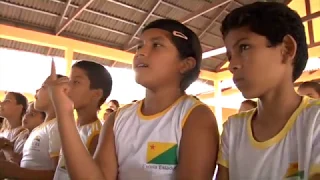
It seems we need to review this form of organization of knowledge within the school. Students visited the hydroelectric plant of Dona Francisca which is near the Fourth Colony region. Each teacher has requested an assignment about this field trip.
The history of the Fourth Colony. Why was it named "Fourth Colony"? Because that was the fourth place that the Italians came to live in the nineteenth century.
Here is Silveira Martins Church. It is the highest round tower. But there are many things yet to change.
For example, in mathematics, chemistry and biology: which is the main part? They have to adapt them because they can't understand the whole subject. There must be important points.
-For life, right? -For life. The simple knowledge of a trivial thing.
A knowledge of bank notes. She knows how much money is worth. Thanks to that she got to learn and do math this year.
We asked this a lot. There is content that we worked in elementary and high school that are useless in life. What I think is in development is to find a way in which all teachers can work with different methodologies for that student.
To dedicate to this student with a different pace. SNE. .
. is not meant to guarantee they will learn, GECY MARIA FRITSCH KLAUCK - PRESIDENT OF FBASD but to give sensitivity to this learning. GECY MARIA FRITSCH KLAUCK - PRESIDENT OF FBASD So this student can have the means GECY MARIA FRITSCH KLAUCK - PRESIDENT OF FBASD to attend this specialized care and that the teacher can have the dialogue with the teacher in the classroom to work together.
This is under construction. The high school student today has deficiencies in basic mathematics. So, this deficiency must also be cataloged.
Our so-called "normal" students are deficient in basic math. They also make my class go slowly. They also prevent us from teaching the whole content until the end of the year, but the university keeps the same list in the entrance exam.
The way we were taught to structure the school and work on it is a hundred years old. It is from the nineteenth century, at least. XVIII or XIX.
It does not change much if you look into its history and analyze the physical structure, the distribution of contents, of knowledge, the disciplines, time control. . .
All that remains much the same, with the aggravating circumstances that because of the entrance exam, the content began to gain tremendous emphasis from a few years to now. So the school is currently not a preparation for life, but for the entrance exam. We have understood the school was no longer good for everyone.
So what some teachers brought us was. . .
now that's all we needed. What? That the student with disabilities also came to the classroom.
This gave us great encouragement. Because the problem is not the student with disabilities That cup was already full. It was the last straw to break through a process and enter into a stage of rethinking education that hasn't been good for many years.
We live in a world very. . .
and maybe the Internet is somewhat responsible for this, but it assumes the production of individuals that no longer hold the technical knowledge exclusively. But the production of individuals who have entrepreneurship, proactive capacity, ability to create. .
. The ability to anticipate and solve problems, these are the characteristics that are to me most important currently to be worked in school than actually content. When making an alliance between State and School, say, for those individuals with disabilities to be in a school, we also want them to be handled this way.
I think developing autonomy is a major goal. It's still a very small portion of the disabled population that reaches high school. I understand that when we restructure high school We also have to think about these students who are coming.
It takes training to teachers that will serve these students. Often students with disabilities need other things. So, the challenge of inclusion in high school is immense.
But Renata, for example, is an example that things work. When I joined, I kind of liked it. .
. I made more friends. .
. You talked to some of my friends. .
. classmates. .
. I even have more friends. .
. They are helping me every day. The school helps me a lot.
She copies slower. Slowly. We do not mind having to wait if she has to finish a word or something to copy.
And we haven't copied yet either. Because normally we haven't copied yet. Because she taught me it had to be like that.
And I. . .
"Oh, I will summarize now. "Leave it to me. " I summarized everything.
I also summarized. Everything in half. She began to do everything in half.
-She copied only half. -Yeah. It was very difficult, too many things, so she started to sum up and copy everything in half.
I think there is no problem. Sometimes she is more advanced than I am. Much more!
The only thing that she gets in the way, not really, sometimes we'd say there was no assignment, but Renata would say, "There was, I did it! Often she is more responsible than we are. Often?
Always! She is always the first to deliver the assignment. While we take 2 or 3 days after the date.
In our room everyone talks to her. Renata is popular at school. Everyone knows who Renata is.
She seeks that interaction with other people. This is very good. She makes a lot of friends, more than we do.
She captivates people. She is very charming. You must be careful because when we turn to the side, Renata is already talking.
. . She starts to chat with anyone.
Except with the Argentineans. I would love to do performing arts. Because I like it.
I really would like to be an actress. I did theater in high school. What do you like the most in school, Rê?
To tell the truth, the snacks. Because they have good food there. They have lentil soup, risotto.
. . What is its name?
Beef with cassava. I eat it with rice and broccoli. You know that very well, huh?
Okay. . .
The swimming pool I go for some dives. This is the pool water. And the doves that are hidden here.
Let's see if I can see them. Let's see. .
. They're here, among that, which is their home. This dog is Sol.
It's Solzinha! Look over here, Sol. Wake up!
This is Bujutra, the old one. And here's the cheeky guy. Let's see the photos.
I'm filming here, huh! And my sister, who is like a mother to me. These are the lively fish.
This is the food that they eat every day and sleep well and happy and chubby. Renata has had stimulation since she was little. She has a great family who bets everything on her.
And the result is there. Beautiful, beautiful, beautiful! It is worth noting that relations she has set up along her life, the people with whom she interacted, what was provided to her allowed her to have all this development, see?
It is also due to the fact she goes to an inclusive school, but because the practices that were offered to her in this perspective of inclusion were a bet on her, understand? How am I going to say? Our standard of living is reasonable.
Now it's set up. When this works it'll be fine. So.
. . I'm here with my capital.
She is on my side. We have. .
. -We can't complain. -Yeah.