When we get stuck in anxiety or when we've experienced trauma, our nervous system can get stuck in a disregulated state, whether that's the activated state where you're anxious and stressed out and tense or the dorsal vagal state where you're shut down, you're sluggish, you feel unmotivated or hopeless. Either of those rigid states can be form of nervous system dysregulation. And today I've invited a expert on nervous system regulation, Dr Ariel Schwartz.
She has written literally eight books on the topics of CPTSD, trauma-informed yoga, polyagal theory, narrative therapy. I mean, she knows her stuff. And she has been so generous with us that today she's going to be sharing an exercise called the Robin, which is a simple way that you can start to regulate your nervous system to return to the ventral vagal state where you are more regulated where you feel more calm, more centered, and more resilient.
So, let's jump in. Do you have an exercise or activity you'd be willing to share that can help us restore our sense of safety? Yeah.
So, in part of what for me as a somatic practitioner and as a yoga teacher, part of what I come back to again and again are what are the sources of safety that that do live inside of us that therefore no matter where we are in the world, no matter what we're doing, we can tap into that which comes with us everywhere. Right? And um and this doesn't mean that we don't also need each other.
This is not a replacement for the social forms of connection and safety. But since we have the foundation of those co-regulating sources of connection, we can then carry that inside of us. There's lots of tools that we have inside of us.
And the basics that I'll share here are your breath and your posture, your spine. Mhm. Because when we think about both of those and I'll share about each one and I'll kind of share just some basic practice around this is that your breath mirrors your nervous system.
Every inhalation will key in a little bit of your sympathetic nervous system. Every exhalation brings in a little bit of parasympathetic quieting. Yeah.
When we look at the health of the autonomic nervous system and this relates to safety, what we want to see is this ability to move pretty fluidly between sympathetic and parasympathetic. We feel unsafe if we're stuck in sympathetic, right? Activation, vigilance, irritability, restlessness, anxiety, panic.
And we feel unsafe if we're stuck in the parasympathetic nervous system. We feel shut down, heavy again, more depressed, more despair, more collapse. So when we look at the health of the autonomic nervous system, we are wanting to restore this rhythm of sympathetic parasympathetic.
It's built right into your breath. [inaudible] mirrors that, right? Yeah.
So the basic practice is rhythmic breathing. Mhm. When I inhale for let's say four to five seconds and I exhale four to 5 seconds, I'm cultivating this rhythm of my nervous system and I'm maximizing on that.
Conversely, if I'm breathing erratically, which I won't do very long because it feels terrible . . .
. Right. Even just a few breaths like that, we can get that sense of erratic breathing being more linked to that form of erratic breathing to panic and anxiety.
Yeah. Conversely, if I'm breathing shallow, almost imperceptible, you can sense how that breath pattern would be linked more to shutdown and depression. Yeah.
So, our rhythmic breathing that allows for an even inhale and exhale is restoring the rhythm of the nervous system. And from the bottom up, from your body to your brain via your vagus nerve, sending signals of safety back to the brain. I'm going to link it to one more piece and we'll breathe together again.
But the posture is also a mirror of our nervous system. So when we think about curling forward, totally valid shape, valid when we need to grieve, valid when we're sad, valid when we feel helpless or powerless, we just don't want to live here all of the time. And that's a parasympathetic shape.
We sometimes need to curl upon ourselves, right? In yoga, we would go into a child's pose or a forward fold. And it allows us to make contact with what our body knows from this shape.
And in its opposite, sometimes we go into spinal extension. This is going to lift my gaze. It's going to bring more breath into the upper chest.
It's going to be more sympathetic in nature. I'm going to be very aware of my surrounds and I'm able to respond to what's happening out there. So, a spinal extension is more sympathetic in nature.
We want it, but we don't want to be stuck here. Mhm. So when we're looking at the health of the autonomic nervous system is related to posture once again we can see how rhythmic postural transitions like in a yogic cat cow or even a seated cat cow that we are basically restoring the rhythmic integrity of the nervous system.
Okay. So when we put it all together, my favorite practice and I love it, you're like, "Oh yeah, I feel it. " Right?
Every time you talk about breath though, it brings your awareness. You're like, "Oh yeah, don't forget to breathe, Emma. " You know.
We all do, right? We all do. You know, I think what I love about polyvagal theory is it's a compassionate way to understand ourselves, our tendencies, and our symptoms.
It's so important when we speak about trauma recovery to not use these things against ourselves. If only I could breathe. If only I were blah blah blah blah blah.
Right? Like our tendency to hold our breath, our tendency to breathe shallowly, our tendency to be stuck in kind of postural inefficiencies if you want to think about it that way. That's just called being human.
Yeah. So, as we layer in breath, posture, and let's add in compassion, right? Those are all recipes for restoring a sense of safety.
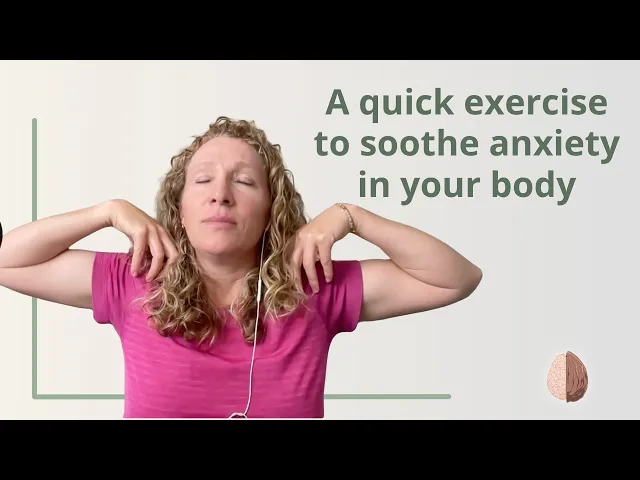
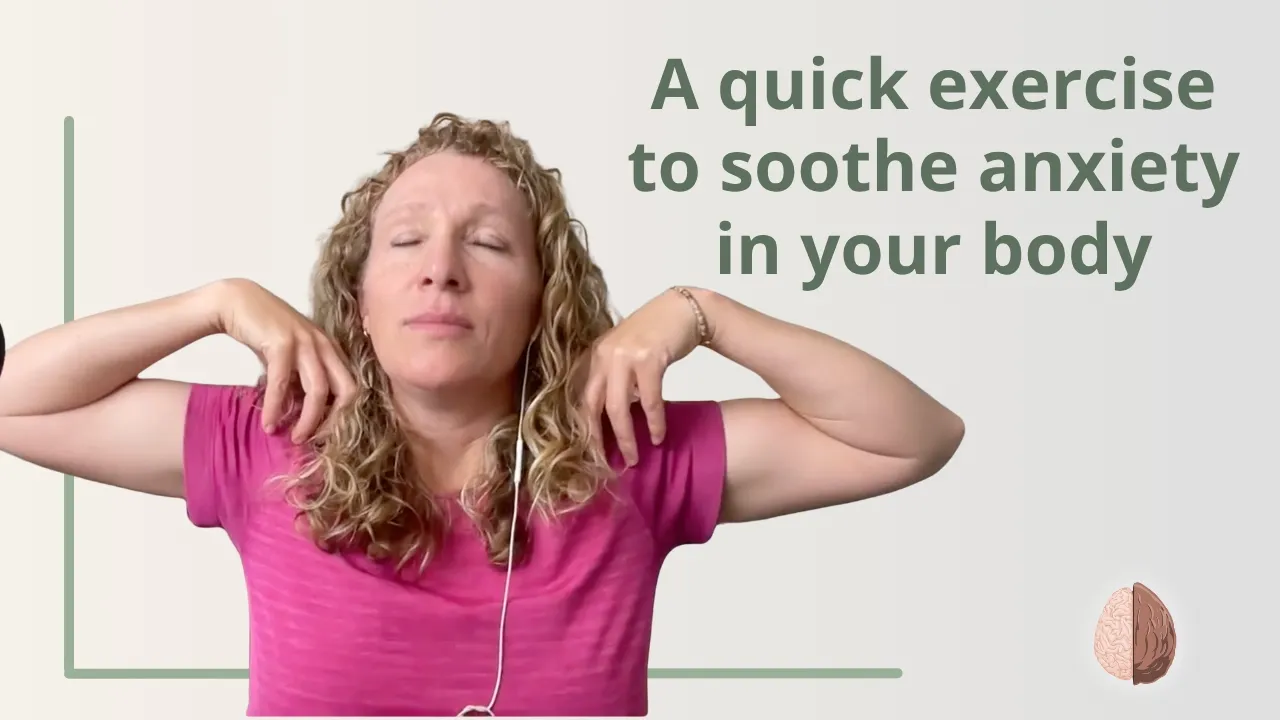
And if we put this together in a practice, a very simple one that in yoga we call the Robin's breath. And I'll guide this here is with your hands on your shoulders, you inhale, you lift your spine, maybe even lift your chin, open your elbows. On the exhale pattern, we find the opposite.
We curl inward. We let our chin tuck. Elbows come to touch.
And then we move rhythmically, finding your rhythm with breath and movement. Opening and closing back in. And very often when we do this, we also find the areas where maybe our spine feels kind of sticky or maybe even a little bit painful.
And then you get to know what your body knows, what it's holding on your behalf. So, say for example, for me was I go into this kind of curling forward and I feel into some of the tension that sits between my shoulder blades, I might pause and just breathe right here two or three times, right? Just acknowledging, oh man, it can be so tight in there sometimes.
Can I feel into that with some compassion? And then open back up. Opening the eyes, reorienting to the safe enough here and now, even as we attend to where the body houses tension or pain from the past.
And just two more breaths. Your rhythm, your sensing into yourself. Yeah, feels good.
It is good, right? And it's simple. It's a practice we can do even sitting at our desks.
Especially if we've been sitting at the computer a long time, we get into good postural inefficiencies or my favorite, this one. Right. So, absolutely.
We have to restore but notice and I'm sure for our viewers too, like notice the subtle shifts from a relatively short practice. I love it. Yeah.
I felt myself becoming more aware of my heaviness and my tension back here. And then as I breathed into it, I felt like laughing a little bit because I was like, "Oh, yeah. " Like that release, like, a little bit of like it softening up and like it was very I really liked that.
Thank you for sharing that. That's fun. So, and you know, of course, there's always the thinking part of my brain.
It's like, am I doing this right? Am I doing this right? It's like, it's okay.
You can be there, but just go back to just feeling it. The truth is there is no right or wrong way to do these practices. And I think that's such an important element of it because the more that we get to know our bodies, the more that we allow ourselves to kind of follow sensation and feel comfortable moving towards what the body holds for us.
And that can take time. And you know, something that we were speaking about just a little bit um early on, I think even before we started recording officially, is just this idea of like can we really restore a sense of safety? Is that really possible?
And you know, when we're up against a lot of neurological wiring of trauma that may be accumulated over many, many years, what we need to recognize is that to restore a sense of safety as a new baseline requires repeated practice. Yeah. Right.
When we look at the research on neuroplasticity and you know kind of like what helps support us to change in a positive direction and Rick Hanson has some beautiful research on this with something he calls the HEAL Protocol, right? He talks about how we have to counteract those negativity biases or the ways in which we are kind of again via survival orienting towards what is wrong and what are the threats because we as we orient towards that it helps us prepare and keep ourselves safe and know what's out there. But the problem is that sometimes we're so oriented to the threats or maybe historical threats or it just becomes all that we can see.
So, we have to actively counteract that by looking for cues that let us know that we're safe enough now, that it's okay right now, that this is a time when I can go into myself and I can relax and restore that sense of safety. And we need to repeat that every single day, right? As we're trying to rewire something that has been orienting us vigilantly into survival states.
Hi there. If you found anything in this video helpful, I would really appreciate it if you could give it a thumbs up or share it with someone who could benefit from it today.