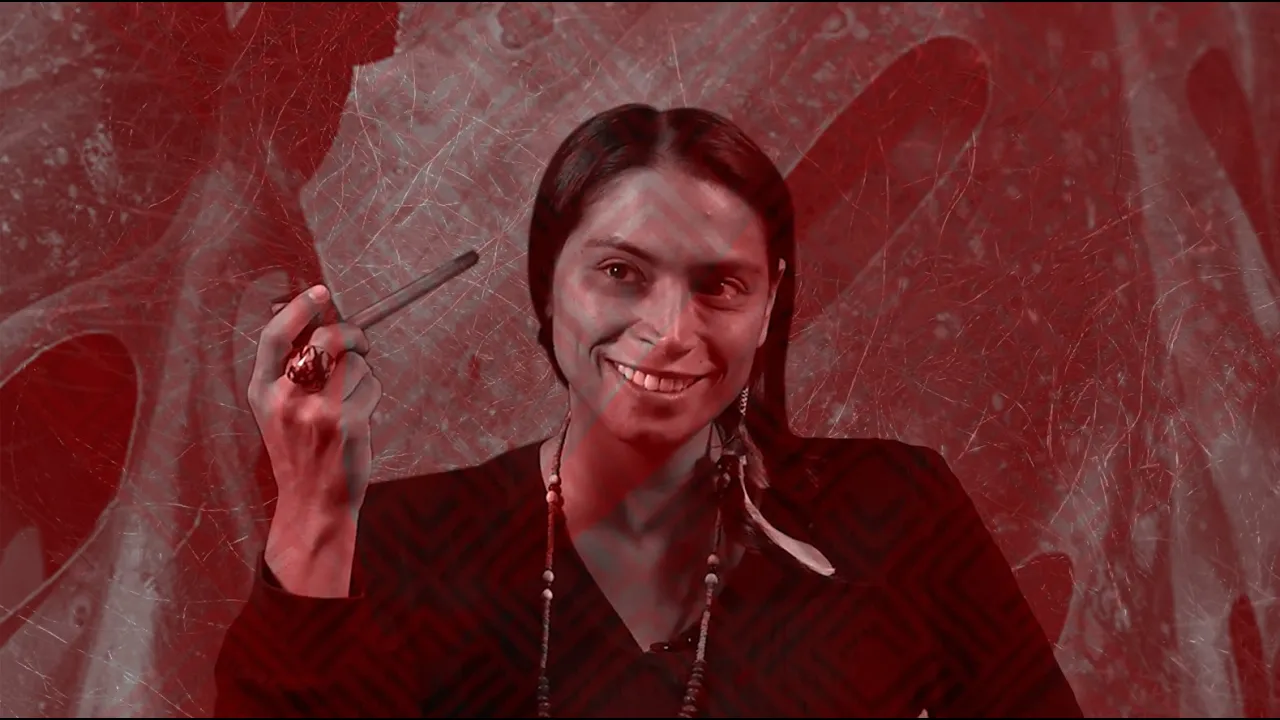
I have many memories of what my tata used to tell me when I was a child, because we have a whole tradition with herbs, we come from a family who really knows traditional medicine. We carry all the spirituality of our people. In our family branch, my great-great-grandmother was always the main caregiver of the family.
And my grandmother and my father had a certain. . .
with my grandmother it was not shame. My grandma was, in a way, afraid to say she was an indigenous woman. But my father was actually ashamed to say he was an indigenous man.
I think a lot of this had to do with the prejudice that northeasterners suffer when they arrive here in São Paulo. My grandma used to tell me often, “Yes, my child, we are all Indians. But here in São Paulo saying that you come from the northeast is already a problem.
So if we tell people we are Indians, we are dead. ” I remember that, on one occasion, my great-great-grandmother was preparing some medicine for me. When I was done taking it, she sat down, looked at me, and said, “Listen, my child: we are all Indians.
I don't want you to ever forget that: that we are Indians. ” I looked at her and I said, “It's ok, I won't forget. ” But I think it took a long time, after that, for me to understand what it means to be an Indian.
Because when you are, it's not an issue for you, you just are. We have knowledge, we have traditions, we have a language, we have our spirituality, we are born and that's it. I only understood what it meant to be an Indian in this world, as a political issue, when I was about 16 years-old.
I always heard my father talk, my grandmother, my tata, and when I asked them about things in greater depth, my grandmother would just say, “We are all bugres [Indians], you see. That's it. ” When I started showing my grandmother some of the things I was discovering, I started drawing our family tree and showing it her.
She knew it, but she would just stare at me. “Never mind that, never mind that. .
. ” And I would say, “But why, Grandma? ” “Never mind.
” Then, the first time I went to Pernambuco, “Are you really sure you are going there? ” “I am, Grandma. I'm going.
” “Then look for my dad's family. ” She meant my great-grandfather, Antônio Rodrigues. Before going I looked them up on social media, I typed “Fulni-ô” and I said to myself, “I’ll message the first name that shows up, I'll get in touch and see what happens.
” I had already been to Pernambuco a few times, but I had never been able to actually talk directly to someone inside the indigenous village. I think I was even a little scared of just coming up to them and saying, “So. .
. right? ” Then I found the first one, it was literally the first one that I found [laughs] and I sent a message.
I said, I explained, “Look, I've been going through this process 16 for a few years, searching, I found these documents, I have photos of my family, first names, last names, dates, and I wanted to know how I can reach you. ” And so I stayed there for ten days, getting to know people inside the village, living with them and really getting to see that everything I had learned in my life was Fulni-ô. Even if you speak the language, if you show that you belong, you still have to build the necessary bonds with people.
So this path I’m taking is extremely lonely. And I'm tired, because I just want to be able to be what I am. It's nothing but that: people in the world.