If you're a gym owner doing less than $100,000 a month and still pretending that you like mopping your own floors, this video is for you because I'm about to cram 14 years of blood, sweat, protein bars, and business lessons into this video. If you're new here, my name is Kale Owen. I'm the former gym owner, current CEO of Gym Launch, and possibly the only guy in the entire world who's broken a whiteboard marker from drawing Gym models too aggressively. Our team's helped over 6,000 gyms rack up a billion dollars in new fitness revenue. And today,
I'm going to give you the top lessons that I wish I had learned before I almost closed my gym. So, let's hop right into it. So lesson number one is that the model matters. And what do I mean by that? Well, the model, everything that falls into your model is going to be your pricing. It's going to be your memberships, meaning what type Of memberships you have, what type of access is it? And then also your team structure like think of like your fulfillment. So how are you going to fulfill, right? And your fulfillment will
matter a lot because your fulfillment will basically affect what type of model you have. And the reason why this is super important, we'll get into this in just a little bit. I'll get deeper into this in other lessons, but your pricing matters because if you set Your business up and your model up where you have too low a pricing, you're going to get screwed because you're going to get to a certain cap where you have so many members, but you still haven't reached profitability. Same thing with your memberships. If you set your memberships up where
they're all unlimited, then you're going to get to a point where you've capped your basically growth rate. So then the only way to be able to grow is you have to either cut The sessions meaning or cut their access to the facility meaning you drop them from limited or unlimited to limited or you move them to you have to move to another location which then has other costs and other problems. So number one pricing number two is memberships and the basically how you set those memberships up is really important and your fulfillment. So how are
you going to fulfill? What model of training are you going to use? Are you going to use Something like personal training which then basically you're trading time for dollars which across all services you are but that will require it's a higher ticket model and it will require great trainers has usually low churn but also harder to sell. Are you going to do a health club where it's general access and it's pure volume and you got to go volume then add other upsells and crossells. Are you going to but also a huge upfront cost typically to
start a Health club because of the equipment and everything else. Are you going to do a large group training facility where you're going to try to get 16, 20, 25, 30 people into one session? Again, volume but at a slightly higher price and then also or you're going to do semi-private, which is lower footprint and you're going to do something where it's a four sixon-one model where you have four to six clients with one coach. You can charge higher prices, you have Um more touch points, but again with that it's higher price. So again, you
have your pros and cons on both sides. The key is is like understanding, okay, what's my fulfillment and then basing your pricing and your membership levers off of that. But there are very core key fundamental aspects of each one of these. But number one, if I could say anything about like if you want to go into business or you're a current gym owner, the key here is get your pricing Right, get your memberships right, get your fulfillment right, and understand what you're really good at and focus on those that one thing. Or maybe as you
grow, you have the ability to now move into an adjacent thing like an upgrade. Like if you do large group and you want to now offer semi-private, well that's great, but just make sure that you have a really good core offering before you start moving on to the next thing. Okay, so that's lesson number one. Lesson Number two is the wedding cake gym profit model. The problem that most gyms have is they don't understand that there are certain there are lots of different ways to be able to collect money from clients. It's not just one
service offering. And if you have one service offering, that produces a huge risk to the business because you have one thing that you do. That's it. Now, that's good when you start and it's really good because you need to focus on getting Really good at this one thing. But as you grow and you become better and better and more profitable, you create more revenue. You have more members. We need to start diversifying in the service offerings that we have. As well as we need to find other ways to be able to create more revenue per
member because there's only three ways to grow a business. We can get more clients, we can keep them longer, or we can obviously make them worth more. Now, Most gym owners typically focus on just getting more. And I'll get to the lessons on that in just a second. A lot of gym owners just focus on how do I keep my clients longer by focusing on their programming, focusing on all this stuff, which in reality doesn't actually work. We want to focus more on the community. I'll get to that in a little bit. And then the
other side is getting keeping make basically making our clients worth more over time. And when We think about that, keeping clients longer increases the billing frequency that we have. So we get them to we charge them more times. When we think about making them worth more to us, we think about, okay, what are bolt-on or add-on things that we can do to increase their average revenue per month or arm of our members and the wedding king gym profit model basically lays this out in a really good way. So at the base level first real quick
basic understanding When you think of a wedding cake picture a wedding cake you've got the kind of core cake piece that's like when we think about that and I draw this wedding cake on this wedding cake model think of that core cake piece that that really delicious part that holds everything together that is uh think of your reoccurring revenue on this then you have the icing the icing think of this as cash collected so front-end cash collected so these all feed into each Other but cash collected on the front end helps drive and create cash
flow, but the EFT, the reoccurring revenue, that's the stuff that creates a really strong business that can stand the test of time. So, at the base layer, and I'm going to use a large group training facility for this, but there's also other different models that you can use on this, but when we think about this, at the base layer, we have at the bottom, it's probably going to Disappear. There we go. At the bottom, you've got your front-end offer, which could be anywhere between a 4W week to 12week front-end offer to bring people in. The
reason why you want this is you want a front-end defined program. You want to collect more cash up front and you can collect anywhere between, I would say, $299 to upwards of $5,000 on the front for that front-end package. Now, goal is you sell them and then you move into EFT. Now, for a large group Training facility, the goal here is to get to 150 members at $49 a week. This is for large group, and we define large group as 16 or more in a session. So, you can have 16 or more people in a
session. All right? So, once you get to there, you're making really good money. Um, I'd have to pull out my calculator and that would make this whole video way longer, but you can do the math. So, let's say every month you're signing up 10, 15 people on the front end, right? And then you're also adding it and you're stacking. So by the time you get to 150 EFTs, now we can start adding the next layer. The next layer is when we think about it is now semi-private. So semi-private is going to be either four on
one, five on, or sixon-1s. And you can start selling people directly into it. My suggestion is is and I'll show you a way to be able to do this later on. And a really key thing that helped me a ton and helps our gym owners be Able to immediately launch a semi-private program with their current clients and make a ton of money off of it. We call it the golden ticket upsell. But with this, you can start selling people into this. And again, same thing. You can do a 4-week to 12 week offer on the
front end, but this time you're you can sell this for anywhere between $9.99 to again $5,000 depending on what you want to do. Or you can even go as High as 10, but most people do it for 5K. Okay? Then what happens is over time you start adding more and more people. So, okay, let's say I get 75 EFTs at a price point of, let's just say, 119 a week. Now, all of a sudden, I'm making a ton of revenue. Okay, so I've got this. I've pulled some people, but I'm still filling them into my
large group. And when you think about the funnel is everyone starts coming in here and then you can upsell them directly into So, They go here, they go into EFT. You have the opportunity now to either upsell them into a front end and then move over into this. You could also have people come directly in right here and move directly into this which then creates a downell opportunity. If people want to leave semi-private and they want to go to large group like you have this option right here. Okay. So the next layer is what we
call hybrid. So in hybrid this is simply nutrition and accountability. So these are for the people that are in large group and or maybe they're online, maybe they're somewhere else, but you can now just offer nutrition and accountability guidance with this. Again, you can do front-end programs where you're selling 4-w week to 12week programs. And you're charging them anywhere again between I would say typically for this you're looking at um I would say $5.99 um to probably again you could go up to 5K but let's just say for this case 2K right and then over
here the goal is is to get to anywhere between 50 to 75 people that are on this and what you want to do is you're going to bolt this on for roughly I would say $28 a week on top of their large group but I'm just going to put the total cost of this membership which would be roughly $77 a week. Right? So now the key here is when you think about this, this is a a bolt-on. So this is something that you Could use with your members or anyone else and they could they're paying
you essentially $77 or you could just have people just directly in this. So you're not exactly stealing from other you're not stealing from other programs. What it's doing is bolting on and it's a new price point. All right. So that's that. Now the next layer that we look at, this is where we think about internal plays. Now internal plays are really, really important. This is a chance for you um Periodically throughout the year to do paid internal plays. And these are when we say internal plays, what we mean is usually it's a 4-week, maybe a
six week internal challenge. And typically with this, you're not going to charge a ton. you're typically going to be somewhere in the $49 to um I would say at most $1.99 depending on what you're doing. But the goal here is like every quarter you're getting 50% of your um basically I would say 50% of your client base to take part in this, right? And so with this um I'll put 50% of EFTs. What this does is it increases every quarter. If you're charging this amount and you're doing something paid, what you're doing is now you're
increasing your average revenue per members because it adds up. This also has a beautiful effect on retention. As we get into retention, I'll break down retention. This also helps that a ton because now When you do that, you're also going to keep people longer. Okay? And so the last one, and this actually goes through the entire cake, um, and I'll show you how in just a second. This would be supplements. So, on the supplement side, you're selling anywhere between 1 month to even 12-month packages and stacks for anywhere between 200 to $3,000 upfront. And then
your goal here is to get anywhere between, I would say, 50 to 75% on subscribe and save. So, I just call it subscribe and save. Basically, subscription. So, you're selling 50 to 75% of EFTs on subscribe and save. Now, if you're doing this right, you're actually starting this layer up here. Um, let's call this layer number five. This one's number four, two, or three, two, and one. Right? You're starting number five already down here. Because If you're doing it right, you've already got people coming in and you're bolting them on. And I'll walk through how
you do this in just a second. But with this layer, this is how you get to 80 to this is how you get to 80,000 to $100,000 a month with high margin if you do it right and you structure your model correctly, right? But if you use this for your pricing and you do this, it's just stacks one on top of the other. And The reason why this is so important is because as you grow and as you scale, you are able to now add other services that can dip into other verticals or spending wallets
that your clients have because you're going to have clients when you do large group. You're going to have clients that are going to want higher attention, more attention, and then that immediately goes into semi-private. Well, now we've got an offer where you can get more attention, Smaller groups, and you can work there. Now, you're going to pay for that, right? But now you have that. Then you have other things where people are going to be like, you know what, I don't really want semi-private. I love the large group, but I would love nutrition and accountability.
I'd love help on that. And you can sell 12-week packages or move them right into EFT where they're constantly getting that. And then you also have your internal Challenges where the people that just are in large group or just in semi-private, they don't want anything else, but they want they love taking part in these internal challenges and plays that you have every quarter. And then now all of a sudden, you've got that. And then you've got your supplements, which stacks across everyone. So now you've got as many people as possible doing that. Now, the cool
part is you're constantly bringing In new clients on the front end. This is the think of this as the icing, right? So, this is front-end cache. And then this over here is the EFT or monthly reoccurring. And so, now it starts to stack and stack and stack to where now all of a sudden, this is how you build a massively profitable large group training gym. And that's how it works. The key is is doing it over time. You got to make sure that you do one thing really, really well and then move to the Next.
Too many times we get so distracted where I see so many gyms with 30 members, 40 members, 50 members, and they're like, "Okay, I'm going to just add on this thing and I'm going to add on meal prep and I'm going to add on a smoothie bar." No. Get really good at the one thing and then move on. It's very easy to get distracted. Don't do that. Okay. Now, lesson number three is billing. We went back, we talked about the model. So, billing every 28 days. This is massive. So, the problem right now is that
most people bill on a monthly basis. Okay. Now, if you bill on a monthly basis, that means that you're going to have 12 billing cycles a year. So, that equals 12. Now, the issue with this is that your you also pay your trainers typically bi-weekly, which means if you do it bi-weekly, let's go here. Bi-weekly pay periods actually equal 26 or if you think about it from a monthly Perspective, 13 total for the year, right? because you're going to build them bi-weekly. That's 26 divided by two, that's 13. So, you're out one. So, if we
think about it, I'm missing one of these. So, I've got to make up one. And how in the world am I going to make up one? Well, the way you do that is you change your billing cycle to every 28 days. Now, there's a couple pros and cons to some people be like, what if I charge weekly or what if I charge Bi-weekly? The reason why I like this is for three reasons. One, you have less admin. Meaning, if you bill every week, you're going to have a lot more failed payments. You're going to have
a lot more questions, a lot more people being like, "Hey, can I just pause my payments?" The second reason is you have the same benefit as weekly or bi-weekly. You just have less admin. And you're still going to make up and get 13 billing cycles in the year, which means, By the way, with this benefit, that means you're going to take whatever your monthly rate is right now, and you're just going to add it at the end of the year without adding a single client, which means you're going to increase your revenue. So your revenue
is going to increase by 8.33%. Most of the time that's going to fall right to the bottom line for like in reality it is. And you don't have to add a single member, don't have to add a Single session, a coach, equipment, nothing. It is just by changing your billing cycle, you're going to make more money. And then the other thing is sales is really easy. And the reason why sales is really easy is you can position your instead of saying the monthly or the every four-week rate, you can just say, "Cool, it's only $49
a week. We just bill every four weeks." Notice how that's way better than saying it's $1.96 every four weeks. You just say $49 a Week. We just bill every four weeks. Sound fair? Great. All right. So, bill every 28 days. Please do that. Massive. All right. Number four, core functions. Understanding the core functions. So, there are in reality there are seven core functions. So, number one is lead generation. And I'm going to get into each of these in just a second, but lead genen, lead nurture, sales, fulfillment, retention, teams/ leadership. Think of this as leadership
as well. And the Seventh is uh finances. And what I mean by finances, I really just mean metrics. So to keep it as simple as possible. So in these core functions legion it's really important to understand core functions overall is each one of these are different areas of the business that have to be that frankly have to be done really really well over time if you want to create a great business. Now do you have to be perfect in everyone? No, you do not. But you need to be able to Understand that each one in
and of itself is a separate business function. They all work together but they each have their own function, their own responsibility. For example, lead genen. If I think about lead genen a lot of times when I think about creating leads as a gym owner when I was broke I used to think leads equal sales but that's not true. I can go out and get a million leads but if I can't get them to actually show up and then actually close Them then it doesn't matter. And so none of these things matter unless cool I can
get a bunch of leads but then I have to make sure that I'm actually nurturing those leads and doing it the right way. And I'll walk you through what that means in just a little bit, but I need to actually get those people to show up. It's a separate business function that requires a separate skill set. Then there's sales. Once they show up, I could be great at Getting a ton of people to show, but if I don't know how to sell, and I don't have the framework to sell, which I'll show you in just
a second, then I'm not going to be able to close people consistently, or what if I do close people, but I can't close them at the rates that I need to. And by that, I mean I can't collect the cash that I need to to be profitable and create cash flow. That's another problem. And that's a skill set. And then cool, let's say I'm great at all of those. I'm great at lead genen, lead, nurture, sales, but then fulfillment. I have a bunch of people that just cancel and leave in the first 30 to 90
days because I struggle and I can't scale it. Maybe it's just you or maybe you're you have trouble scaling your team's ability to fulfill on what you just sold them. And then on the back end is like, how can I keep people long term? Can I keep people past the first 30 days, past the onboarding Stage, past 90 days? Can I keep them for a year, two years, five years? And can I do it consistently? And more importantly, do I have a system that can scale without me? Does all of this rely on me? Because
that creates massive risk. And then as you begin to grow, do you have the ability and the skill set to create exceptional teams? Do you know how to hire? Do you know how to go out and attract top talent? Do you know how to interview them? Do you know how to Train them, onboard them, pay them? Do you know all those things? And then do you know how to make sure as a leader what to look for? Do you are you inspirational? Are you someone worth following? Right? These all lead into it. And then number
seven is obviously finances and metrics and understanding your metrics and knowing that hey data is incredible. Data is neither negative or positive. It is just numbers. And it helps gives us a story of like where are We at in the business? But it helps it. It's the thing that drives the decision-m that we have. And do I know what my my metrics are, my finances? Now, a quick little exercise that you can do is take all seven of these and rate yourself in each one on a scale of 1 to five. One being you have
no idea what it is or how to do it. You have no skill set in it, you struggle with it. Five is you are great at it, you don't even have to do it because you've been So good at it. You've mastered it and now you've have other team members and they're crushing it and you don't even have to worry about it. Rate yourself in all of those and then take the one that has the lowest rating and then focus your time there or hire someone to solve that problem for you. All right. So core
functions and the reason again this is super important. A lot of times we think that all these things work together and that leads equal sales or fulfillment Equals retention. These are all separate things and they all have to be looked at incrementally in order to grow the business. Otherwise it becomes very overwhelming. So if you've ever been overwhelmed looking at what do I do in my business? How do I focus on it? What should I do next? This is the thing that's going to solve that. And it was crazy. It's like I didn't know this
until I got into it. And then when I looked at it this way, it helped me, it Helped clear the fog and the overwhelm of where should I focus in my business? And it helped me understand, okay, where are the holes and how do I fix them? Okay, lesson number five, four layer funnel. Let's talk about acquisition. So we talk about the lead side, right? So we're talking about lead generation here. Now, for a long time, you could just go out and you could run ads or you could just rely on referrals or you could
just do basically One form of traffic in order to grow a gym. And I'll get to the myth of basically the field of dreams myth in a little bit. But in today's world, it's totally different. In today's world, for gyms to win long-term, they need to over time develop four different channels. I call them layers of a funnel. And the way this works is at the top, you've got paid ads. The next layer is content. The next is warm outreach. And the last one is referrals. Now, with this, as you Move up and down the
funnel, you're going to have the chance to have more leads to less leads. You're also, from an effort perspective, you're going to have more effort and less effort. And the reason for that is is because, let's start at the bottom, referrals. The reason why you have less leads there and it takes more effort is one from a less leads perspective is you just have lower total addressable market known as TAM because You just have your members your member base. So if you have 50 people that's the pool that you can hopefully grab from. But at
some point that's going to be capped and it's already capped right now based on how many members you have. And most of the time you're not getting all of your members to actually refer. So no matter what you're always going to be capped from a more effort perspective. The reason why it takes more effort is because referrals rely on You having exceptional actual service. So it is your business and it also is very manual which means you actually have to go out and you have to ask and you have to make sure your team is
asking and it's a very manual process. Warm outreach, what warm outreach is is reaching out to people and creating conversations that turn into booked appointments with people that you have the ability to reach out to. So that would include people that are liking and Commenting on your ads and your content. Those are people that are new followers. Those are old leads. Those are old members. Those are um Facebook groups that you can reach out to. These are all those people that you have the ability to do. People that even view your stories on Instagram or
Facebook. You can reach out to them as well. That's what I'm outreach. Now, why do you have more leads here? Well, it's because your TAM, your total addressable market Increases. You have the chance to reach out to more people, create more conversations that then turn into cash. Why does it take slightly less effort? Well, it's because it's just one part and it doesn't rely on your entire business. And the key is it's still manual work. It still takes time, but man, it can absolutely smash. Like we have some members right now, we had uh a
gym owner of ours that he has a seven figureure Gym, runs traffic. He actually uses all of these and there's a reason he's a seven figureure gym uh for a jiu-jitsu martial arts fitness facility. And he's in Cali. And in January, I believe he closed somewhere around 25 to 30 plus new agreements, like new members just for more outreach. And then in February, I think he did like another 20 or so or maybe it was 15. But like that's just one of his channels that he uses. And then on the content side, as we move
up The funnel, content is just posting content. It's video content, written content, voice, right? So you got your reals, you've got your um Facebook, you've got your YouTube shorts, you've got Tik Tok, you've got all those, right? That's content. Then you also have your written stuff which could be um Google my business posts. It could be Facebook posts, LinkedIn posts, Twitter, emails, blogs, um anything written on your website, website counts as well. And then you also have uh voice which could be uh obviously podcast. I don't suggest you do a podcast but it can be
there. I think there's way bigger things that you can do. In fact, I think the biggest lever that you can pull is just create better content and make it engaging, make it fun, make your gym look really, really cool. If you do that and make it really fun, it's going to be great. Now, what's interesting about content is from an effort perspective, If you're really good, it actually doesn't take a lot of effort. You just spend like one or two hours a week and you can create content for like all the time. It's also pretty
easy to scale because most people today um trainers and everyone else understand social media to some degree. So, it's a little bit easier and you can just post and schedule out stuff. So, you can spend one day or five hours and be able to actually go and just post for an entire Month. And with AI tools, it's becoming easier and easier. Now, as we move up, we've got paid ads. Um, well, real quick on content, let me hit on the leads wise. Well, you just have more eyeballs, right? Because more people are going to be
able to see it. There's a drawback to this, though, because with organic content, you're now being seen worldwide. And like, let's say you get a viral hit, like you get a viral reel and it goes crazy. It gets a million, 2 Million, 5 million views. Well, there's not five million people in your local area, right? and it's just not going to happen within that are actually going to choose to come to your gym. So, it doesn't really actually help you. It may help your follower count, help may create it might help create trust and um
it might help create credibility, but it's not actually going to help you make more sales. So, with content, it's got to be really important That it's just a part of this funnel and the real part is just to create trust and create engagement. And then top of the funnel is paid ads. Paid ads is by far the easiest way to in a local market go and get more eyeballs and create more leads because I can just put money into Facebook. It's way less effort. I create the campaigns or like if you work with us, we
create it all for you and we set it up and we run it. We optimize it, do all that stuff. But like it doesn't take A lot of time and it's the biggest bang for your buck your buck. Now, from a paid ads perspective, Meta is still the best platform. When Tik Tok, if they ever do a better job with targeting, that's another platform down the road. Google is a it's okay. Um it just depends on what you're trying to do. But there's always lots of different ways to be able to do it. But the
key here is you want to decrease the risk from a marketing perspective by hitting all of These. And you want to do it over time. My suggestion is referrals are always going to be there. Always ask for referrals. Start with paid ads. Run paid ads. Make sales. Crush it. Then start adding in content, warm outreach, and referrals. Now, I will hit on this real quick. They all feed each other because when you do paid ads, you're the first thing that they're most likely going to do is go to your website or look at your content.
You probably do that right now. I do it. If I see an ad, I'm gonna go somewhere else and I'm gonna check it out. So, look at your content. If your content sucks or you don't have anything on there, they're not going to trust you and they probably aren't going to opt in. But if it's really good, they're going to trust you and your paid ads become even better. So, they become more profitable. Then with content, as you get more and more people following you, engaging with your content, you create More opportunities for warm outreach.
Now, these warm outreach is again likes, comments, engagements, everything else that's happening, new followers, all that stuff. And then from there, and these are leads, old lead lists, all that that increases your warm outreach, which then as you get more members, you get more referrals, which then continues to drive everything else. And that's why everything feeds. And when you have this working, this is the best way to go by Far because now you've got every single channel working. Key is is like it's got to be installed at the right time over the course of time.
It can't be just done immediately the right way. Um because otherwise you'd just be dabbling, right? So four-layer funnel, that's how to get leads in today's market. Now next one is we talk about lead genen as or lead nurture as the second um core function. Four pillars of lead nurture. Number one is going to be Speed to lead. The key here is that you got to reach out to leads in under five minutes. So that means call, text, video, voice message, video, text message, uh could be a me voice memo, whatever it is, you got
to reach out to them in 5 minutes. My suggestion be call, they don't answer, double dial, don't answer, video text message, then it's follow up with a text message. So number one is speed to lead. Number two is going to be volume of Reachouts. Volume negates luck. And so volume you want to be thinking uh for days 1 through five, three times a day. And then days I would say six through 14, one to two times a day most of the time. And then after that you just drop them into a reactivation. This is super
key. And this is obviously if they don't schedule. So, anybody that schedules, they're going to go in. And so, just so You know, too, there's two types of leads that you could have. You have a self schedule and then you have no schedule, right? These are the two types of leads. So, self- schedules, your entire goal with these is just to confirm. You want to confirm their appointment and you want to follow up with them, ask more about them, and understand their goals and what they're trying to accomplish. With no schedule, then what you want
to do is you your Entire goal here is just to set an appointment. That is it. Because what you want is you want to get them to hear because then all you do once you set it, you're just going to confirm it and continue to work them. Once you set an appointment, don't give up. Just keep working them. Volume, volume, volume. It's always way more than you think. Way more than you think. I was just talking to a bunch of franchises for a major franchise and I Was given the story of when I first started
gym launch in the before I started gym launch, the most amount of leads I'd really ever gotten in a day was like five. And then when I started ads, I like got like 30 in the very first 24 hours. And so I'm reaching out to them. I'm doing following the process that we teach. I'm that's 90 reachouts in a day, right? Then the next day I get another 30. Okay, so now it just continues to scale. Then the next day I Get like 25. Then the next day I get like 32. Then the next day
I get like 18. Then the next day I get like 20. Right? Just you can see it just keeps stacking. And so literally at one point I had 500 reachouts in a day. But that's what it that's what it requires. And by doing that what's crazy and this is again it blows my mind. It's I just it was a whirlwind. I don't even remember. And if you talk to any gym owner that's been with us and they've been overloaded With leads, it is a whirlwind. It's a lot of work. Lead nurture is a ditch digging
of all the core functions. No one wants to do it, but it has to get done. And it's all reactive. And what's crazy is that paid off because in 10 days, I was able to take a bunch of those leads, turn it into 75 sales, and collect $37,500 in upfront cash. We're not talking contract value. That's upfront cash in 10 days. Um, and so it pays off. It all comes down to volume. And I can tell you this, I have there is not a single million-dollar gym out there or prof massively profitable gym that doesn't
focus on lead nurture. Not a single one. All of the ones that are struggling, every gym that I've ever seen struggle, they don't focus on this. This isn't a big key. And they don't, they're not willing to test stuff. They assume that people are going to be adults and, you know, keep their Appointments. It's just not. We have to take the onus on us. Our prospects do not owe us anything. All right. So now number three is going to be personalization. So under personalization, you want to think about, okay, how can I personalize my lead
nurture to them? Now there's a couple different ways you can do this. One is through the medium in which you're going to do it. So let's say they come in through DMs. Yes, you want to Collect their email address and their phone number. But if you are already talking to them in DMs, keep talking to them in DMs. If it's text message and you they reply via text message, do that. If it's on the phone, talk to them on the phone. The other side of personalization is also personalizing and understanding where they're at and what
their goals are. So then you can grab more information. You can personalize the testimonials that you Send them and the proof that you send them, all that stuff. Okay? So personalization is really key. And the last one is availability. Availability matters a ton because if you're not available to sell, you will not make money. There's a reason Walmart makes a ton of money. They're open 24/7. So, if you want to make a ton of money, the best way is 9 to noon and 3 to 7:00 p.m. is optimal. Like, if you had all the time
in the world, that's going to be The best time. Monday through Friday. And then Saturday would be um 9 to noon again. All right. Now, a lot of times gym owners aren't available then because maybe you're on the floor or not. But the goal is is to get off of the floor to allow yourself more time to sell. If at minimum you want to have evening times available Monday through Friday. That's at minimum. And if you can do that, you're going to sell. So that's lead nurture. Those are the four Pillars. That's lesson number six.
Lesson number seven is the closer framework. So we get people showing up. Well, how do I close them? A lot of times gym owners wing it. I remember before I had a framework, before I ever went into sales training, I would just wing sales and I would just hope and pray that it would work. And every single sale was different. And that also led to me having huge ups and downs and also not consistent sales whatsoever From a closing percentage. That means also that I would I didn't have my memberships locked down that well either.
So sometimes I'd collect some money, sometimes I'd let people start for free and it just all over the place. And so this closer framework is by far the simplest way to think about sales for fitness. And it's what we use from a framework perspective here at Gym Launch. We've done well over hund00 million in revenue at Gym Launch since We started. And we've also this is what we teach our gym owners and that's what they have been using to generate well over a billion dollars in new fitness revenue. Now there's nuances to this but the
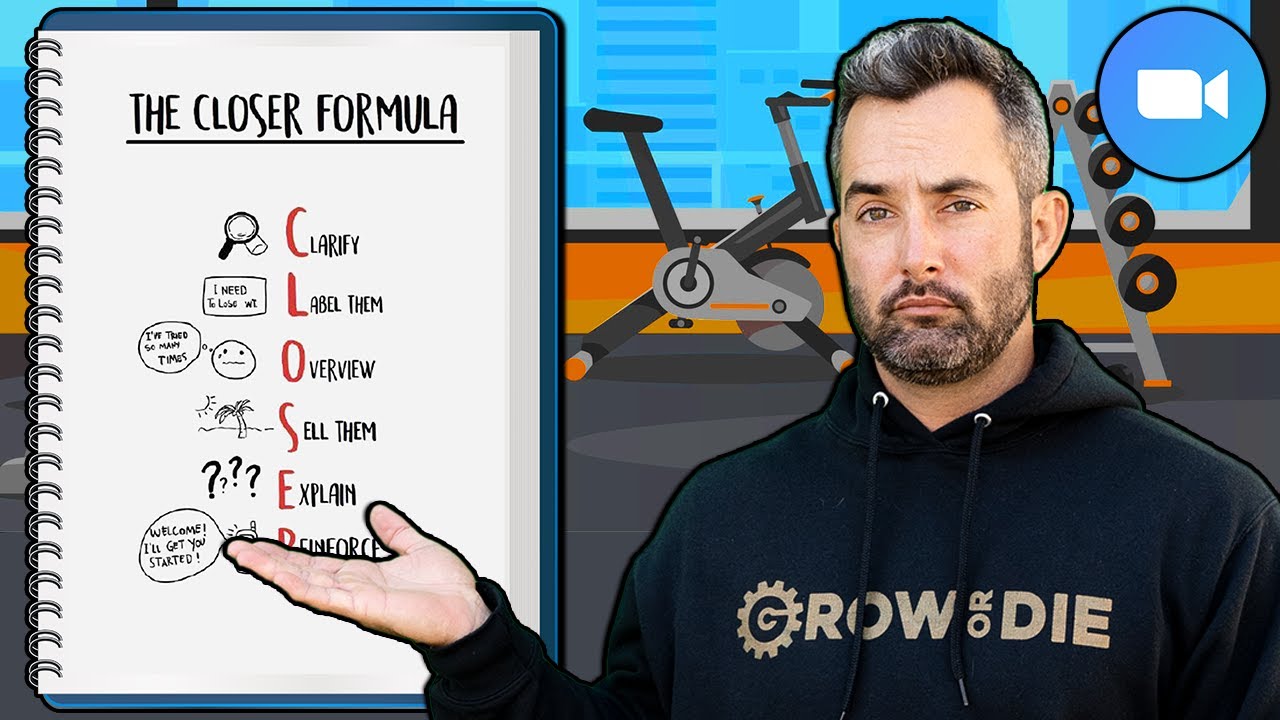
framework still applies and once we understand the framework everything else becomes a lot simpler because if we just follow this framework we're good to go. So the C stands for clarify. We want to clarify why someone came in. That's the whole goal. Like what's their goal? Want To lose 20 pounds. Whatever it is we want to understand what why they came in. The L is for label them. So we want to label them with a problem that we plan to solve. So, if someone comes in and they're like, "I want to lose 20 pounds." It's
like, "Got it. Can you tell me a little bit more about that?" Cool. Got it. So, you want to lose 20 pounds because of X, Y, and Z. Am I off on that? Great. Got it. So, you want to make sure that we are repeating it back To them. All right. The O stands for overview, past pain, and experiences. So, it's really just think about I want to go back in time and I want to create a timeline from past to future. And I want to understand where we're at in the present. What have they
tried? What's worked? And what hasn't? What do they like? Maybe they did different programs. Maybe they tried different nutrition plans. Maybe they tried Weight Watchers. Maybe they tried a personal trainer. Maybe they tried large group training. Maybe they tried CrossFit. Whatever it is, I want to figure out what have they done in the past. What do they like? Where are they at? And then also more importantly, what where do they want to go? Like what's their goal even deeper? And I want to then make this way more personal. This is way, this is where you
dive into the pain. This is where you make it mean more. People say, "I just Want to be healthy." That's not a reason. I don't know a single person who's ever woken up and say, said, and woke up with the goal, feet hit the ground, I want to be as unhealthy as possible. Every single person wants to be healthy because it's the assumption that we'll live longer. Well, the point of this is to figure out, okay, not only do I want to figure out why you tried, but like why do you actually want to do
this? What's the real reason behind it? What's the impact? You want to make it mean more. Okay. Then the S stands for sell the vacation. When I say sell the vacation, what I mean is that most of the time in sales, a lot of people focus on the ben the features and kind of mix in what they think are benefits of their program. So they talk about things like the programming and their certifications and all these things. That doesn't matter. What matters is how is this going to actually solve their problem. We talk about with
our gym lords of like a dynamic presentation. Meaning you've got all their pain. You got what will make it mean more. You've got all these things of like why are they here? What are we truly trying to solve? And then you adjust the presentation to sell the vacation to basically how it's going to solve their problem, whatever that is. And you want to sell the vacation. When you think about a vacation, if you went to a travel agent, which they don't have Anymore, and you wanted to do that, it's like when you think about a
vacation period, if you've ever gone on a flight and you're thinking, "Okay, I'm going to Hawaii, right?" And or Jamaica. I love like I've been to Jamaica a ton of times. It's close. I live in Florida. Really easy to go. So, we'll just choose Jamaica. Quick flight, all that stuff. But if I wanted to go, I've got to drive. I've got to pack. Got to get everything together. I've got to make Sure I have everything. Gotta make sure I have my passport. Got to make sure everything is set. I got to make sure I have
babysitters. I got to make sure I have my kids taken care of if I'm not taking them. Got to make sure my wife's all ready, gas in the car to get to the airport. I got to make sure all that stuff is good. Then I got to drive to the airport. And depending on which airport I go to, that's either an hour or two hours away, right? And then I got To find parking. And then I've got to walk in. Then I've got to check my bags. Then I got to go through security. And who
knows how long that's going to go. Make sure you have TSA pre-check. But either way, I got to go through that. Then I got to sit at the gate and I got to wait. And then I got to hop on. And then I've got to sit on the flight and then I got to get off. Then I got to go through customs. Then I got to get to the resort or the hotel or wherever I'm Staying. Blah blah blah blah blah blah blah blah. No one cares. It's not fun. No one wants to think about
that. What everyone wants to hear though is imagine you're sitting on the beach in Jamaica and you're sipping a whatever their favorite drink is, right? And you're relaxing and enjoying. Imagine how enjoying your time and you're relaxing and enjoying your time. Imagine what that's going to feel like in three months or six months. That's all they Want. They want to know how is this actually going to affect me. Okay. The next one is explain away concerns. So the E is explain away concerns. This simply means objection overcomes. So when people bring up smoke screens, which
most of the time objections are, they're usually going to fall into I need to think about it, right? So a time delay or stall. um I need to talk to my spouse. So, it's a decision maker issue or it's a price. It's usually going to Fall into those three things. And if you understand that, you can then be able to dissect, okay, how do I overcome each of these? Now, if you do your job right early on and you have the right process, you're going to go ahead and, you know, preemptively overcome a lot of
these beforehand. That's what good sales people do. That's takes training. But you explain away concerns, you make it all good, and then you close the deal. Now, it's really important to understand That sales doesn't start or closing doesn't start until after you say the price. Once you say the price, that's when closing happens. And if you say the price and you're not closing, you're not a closer. You're just talking to them, right? You're not actually selling anything. You got to close them. And closing happens once you actually say the price. And then once you close
them, this is reinforce the sale. Reinforce a sale is a good way to just Simply make sure that you remind them of they made the right choice. This could be a handwritten card. This could be a phone call from the owner. This could be a swag pack just to join the gym. Could be a gift. Whatever it is, just reinforce the sale. All right. So, closer framework. Clarify why they're there. Label them with a problem. Overview past pain experiences. What's their where they at now? Where do they want to go? Understand, make it mean More.
Find the pain. Don't move on until they say that they need help. That's a key thing. And then sell the vacation. Don't worry about like all the little nittygritty stuff. Don't talk about your equipment. Don't talk about all that stuff. Talk about how it's going to help them. Explain away any concerns and then reinforce the sale. Do that. You're going to close more deals. Just keep it simple. If you want help with this or you're not sure and you're struggling With sales, just a little tidbit. Like we have all of these scripted out. We have
everything for every type of gym already done with trainings and we do daily sales training for our clients. So, little plug there. Now, lesson number eight, always on board. What do I mean by this? Most gyms typically will have some sort of onboarding idea, right? So like CrossFits will typically have some sort of onboard or um kind of like this on-ramp program where they Because they have more complex movements and that's great. I think it's good. But the problem is is a lot of times we're not talking about the things that are most important which
would be nutrition and the stuff that matters because if you want to transform someone's life, there's three things that have to happen in fitness. You got to have or within a gym in order to transform somebody's life. You got to have fitness. So you have the training aspect of it. You got To have nutrition and you got to have accountability. And a lot of times gyms are just focusing on the one and maybe accountability. But if you have all three, that's when you can make true lasting change in someone's life. And when you nail that,
it absolutely crushes. So with onboarding, what I mean is post sale, every time you make a [Music] sale, move them and schedule them to what we call a nutrition onboarding. This nutrition onboarding post sale. It should not happen same day. It should happen you could let's say you sell Monday through Saturday and then you do your nutrition onboardings after or you sell Monday through Friday and then you do all of your nutrition onboardings on Saturday or you just do it on another day. It doesn't really matter. But this nutrition onboarding needs to be a one-on-one
30 minute Meeting. And in this meeting what you're going to do is you're going to go over you're going to welcome to the gym. You're going to make sure all their tech stuff is done. So, their tech, meaning like their apps, everything else. You're going to make sure that they get their before pictures really key because you want more testimonials that will help you sell. You want to make sure that you have your um nutrition plan. So, you Want to go over your nutrition plan. If you don't have that, I highly suggest um that you
do that. Also, your assets like nutrition plan and assets. meaning assets are like um meal prep guides, eating out guides, recipe books, all that stuff. We provide this for our clients. Uh they can custom brand them and do all that stuff. But we give tons of assets for our clients. You want to do that. And then you want to sell subs. Really, really important. Sell Subs here. Um you can make more money cross-ell. You will thank me later. It's just a way better. It's just a way better process to do the sale on the service
and then do the sale on the product later. Um, and you can do that during nutrition because it aligns really well with talking about nutrition because that's the thing that most people want. And the first question that most people have anyway is, you know, what kind of sub Should I take? Well, instead of you saying, hey, you don't need to do that. Just eat chicken and rice and more veggies. Well, guess what? They're gonna go and they're gonna listen to their favorite favorite in they're gonna go and listen to their favorite influencer and they're gonna
go buy whatever subs they're pushing or they're gonna go to GNC or Amazon or they're going to go to Google and just search up and just search a bunch of stuff that they should Take. Why don't you just offer that because you're the closest to their training. You're the closest to them. You're the one holding them accountable. You know what they're doing. So focus on making sure that you're providing every single aspect for them. Go back to the wedding cake gym profit model. We need to be doing subsales. So doing this and the reason why
this is super important is it sets the tone that your gym is different because how many times can you Just come in start a gym and then just join no matter what you never have an onboarding. Set the tone create expectations and then from here you can also set another meeting like a check-in or something else and it creates a way better experience. So always onboard your clients. Next is lesson number nine. Always create a 90-day client journey. Have the first 90 days mapped out. industry averages or industry data shows that most industry data shows
that Most gym members will exit within their first 90 days uh within a gym. So, you want to make sure that you set this and when you think about this and you're trying to organize this, the ways to think about it are, okay, what are the checkpoints that I want to check in with them? What are the messages that I want to send them? What are the gifts? What's the recognition? And when do I want to upsell if you have an upsell? Okay. So, in that 90-day client journey, you want To outline what's going to
happen in their first 90 days. And you want to have checkpoints here. So, you either call, phone call, or you're doing in-person meetings where you're checking with them. You want to make sure that their experience is going really well. And those checkpoints also fall in line with you can upsell them. So, if there's any issues, you can course correct or you can upsell them into something else. You want to track your messages. So, Whether it's email, if you have an app through the app or SMS, you want to make sure these are all lined out
so you're checking in with them. And then that also gives you an idea of, okay, is someone falling off because they're not replying or they're not attending. You want to make sure you're tracking that. And then gifts, like what gifts do I want to do? Um whether it's a swag pack, whether it's um their first month or their first 10 workouts, you want to Give them recognition, whatever it might be. And then recognition, like am I going to give them a shout out inside of my Facebook group or shout out publicly or do I have
another group that I'm using? Platform. And then upsell. You want to upsell people. Do this. I can't tell you how like important this is because this will massively drop your churn and most gyms don't have this laid out. If you build this process out, you can automate a lot of these things. But Remember, you don't want to automate human connection. It's just never it's impossible. You're not going to be able to do that. So, make sure you think about this with intentionality and make it yours. So, the key here is just reaching out as much
as possible during the first 90 days, making sure that they have a great experience and following through with it. Lesson number 10, we're talking about retention here. So those other two we're think about fulfillment. Now we're talking about five horsemen of retention. So under the five horsemen of retention, number one is attendance. So when we think about tracking, number one is attendance. So when we think about cutting churn, because churn is is brutal, right? When you start to grow, and you start to get more members, what happens is cool, I'm doing great. I'm selling a
bunch of people, but then all of a sudden, why am I not growing? Well, it's because you've reached essentially Your hypothetical gym max, which means you have the same amount of inflow as outflow. So, it doesn't matter what happens. Like, as as long as everything stays the same, you're going to stay the same. So, you have three options. You can increase what you're doing, you can decrease your churn, or you could do both. I'm a huge fan of doing both because it just makes you way more money. So, the first thing in decreasing churn, so
increasing retention, keeping Your clients longer. We tested and did a study group with a ton of people. So we did case study, we did focus groups, we did a whole bunch of stuff and with a ton of gyms all with sub, I think it was sub 3% turn monthly in large group training facilities and what we did is we basically dissected and reverse engineer what are the things that are repeatable and scalable that they do that no one else was doing and this was the core things that all of them did. One was attendance tracking.
So they would track attendance and with it tracking attendance is every Wednesday they would pull a report of everyone that either didn't schedule and they obviously didn't show up or anyone that scheduled and didn't show up and then they would ask like basically send them a message or call them just pick up the phone on Wednesday and call them to get them rescheduled and back in. Because if you own a group fitness facility, you Understand that if someone goes on vacation, they come back, they come back and they they go three times that week, then
the next week they go two, and then something comes up, and then they go one, and then they go one, and then they request an exit. It just happens. What we want is consumption. And so attendance tracking is really huge. Number two, we found is reachouts. And with reachouts, what we mean is they just did consistent reachouts to all of Their clients via SMS and calls. So they would do once a week or once every two weeks or sometimes twice a week depending on the type of gym and the type of uh people that they
were or the members were. And so they would do consistent reachouts all the time. And so they had a system and a cadence in place where they would do these reachouts. Number three is handwritten cards. Handwritten cards. So on handwritten cards, you might be like, Whoa, that's a lot of that's a lot of stuff. It goes a really long ways. Getting a handwritten card is absolutely incredible. Now you can do this monthly, every other month, or you can do this quarterly. at minimum do them quarterly, but they're a great great way to recognize people, let
them know that you're thinking about them. And also, if you're having an event, you can also just, you know, invite them to the event. And that goes into number four, Which is monthly events. The key here with monthly events is they don't always have to be in the gym. In fact, I would, in fact, what we have found that works best is if they're outside of the gym. So, think of like a pub crawl or you go to a local sporting event or you go do something outside of the gym. It makes it way more
fun because it brings the gym to them. It brings a community to them. Because why do people go to the gym? They go to the gym because they Want to relieve stress. They want to feel better. They want to look better naked. They want to, you know, live longer. They enjoy the camaraderie. They want to get challenged. They want to get pushed. But all of that leads into they want to have a better life, higher quality of life outside of the gym. And so, why don't we just meet them where they are? And why don't
we bring the relationship to them instead of having to be like, "Oh, we're doing something In the gym." Why don't we just go to where their favorite places are and make it a part of their life? It's a way better way to do it. And we have seen over and over again how much this impacts churn in a positive way. So monthly events every single month. All right. Number five, exit interviews. This is the thing most people don't do. Exit interviews. Got to do them. And the key here is just making sure that people actually
show up and do this. Call them. As soon as someone puts in an exit request, call them and just ask them. be like, "Totally understand. I can process this in just a second. Just if you don't mind, if you mind taking a couple minutes and just letting me know like why why do you want to exit? What could we have done better? Um, what are some things you know going on?" And most of the time for most people, you can cut exit requests by 50% or more just by having this conversation as quickly as Possible
and figuring out, okay, what was the problem? Maybe they had a poor experience with a coach. Maybe they weren't actually coming in or maybe they just needed they had maybe they just were super busy in their life and they needed their beliefs broken or someone to hold them actually accountable and remind them of why they did this. So exit interviews are really important. So that's a five horsemen of retention. The data behind this is that when you Implement this on average what we have seen is gyms will decrease their churn by 50% or more in
3 months. The key though is when they do this, what'll happen is churn, so month one, then two, then three, month one, churn's going to go up by 50%. And I'll give you an example in just a second. Then the next month it'll go down by 50% and then the next month it'll go down by 50% and typically stabilize. So let's say you're starting out at uh 10% churn per month. Well, that means that it's going to go one month one it's going to go to 15%. The next month it's going to go down to
7.5%. And the next month it's going to go what is that 3.75 and it's going to stabilize there. All right. So that's well over by the way that's well over 50% decrease but on average we're seeing 50% decrease in churn when you implement this in 3 months and it stabilizes. All right. Now lesson number 11 60-day LTV system. So five horsement of retention. Think of that as the operating system. 60-day LTV system is think of it as an upgrade. So it's an upgrade or an update to the operating system. And the 60-day LTV system basically
takes all of those things and puts it into a very simple wrapper where it's a cadence where you can do monthly challenges, monthly events. And what it works is is you basically have A months and B months. And so in A months, these are off challenge, meaning you don't have a Monthly challenge internally. And B months are on challenge. So you have a monthly challenge that you're doing. Now, remember when I talked about the internal challenges for the wedding cake gym profit model? Every month you don't want to charge for them. So like every other
month you don't want to do it because that's six a year. You do want to charge for I would say probably maybe three to four a year but you shouldn't charge for all of them at like some gyms Don't charge at all and we find that that really helps with retention. If you're really good at cross-selling and upselling and you have lots of different stuff you don't really need to do that. You'll actually increase retention if you don't. But basically with A's the whole point is just take a break from a challenge have a monthly
event do what you need to and then the next month you have another challenge which is could be anything from an individual right so it Could be I'm going to put IC individual contributor it could be a team challenge um there's a whole bunch of different things but every single time you're doing this you're also producing you have winners you have prizes you have raffles you have a whole bunch of different stuff with the off challenges you're doing what's known as like theme weeks so you have theme weeks you have referral, you have referral pushes
which also lead up into if you go here, it Really it if you do that it leads up into the challenge. So then you're referring leading up to the challenge which gives them a reason to do that and a whole lot more. But basically what this does is it creates a whole system and what we've done is we've created a and what we've done is we've created a plug-and-play system for all of this. So it basically is just here we hand it over and every 60 days we update it and give it to our new
gyms. And every 60 Days we update the next 60 days and give it to our clients. And so it's everything from like here's a theme week, here's the workouts, here's uh the challenge, here's what you're going to do, here's the messaging, here's what it's called, all that stuff. It's incredible. Um, cannot like it is absolutely changed the way that a lot of our gyms think because what it does is it turns gyms from being accountability places where they're they're reminding People why they fail through just simple reachouts of like, "Hey, missed you." two, now they
have a reason to reach out to create FOMO and interest in what they're doing because it makes the gym so much more fun because now there's a bunch of activities, there's outings, there's raffles, prizes, all this stuff. It just makes it way more fun and it's an incredible system that has decreased churn for our members considerably. All right, so that's lesson number 11. Number 12, golden ticket upsell. I alluded to this earlier when we talked about the wedding cake gym profit model. Golden ticket upsell is where you are going to take large group. So, you're
going to go large group into semi-private. And super super like easy way to do this is basically it's a kind of a four-step process where one, you basically identify core clients. So, once you're ready, you're going to Identify your top 10 clients. That's step number one. Once you're ready to start a semi-private program, you don't have to advertise for it. Just take from your current clients. You're going to identify your top 10 clients. Then what you're going to do is you're going to invite them. Next, what you're going to do is you're going to invite
them personally cuz you've identified them. You're going to give them uh basically you're going to take these golden Tickets, think like Willy Wonka, literal Willy Wonka, like golden tickets. It's sick. It actually works. And you're going to give them to your trainers. So when those clients come into their sessions, the trainers are going to pull them off to the side and make sure that they're still in class. They're not going to pull them off anywhere else because you want people to know. You're going to hand them the golden ticket and say, "Hey, you've been invited
to have a Chat about a brand new top secret program that we are running." And uh you're going to meet with the whoever the owner is, right? So you're going to meet with the owner. They're going to break it down for you. But um just do me a favor. Don't tell anybody about it once you get in. Uh but the owner, whatever his name is or her name, will go over everything and walk you through the program so you understand everything. Okay? So pull them aside. Invite them. Top secret. Make sure that when you do
invite them, invite them in front of other people so it's like they understand. They're like, "Wait a second. What's going on?" Then what you're going to do is you're going to meet and sell. So, what you're going to do here is now the next step number three is you're just going to meet with them and you're going to sell them and you're going to sell them and you're going to give them a discount on the Ultimate long-term 12week price point because it's going to be a 12-week beta program semi-private and you're going to sell them
at usually anywhere between I would say 50 to 60. You're going to sell them anywhere between usually like 30 to 50% off. And so, you're going to give them a first mover advantage of being the first ones to take advantage of this and test this out. And then the fourth one is then after four weeks once you have them started you're literally just Going to repeat and you're going to then go after another 10 clients and then you're just going to keep adding and then another four weeks do it again. And then by then you
should have 30 clients in there and if you price it right you can make anywhere between 50 to $100,000 just from your current clients just by doing that. And that is a golden ticket upsell. Okay. Lesson number 13 hiring hierarchy. So, we talked about kind of money-m and all that stuff, lead genen, Core functions, all that stuff. Let's talk about like the hiring aspect of stuff. A lot of times that I found is the problem for most gyms is that they don't understand who they should hire for and what roles and in what order. Because
I think a lot of times as gym owners, we want to be on the floor. We want to coach. And I get it. I love coaching, too. It was my favorite part. But it didn't make me money at all. In fact, it's the lowest ROI of our time Because we as the gym owner have to be the builder. It's on us. It's our job to be the rain maker to go out and get leads, get sales, and grow the business. Otherwise, we don't have a business. And for a lot of us, it's uncomfortable. It makes
us uncomfortable. I know for me, I didn't really like it. I'd prefer to be behind my desk and do great programming and then be on the floor and get back to my clients. But I did that for two years and I had 33 members. The moment that I Stepped away from that and I started focusing on acquisition, that's when my gym blew up. Went from 33 members to over 250 in 8 months. built a team, all that stuff. It requires us stepping out. Now, for a hiring hierarchy, what I mean is like these are the
roles that you're going to need in a large group training facility and the order in which you're going to need them. So, the first thing that we're going to want to do is we're going to want Coaches because we got to get off the floor. Okay. The second thing that we're going to do is we're going to need lead nurture. So, a lead nurture specialist. And the reason why that we need this is because lead nurture is very much a react is very much a reactive type of core function. we have to it's it's basically
whenever it comes in and what happens with that is it it creates a lot of confusion and what it does is it takes away from our focus on growing and So lead nurture specialist is an X especially if you're driving leads right and by the way I'm assuming at this point that you are either running ads yourself or you've hired someone else to run your ads so just so we're clear because that's what you should be doing no matter what so lean ner specialist from there you have an admin This is the person that's supposed
to take all of the little bitty tiny behind-the-scenes stuff, right? Client, Think customer support, right? So, client request, uh, billing request, membership request, um, all those little things that come up. They can also help with events. They can help do a bunch of that stuff. The next one is going to be as you grow is going to be a retention manager. The next one as you grow is going to be a retention manager. Typically, this is if you're a large group facility is around the 125 to 150 mark. because at that point it's pretty Hard
to maintain retention for everyone. So this person's entire sole focus is to keep people longer. So they're doing the reachouts, they're doing the handwritten cards, they're working on the monthly events, they're coordinating with the admin, they're coordinating with the coaches, they're making sure everything happens. Okay? Notice I have not talked about sales because you're not doing that yet. Sales you don't want to hand off yet um at this point. Now, as you Get to this point and you're selling, now you can talk about, okay, let's bring on a salesperson. So now I've got all everything
else in place. Now I've I'm really good at sales. I have done this. I've grown the gym. We've hired the people. Now I can start looking at hiring someone to replace me. So now I've got sales. Everything is set. And then last but not least, you would go for a GM. And this is where you would want to go. Now, in our training that we Have for our clients, I actually walk through at what revenue uh I actually walk through at what revenue spot you should be hiring these people and what member like how many
members and member count you should be at when you hire these people because margins matter. But this is the hiring hierarchy. This is the people that you want to hire and the order in which you want to hire them inside of your business. Um, now for many of you, you've probably already Like, shoot, I am well ahead of this. I tried to hire sales and I'm still on the floor. No, you need to get really good at sales. How are you going to train someone to be good at sales if you're not? Because what's going
to happen is they're only going to be at best as good as you. And if you already suck, then that's not great. So, you want to lead from the front. And by far, you should be the best. Even if you're not highly skilled at sales, you should be the best Because you already have credibility, you have positioning, authority, and you have conviction or hopefully you have conviction. So, you should be really, really good and you can train someone in sales. But the key is get off the floor, find someone to take the lead nurture because
it's it's actually very easy. It's just timeconuming. So get that off of off your plate. Get all the backend stuff that takes you away from getting more leads and making more sales. Find a Retention manager to help you retain everyone and then hand off sales as you go. And then general manager ultimately longterm and they they handle everything. They become basically an extension of you. All right. Lesson number 14. How to hire. All right. There's a three-step process to how to hire. Step number one is you need to create a scorecard. Um, and a scorecard
is, think of it as, um, basically it's a one-page document That outlines the mission of the role. The mission of the role. Actually, I'll write these down. So, mission meaning it's a couple sentences that if anyone read it, they would understand what this role's mission is and how they should do it. The second thing is going to be the objectives or the outcomes that this role should have. So objectives would be anywhere between 3 to eight. And these are literally objective. They're not Subjective. These are clear yes nos. So these are measurable. These are things
that should happen. And this will tell them whether or not they're successful in their role. And if they get these things done, it should lead up to the ultimate overall organization being successful. Then what you want to have is core competencies or like competencies that you're looking for. Make this before you actually go and try to hire Someone. Core competencies are things like, okay, I want someone that is has integrity. Um has the ability or experience working with adults or youth athletes or whatever, right? You want competencies. Um they have uh certain certifications, whatever it
is, you want that. And competencies also like they work really well with people. They are self-driving in the sense that they're self-sarted, they take initiative, all those things. Those are core Competencies that you want to list out. And then that helps you figure out who do I want to go after. Okay. Then once you create that scorecard, right now we need to go out and try to attract people. The way to do that is you can use Indeed, uh, Zip Recruiter, um, all those different ones. You can also use Facebook, you can use referrals, like
use every channel you can possibly think of. Then when they come in, you have your hiring process. Okay? And the Hiring process is basically split into a couple different things. One, you have your intro interview. Let's just say you have your um the next part is like the interview process. How what kind of interviews and how do you do it? So the first one is going to be a screening interview. So this one can be a phone call. I highly suggest a phone call. And if you have a lot of applicants, you can even do
a group one, but it's a screening interview. This one is just to Understand, okay, what are they really good at? what do they think they're really good at? Um, if I reach out to people in the past that have worked with them, what are they going to say about them? All this stuff. And so, you're just trying to figure out, okay, is this someone that I want to talk to? And why are they obviously applying for this job? That's what you're looking for. You want to screen out people that you're not super excited about. So,
that's Number one. Number two is you're going to have what we call a who interview. And this one is you're basically going to take their resume because hopefully they have a resume. If they don't, that's fine. You're going to take their resume and you're just going to do chronological order starting from the very first job that they ever had all the way to where you are. And you're just going to ask them five basic questions. You're going to ask them what Were you hired to do. Um, what's your proudest accomplishment? What was lowest point? Who
did you work with? And then you're going to ask them why did they leave? And there's a million different questions in there. And I have I think I have some training on this. Maybe not. I might make some training on this. And you're going to ask them those. And there's a lot of other questions that go into that. But those are the core things that you need to ask. And the reason why You want to do this is it takes out any bias that you might have and any what is kind of known as like
voodoo hiring tactics and interview processes where you're just going off gut instinct or you're like, "Yeah, I like the vibes of this person and you're just winging it, right? You never want to ask when you're interviewing people hypotheticals because what are they going to do? They're going to give you the best answer possible." Yeah, you might be Able to ask figure out how they think, but when you ask them like, "Cool. So, if you're struggling with communication with me, how do you think you would address it? Well, what do you think they're going to do?
They're going to tell you the perfect answer. What you want to do is figure out, okay, cool. They had maybe problems in the past. Okay, well, what happened, right? And what was the feedback that you got? And then what will they say about you? And Then you can go back and you can check all your references. And that's number three is the reference checks. So, obviously, if you need a technical interview, please do that. Like, by all means, do a technical interview, especially with trainers. Have them come in, do all that stuff. I'm just talking
about just from like a sitdown perspective. You want a screening interview. You want to sit down, do a who interview so that it's not biased. And then you always want to do reference checks and background checks. So make sure you do all of those. And then number three is just make sure that when you bring them on that you create that you create a 90-day onboarding plan for them. So they know what success looks like in 30 days, 60 days, and 90 days. And for some people it might be they need more education. For other
people they need to meet other people. Um, you want them within 30 days taking their Coaching their first class. You want them within 60 days being able to do their own programming, whatever it might be. You want to create a 30, 60, 90day. And then you want to make sure that you're following up with them, doing one-on- ones, and you're tracking them. Telling you, like hiring for so long, I was terrible at this. I made so many mistakes. I was so biased. I had so many I was like a vibe hirer, basically. You know, talk
about vibe coding. I was like A vibe hireer. I'd go off energy and like what I was feeling and all that stuff. Terrible. Made so many mistakes. And then finally, this past I would say past year, I really just focused on trying to bring this up as a massive skill. And by doing this, this has helped me really understand what good hiring looks like. And it is way different than what most people think. It is pretty boring, but it's very telling. And when you do this, it Creates a clear system that you can follow. And
it has completely changed the way that we hire. And the best gyms follow this system. All right. Now, lesson number 15. Data is dope. What I mean by that is track your metrics. Problem is most gym owners have no idea what's going on. I know I remember when I was at my gym, I barely even looked at my bank account because I knew that it was so low and it sucked that I didn't want to remind myself that I was Failing. And hopefully you're not in that situation. God, I hope not. But for me, it
was rough. And it was just a daily reminder to myself of like, man, you suck. And the thing that I had to learn over time is that data metrics and KPIs, they're not positive or negative. They are just what they are. They're just helping us tell the story of where the business is at, where it's trending, and where it's going. So, here's some of the key like KPIs that you should be Tracking. And I'll break it down first by acquisition. We want to be thinking about, okay, what's our ad spend? what's our how many leads,
which also goes into CPLs. Then you want to look at what's our schedule rate. Then you want to look at what's our schedule rate, which goes into show rate. And I'll just put percentage here. And then you go into close rate. So of how many people that showed, How many are actually closing? And then that goes into cash collected because you want to know how much are you collecting up front and that gives you a good idea right away. Um with this you'll also get your rorowaz so return on ad spend so you have a
good idea which also with understanding a lot of this you'll get your CAC so cost to acquire a client um on the front end. Now from this when we go in the back end what you want to make sure that you're Tracking obviously you've got your top end stuff of like basic financials but I'm going to go into retention a little bit. So operations here you've got churn. The key here is you want to look at what's conversions. If you have trials verse EFT churn, right? You want to track that. Um you want to make
sure that you're tracking attendance. You want to make sure you're tracking um exit requests. And then obviously you want to make sure That you're tracking revenue, profit, expenses, and making sure that you're tracking those all the time. And then one last thing that really matters a ton, and this would be in this would be LTV. You want to find the lifetime value of your clients. If you can track all these things, you're in a really good spot. It takes time sometimes to like understand all these and where to find them. But we actually we're in
the process of we're building gym Owners.com, which is going to be a subscriptionfree CRM for gym owners. And this will have all this stuff in there. Um, it already has a bunch of this already, but it will have even more of that in there. And this will help you make decisions faster because it will give you the information that is actionable. Number 16, your market isn't saturated. I get this all the time. Everyone's like, "Well, there's so many gyms in my market and I've already Saturated my market and everybody knows who we are." They don't.
They simply don't. And here's why. A lot of times we think as gym owners, we look at an area and we think, "Okay, let's say I'm the only gym in here." Well, that's me. I'm the only gym. I look at as a pond, right? I'm here. Well, if there's now another gym in the area, all of a sudden, it's the same size, but now I'm over here, right? And then as more gyms come in, let's say now there's I'm the Fourth gym, right? Or there's three other gyms that come in, and now shoot, same pie,
but now I make I have way less of that pie. It's called a slice of pie fallacy. when in reality that is not true at all because there are still so many people that you have no idea that have no idea that you're even there because most of the time most gyms aren't even marketing and they aren't even getting close to saturating their market because you've got people coming In you've got people leaving you've got other people who maybe aren't looking at your ads or you're not not seeing your ads they're not seeing your content
any of this there's a ton what happens is that you actually think about is like you've got all these different plots of like different channels that you can hit. And when you think about all those different channels, so let's say you've got Meta, you've got Google, you've got Tik Tok, you got referrals, you've got Print, you've got mailers, right? You've got all these different things that you can do. And each one of these, like it's not like every single one of these gyms is in any of these, right? So it's a matter of like, okay,
can I be able to grab people from this one? Can I get people from this one? Can I get people from this one? Can I get referrals? going to get on print or mailers or whatever it is and expand my market. As an example, here at Gym Launch, we have Spent literally millions of dollars advertising. And when we started cold outreach and cold calling gyms, nine out of 10 gyms had never heard of us. To this day, there are tons of gyms that have never heard of Gym Launch. There's tons of people that have never
heard of Alexi. I know it baffles me. It's crazy. But we get biased because we live in our own little market and we think that everyone knows us because we only live and work with people that know us. But There are so many people in your market that have no idea. And so if you go in thinking, well, my market is saturated. It's not. Spend more, market more, do more. That is it. And the next thing is lesson number 17. Lesson number 17 is what is known as a pi equation. So the pi equation is
think of it as like if you ever wondered and sat back how big can my gym get and what's the capacity from a member's perspective or revenue perspective of my gym? This one's really Important because I think a lot of times as gym owners, we get super excited and literally pie in the sky of trying to figure out, you know, man, if I just get to this point, it's going to be great. And we think that it's just going to happen a lot of times, or at least I did. Maybe I'm different than everyone else,
but I was like, man, if I just get to 150 members at $150 a month, I'm going to be happy. And then I got there and we made more money per member. And Then I was like, this is nowhere near what I need. And the key though is like, okay, what is possible based on my current numbers, based on how many new members I'm signing up and how many I'm losing? What's going to be my max? Like, where can I max out at with a member base? And the way it works is you basically just
take your inflows divided by your outflows and it's outflow percentage equals your max. All right? So, let's take an example. Let's say That you as a gym have you sign up and this will be this the simplest way to do it. You sign up 10 new people per month and you have 10% churn. Okay. Well, the way to do that is we got to go 10 / 0.1 or you just make it easier 010. You do that, you're going to see that you can have 100 member max. The reason is is because when you get
to 100 members, if you are signing up 10 people, and that's your max, by the way, if you are signing up a hund, if you're Signing up 10 people per month and you're losing 10%, 10% of 100 is 10 people. So, when you get to 100 members, you're just not going to move up or you might move down if you lose more people, but you're not going to move up. So, the only way to do that is we've got to figure out a way to increase how many we're signing up, decrease churn, or do both
at the same time. And when you do both, that's when the fun stuff happens. So understanding this though, it allows You kind of to have this crystal ball to be able to see into the future and figure out, oh shoot, like this is this is where I'm going. And it's very telling because I use this a lot on sales calls to be like, okay, cool. So how many you signing up? Okay, how many are you losing? Okay, cool. So right now you're you're pretty much maxed out. In fact, you're actually declining. And it's a very
simple equation that you can use to figure out whether or not you're Trending up in the right direction or you're moving in the wrong direction. You're regressing. All right. All right. All right. So, lesson number 18 is know your margins. When I talk about know your margins, the problem most of the time for most gym owners is that there we don't really think about how much are we making and are we actually profitable in our sessions. And I'm talking about sess I'm talking about session margin like our gross margin on what we're Actually fulfilling. And
the way to figure that out is actually pretty simple. But let me give you a benchmark first. The goal that we're trying to shoot for when it comes to our session margin is going to be 80% margins or better. That's like bare minimum is 80%. Cuz you got to think if you have 80% margins on your sessions, you also then have all of the other costs that flow down after that, which you know all are going to eat away at your overall margin And your net margin, which goal here for net margin is 30%. That's
what we want, net margin. And if we're below 80%, we're in serious trouble. But the first thing is like we got to understand our margin. So to figure this out, first thing we need to figure out is what's our revenue. First thing we need to figure out is what's our revenue per session. Then we have to figure out our next thing is going to then the next thing that we have to figure out is What's our cost to fulfill. Once we have those numbers, we're going to be able to figure out what our total margin
is. So an example of if if we know that if we take our total revenue, so think of like total service revenue in a month divided by number of sessions in a month, that's going to give us our revenue per session. So, we're going to know how much revenue we're actually making every single session. Then, we just need to understand what our cost fulfill is. Usually, with our cost fulfill, you're going to take the trainer pay and you're going to multiply that by 1.22. Why do you do that? Well, you're going to multiply your trainer
pay by 1.22 because that's going to include all of the other costs like HR cost, payroll costs, like taxes, all that stuff. Um, hopefully they are on payroll because they shouldn't be 1099s. um that's a whole different story, but you're going to figure that out and that will give You your cost to fulfill. Then all you're going to need to do the once you have that, so let's just say our cost to fulfill is or let's let's just say our revenue per session is $100. So we know it's $100 and our cost to fulfill is
let's say it's $30. You already know right off the bat that you've got $70. And the way to do this is if you use this, all you're going to do is you're going to take your $100 minus 30 divided by put this like this Divided by your original revenue per session, right? So it's $100. This is going to equal 70% margins. So you're at obviously $70 at 70% margins. And when you look at that, it's like, okay, well, I'm not making enough. So I need to get more people into my session. And the way you
figure out obviously revenue per session is you got to think about okay well I need to cut sessions. So I need to cut my lower attending ones and I need to make sure that I am maintaining An 80% plus margin on this. And if I do that then I'm going to be way more successful. And this is something that man I struggle with so much because it's like you hear you get the clients that come in and they're just like man I really love that noon session right? You get you're like cool yeah if I
can get a couple more people we'll make it work. But in reality I remember literally doing this exact thing. people wanted a noon class and I was like cool if you Get five people we can do it. This is before I joined gym launch before I knew all this stuff and lo and behold they get five people and they say yes. We put on the on the schedule and I was an idiot and I put on the schedule for Monday through Friday and we had first day five people next day nobody, Wednesday three people, Thursday
two people, Friday one person and then it just continued like that. But here's the problem is once you add sessions it's Very hard to take them away. um unless you do like a wholesale just cut and you just go ahead and cut all of them or most of them to get you to that point. And so once you know your margins then the way to bring this up is okay we need to decrease the amount of sessions that we're actually fulfilling on and try to get as many people into those sessions as possible. And I
can tell you right now for most like a good rule of thumb is most people can cut I would say 10% To 15% of their overall sessions and be totally fine. You might lose one or two customers, but what you earn back in margin is going to pay huge dividends when it comes to profit. So, knowing your margins and your cost to fulfill is really, really important to make sure that you're protecting your profit. All right, number 19. This has everything to do with focus. And I don't have a lot to write on this. It's
more of me just letting you know like Alex Hormosi Talked about more, better, new. And I think it's really, really important because so many times we get caught up in shiny object syndrome where we want to try so many different things. And I'll give you an example of this. When I was a gym owner, I was struggling. I saw this ad for online and how you can go online and make more profit. And I was like, "Oh, I'm going to try that." And then I saw my I listened to my clients and my clients were
like, "Oh, it'd be Great if we started a run club or we started a running program or we start a weightlifting program." And I tried all of those things. And every single one of those things that I did took me away from my primary focus, which was I need to fill my large group sessions and I need to market and I need to sell. Did I make money in my online program? Sure. But all of it fed right back into my gym to keep my gym afloat. And my gym went down as my attention went
to my online Program. And it just it never works. It never works. And it's the same thing if you want to start a new location. So let's say you're doing 30 $35,000 a month and you're like, I'm going to go start another location. That's the best way to grow. It's not like it's it's not at all because you still have to maintain your current one and then you also have to put 100% attention on the next one. And unless you have an exceptional team and they are growing The gym without you there, that gym, the
original gym, gym A, is going to go down in revenue and profit and while you're struggling to bring everything up, and what's going to happen is you have twice the headache because you have twice the locations, twice the staff, twice all the problems that come with it, and you have the exact same amount of revenue. Or sometimes in if it goes really bad, you have less. And it's never worth it until you have everything in place. You Don't have to be at the gym and you're making profit and you only have to spend basically five
hours a month or five hours a week um focusing on your business, not actually in it. So that's in regards to scaling. But the other side is it really just comes down to focus. So if you're making less than $30,000 a month, the primary focus is I need more members and I need more revenue. So I need to market more, get more leads, get more people to sign up, And I need to just be fully focused on that. So acquisition, acquisition, acquisition. It's the three core functions, first three core functions of a business. It's lead
generation, lead nurture, and sales. I got to get really, really good at that. And while your and while your service has to be really, really good, you don't really have too much or shouldn't have too much of a problem with churn because you really don't have a ton of members. And so the Goal is like we need to get to that revenue mark. Now, that's a combination of both front-end cash and EFT. Then as you grow and you get usually past that 30k mark, churn starts to rear its ugly head where you start to hit
that ceiling. We talked about the hypothetical gym max and now it becomes one of those issues where it's like, okay, I'm signing up a bunch of people, but then I'm losing a bunch. Well, now I need to focus and make sure that I I Create a better experience and I need to improve that and scale it. So it's not just me because at some point it can't scale past me. So I need to be able to service that and drive growth on both sides of the business. I need to drive new front-end growth. I need
to drive LTV by keeping people longer. So, it's really really important to do that. But the key is is like it's not always new. Most people will default to I want to start with new first. And instead of Actually digging deeper and doing more volume, right? Another example of this is as a gym owner, I used to think when I would market, I'd be like, ah, like my marketing, no one wants what I no one actually understands what they should want. Like I know what gym owners I know what people want. I know what they
need for fitness. And then when I'd get leads, it'd be like these are lowquality leads simply because I didn't have the skill set of sales. I didn't know how to Sell. And I thought it was a basically I thought it was a leads problem or my marketing agency's problem that I hired in the past and all this stuff. When it came down to it is I just needed to train more. I needed to do more volume of sales training and I needed more volume of sales in the trenches and I just simply needed to be
better. And a lot of times it's just do more. And when you start to get something that's working, the thing that will derail a Business faster than anything else is once something starts working to start trying to do something else. Just do more of that. That's it. Like we go back to the four layer funnel and you think about all those different channels. Once you get paid ads, cool. Why don't we just pump more money into that? And then at some point, okay, great. Now, let's start posting content. Let's get really, really good at that.
Let's post let's post more and then let's get our data And let's figure out how we can do it better and let's just keep doing that. And then once we nail that, then it's like, okay, warm outreach. I've got all these people that are commenting, liking, all this stuff. Why don't I just start doing a ton of volume there, figure out what works, grab the data, get better at it, and then just continue and continue and continue before I start something new. New is going to be the thing that keeps so many businesses from Growing.
And if you're watching this and you're stuck and you hit a ceiling, usually it's because you're trying either you're working on the wrong stuff and a lot of times it's because you're working on too many things. And you know, you don't fall I think there's a a quote basically is like you don't rise to the level of your goals, you fall to the levels of your systems, but most people's system is just one thing. The key takeaway is always think how can I Do more of this? And then how can I do it better before
I ever try something new? If you do that, I guarantee you're going to be way ahead of everybody else, your competition. But it is by far one of the hardest things you can do. You're going to have your team saying, "Hey, we should try this new thing." You're going to have your clients saying this. You're going to be watching stuff online. you're even watching this maybe and you hear a bunch of stuff that you're like, "Oh, I got to try all those things." Well, if something is working, just do more of it. You don't have
to do new, right? Keep doing it. Make it better. And then once you have it dialed in, then go to the next thing. Lesson number 20 is volume negates luck. I don't really have anything as well on this one uh to write down, but I do want to tell you straight up, it's always going to be way more work than what you think. Always. Always. Volume negates luck. And It is an unreasonable amount of work that it takes to be successful. I just had a conversation with some franchises and in that conversation I talked about
this and it is when it gets down to it like you are going to have to do you're going to have to do what it takes not your best effort. A lot of times we're like man I tried my best and we talk about it in culture all the time right? We tell our kids it's like just do your best like try your best and everything Will work out. But in the real world that's not actually what happens. I could try as hard as I possibly want, but it doesn't matter if my effort isn't enough
to actually make progress in the business. And as a gym owner, I worked so much for two years and I only had 33 members to show for it. I worked a ton. No one could question my effort and my volume of like effort or my intensity. The issue is is like if I don't I was working on all the wrong stuff. But once You have the right stuff, you have to work twice, three, five times, ten times as hard on the right stuff in order to win long term. And so that's why it's really key
to make sure that one, we're moving in the right direction, that we have the right strategy, we have the right tactics, and we know what we should be working on. And then once you do that, it's taking that work ethic that every gym owner has inside of them and then just pointing that in the right Direction and doing way more than they think possible. Lead nurture is that perfect example of just pure volume and violence of work. And then it's same thing with sales training. If I'm going to train instead of just thinking about my
my sales appointments as my reps, right? And that's my training. I need to spend an hour a day training. I need to say my script out loud. I need to go over objection overcomes out loud. I need to listen to game tape review. I Need to practice so that I am ready for the game because my background, I played baseball from 8 to 23. That was all I wanted to do. Played a little bit professionally, but all I remember is like watching the best players in the game. And I got a chance to watch some
of literally the best. And every single one of them would go out. They would get a bunch of ground balls if they were an infielder every day. They'd hit a bunch of balls off a tea, bunch of baseballs Every day, 100 or so. Then they would get live BP. They would do their workout. They would throw. They would do a whole bunch of stuff because it's a high skill sport and requires a lot of things to practice. And similar to golf, similar to other sports, but like that's what it takes. I mean, it was hours
and hours of training. I remember playing in the Gulf Coast League in the Phillies organization and our games were at noon in the middle of the summer in Florida With literally like it just felt like 100% humidity and it's 90 something degrees. Sun's beating down on you. Games at noon, hottest part of the day. Sometimes those games would go till like 5:00. I don't know why. They just we played slow. But we would show up, we'd have to be in the clubhouse by 8. I would get there by five, do my workout, hit practice, get
my own stuff ready. And then by 8:30, nine o'clock, we're out on the field doing a full practice As a team, BP, infield, outfield, uh, situations, like all that stuff before the game. And we did that every single day except for Sunday in the Gulf Coast League. And that was just a little bit of it. And I remember staying afterwards wanting ground balls and wanting to work. And others staying afterwards wanting ground balls, fly balls, um, extra work, working out, all that stuff. And that's what it takes to win. um no matter what. And the
way to never have To worry about whether or not you need to wait on or you're hoping for luck or hoping for something to happen is to just work your way out of it by far. And it's always always always going to be way more than you think. So just be prepared. Number 21, the field of dreams myth. This is the if you build it, they will come. This is the if you build it, they will come myth where if you start a gym because you're like, I'm very passionate about fitness and I know what
I'm doing and there's going to be other people once I start my gym. I'll make a few posts and I'll get a bunch of members. I did this. Thousands of gym owners do this. They don't have a plan. They don't have a way to market. They don't have a way to get in front of people and then their gym slowly starts to stop. Their gym stops growing. They start making their gym stops growing. They stop making money. turn increases and all of a sudden they're just Stagnating, stuck in the same spot and they're wondering what
is going on. Well, it's because they didn't go in with a plan. And man, I wish I knew this well before. I wish I had a a clear marketing plan. I wish I had the four-layer funnel. I wish I had gym launch from the start. It would have absolutely smashed. But the key here is to make sure that you go in knowing that you have to market. You can buy all the equipment in the world. You can have a Beautiful spot, but if you do not let people know where you are and who you are
and what you do and how you can solve their problems, you could be the best trainer, best programming, best equipment in the world, it won't matter. You'll go out of business and you'll be broke. And perfect example of this is really funny. I used to take so much pride in programming. First gym I was a part of, I was a partner in and we used to talk about programming and training And we were just, you know, we were those elite trainers that focus on performance and all this stuff. And there was a gym in the
same there was a gym in the same area that we were in like the same shopping center. And I remember walking by their gym and I remember seeing a bunch of cars out there. And I remember seeing people outside running and I remember walking by the back door and it was full of gym members. And I was this gym Owner's driving a jacked up Jeep. And our gym is empty. No one's there. But here I am saying that my programming is better. our workouts are better, we get people better results. But at the end of
the day, we were losing. It wasn't true. These were all made up. These were lies that we told ourselves to make ourselves feel better because at the end of the day, the market had decided that we weren't that good. And that's a lot of it is because We didn't market. No one knew. So, no one even had a chance to understand how good we were and what we could do. And if you understand that and you go in, never assume that people know who you are. Never assume that you've ever come close to saturating a
market because it's not going to be possible. And never assume that your brand is going to carry you. This goes inand with if you're going to start something new inside the gym like a new program. Market it and Make it a big deal. Let people know about it. You'd be shocked at how many things happen where you just you'd be shocked at how many gyms will have a you'll be shocked at how many gyms have an established brand, but then they open another location and it flops because they assume that people know who they are,
what they do, and what they're about. And never make that assumption. Always make sure you go in with a plan and always focus on acquisition first, No matter what. Lesson number 22, be intolerant. In a world today, in a culture today that tells us to be tolerant of everyone. I am talking about your standards. Be intolerant for anything less than excellence. You what you tolerate is what you're going to get and you get what you tolerate. That is it. And I remember listening to Leila Heroszi tell me that you get what you tolerate. And if
you tolerate anything less than excellence, that's what you're Going to get. If you tolerate trainers being okay and not being exceptional, you're going to get okay mediocre sessions. If you tolerate people being late, they're going to be late. If you tolerate people talking back or being disrespectful, you're going to get that. If you tolerate salespeople skipping corners, not asking for the sale, not clarifying why people are there, not overviewing the past pain and experiences, and not going through it, You're going to get that. If you tolerate people that are doing lead nurture, and they are
like, you know what, I just don't really feel like it. Um, I'll get back to them via email. You're going to you're going to get low show rates and low schedule rates, and you're going to make less money. It's so important to make sure that you are the one that holds a standard and you have to hold that standard so high and you have to set clear expectations for every Single person including yourself and you can't back down. Never back down because no matter what it's going to be up to you and it's going to
be your fault if you win or if you lose doesn't matter right it's on you and it's totally up to you as being the person that's the leader to set the tone and set the stage. So be intolerant. I made so many mistakes as a leader of, you know, trying to be the nice guy, trying to be the person that everyone liked, trying To be the person, you know, that would be close to people and help them. And I quickly realized that that is the fastest way to losing, the fastest way. As soon as I
started setting clear expectations, holding people to it, and firing people that didn't after coaching them and helping them, and when I finally started letting people go, it is amazing how fast the entire It's amazing how fast production moves up within a company and within a gym. When you start To fire the low performers, you hear about it all the time. It's like, fire the low performers, but so many times they just don't. We just don't. You hold on to them because you you were friends with them or they've been with you for a while, but
the impact on your business is insane. So have a low level of tolerance for yourself and for your staff and hold to it. Lesson 23. This is the perfect day. So how do we think about setting up that day? So I've gone Through, we've talked about acquisition, we talked about leadership, talked about all this stuff. Biggest thing is focus. Like where does my time go? Because where your focus goes, that's where your growth is going to go. And you can either grow in debt, grow in expenses, you can grow in not making a profit, or
you can grow in memberships, revenue, and profit. Either one, right? And how you set your time up every single day is really, really important. So, I'm going To structure this a little bit from a broad perspective, and then you can kind of figure this out on your own. The main thing is is I break it up into kind of three different stages. You've got morning, middle of the day, and then evening. And so if I'm a gym owner and I'm in the gym all the time and my goal is to grow the gym, this is
how my day would be set up. One is let's say um so let's go morning and then I've got Lunchtime or midday and then afternoon evening. So we'll just do evening but it's afternoon evening. This block that I'm going to do here is going to be basically creation mode. And what I mean by that is I'm going to create here create plus market or advertise because I'm going to create leads. I'm going to create programs. I'm going to create systems. I'm going to create a whole bunch of stuff here that is going to move the
business forward Because this is time I'm going to block. I'm not going to be on the floor because I'm going to hire someone to be on the floor during that time and I'm going to make sure that I have this time set aside. Now, for some of you that are on the floor in the morning because you don't have you only have help in the evening, then you're just going to have to move this to either earlier in the day and wake up earlier or you're going to have to move it to right after you
Train people. But you have to lock this in and it has to be completely blocked. Like I mean, no one can get in that time frame. That is yours. It is 3 to 5 hours of just pure block time. You don't reply to emails. You don't reply to messages. You don't do anything except you create. If you're going to reply to messages, all it is is you locking yourself in a room and you are literally DMing people, calling people, closing people, working leads, marketing, creating copy, Creating posts, creating ads, managing your ad account, creating systems,
whatever it is. That is it. That is all you do. And it's literally every day. And imagine if you had a 5h hour block every single day to go and market and build for your business what would happen in 6 months or a year. It'd be nuts. 5 hours completely protected, completely isolated from everyone else, completely focused. You turned off everything else, no notifications, and You just worked. This is what it takes, right? I still do this. I don't have any meetings. I usually get in really really early. Um like if I have big projects
I'm in at like 4:00 4:30 in the morning in the in the office and then I my executive assistant knows no meetings before 11:00 a.m. Like I don't have meetings before 11. Usually I try to push them back all the way to 1. So then I have all creation time. So I can do stuff like this. So I can make trainings And I can do other stuff for our team and for our clients. So this is really big. Then lunchtime, this is when you do your admin. This is your admin work. So this is catchup.
This is customer support. This is answering emails. This is meeting with a team. You can train during this time if you want to, but all that stuff. And then in the evenings, if you do this, if you follow this simple structure and block your calendar in this way, you will make way more money. You'll get more leads. You'll get more shows. and you will make way more sales if that is your focus because if you do that, you get the right trainers, you get the right people on board, you're going to scale so much faster,
right? So, that's how it would be. And then admin, like obviously with this side, on the admin side, it's not fully blocked because now it's like, okay, I might have one-off meetings, I might have be meeting with the team, might be doing One-on- ones, might be making phone calls, might be working with stuff. So, it's not as blocked. But then sales is like, this is completely blocked for sales, and you want to make sure that you're selling all the time. And the goal is is that morning time is spent trying to create new appointments for
you for both tonight, tomorrow, next week. It's just creating everything you possibly can to fill your calendar for sales so you can sell more people. Cool. Now, number 24. Don't be an island, right? I'm going to draw a little island. Love my little drawing. It's pretty dumb, but don't be an island. And the reason I say that is you're not alone. You're not alone as a gym owner. the struggles that you're going through. I guarantee you there are other people going through it. It's funny. I literally walked in today and I was struggling today. Today
is a it's a pretty rough day when I came in. Um just There you have your days when things are going better than most and you have your days when they're not. When it feels like you're just literally crawling up a hill and you're dragging two tons behind you and you're just inching your way up and every single little centimeter is of fight. you have those. The key is is that you're not alone. I have people that I can reach out to. Um, and I used to be think that, you know what, I had this
ego. I was like, I'm gonna make it On my own. I'm going to do it on my own. I don't need help. It's the same thing as like your driving. And the whole cliche about guys like we don't want to ask for directions. Ask for help. Ask for help. Reach out to other people. Talk to other gym owners. Talk to other business owners. They are going through similar things. And if they aren't right now, they have or they will. is so key because there's two places you can be and you should be in both at
the same Time. You should be getting mentored and you should be mentoring people. And on the mentor side, that means you need to be around people that are well above you and have already gone through what you've gone through because it will speed up the time frame of you getting to where you want to go because they've already paid the ignorance tax and you don't have to pay it. So, you can either pay so that you can get there faster, which always costs less. Just a heads Up. paying to speed up to get there faster
always costs less than you actually paying the ignorance tax because we never feel the ignorance tax except we just see it in time and we look back and we're like man I could have gotten there so much faster and then on the other side is mentoring because like if you're mentoring other people that also is number one it kind of for many people will recharge your battery it also gives you a chance to Pay it forward and help other people because you've been mentored and then it gives you a chance to work with other people
so don't be an island right go out Work with other people. Be around other gym owners. Share your struggles. Be open about it because you are not alone. You are not alone. Right? Number 25, last but not least, action over everything. Take action. Be willing to fall flat on your face. Be willing to make a mistake. Right? Because all of The triumph, everything else goes to the man in the arena. The man or woman in the arena that's actually doing the work. Because you're the one that's taking a chance. You're the one that's taking a
massive bet. you're the one out there actually doing the work. And I can guarantee you this, there's not a single million-dollar gym owner out there that hasn't made a mistake, that's waited for the perfect time, and then suddenly they woke up one day and they had a million- Dollar gym. No, that million-dollar gym, the road to that is paved with mistakes, paved with failures, paved with falling flat on their face, tripping over stuff, making mistakes, having clients leave, having trainers leave, all of that. It's it's full of that. But that's what makes the story. But
I can guarantee you this. If you don't take action, if you don't go out there and actually do the thing that you want to do, you will stay in the exact same space, you will stay in The exact same place or worse, you will shut your gym down. There's no other option. We have a one of our core tenants is grow or die. And that literally means if you are not growing, then we are not living. And it is really important in business to always be growing, always be pushing. And the key piece of this
is to take action. Imperfect action is so much more important than waiting for the perfect plan and everything else to come Together. And I see this all the time. For those of you that are watching this and you're like, you know what, I need to get my systems in place before I start ads. I need to get my systems in place before I start doing this marketing thing. I need to get all this stuff right. There will never be a right time. I was just at a very well-known business and they are doing multiple millions
every single month and their internal system is complete is a Complete mess. It's a complete mess. And they they they will tell you that they're like it is a complete mess. But guess what? They are absolutely smashing it from a revenue and profit perspective. Absolutely crushing it. But they and the reason why they're able to do that is because they know that action matters over everything because they focus on the one thing that matters the most and that is obviously revenue sales. They can figure out the back end As they go. So don't wait around
for operations or anything else to ever feel like the right time or in the right place or everything's set. Go and make sales. Go and grow your gym. Break stuff and then rebuild it. Break it, rebuild it. That is literally what business is. It is just a cycle of you break stuff, you rebuild it. You break stuff, you rebuild it. Because at each level, you have to learn new skills and it unlocks new problems. And each problem you have To then learn, move faster, break it, rebuild it. That is literally business. That is life. And
so, if I can leave you with anything out of all of this stuff, please just make sure that you always go and take action. Do not wait for the perfect time because there never will be a perfect time. be willing to fall flat on your face moving forward and I guarantee you you will have a chance to grow. So, if you want to help and you want to work with people who have Already paid the ignorance tax and already know what works, what doesn't, and if you want help implementing these strategies I went over inside
of your gym, plus a lot more, but you need probably some guidance to be able to do it, go ahead in the description down below, you can click that link to book a free strategy call with my team. What we'll do is we'll analyze your gym. Uh we'll identify the biggest opportunities and if we can help you, we'll show you How we can help you fill your gym to capacity with high ticket clients. The difference between a struggling gym and a thriving one isn't luck or location, it's systems. Implement these strategies and you will build
a gym of your dreams. In the description down below, there's a link to book a call with our team. If you want some help implementing these and many more systems into your gym, go ahead, click that link and I'll see you on the other