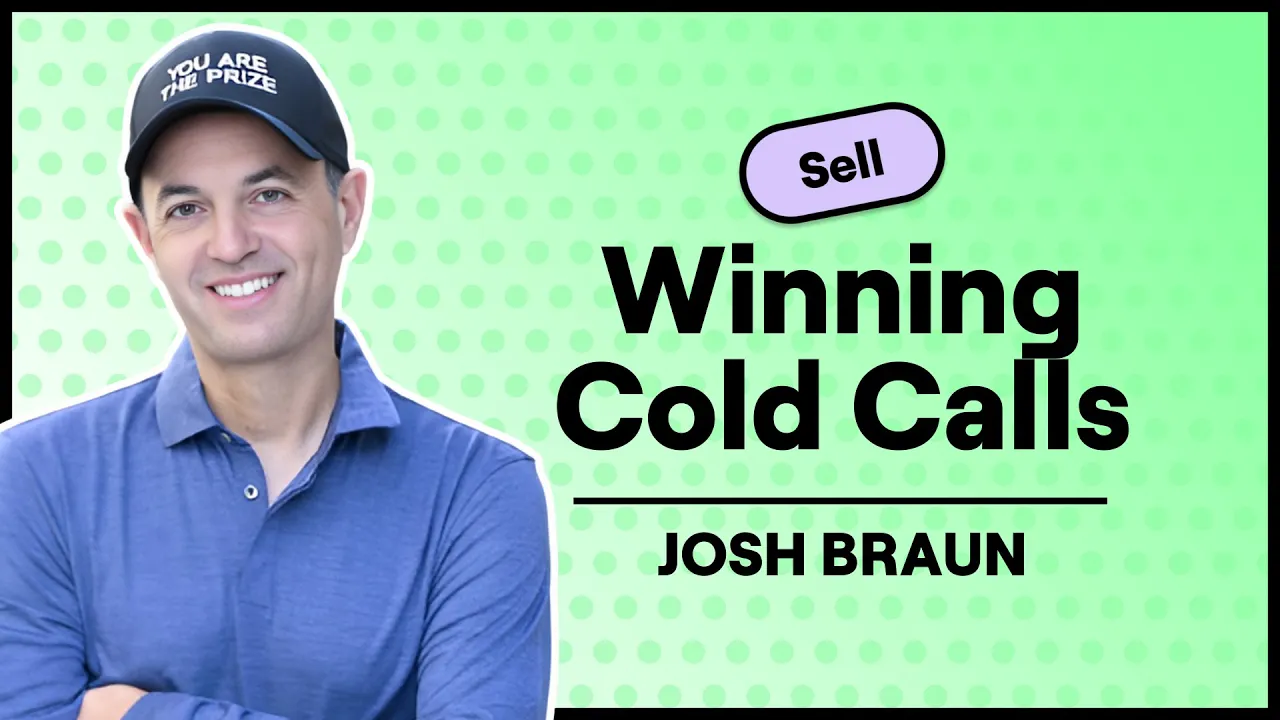
Good morning, everybody, and welcome to this episode of 30 Minutes to President's Club. My name is Armand Farouk, and I'm here with my co host, Nick Siegelski. And today, it is the King of Crispy.
Josh Braun, he's been on like seven episodes with us at this point and every time it is great. But this one might be the best Nick. Josh talks about how to win on a cold call.
And Armand, you and I literally wrote a book on cold calling and we still walked away from this being like, wow, we learned a ton from Josh. So if you are looking to improve the way you explain what you do on a pitch, if you're looking to help reduce the resistance, you get from prospects on a cold call. Josh has some must listen stuff.
And a three, two, one All right, Josh, welcome to the show. You might remember, we start every single episode with your top three actionable takeaways. So let's get your three.
Know how to explain what you do in a way that inspires people to care and motivates them to want to learn more using the before and after framework. It sounds like this. Example for Uber, you know how hard it is to get a cab during rush hour in Chicago with Uber, you press a button and in 15 minutes, a black Mercedes takes you to where you want to go without you having to take out your wallet.
Amazing. Take me to number two. Number two, detach from the outcome.
When you are attached to the sale, you sound like a mall kiosk person begging to rub sea scrub on someone's hand, which is why prospects ghost you. So if a prospect ghosts you, instead of trying to follow up and rub more sea scrub so that you can get what you want, lean back. Here's what that might sound like in an email.
Hey, Armand, looks like you decided not to move forward with the cold call workshop, which is not a problem at all. I know you have a lot of people competing for your time and attention. Here's my ask.
And I know it's a big ask. Would you be open to providing some feedback so I could serve you should I need a ride arise in the future? What's number three?
Number three, no matter what you sell, people are getting the job done without you. They may be comparing you to something else, and they may say to you, I saw what you sell, but for cheaper. I saw this couch, Josh, that you're selling, but I saw it for 20 percent less.
Your inclination might be to defend why your couch is more. Like a mother bear defends its cubs, but instead ask a question that creates a gap in their knowledge. Here's what that might sound like.
Armand. I know you're looking at another couch. Would it be okay if I ask you a question about it?
So I don't know if this is the case with the couch that you're looking at, but oftentimes manufacturers in order to cut costs will use different cushion densities ranging from 1. 2, which means the cushions last about 3 to 4 years before they start sagging to 2. 4.
With coils, which means they last about eight to 10 years. What is the cushion density of the couch you're looking at that's less expensive? Josh, let's talk about describing what you do.
And by the way, three of the best actual tactics I've heard in my life, the way you described the before state of the couch, or just what is important when evaluating a couch? It was so specific. 1.
2 to 2. 4, the coil density. Talk to me if I want to start by describing the before state, how do I describe the before state correctly?
Yeah, so if we're looking at the before state, we have to understand what the potential difference is between what you're selling versus someone else. I had a contractor come in to give me a bid. I was doing some home renovation, so I got three bids.
And one of the contractors who came highly recommended was about 18 percent higher than the other two bids. And I said to him, you're higher by 18%. What he didn't do is say you pay for what you get.
What he didn't do is tell me all of the projects that he finished. What he did do, he was very specific or crispy about asking questions to create a knowledge gap. So he said, can I ask you some questions about the other bids?
And I said, sure. Now listen to the first one, Josh, for the moisture barrier. On your floor.
Are they using red gate? I'm not sure for the doors that you're replacing in your house. Are they using hollow doors or solid doors?
I don't know. Last question, Josh, the copper pipes when you're renovating the bathroom, are they leveraging your existing copper pipes, which have been in your house for 16 years? Are they installing new copper pipes?
He's not convincing. He's creating a gap. That's very specific, which builds credibility.
And because I didn't know, and when I compared it, I realized that they were using shallow, hollow doors that weren't using a moisture barrier at all, and they were not putting in new copper pipes. So it became not apples to apples and I ended up selecting him because he really wasn't 18 percent more I just had a gap in my knowledge So you have to know the domain and you have to be very specific or crispy to make it more credible and believable So if I'm a salesperson listening to this and I'm not a general contractor What are some common areas that I might look to in thinking about what I sell? Versus either the competition or the status quo that I might commonly be able to lean on.
What are some areas that you coach people to look for here, Josh? If you're fortunate enough to have someone in your company. That is doing the job of your prospect.
Let's say you sell to chief revenue officers and you have a CRO. you can ask them to show you how they were getting the job done before they were using your solution. Assuming that they're using your solution.
The best way is to actually talk to customers. That bought within the last 30 to 45 days and have them do a show and tell with you, have them show you how they were getting the job done before they switched. you can also mine customer success stories, but only look for things in between quotes, meaning.
A customer said it, not marketing. I call these before story quotes. You can start a document called a lingo library, and you can paste in those phrases, and you can use those as your gap questions, or even in your cold calls or cold emails.
I have the saying that good copy and good messaging and good questions, they're not written, they're found. So Josh, if I wanted to weave these problems into a cold call opener, for example, if I've got ten of these quotes, How do I know which one to put in the opener? So we'll test some things out.
We'll do one right now. So you guys have a podcast and I'll show you how I would structure it in a cold call. We'll make it really actionable.
Here's my best cold calling tip that I can ever give anybody. So no matter what you sell, your prospects have a solution in place. When people say I have a vendor for that, or I have a solution for that, that's not an objection, that's the truth.
So what we want to do is we want to actually bring that up at the beginning of a cold call. So after your permission based opener, I might say to Armand, Hey Armand, when you are editing and producing your podcast, are you using tools like Riverside or Adobe Premiere? Yeah, we're using Riverside.
Okay, so stop for a second. How to role play. So I'm trying to figure out what the current state is.
It's almost impossible for Armond to say we have a vendor for that. Right? So from there, I might say something like this.
I have no idea if this is the case for you, but sometimes I hear when people are using, Riverside, they can spend a little bit of time editing the clips, the best of clips. They have to take them out, figure out what they are, edit them together. Is that something that you guys do manually right now?
Or is that more of an automated process? Or do you have other people doing that for you? it's definitely a manual process.
And now I'm going to presuppose that they've heard of my solution, which Arman probably has, we haven't role played this. Oh, you've probably looked into the script. Yeah.
Oh, it sounds like the value wasn't there for you. You guys aren't using it. It was one of those things where you basically still have to do all the QA behind it.
What do you mean the QA? All the QA behind the clips, because we have an editor who makes sure all the subtitles come out, right? They clip the unnecessary parts where a guest is rambling or something like that.
I find that that stuff doesn't work. Isn't usually handled by something like Descript. So Armand, that was absolutely the case with the 2.
0 release in the 3. 0 release. That's all been fixed.
if you'd like, I can send you a video of how that works and you could tell me if it's worth taking a look at, or if it's complete garbage, would that be okay? Josh, I want to go back to, Like, you basically said, I presume you've already looked into Descript. And Arman played the role of, he had, he looked at it, and you found out he had a misconception about it.
But I bet there's a lot of times prospects are like, no, I've never heard of you, you're some random 10 person company. What do you do in this scenario where the person's like, no, I actually have it? Let's use another example, for Captivate IQ.
Captivate IQ. Sure. This is a commission automation platform that people might not have ever heard of before.
So instead I'm going to go You have like a hundred reps when you guys are running commission payouts. Is it more of a spreadsheets or are you guys using like automation? We do a, we've got a lot of V lookups and macros and stuff, but it's through spreadsheets and then I'm going to say this.
Oh, you've probably looked into automating it. Yeah. All kinds of tools and different things that could get us out of the sheets, but none of them were fantastic.
Seems like your commission structure is too complicated to automate. that is what it seems, or the people that are able to automate things today, see what I'm doing. I am simply asking questions to pull out of Armand, his preconceived notions of the path he tried to go down.
Because if Armand's been doing commission payouts for 10 years, chances are he's thought about automating it and he's decided not to switch. So instead of telling people why they should switch, understand why they haven't switched. And look at all that glorious information I got out of Armand.
And it might be the case that it's not a fit. He's got some edge case that wouldn't work. Or it might be the case that there's a gap in his knowledge.
At which case I'm going to lean back and I'm going to say, Armand, you've been doing this for 15 years. this sounds like the kind of thing that we could address, but I have no idea you've been doing this more than I have. If you'd like, I can send you a video and you could tell me if it makes sense to continue the conversation or if it's complete garbage.
How does that sound? It's a very low friction ask. I'm not asking for a meeting and I'm enlisting his opinion because he is the expert.
I, as a salesperson have no idea about running commissions or doing compensations like Armand does. Who's been there for 15 or 20 years. Well, Josh, What's brilliant about what you're doing here is a lot of times when you're doing a quote unquote pitch in sales on a cold call, especially you're shooting in the dark, you're like, I got to take my best guess.
I've got a list of seven problems. I'm going to roll the dice, and hope that I landed on the right one. And if I didn't, oftentimes I've lost the call because my pitch didn't hit the mark.
And so what you've done is you've pulled their situation in one very small question. You said, are you using Riverside or using Adobe, whatever it was, or are you using this or this a really small question that includes the options to make it easy for them to answer and demonstrate that, you know, the space. And just by asking that 1 micro question.
You can have a 99 percent chance of being confident that you've nailed the right problem. Yeah, and if you haven't, that's okay too. This is where detachment comes in.
Like you just go and call the next person. Everything's going to be okay. I mean, to dovetail on that, one of the best cold calls I ever received Was from Kendra Warlaw over at gravy solutions at the time.
I don't think she's working now. She's not there anymore, but she called me. I was in a car with Jenna, my wife and my phone rings and I pick it up.
I go, Hey, this is Josh. She goes, Oh my gosh, Josh, I didn't even expect you to call him at the drive through at Starbucks. Do you got a second?
And I go, what are you getting? And she goes, Oh, a caramel macchiato. I go, okay, how can I help you?
She goes, Josh, I know you sell courses. How are you recovering failed credit card payments today? Are you doing that manually or do you outsource it?
And I go, I don't have that problem, Kendra. I use Stripe. And she said something brilliant.
She said this. Oh, it sounds like you're logging into Stripe. Running the failed credit card payment report.
And I said, what's that? I have no idea what that is. See?
Knowledge gap. And then she said I don't know if you have that issue either, Josh. If you'd like, I can send you a little doc via email.
Shows you how to check that report in Stripe. And if you have failed credit card payments, We can continue the conversation. How does that sound?
I go, sure. And she said to me, it turns out I didn't have that problem, but if I did, I would have engaged with her. See what we're doing here is we're not telling Your job is to draw it out because people are more persuaded by reasons they discover than reasons salespeople discover for them.
If I'm a salesperson listening to this I haven't thought about this approach before, Josh. Some of the areas where I'd be like, wait a minute, I don't buy this yet, would be as follows. if you go back to that commission example, you just cold called Armand, and you basically got him to admit and say out loud, our commission structure is too complex to automate, yet you're selling a solution that should help automate it.
Furthermore, why wouldn't you just be leading with saying something like, look, we've got the best commission structure out there. We work with over 300 companies and we help them automate their commission structures, no matter how complex they are. if I'm a salesperson listening to you, I'm thinking, why doesn't he just get to the point?
I'm curious how you'd respond to that person. So Nick, if I told you I was the best sales trainer, would you believe me? Let's assume you don't know me.
uh, I'd say that's a pretty big claim, Josh. Like how would you back that up? Well, of course I'm going to say I'm the best because I'm biased.
It doesn't matter what I say. It matters what you say. So I didn't tell him anything.
I asked the question. I took a guess as to why he wasn't automating it. So what I'm going to do is I'm going to presuppose he's looked into automation.
Our mind, you probably looked in automating it. Yeah, we did. It wasn't for us.
I'm going to now go through the six or seven reasons why people don't automate. I'm going to pick the first one. And I said, Oh, your commission structure is probably too complicated for automation.
Now he bid on that one. He's like, but if he didn't, he would have corrected me because people love correcting. Just ask my mother in law, she corrects me daily, So he goes, well, it's not that it was this.
Or if you said, it's not that, I might go to the second one. It's okay. If you presuppose or guess wrong, but you have to know the reasons why specifically people choose not to automate.
Assume that they've looked into it. They've been doing the job for 15 years. Arman's been doing podcasts for how long you guys been on the air now?
Five years, six years, four and a half years, four and a half years. I'm going to assume Arman has heard of Descript. In this case, and has chosen not to use it and there may be very valid reasons why or not.
I'm going to draw it out to see if there is a potential knowledge gap. Josh, could you walk us through I'm a beginner seller. And I want to come up with a basic one, two, three step framework to walk my prospect through this on a cold call.
what's sort of the order of operations of how I can build one of these statements on my own? Well, let's actually just do one. So we're going to open the call with Arman's opener.
That doesn't, whatever opener you choose is fine. So Arman's, I hope I don't butcher this, but, Hey, Arman, I'm working with several podcasters that do sales podcasts. My name is Josh with Descript.
Have you heard the name of our company tossed around at all? Well, yeah, I've heard your name tossed around. the second thing is I'm going to figure out what the current state is, meaning how's he currently getting the job done, I'm going to call out the job and the solution.
So Armand, when you guys are editing and promoting your podcast, are you using tools like Riverside, Adobe Premiere, or like Apple logic? So when you edit and promote, so that's the second question and you're giving multiple choice options. Yes.
I'm going to name. I'm going to name the tools. No, we're not using that.
We're using this. I'm going to give the specific tools, when you guys are running commission payouts, are you guys using spreadsheets Excel or is it more like of an automated process? Josh, when you're recovering failed credit card payments, are you doing that on your own?
Or is it done by like an outside organization when you guys are doing cold call training? Is that done primarily internally? Or do you sometimes bring in external vendors?
It's almost impossible for our mind to say we have a vendor for that. Cause I'm actually calling it out at the beginning. So yeah, we're using, we're using spreadsheets.
Oh, you've probably looked into automating it. You got, you've been doing this for 10 years. You probably looked into automating it.
That's the third thing, right? I'm going to shine a light and I'm going to presuppose they've actually considered it now. They may say, well, Josh, cut to the quick.
What do you do? And then we're going to answer that question, which we did at the top of the podcast, which is we're going to use the before and after framework. So example for nooks, right?
So you know how hard it is or frustrating it is for reps to make 50 calls. And if they're lucky, they have one or two conversations, even if you have direct dials and cell numbers. Josh.
People just don't pick up the phone. With Nooks, your reps make the same 50 dials, but instead of having one or two conversations. They have 12 to 15.
Generally speaking, Armand, does that sound interesting or not really? Now look what I did with my voice there. I'm pausing, I'm bringing it up, I'm bringing it down.
I'm not all monotone. I can't work on the tonality until I have the words. So you've got to have the words under your tongue.
And then you can say, so with Uber, you press a button and in 15 minutes, a Mercedes picks you up, takes you to where you want to go without you having to take out your wallet. Then you can just shut the front door. Well, how does that work?
If you'd like, I can show you later this week. Josh, the four steps that you just recapped. Opener.
Current state. Shine a light on what they've already done. Or the roadblocks they've already run into.
And then, what do you do? Which is before and after state. I want to come right back to what do you do.
Bring me back to step three, which is the step that I'm least familiar with. Yeah, let's walk you through a couple of examples. So, Armand, when you wash your car, do you use like 1 bucket or 2?
I'm a 2 bucket guy. 2 buckets. So, sometimes when people wash their car, even with 2 buckets.
What can happen is that dirt can settle to the bottom of the bucket and can get trapped in your sponge, which can scratch your car. if you don't mind me asking Arman, how are you making sure that doesn't happen today? So what I'm doing here is I'm illuminating a potential problem.
Well, I just like dip it in the water and I try to shake it out. Why? What are you, what are you suggesting?
Oh, you've probably heard of a grit guard. What's a, what's a grit guard? With a grit guard, you rub your sponge at the bottom of the bucket.
And the dirt settles to the bottom and off your sponge. So you never have the risk of scratching your car. Notice I'm not telling them exactly how it works.
Cause I want to live a little bit of a teaser to see if they're leaning forward. That sounds interesting. How does it work?
And then I might ask for the meeting. If you'd like, I could show you, cause I know I'm just barging in here. It allows the other person to protect their status by, you're like, oh I'm sure you're an expert, you've probably already looked at this.
And if they have, they'll tell you yes. Now that gives you an opportunity to investigate, okay like, what did you see, what did you hear, what did you find? If they say no because you protected their status, It opens up an opportunity for you to say, well, to your mind, if I share how we typically work with people who have really, really complex commission structures, It sounds like what you're doing, Josh.
You call out the job to be done, editing a podcast. You ask them how they're getting said job done today. And then it's on you as the salesperson to understand, okay, if they use Riverside, here's the common reasons why someone would not leave Riverside or not be able to get something done if they're on that.
So you need to understand the common problems associated with the different solutions that your prospects are having. But then you're calling that out in the form of a question. It's spot on.
Like, let's just use another example just to burn this in. Imagine you're selling an iPod when they first came out and you have a list of people that are runners, long distance runners. And they love to run with music.
before the iPod, what were people doing if they wanted to run with music, CD player? It's like a CD players, like going like a boombox boombox. There were also, do you guys know what the precursor to the iPod was?
I had a pair of like earmuffs that connected to the radio even. Do you guys know what the problem was? Or I should say the potential problem was with the MP3 players that were before the iPod?
Not enough storage. Yes. So that only matters if you're a long distance runner.
So those players only held 30 minutes of music. So when I would call as an iPod person, Hey, Josh, when you go running. Are you using like a diamond Rio or like a creative nomad?
Yeah, I'm using a diamond Rio. Amazing player. Popular.
as you know, they hold 30 minutes of music when you go on your two hour runs. Are you like listening to the same songs over and over again? Or you change them out when you get bored?
Oh, I just like barely change them out. Cause it's such a pain or, yeah, I listened to the same songs over again. What's my next question going to be?
If I sell an iPod, let's see if you guys have been paying attention to your own podcast. Found your favorite album. So you only have to listen through it once.
if I'm selling iPods, what am I going to say? You probably looked into it. Already looked into an iPod.
I did. I looked into it. And then what might you say?
Why might someone not want to buy an iPad back then? You don't want to buy an Apple all over again. That's great.
Or, or, uh, it's probably too expensive for you. No, actually I'm on windows and. That thing's only on a Mac.
That's a knowledge gap, right? So what we're doing is, anyone that's been running and especially back then, they know of an iPod. They, they chose not to buy one.
Is it because what Arman said, I don't want to have be locked into the, Apple ecosystem because that was, again, that's a knowledge gap. You're calling out the biggest. misconceptions that would prevent somebody from buying your solution.
and you're establishing You're almost inoculating against the objection because you're like this exists and then you created a gap to dispel it you're not jumping right to, Oh, the 3. 0 release now has this. You're like, Oh, you probably saw this issue.
And that creates space to, I'm not explaining unless someone asks me to explain, but also I want to be very clear here. This is not aimed at getting someone to buy your iPod, right? So Arman's excellent example was I never.
Want to be locked into the Apple ecosystem. I have records and I want to put my own MP3s on there. If that's the case, the iPod is not a fit.
That's okay. Go call people that aren't in that situation. It's not your job to convert meat eaters to being vegans.
If you sell a vegan product or vice versa. So this is not like a way to convince everyone to do what you want them to do. It's a mechanism to detach and get to some truth to see if there might be A problem rather than assuming that everyone needs an iPod, which is the mindset of most sellers Yeah, the one thing that I think you do that's really really smart You said hey, you're not explaining unless they ask you to explain But you're also not being a totally totally passive salesperson.
Who's like Only waiting for inbound leads or only waiting for the prospect to be like, so let's hear your pitch. Now you are actually prompting them to ask them what you do and you're prompting them to get your pitch by saying, I presume you've already looked at the script. That statement opens the door.
That's your way of saying, would you like to hear what we do? Would you like to hear our pitch? Buyers.
Have the answers. Sellers have the questions and most sellers think they have the answers. They come from a place of, I know what you need.
Let me give it to you. What I'm suggesting here is that the buyer or the prospect actually has the answers. If you know the questions to ask folks, just to bring this full circle, we went through a series of different examples today.
If you want to build your own cold calling flow, The steps that Josh took is he gave us an opener. In this case, he used the, heard the name tossed around opener. He's also used the permission based open in the past.
From there, he maps the current state. And he's like, are you doing this, this, or this? And the examples Josh gave are, are you a one bucket or a two bucket person?
Are you using Riverside or Adobe? That gets you a little bit closer because to have a specific problem, you need a specific situation. So you need to ask him.
And then from there, if you know the two or three situations your buyers can be in, You just need to remember one problem for each of those situations, and you can control at least most of the directions that a cold call will go in. And sure, you're going to still get some, some wild curve balls thrown your way, but if someone has these three situations, they probably have these three problems, and you can at least get yourself two minutes of semi controlled cold calling, at which point you'll have at least demonstrated some industry expertise. I love what you said about curve balls.
If I may add one thing, a baseball game without curve balls is not possible because curve balls are the nature of a baseball game. Just like when you make a cold call, you're going to get curve balls. You're going to get rude people.
It's okay. If you just accept that that's the reality of cold calling, it just turns the volume down. I mean, my mentor that I have told me something so profound.
She goes, Josh, your primary job is to just observe your thoughts. If you could just observe the call as prospects are talking and be aware of your thoughts, you're going to be much more present rather than thinking about what you want to say. Most of the time.
If you don't practice this skill of being observant of your thoughts, you are reacting and you feel the pressure of pitching and responding. This comes through mindfulness practice, but you can do it even if you don't meditate. While you're walking, while you're on a slack, while you're on a meeting, can you think of what you're thinking about?
How many times can you notice your own thinking in the course of a day? That is going to help you get these reps in. So when Armand says, whatever Armand says, I can lean back and be curious about what Armand is saying versus what I want to say.
But you can't get there if you're always in reactionary mode. Armand's talking, what am I going to say next? That's how most people are wired because they're not paying attention to their thoughts.
That's another muscle that you can work out and get stronger. Just like you work out your biceps in the gym. Amazing.
Josh, thank you for joining us. We're running out of time. And so the last question is what's one bad habit that you see a lot of salespeople exhibiting that you think they need to break because it's hurting them more than it actually helps moving in harmony with the nature of sales.
So if you go to a public pool and you expect it to be quiet, you're going to be disappointed because if you go to a public pool, there's kids running around unsupervised all the time. Likewise in sales, if you go into expel sales, expecting things to happen the way you want them to happen, focusing on things you don't control, you are going to be disappointed. You will never be thrown off balance.
If you simply realize that the nature of sales is sometimes people will buy. Sometimes they won't. Sometimes your quota will go up.
Sometimes your territory will be shrunk. Sometimes prospects will be rude. That is just the reality of what it is that we do.
And by just observing that, you just have a calm, tranquil mind, and it lasts longer of you being happier in the profession. If you don't have that, and you're trying to control everything, you're gonna be anxious and worried, and you're gonna be comparing yourself to other people. So just accept the nature of whatever reality that you're in, The nature of things, it's not here for you to judge it or to change it, but to just embrace it.
Josh, thank you for joining us. Everybody stick around for a 60 second recap coming up soon. All right, Nick, time for a two by two recap from this episode with Josh Braun.
What do you have for your two? Presuppose that the prospect has already looked into your solution. You might say something like, my guess is you've already looked into the script.
If they say yes, awesome. You can ask them, what'd you hear? If they say no, that creates an opportunity for you to tell them what you do and give your pitch.
Number two, when you're explaining what you do. You also have to explain the before state Before they use the product and explain the problems with the current state. That way, when you explain what you do, the contrast is far more evident in terms of how you help the prospect number three, before you explain what you do, you need a specific situation to get a specific problem.
And so ask them. Nick, are you a one bucket or a two bucket guy when you're washing your car or are you using Riverside or Adobe when you're editing your podcast? once you get that specific situation, all you have to do is memorize one painful problem story for each of those situations.
So get the words down for how you describe the problem and then get the tone down. Okay. Alrighty, Nick, how can people help us out here?
So on pretty much every cold call you are ever going to make, even if you follow this framework, you're going to get hit with objections. And we partnered with Josh Braun to give away a number of his tongue tied objection flash cards for free. And there's a link in the show note to go check that out.
this will really help you when you are overcoming or responding to reactions, objections, dismissals from your prospects on cold calls. Thanks for listening. We'll see you next week on the show.