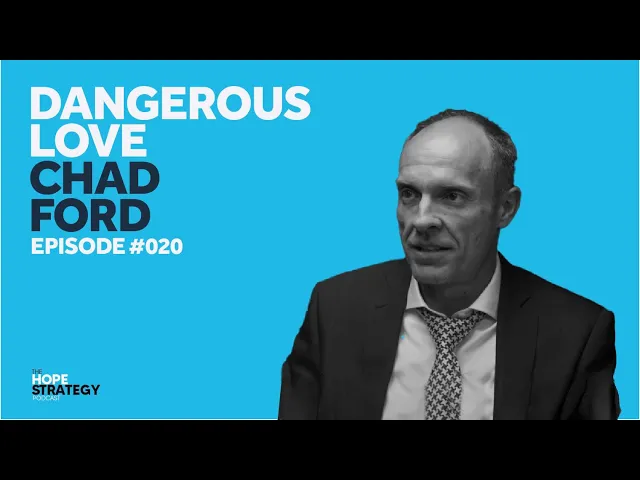
[Music] why is it called dangerous love because that requires vulnerability it requires us to do something that's scary it requires us to do something that we're not sure whether it's going to be reciprocated back from the other person or not but it is the thing that is going to change the dynamic in the relationship in a way It offers hope [Music] welcome to a new episode of the hope strategy podcast i'm here with josh as always and we just had a great conversation with chad ford what'd you think josh you know i like all of
our guests but that might be my favorite one yet because i felt like there was so much depth and useful stuff i wish we had 10 more hours to talk I know we really may have he might be one of our first return guests i might have to win my job to him in a few months to recap all of this chad ford has been living five lives simultaneously for nearly 20 years he's been an international conflict mediator a college professor a senior consultant and facilitator for the arbinger institute An executive board member for peace
players a writer analyst and entrepreneur covering the nba and nba draft for espn while most people know him for his work at espn being a basketball analyst and writer was actually his side gig from the last two decades chad's piece-building work is what defines him after completing a master's degree in conflict analysis and resolution from george mason university And a juris doctorate from georgetown university law school in 2000 chad was poised to begin his career as a conflict mediator and facilitator however and we didn't even talk about this which i want to get to but
chad sold a small internet startup sportstalk.com that he co-founded while in graduate school to espn right after he graduated and spent the next four years working full time with espn as a senior editor and writer covering The nba and nba draft the experience covering nba games was a lifelong dream but chad yearned to do something more impactful with his conflict resolution skills in 2005 he left his full-time work with espn to become the director of the david o mckay center for intercultural understanding at byu hawaii that bio there's one of the cooler ones right that
we've had i i remember learning about chad and Initially through byu hawaii because if you've listened to the podcast you know that i have connections there in fact i studied what he taught at byu hawaii and then i heard that he was an espn analyst and i'm like what are you talking about and it's like no he he writes for espn he's like the guy for the nba draft anyways fascinating background fascinating story and i think we covered a lot of bases with That but there's still so much more like i said to get to
again it's november 11th it's veterans day that was incredibly timely you'll hear about that right off the right out the gate in the podcast but then also he has been in the middle east he's been in south africa he's been in northern ireland he's traveled the world as a mediator and a peace builder working with Governments and individuals both on a small and a very very large important scale to help navigate tense situations to find peace that's his whole that's his whole thing right and again with the in the u.s here many people that listen
aren't in the us but here in the us with the election that just happened and the bitter divides that we're seeing not just between People from different political ends of the spectrum but really probably way more importantly and critically family members friends you know these divides that are happening and so to talk to him and ask him very specifically how we can put things into practice based off of all of the knowledge that he has you know any tips or guidance that he has in order to navigate the world we live in right now Effectively
listen to this podcast and take notes and implement what he's what he talked about and then go and read his book dangerous love the website is dangerouslovebook.com but yeah like i said i don't think there's ever been a more timely conversation that we've had and and i'm with you that was that was fantastic it was a great one hope you all enjoy it yeah we'll leave it at that Listen and enjoy this conversation with chad ford something is happening in our world time is very precious i'm gonna show you how great i am hope in
the face of difficulty more than machinery we need humanity hope in the face of uncertainty i'm better now than i was i'm experienced now changing the world can happen anywhere And anyone can do an audacity of hope this is the hope strategy podcast with corey blake and josh steinle i feel like your life's work to this point which i mean your bio is accurate where it says you've been living five different lives simultaneously for the last 20 years it's shocking to me like when i when i read about everything that you've accomplished there's a lot
that we can dive into i think the first thing we always like to Understand in order to understand where people are now is is where they're coming from and get a little context so would you mind tell us you grew up in kansas city right that's right yeah so what was life like for you growing up what was your childhood like yeah you know my childhood was was really challenging for a couple of reasons my father was Drafted into the vietnam war when i was young and and when he came back he started experiencing a
lot of neurological symptoms uh some that were really consistent with ptsd so you know i would wake up in the night and my dad would be hiding behind the couch with his m16 thinking the viet cong were in the living room and some of it began to Affect his speech and his balance and what have you when i was about you know seven or eight he was diagnosed with a generation of your cerebellum in the back of your brain which affects your your fine motor coordination balance you know speech and what have you it's extremely
rare disease there's no cure treatment for it you know my father At that point had a bit of a freak out i guess is probably the best way i was pretty young so you know i don't remember all of it but he left just in the middle of the night and i didn't see him again for for years and you know left my family in a really really difficult position we weren't particularly wealthy to begin with my mom just with a high school education it you Know things got really rough you know for a really
long time you know in addition to that and i think this is not a negative this was a positive i grew up in a in a part of kansas that was was multi-racial and at the time there was a lot of racial tensions in the community but i got exposed at it at a young age to that but also to making a lot of multi-racial friends And and connections there and you know between all of that by the time i rolled into college and decided that that's what i wanted to do at first i wouldn't
want to be a filmmaker and that didn't end up you know panning out because i i became really interested just in in conflict in in social movements i bounced around a little bit into what the What the studies so i started in history and then political science and and then hawaiian history is i i went on to byu hawaii and you know through all of this i just noticed that i kept gravitating to like why are we divided what are the causes of that what are the causes of war sort of historically you know i
think a lot of it was deeply generated by you know my own life experience sort of growing up And i was a student at byu hawaii which has a very unique university uh with you know students from you know over 100 countries you know 3 000 students and and i noticed that there was also there was tension there but there was also a lot of harmony there and you know when you started understand the founding of the school and that the the intention was to bring all these People together to try to find a way
to sort of live together and work together it just really rests upon me probably like my senior year of college this is what i want to do like i want to figure out how to help you know people come together i didn't know how to do that i talked to a lot of people i said i was going to go to law school and you know that's a lot of jokes probably there because you know why You know lawyers cause problems they don't solve problems but it was a it was a huge part of the
journey for me because when i got there i started to learn about mediation and alternative dispute resolution and diplomacy and you know all of these different things and you know from there you know i really started to focus my career so one of the questions i was going to ask you well the second question that i had Jotted down where were there any specific motivations or reasons from your childhood why you decided to study conflict resolution i had no idea i just thought well this is an interesting thing to go all in on the way
that you have a lot of people study something because it's convenient or because they don't know what else to study but when you get a bachelor's in history and then you go on to get a master's in Conflict resolution and then you go on to get a law degree and then you bring that all together to do what you've done i had a feeling there might be something more there so and i guess it's timely it's veterans day today so yeah you know the interesting thing corey is that a lot of that was subconscious like
a lot of that i i'm unpacking in like graduate school like why am i here Like i it wasn't conscious you know at the time it took it took quite a while for me to sort of realize what that was about and why i was making the decisions that i had and so you know i wish i could say oh it was all very clearly laid out you know i vowed as a high school senior that this was what i was going to do i i it took a long time to get the motivations clear
that's how it goes though i mean i think for everybody you get you know Later in life and you start to look back and say oh my goodness i had no idea the way that these dots were connecting but now that i like you said unpacking a lot of this it's starting to really come together and make sense when your dad left and you said that you didn't see him for up many years down the road i mean did you eventually have a moment where you guys came back together and i mean i did Um
my dad did eventually return and the disease continued to take his toll by the time i was in you know high school he was in a wheelchair and and wasn't really able to walk my parents divorced as part of it so he was living with his mother my grandmother for a while but you know the relationship really you know reconnected and you know i was really close with my father And you know obviously felt for him yeah and the life experience that he was going through especially tough to have a disease where most doctors have
never even seen it before in their life you know there's so few people that have it that there's not any real research or progress being made or hope down the road and because it's a neurological disease too you don't really know what part of your Life is going to get taken next as your cerebellum degenerates different functions that the cerebellum controls you just lose kind of almost like randomly overnight you know he would lose something he passed away in 2005. the last you know probably 10 years of life especially the quality of life for him
it was really really poor and um and i talked about this a little bit in my book but My dad and i had one huge conflict left for us right you know right towards the end and it probably taught me more about conflict resolution than anything i'd studied and any mediation that i'd ever done in the middle east or anywhere else you know this one that i had with my father you and we're going to talk a lot about this all of the different areas of expertise and experiences that You've had as you've you know
built this career and really made a huge difference in a lot of different ways in conflict resolution specifically but it's interesting the role that empathy can play in in conflict resolution specifically right and understanding somebody and truly you know we talk a lot about seeking first to understand and then to Be understood right one of the seven habits like that idea of like if you can really truly understand somebody not just on the surface but really try to dive deep and get two or three or four layers deep with somebody and understand and have empathy
for the trials that they're facing the difficulties in front of them their past experiences whatever it gives you a completely different perspective And allows you to help in ways that maybe you wouldn't have otherwise so as you've gone to the middle east i think over 50 times right and you've worked specifically with some very significant world conflicts and as a mediator and as a consultant and things and i don't want to keep hitting on this too hard but having grown up with a father who Was a veteran a vietnam veteran who was the rest of
his life was plagued by war by the fact that he went to vietnam and fought and it affected him so severely i mean again and a lot of this is probably hindsight right as you've unpacked it but what type of empathy has that given for you and motivation to in whatever small way you can Impact others to overcome conflict in a better way you know i don't think that part hit me until i had my first child and i started to think about you know how my father was there and then wasn't there and a
lot of it wasn't his fault and how i wanted to be there and what i wanted for my children and you know part of it was that uh you know i wanted a world where they were never Called into that that sort of service that they never had to do that i have deep deep respect though i am someone who promotes and believes in non-violence and someone who actively tries to pursue conflict resolution in a non-violent way i have a deep respect for what our military does and the veterans there my my father ended up
in a veteran hospital for the last You know 10 years or so of his life and you know going to visit him but also all the veterans that were there and seeing the very real costs of war we glorify it in a way that is obscene to me because the people that typically glorified or the people that haven't experienced it or haven't experienced the ramifications of it that's a trend that i see you know all the time and Having worked not only you know in the us but with a lot of in war-torn communities that
to see the impact that it has on women and children the impact that it has on the economies of people the impact that it has on health and mental health and it's devastating they're not winners in war yeah and and by the way you know the wars that are happening on large scale are happening in small Scales in our homes and in our communities all the time and while they might not leave the physical damage that you know large-scale war does that the mental emotional damage that they leave is is just as devastating you know
for people and so you know part of what came out of all of this for me was that if there's anything that i could do To help alleviate that if there was anything i could do to provide an alternative way right to deal with our problems that's that's what i wanted to be dedicated to and doing and you know your your podcast is about hope and when i wrote dangerous love a big part of that was that my experience as a mediator in all sorts of conflicts whether it's family conflict or out in the world
Is that people lack hope that there's any other way right that conflict just has to be destructive that's what's going to happen and so we run from it or we you know put on our armor and we you know we go to war to try to get what we want and there's there's other alternatives to conflict that aren't avoiding it but aren't wreaking destruction uh in in families and communities that Can actually lead us to a better place i'm no longer afraid of conflict i actually think conflict can actually be constructive i actually think it
can actually improve our relationships and improve our our communities and workplaces if we have the tools and know how to engage in it and so you know part of what i feel like my job is is to give people hope that you can do this That there are ways forward and there's this writer i like his name is john paul lederock and he's a longtime conflict mediator and he talks about the moral imagination and he says you know look violence is a failure of the moral imagination it's when i'm in a conflict i can't figure
out how to solve it i can't think of any other way and so i'm just going to force the person Right whatever that takes run them over knock them out beat them up you know use my power for them to get what i want and how do you ignite that moral imagination to think about alternative ways uh both getting what we need at the same time caring for the people that we're in this life with and so you know you talk about that seek first uh i understand before you understood you Know that's at the
heart of this book the arbinger institute and and the influence that they they've had on me as well is that you know we are able to work through conflict constructively when we see people as people and we're not when we see people as objects yeah that's that's awesome i um again i didn't anticipate having this but i guess since it is veterans day we'll say Shout out to all the veterans anybody that is listening my dad i texted him first thing this morning my dad served 22 years in the air force i grew up a
military kid and i was just talking to him just going back to the impacts that some of that has i was talking to him a few weeks ago i was at his house visiting him and he never was in like an active war right he served in somalia and kosovo And egypt and he was on deployments of these different places but he was a computer guy so he wasn't out on the front lines fighting or anything but i was talking to him and in the small town that he lives in lives the guy that was
the doctor for seal team six and he said that he went up and spoke with him and this guy was explaining to him that he couldn't even leave the house he because he was Just so fearful like he he just couldn't do anything without being taken back and my dad he started crying as he was speaking with me and he said i have a hard time doing anything either and this is my dad who just saw things but never was on the front lines actively you know doing the terrible things that you have to do
in war right the impacts that they have and i'm with you man the way that it's glorified and The way that it's it's portrayed is so damaging anyway so we don't need to go down that rabbit hole for too long but just a shout out to all the veterans out there the arbinger institute we're going to jump way ahead real quick because i i'm in the process of reading the anatomy of peace so i've watched a bunch of stuff about i'm in the process of reading it right now i watched an interview that you did
with The arbinger institute and you were talking about how i think it's when you were in school or maybe you were in the middle of some mediation somewhere i can't remember but you read the anatomy of peace and you said that it completely changed your perspective and you had some and it really changed the way that you saw conflict resolution even though you at that point were an expert right we're always trying to become more and more Expert at whatever it is that we're doing what impact did that have on you specifically and why did
you decide to get involved with the arbinger institute for for so long yeah i had i was my very first year uh teaching at the university and i had a student who was an older student who had encountered arbinger's work and an organization called anasazi which Is uh out in the arizona desert it's actually sort of what the book anatomy of peace is based off of drug rehab other issues for young people and they go out and they they essentially walk in the desert have to figure out how to find food and and you know
all of these different things and as part of that the parents that are having their kids there go through a workshop and one of the Takeaways is it's not just that my kid is messed up it's all these sort of interactions and an anatomy piece really sort of mirrors that as a story and it mirrors the sort of parents going in the room and learning something about this and and so she had that experience as a parent and so she's seen in my peace building classes and she's like hey these are really good and i
really appreciate All that you know you're teaching me but i think you're missing like this huge point out of all of this and you know i'll be honest i was like offended i was like okay you're in my 101 class i've been i've been studying this for all time and you're really just going to come in here and tell me and she handed me a pre-publication version of anatomy a piece it wasn't actually out yet Um but she'd gotten it from someone at arbinger and she said i just really think you need to read this
book it's gonna change your life and and i said thank you very much and it set on my you know desk for a while and and then i was gonna go do a mediation in the middle east that was you know quite a tense and uh and scary one and um and she came back in And she again this time with like tears in her eyes like you have got to read this book it's going to save your life i couldn't get her stop crying so i'm like okay i'll read it already i'll put up
my bag i promise i'll read it and then i i don't like i put it in my bag you know it's a really long flight from hawaii to um to israel and i didn't read it but i had an experience In the mediation that blew my mind and and i didn't understand it a negotiation that was going terribly turned on a dime and all of a sudden it went super successful and as i went home and i'm like laying in the bed like i'm i'm one i'm feeling really good that the negotiation the mediation turned
out to be a success but i also couldn't quite connect the dots in my head about why and it was really bothering me and So much more humbled chad on the fly at home picks up anatomy a piece and about halfway through the book like i have like one of those like life-changing she was alright like light bulbs go on in my head and and here's what it was as a mediator i always saw myself as the solution to the problem never the problem the people that have the conflict they're the problem Right and so
i walked into this session seeing this person that i was negotiating with as the problem then and i had lots of justification for why they were and i'm here to fix the problem and what occurred to me as i was reading the book is what changed in that negotiation was there was a moment when it clicked to me that i wasn't seeing him as a person and when i saw him as a person Everything about our interactions started to change in really powerful ways and and so my takeaway on the flight home was the person
in the room that needed to change was me and when i changed everything else in the room changed and it just had not occurred to me before i mean i'm a piece builder i'm a conflict mediator i'm a really good guy like i'm not the guy who starts Conflicts i'm the guy who goes and solves them and it opened up this entire world for me corey i mean you know i started to look at not just my work but my relationships at home and in my life and i'm like you know what if i approached
it from this standpoint right instead of just blaming other people and saying that i'm having these Conflicts with others because of them what if i looked at the ways that i'm seeing them and the ways that i might be contributing to conflict and that's that's what the arbinger work is so helpful to me it's overcoming this problem of self-deception and overcoming this this issue around the fact that when i see someone as an object i see them falsely and because i see them falsely i no longer can see My role in the conflict anymore and
so i'm actually like pouring gasoline on a fire but i think i'm pouring water right like i tell myself i'm pouring water to put this fire out but i'm actually pouring gasoline on it and then when the flames get higher and higher and higher i'm blaming them for the flames getting higher but i'm the one pouring the gasoline on right and having that shift of mindset for me You know not only did it change a lot of personal relationships which probably was the most important thing that happened but it started to change the way that
i started thinking about the work that i was doing as a mediator both in how i interacted with the people that i was trying to help but also how i helped them change the way they saw each other as a way of Of transforming the conflict i want to get into the weeds on that just a little bit and again we'll talk a higher level here in a second as well but okay so you're in this and big shout out i miss i miss the roosters in the background of all of my zoo meetings when
i lived in hawaii i don't get the roosters anymore i love i love hearing the roosters so you're in this moment and you have This this paradigm shift in that moment right of saying oh my gosh i need to look at this person as a person right now i'm seeing them as a all of the things i studied in my textbooks and all the things i've listened to and researched and whatever all the notes i've taken i'm looking at them as how do i solve this puzzle versus how do i help this person what are
some of those tidbits And again you can learn all about this in the in the book i'm in dangerous love i'm sure you go into a lot more detail on all of this stuff so go listen to that or read that what are some of those specific tools that you use again in a business partnership between me and josh right or in a personal relationship between spouses or partners or whatever it might be what are some of those tools that you Employ before you even walk into the room or sit down on the meeting or
whatever in order to get to that place where you're able to see people as individuals as human beings with goals and ambitions and things and trying to solve those problems as a as a you know team i guess i think part of it is that we have to turn off our fear brain and um you know i talk a lot about this in in the book but What i've seen as a mediator and it's so helpful because it illuminates my own life by the way you know helping other people often is an illumination on your
own life right and when you see other people going through it sometimes it's easier to kind of see it you know even in yourself most of us grow up with a one a just generalized fear of conflict and so if you think about a particular Definition of conflict this is one i use in the book i'm not saying it's the only one but i think it's helpful as our inability to collaboratively problem solve right and whether you're working with a family or an organization or whatever when we have a problem and we can't figure out
how to solve it together conflict erupts right and and for many of us just that just that evokes a pretty Strong fear response within us and when that that response is evoked some predictable things start happening to human beings right and is that just societal is that just cultural like some of it's genetic um you know to be honest i mean if you start to think about sort of developmental psychology the survival mechanism right yeah it's the fight or flight Instinct that that human beings have but you know in in a modern society it's not
that i'm being chased by a lion right that that doesn't we don't really have that experience very often but all sorts of emotional distress or psychological distress can provoke a very similar response and so what do we do when we have that response and you know There's really interesting brain scans to actually sort of show what happens to the human brain at that moment right it's like we get blinders on and and we start to calculate our options can i run away right can i run away from this right that's that's the flight i'm sort
of instinct and it's the most common instinct for most people if i can just avoid this conflict or get away from it that's what i'm gonna do if i can outrun The lion i'm gonna outrun the lion right if i can't now i have to stand my ground pick up a weapon and i gotta fight right it's come to eat me so i gotta fight right and that that's the other way to survive or you know for some of us some threats i call this accommodation we lie down and play dead right we just sort
of give in we're quickly submissive and hope that because we're submissive The person will be happy the conflict will subside and you know it'll go away and and and because of that we do all we do basically everything wrong right when conflict should be about in that moment asking questions be becoming curious about the other person trying to understand the role that i play versus they play rolling up our Sleeves and saying i need to know what you need here's what i need and we're going to work together to find a solution that works for
both of us we're doing all that other stuff all of it which is completely unhelpful right so if we run away then the conflict doesn't disappear right we just get it out of our mindset and it keeps keeps kind of erupting it keeps kind of coming back to us then we Get frustrated and we get fatigued if we sort of fight and we lose then you know that's that has all sorts of negative consequences if we win we might feel good in the moment yeah but the other person doesn't right or the other group doesn't
and the seeds of the next conflict are already sown and now i'm in this sort of constant battle that's going forward and If i accommodate if i just lay down and play dead now that's the strategy i'm probably going to have to employ over and over and over again and eventually i'm gonna get exhausted and i'm gonna get frustrated and and i'm going to start to feel a lot of resentment and i'm just gonna explode and so all of the instincts that we feel as people when conflict comes are Counterproductive right they're actually asking us
to do things that are either going to prolong the conflict or make it worse or make it spread and then when that happens we become hopeless because we feel like man there's nothing i can do about this i mean i can't tell you how often when the people come in and talk to me what they're saying is i've tried to tried everything nothing works this is Impossible [Music] the problem is i've tried all the things that don't work and then they didn't work and i don't understand what doesn't work and so i know that sounds
like a funny first step but it is the first step to sort of recognize that the things that i'm doing aren't actually helpful right running is not going to solve your conflict fighting is not going to solve your Conflict laying down and and giving in is not going to solve your conflict and i have to let go of those tools to be able to actually sit down calm down and this is the other thing it's hard for me to see you as a person if i'm feeling huge threats from you in the moment if i'm
feeling like you're going to hurt me it's really hard for me to do that and i have to open up space that just because we're in conflict with each Other doesn't make you a bad guy doesn't mean that you're trying to hurt me doesn't mean that you're trying to ruin my life and now i've got to get deeply curious and that's the the other big step can i get curious about the other person and what their needs wants and desires are what it is that they're looking for in this conflict instead of the hyper focus
on myself because i know What i want to need but now can i put that aside i'm not getting rid of it but i'll kind of set it aside for a minute and get deeply focused on another person so is it fair to say that the number one cause for not resolving conflict an ongoing conflict is it ego if you're unable to put yourself aside and look at the other person and truly understand i mean that's probably it's probably way bigger Than that but is that a is that a fair assessment and ego and fear
are combined because i always say fear but ego's connected to that because one of my biggest fears is that i'm wrong right and the need to be right is such a huge need in conflict that i will bend myself into pretzels to be right and and it's and so the fear is that i was wrong I was wrong about this person the thing that i did or said was wrong and and i don't want to be wrong when i tell people that they always come back with this but what if i'm right because i really
think i'm right right which is which of course in conflict we are going to feel like we're right and you know my response to that is you Know there's a way to be right on the facts but to be deeply wrong in the relationship and which is more important to you one thing that i've seen and again this is mainly in probably managing people like on our team right as we've built a business and we've again i studied international culture studies like it's kind of like what you said unpacking later like i just so happened
to run an international Business with a team in hong kong that we've built in these different places and i love it i mean it all came together nicely because people are like wait why are you an entrepreneur and you started this business but you studied ics you know whatever but one thing that i've seen in managing teams and people and building building a company is that a lot of times the assumption With ego going back to this ego the assumption with ego is that ego means that you're cocky that you're arrogant and which which see
if let's see if i can say this right so that when the only time ego is the problem is when somebody's coming in arrogantly or cocky or smug or whatever but the fact is is a lot of times people's ego gets in the way even when they're being submissive or fearful or something The opposite of those things just because they're not able to put their self to the side and look at this we're focusing on the greater good not me versus you i don't know if i'm explaining this right but a lot of times it's
just assumed that ego this the connotation is like arrogant cocky bold whatever but a lot of times ego can get in the way when you're the other person as well and you're unable to just put your Personality or your personal desires to the side in order to communicate for the greater good does that make sense yeah it's it's like ego is all about self-preservation it will look different in different people but what it will have at its core is self-preservation right great collaboration and great conflict transformation is all about us preservation and that distinction is
a really important one Because in conflict i have to not let go of my own needs because they're important but i have to balance them out i have to equate them with the needs of others and and so what happens mostly in conflict is is people err on one side or the other it's either all about me and i could care less about how this impacts anybody else or i'm one of those people that i care deeply about how it impacts Everybody else but i don't understand what i need or want out of the relationship
and so i i'm essentially the martyr in the organization or in the relationship that always lays down the sacrifice for everybody else and that's not us preservation either that's them preservation it's that type of preservation that that you would think or it's easy to assume is not based in ego Because it's like well no i'm doing this for everybody else i'm it's like no but you're the problem is you're not able to recognize that because of ego right and it's it's this too what's behind that when i'm doing it for everybody else and i'm not
able to bring my own needs into it what's in it it's the need to be loved right because i i'm operating under an Assumption that people will love me if i give them everything that they want and that my needs are dangerous to the relationship now right and so but what i really want out of that it's still egocentric is i want people to love i want people to acknowledge that i'm the person that always sacrifices first i want people to point out how great i am and how easy i am to work With and
how i always put other people first and and that still is about me you mentioned needing to have a deep curiosity chat about the other person that you're talking to when you're in a conflict which to me this reminds me of what i read about in leadership and self-deception about being in the box and out of the box And i have a question about that but before we talk about that for people who may have not read the book and aren't familiar with that terminology can you explain briefly what in the box versus out of
the box means yeah so in the book leadership and self-deception and in arbitrary second book anatomy of peace they essentially equate being in the box or out of the box with seeing someone as A person or seeing someone as an object when i see someone as a person i'm out of the box when i see someone as an object i'm in and there's different ways that you can see someone as an object it can be like a vehicle to me in other words i'm actually outwardly nice to them because they're useful to me but the
minute that they're not useful to me i could care less about you anymore or they're an obstacle they're In my way in some way or they're irrelevant they neither help me nor hurt me so therefore they're irrelevant to my life and it's a metaphor you know i've heard different people from arbinger explain it different ways but to me the way i've always liked to think about it is like if i were to literally sort of think about being in a like a refrigerator box because i'm a Pretty tall guy right like if i'm in that
box i can't actually see the humanity of other people i really can only see myself inside that box but i'm also i feel trapped and i feel like i can't really move and it's it's actually something that's actually quite stifling and when we're in the box that's a very sort of common emotion that we feel and you know part of it is The sense that conflict is something that happens to me not something that i participate in right and so when i'm in the box it's because of your thoughts your actions what you did what
you said and how it's impacting me and i can't see it any further than that i can't see how i'm impacting other people or i don't take any responsibility for my emotions any responsibility for how i React or my actions or behavior anymore it's all externally dependent on someone else and so when i'm in the box i what i'm going to do is i'm going to blame i'm going to horriblize uh you know other people if that's a word i'm going to focus on how i'm right and you're wrong i'm going to always be taking
values and my val you know i'm a value driven person And you don't you lack those values i'm going to be creating the story this narrative that makes me out to be great and the other people to be the problem and therefore i don't have to deal with the problem because the problem isn't me and when i work with a lot of organizations you know this is the most common way how do you know organization is in the box the organization's dysfunctional they're Losing money there's major problems and when you go interview people office to
office everybody locates the problem outside their office every single person says yep there's a huge problem this organization just doesn't happen to be here we're killing it we're crushing it uh right you know my team or my group is but over there that group there and of course then you get done And everyone's pointed the finger at each other that's like typical like in the box so in the box is bad out of the box is good and the problem is it's when there's a moment of conflict that's when you need to be out of
the box the most so that you can see people as people rather than objects but of course when you're in a state of conflict you're in the box because you're Emotional most likely end yeah how do you move from being in the box to out of the box because i read the book and i've been trying to figure this out for 20 years and i still i get in that emotional state whether it's with my wife or somebody i'm arguing with on social media and in that moment there's even that tickle in the back of
my mind that says you're in the box you Need to get out of the box bad things happen when you're in the box and i can't do it and then an hour later a day later i'm like why did i say that stupid stuff like i know i'm not supposed to do this it's like where's that tool that allows me to move from that emotional state of seeing people as objects and stop it and say wait a second In the box and then move how do you do that one you already talked about maybe the
most important step i have to recognize i'm there in the first place right if i don't recognize that i'm there i'm not going to make a move out right and so understanding and i think this is where arbinger's language is especially helpful and they're books helping you understand that you're in the box right I mean it's not necessarily a great feeling when you get done reading leadership and self-deception or anatomy a piece it's sort of like i'm an idiot is is kind of you know the big takeaway um you know from the book but that's
actually really important in a certain way because it's alerting us it's like a smoke alarm that's going off in our brain that's saying there's a fire here That you have been not alive to for a really long time and it's here and unless i'm alive to it i can't put out the fire because i don't know where the fire i think the fire exists elsewhere instead of me and so that's the first step actually you know then after that what i really need to do is i need to start thinking about okay one of the
things i know that i do In the box is i create justifications for why i'm right and they're wrong and i start telling that story to myself and so i have to start asking myself what parts of this story might i be wrong about what sorts of things might i not understand in what ways am i not being curious we talked about this about the other person and what's going on in their life that might explain their behavior or their actions In a way that i haven't seen before in what ways might i be contributing
verbally non-verbally whatever to their reaction to things and i have to start asking myself a bunch of questions that i don't typically ask myself in the box that i don't typically ask myself in conflict right and uh so much about it is about what's my impact on them and what's going on in their internal world In ways that i might not understand and what's so interesting about when we're in conflict is that we become mind readers it's amazing right we know somebody said something i know what they meant i know what their intention was i
know why they said i know everything right even though they didn't say any of that and i asked this all the times immediately so they actually said that to you well no they didn't say it i mean You know of course they wouldn't say it but i know trust me you know i know and and i think it's having that humility to say do i do i know is that the truth really about them also am i giving myself a pass here are there things that i'm doing or saying or contributing as well that might
be part of that and so you know one of the the The tools i guess that i use is the minute that i feel that justifying voice in my head that says oh you know what that was about or did you see that the them rolled their eyes right there did you see the way that they were looking at you or did you see how long it took them to return that email that text or whatever did you see that they didn't ccu on that Or you know whatever it is that instead of just filling
in the blanks and saying i know what's going on there um i instead say i don't know i don't know what's going on there and i should probably find out but if i'm afraid of conflict i'm never going to do it right i'm never it's so much easier just to jump to that assumptive world and get there but if i'm not afraid of Conflict most the time i'm going to find out and this is the thing that i think is tough for people it's complicated this is what i'm going to find out they may be
in the box with me right but that's not a reason for me to get back in the box within or it may be something completely innocent there's something totally else going on in their their world and that's what's going on Either way and you know this is something the book the most important thing the most important move that i'm going to make is that i've got to be the one to turn first if they're in the box with me if they're seeing me as an object and i'm seeing them as an object i can't wait
around for them to start seeing me as a person i'll wait forever and you hear this all the time in conflict well i'll change When they change i'll do it when they do this thing first i'll trust them when they prove to me that they're trustworthy and you know my response is they're thinking and saying the same thing and then those people say well that's not fair because they started it or it was their first or they did the worst saying or you know you'll hear all this okay that might be true but what do
you Want do you want to be right or do you want to have peace and if you want to be right i can sit around blaming people for the rest of my life and know that i'm right and know that they started it or know that whatever they did was first or that they should have been the one that turned first or they should have gotten out of the box with me or i can just get out of the box i could ask those questions i can turn towards Them and try to create the space
for them to come and that's the most dangerous move right why is it called dangerous love because that requires vulnerability it requires us to do something that's scary it requires us to do something that we're not sure whether it's going to be reciprocated back from the other person or not but it is the thing that is going to change the dynamic in the relationship In a way that offers hope as you were talking the thought that came to me is vulnerability right the the reason that that's so scary and i love the name dangerous love
of the book because the connotation with dangerous is maybe harmful or it can cause harm to somebody or you know like the danger of jumping off of something you know whatever but i i what i like and correct Me if i'm wrong you kind of just said it so i don't think i am but but the idea with this this notion of dangerous love learning being able to see somebody as the individual and and trying to understand their goals and ambitions and getting to a place where you can solve problems together requires you to say
i don't know and that's requires a level of Vulnerability that most people just aren't comfortable with because you want to know especially if it's in a professional setting if it's in a relationship where you've invested so much time energy resources whatever it's really scary and dangerous to say i don't know and to put yourself in that place of vulnerability but until you get to that place where You can accept that and be vulnerable conflict will not be resolved problems will not be solved and there's going to be there's going to be continued issues right and
this is why i like talking to entrepreneurs because i think there's an easy connection here right not everybody has the stomach to be an entrepreneur why because you're starting your own thing and there's a there's a the safety net Isn't there in ways that it is in traditional jobs and while the potential for success is very high there's also the potential for failures is also very high right there's lots of startups and lots of organizations and and even some of the most successful entrepreneurs in the world can can talk about their failed business ventures right
and things that that didn't work Out or products that didn't work out or what have you and and what makes a great entrepreneur in my my opinion is that they're willing to take a risk they're not afraid to fail and if they do fail they don't give up they go back and learn from their mistakes and and they try again and lots of people don't have the stomach for that in business right and so they're never Going to be entrepreneurs because you know the risks involved in being an entrepreneur they're just really really hard to
stomach i think the same thing holds true in conflict in human relationships right to have deep meaningful connected relationships require us to be vulnerable require us to take risks require us to often fail at times in our relationships and make mistakes and Instead of you know beating ourselves up and just giving up picking ourselves back up and trying again it means that often things are going to be lean for a while that i'm not going to get instantaneous rewards or returns on my investment you know also having grown up and starting my own company that
you know that i sold the espn those first couple of years Were pretty tough they were really lean and you know there was so many days that i was asking myself you know is this going to pay off in the end because it's not paying off in the short term and then it did you know it ultimately did pay off for us but when we apply that to relationships we're so quick to give up and and throw our arms in the air another in instead of staying In it and being intentional and saying you know
we okay we you know josh and i we just spent five hours trying to solve this problem and we didn't solve it so for screw it i'm just gonna go do my own thing or you know this is unsolvable and walk away but to get up the next morning and say we're back in the meeting room again josh and we're gonna roll up our sleeves and and we're gonna do this again and we're Gonna keep doing it until we get it right and one of the interesting things is when i make that commitment it actually
speeds up the process but when i don't make that sort of commitment it actually slows it down because at any moment i'm sort of hedging my bet and one one foot's in and one foot's out and i'm always thinking about alternative options Instead of just sticking in it and and so there's a real parallel to me to what makes a successful entrepreneur and what makes a successful collaborator or someone in conflict and it's that same sort of tolerance that we have for risk and so how do we get rid of it again we have to
let go of our fear and we have to trust the process eventually people are going to turn eventually there are solutions to the problems that We have and when we get there they're going to be so powerful for us and so sustainable that will wonder why would i have ever gone about it any other way trusting that process and having that patience is is tough right especially when there's when the heat is on and when there is emotions involved shifting gears a little bit not really but just making it more relevant to today Right now
what's happening in the world today right i watched your tedx talk and i think correct me if i'm wrong but i think the staff that you used at that time which i believe they did that because i almost did that in la yeah it was it february or or early this year right yeah it was in february yeah okay one of the statistics that you shared at that point this is february the the world is Not the same place that it was in february in so many ways i mean who would have thought right but
one of the things that you said as you were as it pertained to politics was that one in six individuals claimed that a relationship had been altered or messed up or shut down or whatever as a result of political beliefs that number i'm willing to guess has Doubled tripled quadrupled maybe at this point one of the things that i'm seeing and where i want all of this information and all of your knowledge to really bless the lives of people that listen to this podcast right now i hope and let's get this message out to the
best that we can leveraging your expertise in this moment because one of the biggest things that i'm seeing on social media now is you know you can delete me Or unfriend me if you don't want to talk or if you don't believe what i believe or whatever or posts that are just saying basically saying my way or the highway if you believe in this guy or this person or this girl or whatever you're a terrible person you don't belong here i don't want anything to do with you i'll destroy years of friendship or familial ties
because of this Right that is the world that we live in right now on november 11th 2020 when there's a political election that just took place talk about conflict right so how do we solve this problem how do people seek to find solutions without burning bridges and destroying relationships all for something that at the end of the day they have very little control over and it's just not worth it Objectively right you can say that what is your take on this yeah you know i just did a follow-up i just wrote on the dangerous love
i have a website they just love book.com and i just wrote a um article about how to talk to family about politics and i wrote it in part because of i'll just share a story because i think this is right that this was you know one of the conflicts that Came to me was there was a father in a family and he decided he was going to kind of write his life history this was just recently and as part of his life history he decided he was going to delve into all of his religious socio-political
beliefs as well at the end as sort of a a thing that he was going to send all of his kids deeply deeply conservative man and and Sort of laid it all out when some of his kids who were much more liberal or progressive got it they they flipped out like why is dad writing this like why couldn't he just stay to his history he's brainwashed all he does is watch fox news all day you know it was just going off and and the response was one of his daughters calls him and begins just laying
into him You're sexist you're racist you know you know all of these different things and it creates this actual schism in the family right and and both sides feeling deeply hurt by what had happened and both sides feeling deeply right and i'm willing to bet that 95 percent of anybody that's listening to this right now has either experienced this personally Or seen it in their own family or in the family of somebody they know this exact scenario in some way right whether it's a hateful message or whatever so anyways it's so relevant keep going and
and you know and the dad was like what what happened i'm just telling my story i'm just talking about my beliefs and by the way i raised my children Under these beliefs like i'm so shocked and surprised like what happened to my children my children have been brainwashed you know and then you talk to some of the children and they're like what happened to my dad you know my dad was this great this isn't how he raised us this isn't how he was you know and now you know all of these different things and And
then feeling like i have to sit and this is the other interesting thing i have to stand up for what i believe i have to i have to say this i have to share my social religious moral beliefs with my children it's my my duty as my father to share it with him i have to stand up to dad and teach him what i've learned about anti-racism right and what i've what i've read recently in the newest book i have to Share that with dad because dad just doesn't get it and doesn't understand and he
doesn't know he's a racist and he needs to know he's a racist and needs to serve knowledge and there's something moral a moral imperative within me to do it right you know as a mediator you know i step back and look at this stuff and say look this Isn't that different than any other sort of conflict that sort of sits out there right now right both sides believe that they're right both sides believe that the other person needs to change both sides believe that by telling the other person they need to change and how bad
they are that it they're somehow going to shame them or convince them into changing and when that doesn't work i'm going to blame the other person for being so Stubborn and stuck in or stuck in their ways or brainwashed or whatever it is that they don't change and i can sort of walk away claiming victory and and so look that's not that different of a pattern to be honest right it's just that the stakes are really hot i think for so many people right now the stakes feel really really high right now what concerns me
deeply as a mediator for a minute Is that i've seen this this dance um before i've worked in northern ireland i've worked in south africa i've worked in the middle east i've seen where this dance leads it leads to a not good place and when we as neighbors as family members can no longer see the humanity of each other anymore when we get to the point that our political beliefs Become more important than our relationships we are on a path you know not to be an alarmist but ultimately ends in in civil war that ends
in in death that ends in violence for people and and while people say oh it can't happen here i think all the the signs that it that it very well could Are are there um we may not want to see it and we want to avoid it um but it's there and so how do we stop us from becoming the next northern ireland right or you know the next you know south africa and the answer to me always goes back to let's think about what's really going on here in this conflict i just want to
use this example for a minute and and i understand that maybe this That not every example is the same one as this but you know if i were to be able to pull the daughter aside for a minute and and ask her you know what do you think your father's intentions were when he said that to you you know really what do you think oh well dad's racist sexist he thinks i'm a bad person or whatever okay that's the assumption from in the box right that jaw says right out of the box Why my dad
do that why might you share beliefs that are important to you because i care about other people because they're important to me because they've been motivators in my life they've been helpful to me in certain ways and because i care about you i'm sharing these these beliefs with you right you know one of the things i can say is when someone is sharing their belief with me They're sharing something that's important to them they're sharing something that's been helpful or useful in their life part of part of showing respect and seeing someone as a person
is that i take the time to listen there's nothing dangerous about listening i don't have to agree with that belief i don't have to act on that belief I don't have to tell the other person you're right but there's nothing dangerous in listening right and and trying to understand and ask a lot of why questions um with the people that are asking that to understand why did you come to that belief what were the the things that happened i this this dad by the way grew up not in the united states grew up In europe
and grew up during world war ii and because of some of his experiences as a young person in world war ii his world view got created a particular way he fled the united states you know as a refugee and had all of these sort of life experiences that were coming on and as we got deeper into the mediation With this family the answer with the kids was well i guess i kind of knew that but i didn't actually know all those stories about dad i don't i didn't see the connection before about why dad might
be there let me tell you another one on the other side that was so fascinating to me one of the kids said why is dad keep sending me news articles and forwarding me news articles and and you Know telling me all this stuff i just want dad to spend time with me this was an adult child by the way think about that for a minute right these political figures often are just exposing other fissures in the relationship what was going on with some of those kids i've lost my dad my dad doesn't spend time with
my dad doesn't call and ask how i'm doing my dad doesn't show up and see the grandkids and take us out The ice cream anymore every time that dad gets on the phone dad is telling me what he heard on fox news right now right and you know to ask the dad what do you hear when she says i wish dad would spend time with me well i thought she hated me i thought she just was you know you're saying all this stuff maybe she's saying dad Talk about me talk about my life right connect
with me at that level instead of just telling me what you saw on on news or what you saw on twitter or what have you when we get in these polarized situations that becomes so big in our life that we actually forget the humanity of the people right in front of us so when we see them the first thing i want to know is Whether you've voted for biden or trump i don't want to know what's going on with your health or what's going on with your job right now or what's going on with your
kids or whatever that that rises to a level that i think most of us could actually if we took a step back stays probably not the most important thing in our life right now and so i'm no longer connecting to people at the most human level Um anymore i'm connecting at this level and then and then the question that begs me that that i think is is begged out of this is why why is that happening and if we don't understand the social media forces that are there if you haven't watched netflix special the social
dilemma you know i highly recommend it that there are people that are selling Conflict that there are people that are actually deliberately trying to create division what have you and that and that through my engagement in social media and a lot of other things i am unwittingly becoming part of that as well that i need to get control back and get back to my values and get back to this idea again that i can be right i think this is the right political policy the right tax Policy the right immigration policy you know the right
supreme court justice whatever and be deeply wrong about my relationship with someone and at the end of the day being right on the facts or on politics will never ever make up for being deeply wrong in the relationship that's so helpful and and i hope we can glean from that some specific steps to take right when You're when you're sitting on facebook and you see something or you get that message from your parent or from the friend or spouse or whatever right because these divisions are just unnecessary and i think we talked to a social
media marketing expert a couple weeks ago and we talked about the social dilemma a little bit and the impact one of the things is that's so interesting for people that they just Don't understand because they don't understand the business side of what the internet's doing in digital marketing and all of these this digital advertising and stuff is that my facebook feed if i click go through facebook i may as well be on a completely different website than my dad right who's older and likes different things and follows Different things and engages with different posts his
feed is a different website than mine and i think it's easy to say no i'm on facebook you're on facebook we're seeing the same thing and this lack of understanding and so when you watch that social dilemma right you start to see that there's not only it's not like this is a subtle effort it is very complicated and very intentional and very specific In the way that people are being targeted in the content that they're seeing in the divisions that occur as a result and it's easy to then draw conclusions from that right if you're
a 70 year old who's on facebook scrolling through you think oh yeah everybody's seeing this and and then you bring it to the world and people are like whoa whoa whoa i don't i don't see that i don't understand that it's different And it just causes it just it's just a breeding ground for more and more conflict and it's tricky i hope and that's a very tough one when somebody gets misinformation yeah right and again how do i how do i respond to that and and the one way i can tell you that it isn't
helpful that the person is saying you're being brainwashed or the information that you have is wrong It doesn't it doesn't work that way if i were to tell you that to corey you'd say i'm educated enough to know that i think my sources are right but if i were to talk to your dad he would probably feel the same way whether that's true or not true and so you know part of conflict is understanding that people's reality whether it's empirically right or wrong is the reality it is their truth I'm in the moment and that
when i treat people with respect of what the truth that they hold is their truth and how do i help them see the humanity of other people that's a different endeavor than telling them that they're wrong and i i think that a lot of the work in dangerous love is about how to go about creating space for us to see each other's humanity again And and seeing this very unhelpful way that we go about it which is telling people you don't see my humanity and therefore you're an awful human being right is is not the
way it is is just not the way forward and it was so interesting um the father wrote in that that thing that he sent his kids you know he wrote a disclaimer he said something like i just want to say that you know i recognize that these are My beliefs and not yours and whatever but again this is about me he said and i'm like you know he he got so much of that right and he got one word wrong and i think it's the word that gets all this wrong this is not about me
this is about us and this country is not about me it's about us and this community is not about me it's about us and this family is not about me It's about it's about us and we thrive as a community as a country as a family when we recognize that there's differences when we see that there's there's needs that might not all be the same and we roll up our sleeves together to try to find solutions to those problems and we die as a family and as a community as in a country when we say
my needs are the only needs that matter My needs are the only ones that are important your needs are wrong or not what they should be and so i'm only going to pursue strategies that meet my needs and you know cry yourself a river if that's not the way it is i have the power i have the majority i have the ability to get this done our country actually was founded in our constitution under this idea of Compromise and under this idea of that there's going to be multiple factions and we're going to try to
work together and we we seem to have lost that in our political polarization anymore and we seem to feel like you know if biden wins we're going to go do all of this stuff and we're gonna make america great again but there's 50 percent of the country that absolutely doesn't want to see america Go that direction or if trump wins he's going to make america great again he's going to do all the sudden there's 50 percent of the country is going to feel left out yeah and this polarization is going to go on and on
and who has the courage to say i don't really like your ideas very much but i recognize that you're part of my community or part of my family And that i need to understand where those ideas come from and i need to understand is there a way that we can find common ground together to find solutions that are both going to work for me because i feel like me and my community matter as well and that are going to work for you and i think this is eminently doable it's absolutely possible to govern this way
to live this way in Our country in our communities and our families but we have got to drop this this idea that this is all about me because it it just can't be to have healthy relationships relationships can't be one-sided and a country is a relationship and a community is a relationship and a family is a relationship it can't just be one-sided when talking about all of this Right and and a lot of these issues and a lot of these concerns which again you talk about throwing putting gas on the fire like social media and
the internet is what has really done that because we say like well we've been in this place before you know we've always had political unrest we've always had disagreements but when you throw in technology and the rapid rate the technology is cutting down time and Space in the way that we get information and how we engage with it it's tricky and i and i do agree and i want to and i and i do have hope that that we're going to figure this out because we figured out a lot of things where do you see
the hope in all of this and maybe how does you know dangerous love and kind of all of the work that you've done to put that together tie in here you know i start the book in Chapter one with this one woman mariam who and i deliberately start this way her first quote in the book is but what if he's an evil man it starts there because that's that's the pushback right well you don't know democrats the way i do or you don't know republicans the way i do or you don't know my father-in-law the
way that i do or you don't know my boss the way that i do and maybe this works for lots of People but it won't work for them and it won't work in this specific context and and my experience is that people are almost always wrong right that it will work if i if i put in the work to do the work it will work but one of the most self-defeating prophecies that i can possibly have is it won't work so i won't even try i know turning first they'll never turn back i know if
i see them as a person They'll always continue to see me as an object so why even try to see them as a person because i know it's going to fail and so i don't try in the first place and i sit and just keep pointing the finger at everybody else and so when i've i've watched thousands of people turn and when they've turned doesn't work every time i'm i'm sorry to say the answer is no It doesn't work every time but when people don't turn it never works and so you know if you're if
i could tell your odds are going to go from a zero percent chance that it works says 70 chance that it works are you really going to tell me well you just told me there's a 30 chance that it won't work so i'm not going to try it and i'm just going to go with the zero Right like we understand logically that doesn't make any sense but that's often the sort of narrative that is there and so as you give people tools and hope that they can turn the the answer is that it works and
so why do i have hope you know for for america you know look there's times that i worry that that maybe we're too far and that maybe you know we've gotten there and so I think i think the hope has to start individually and so you know my message to every listener every reader the book is quit worrying for a minute about what your neighbor's doing or what your local political leader is doing what are we doing what are what are we doing today right and if we could just do that we start creating really
Incredible space right for this to open up and i'm gonna also just add like it's really hard i've been attacked by family members by friends by former students by faculty members everything else where they say this about me chad get off the fence right you seem to be like trying to bring people together it's time to take a side right and we know that you have values We know that you have voice just take a side and and you know the pressure is really strong i used to respect you so much chad but you know
because you're not out there making the making the stand that i'm making right now i just don't know that i can respect you anymore and you're talking to me about working with the other side working with the Enemy working with this you know evil group or evil people right now what what's happened to you and you know my response to that is what's happened to me is i i've seen [Music] what happens in communities and countries where there aren't people that are trying to bring people together when there aren't people that are trying to advocate
not for a particular fact or principle But for the larger principle of that we're in this together that this is about us and how do we you know how do we work together and if i can share what like one story i don't think i've actually ever you know shared this on a podcast or in a book before that maybe can help i've worked in the middle east for a really long time and i've seen a lot of bad things and I've become really close with a lot of palestinians and a lot of israelis and
i've seen some really really horrific and horrible things that at times have made me want to jump onto a side that have infuriated me at times and and frustrated me because it's happening to people that i actually care about and one day as we were in the west bank and we were leaving the west bank to go back into Jerusalem and i was with one of my palestinian partners in this we were stopped at a checkpoint and despite the fact that this man is a peaceful man who was working on conflict resolution and everything else
that the soldiers of the israeli soldiers at the checkpoint asked him to get out of the car and as they were asking him to get out of the car Things were getting tense and it looked like i'm sitting in the thing and they're not messing with me because i'm an american i could care less right um it looks like they're going to take him away and i sort of recognize at that point if they take him away i'm sorry the news is bad we might not actually see this guy again we don't know what what
is going to happen to this guy and so i do something Crazy i get out of the car and i grab him i start trying to pull him to the car guns are drawn people are like pointing at me like everything's tense in the moment i'm putting my arms around and i'm like no no you don't understand this is a good guy this is a good guy you can't take him and there's a standoff for just you know what seemed like probably four hours to me it was probably you Know 30 seconds to a minute
before everybody's like okay you know you can go and as we're driving home and my heart's beating on my chest and i'm sure his is as well his reaction catches me by surprise he looks at me and he says i don't get you and i in the in the and the voice is one of anger at me and i'm i'm like shocked i'm like i Thought he was going to like say oh you know thank you for doing that he was angry at me and and i i'm really confused and he's like i don't get
you i'm like what do you get he's like you have seen this happen to us over and over and over again which is true when are you going to take an effing side he said you know we have this Relationship you know what could have happened to me there when are you going to join this cause right to liberate to liberate palestine and and you know and i could tell that he was disgusted with me because he knew that's probably wasn't going to happen and as i sat there every everything in my body wanted to
jump onto his side and say i see it this relationship's really important to me if That's how you really feel about me you know i'm going to do more or whatever and i had to tamp all of that down right all of those emotions down for a little bit and i took a deep breath we were silent in the car for about 15 minutes before he said look can i just i just got to be honest with you i can't do that because i love you he's like what are you talking about if you love
me no no no like here's the Thing there's plenty of people that are on your side and there's plenty of people that are on their side who are the people in the middle right now trying to help you see each other's side so that we can come up with a solution that actually is going to lead to the peace that i know that you want and that your family wants i'm in every ass because it's because i love you That i'm not going to take a side but but don't don't misunderstand that because i'm not
taking your side doesn't mean that i'm not taking a side the side that i'm taking is for peace the side that i'm taking is for seeing each other as people the side that i'm taking is for collaborative problem solving i'm actually deeply entrenched in values and these Values they're just not the ones that i think that you want to hear right now in this moment and that's cool you have every right to not want to hear it but for a long-term solution to the problem that you just saw today those are going to be the
things that are ultimately going to have to happen we have to change the way that we see each other We're going to have to practice inside outside transformation we're going to have to take responsibility for the things that we're doing and contributing to the conflict and turn first and we're gonna have to roll up our sleeves and find solutions the problems that work for both of us which requires me engaging the other side and seeing their humanity and listening and being cured that's that's the way that gets you to Where you really want to go
and because i love you i want to help you get there and and so you know for anybody that's you know feeling that pressure right now of you know i need to take a side because it's the right thing to do in a conflict think deeper about what values are really your values right and and what what really is there and is there a way that what i'm doing is i'm taking all The sides and i'm trying to find a way to help us live together and see each other and connect with each other in
ways that we're struggling to right now the world needs more peace builders the world needs more peacemakers um in our families and our communities in the world and you know my book was just a way to try to help give us a path to get there both in our personal relationships and our communities and and i believe we're Imminently capable of doing it there's so many great amazing people in this country and um in our communities in the world and we just have to take a different side well chad we we appreciate the time i
know we went over and i appreciate being willing to to do so i feel like we might be reaching out again to talk to you again because i we didn't even we didn't even scratch the surface man There's a lot more i really wanted to talk about sportstalk.com that started in 1996 sold to espn in 2001 i'm fascinated by that i remember hearing about you and learning about you and then hearing that you were and i recognized your name and i'm like wait that sounds familiar and then i looked i'm like oh yeah this is
like the nba draft bracketology guy on the eddy spn yeah I've read his stuff before so a whole whole other conversation we'll have to have some time but the website is dangerouslovebook.com the book is dangerous love i think again we've scratched the surface but i look forward to to diving in uh to that and continuing to learn more and chad we really appreciate the time man this has been an absolute pleasure for us yeah thanks for having Me on corey and josh okay we'll talk to you soon thank you so much man see you thanks
guys all right bye hello it's cory here and i just want to thank you so much for listening into the hope strategy podcast i hope you're enjoying it as much as we are enjoying having these amazing conversations with these incredible individuals talking about hope we'd love it if you Wouldn't mind liking subscribing and leaving us a review on itunes or spotify or anywhere that you listen to your podcasts and share it with anybody you feel that can benefit from these messages of hope thank you so much for listening to the hope strategy podcast