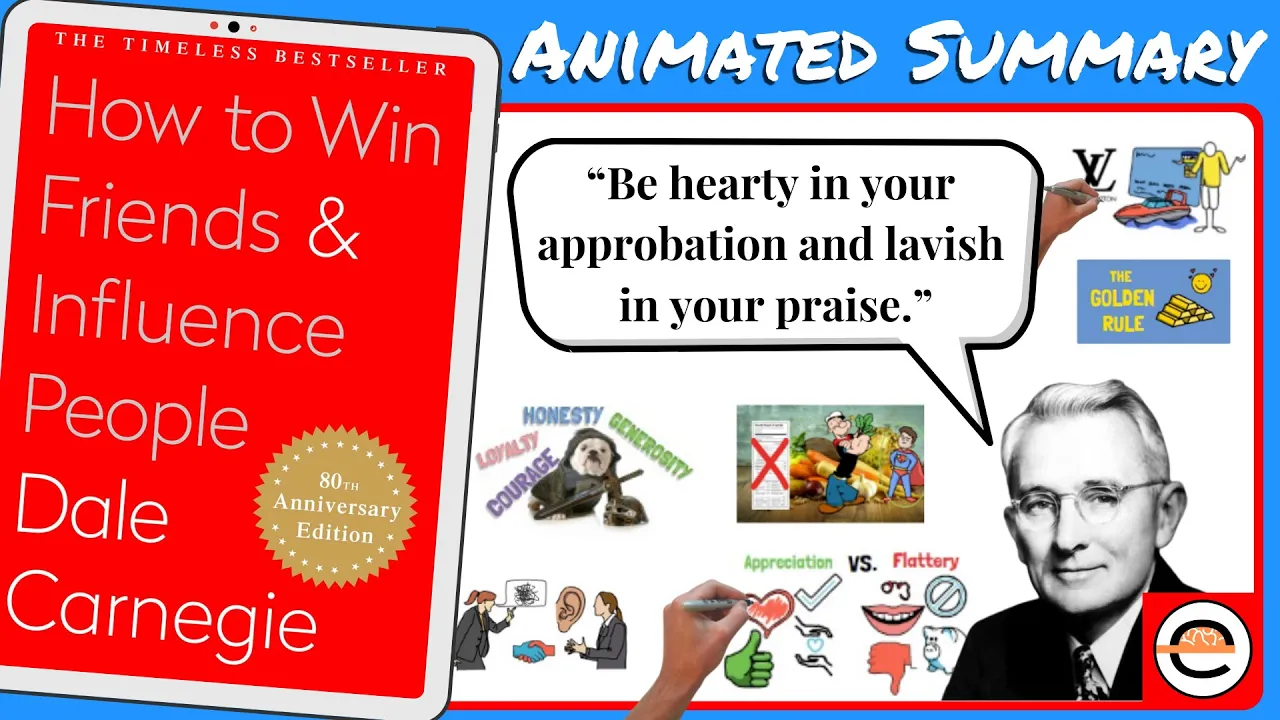
welcome to a full animated summary of how to win friends and influence people by dale carnegie let's get right into it part one fundamental techniques in handling people principle one never criticize or condemn criticism is ineffective when you criticize someone it doesn't remedy the situation you condemned because people don't improve in response to criticism instead criticism makes people defensive and it causes them to justify their actions or make excuses criticism is hurtful it wounds a person deeply because it damages their sense of importance and self-worth when you criticize someone it causes severe and lasting emotional
pain criticism destroys relationships criticism creates resentment it prevents friendships and it inhibits connection when you indulge in criticism you stir up bitterness and contempt in the person you criticize you create an enemy for life remember when you're dealing with people you're not dealing with logical creatures like robots or vulcans to the contrary you're dealing with emotional creatures motivated by pride ego and vanity and thus interacting with people is not about iq or traditional intelligence instead a master persuader must develop his or her eq or emotional intelligence emotional intelligence is all about perceiving emotions managing emotions
understanding emotions and using emotions to achieve a desired outcome so how should we deal with the urge to be critical the trick is to find constructive ways to blow off steam without injuring a person's ego for example abraham lincoln would write a critical letter and pour out all of his feelings of disappointment and discontent then instead of mailing the letter he'd bury it in his desk never to be read by another person effective leaders avoid condemnation at all costs any fool can criticize someone and most fools do but it takes character and self-control to be
understanding empathetic and forgiving so instead of criticizing people study them try to understand where they are coming from and why they do the things they do in so doing you will cultivate sympathy tolerance and kindness all qualities the greatest leaders possess as the saying goes you will catch a lot more flies with honey than with vinegar this leads us to the next principle for handling people principle 2 give appreciation and praise every person wants to feel appreciated and important sigmund freud called this the desire to be great it's a powerful craving inside of everyone you
encounter and the rare individual who satisfies this desire and others will hold them in the palm of his hand the desire for a feeling of importance motivates people to achieve greatness for example it inspired steve jobs to want to bring personal computers into everybody's home it inspired jeff bezos to quit his lucrative career on wall street and build the everything store from scratch it inspired elon musk to advance electric transportation space exploration and solar technology the desire to feel important also drove arnold schwarzenegger to become mr universe seven times to become a superstar actor and
then to become the governor of california although the desire to be important and to feel important can be a powerful force for good that very same desire can also motivate people to make bad decisions for example it can drive people to spend money they don't have to buy things they don't need all to impress people they don't even like it can also drive people to commit crimes for example it drove bernie madoff to carry out one of the biggest ponzi schemes in modern history and he ultimately made off with billions of dollars the need to
feel important will even drive people to fake illness or disability to get sympathy and attention [Music] so think about it if people are willing to go to such incredible lengths to acquire a feeling of importance what miracles could we achieve by simply showing people a little honest appreciation charles schwab the 19th century steel tycoon and one of the most successful persuaders of all time said be hearty in your approbation and lavish in your praise this was his secret to making the big bucks his people skills landed him a million dollars a year when fifty dollars
a week was a lot of money now before we finish up this principle remember that flattery is not honest appreciation flattery and appreciation are very different appreciation is real flattery is fake appreciation comes from the heart flattery comes from the mouth appreciation is unselfish flattery is selfish appreciation is universally admired flattery is universally despised overall flattery is like counterfeit money if you pass it around to enough people eventually you're going to get into trouble however if you remember to honestly encourage and compliment people every chance you get and if you truly make them feel appreciated
the success you desire will take care of itself this brings us to the final principle for handling people principle 3 arouse a want in others picture this imagine we're fishing together what bait should we use to entice the fish to bite the hook now i love chocolate chip cookies and i bet you do too but fish well fish like worms so if we're trying to catch fish we should bait the hook with what the fish wants not what we want [Music] this very same principle applies to people people are interested in what they want not
what you want so the best way to influence people is to frame things in terms of what they desire in other words make people want to do what you want them to do persuade them to volunteer let's talk about some hypotheticals to demonstrate this principle how about this how might you persuade a little child to eat vegetables you could present the child with the nutrition facts and explain the antioxidant properties of vegetables or you could explain to the child that vegetables will make him big and strong and powerful which approach do you think would work
better well we all remember popeye the sailor man the cartoon hero that achieved incredible strength and defeated his enemies simply by eating his spinach researchers showed that children who watched popeye ate on average twice as many vegetables as kids who didn't and they did so because the cartoon tapped into their desire to be big and strong here's another example say you want to convince a teenager not to smoke cigarettes teenagers smoke for various reasons some think it's cool to smoke it's counter cultural it's an act of defiance and others well they think it's sexy or
glamorous to smoke so if you want to persuade a teenager not to smoke you might explain that it causes bad breath or low stamina these side effects are not cool and they're not sexy in fact bad breath and low stamina are both pretty lame so the next time you'd like to persuade somebody to do something or not to do something remember the fish and the worm figure out what the other person wants and then appeal to that desire if you can learn to focus on what other people want you're sure to get everything that you
want it's only a matter of time zig zigler the famous author salesman and motivational speaker captured this principle in one of my favorite quotes of all time he said it like this you can have everything you want in life if you just help enough other people get what they want part 2 six ways to make people like you principle one become genuinely interested in other people to learn this principle you don't have to look any further than man's best friend that's right dogs dogs give you consistent love and approval they offer you their full attention
and unrestrained affection and they only ask for your love in return as a result dogs are loved above all creatures on this planet and they never have a shortage of friends humans however tend to focus on themselves for example the new york telephone company conducted a study of conversations and found that the most commonly used word in the english language is the personal pronoun i also think about this when you look at a group photo that you're in do you not instinctively search for your picture first this is natural and everyone does it however it's
also a strong indication of the inward focus of human beings we are all interested in ourselves learn to show appreciation for other people and they will love you for it but how do we do this well for one speak to people every chance you get a few kind words are all it takes to let people know that you see them and you are interested in them next learn birthdays and remember to send birthday cards and happy birthday messages this is an easy way to let people know that you care about them finally greet people with
animation and enthusiasm dogs do this by bouncing and wagging their tails we can do this by simply smiling let's move on to the next way to make people like you principle 2 smile a smile is the easiest way to make a great first impression you can spend as much money as you want on accessories and clothing to bolster your appearance however your most precious attribute your smile is as free and as infinite as the air you breathe in addition to being free and plentiful smiling is contagious research has shown that we are biologically programmed to
mimic those around us the neurological term for this is called sensory motor simulation thus when you smile people will smile back at you and your environment will brighten with positivity moreover this effect is not limited to in-person communication to the contrary if you smile while you're talking on the phone it will make you sound more enthusiastic and thus the listener will be infected with your happiness so what if you're not feeling happy or you don't feel like smiling interestingly research shows that the action of smiling can actually make you feel happy because it causes your
brain to release the feel-good neurotransmitters dopamine serotonin and endorphins thus the act of smiling makes you feel happy in this way if you force yourself to smile not only will those around you become happier but you will become happier too let's move on to the next principle principle 3 remember names a person's name is to that person the sweetest and most important sound in the world if you remember a person's name and recall it easily you pay them a very subtle and very effective compliment however if you forget it you will place yourself at a
sharp disadvantage so how might we more easily remember names well for one focus when you meet people focus on them and concentrate when they tell you their name then repeat the name in your head and try to use it in conversation a few times before your interaction with that person ends also as soon as possible after learning someone's name jot it down in a notebook or in your phone then review the list of names every now and then and this will help you remember the names forever names carry power and influence andrew carnegie one of
the richest and most successful people in american history learned this lesson from his pet rabbits when he was just a boy carnegie had a mama rabbit and when that rabbit had babies carnegie had lots of baby rabbits and nothing to feed them so he told the other children in the neighborhood that if they gathered food for the baby rabbits he would name the baby rabbits in their honor this trick worked like magic and carnegie never forgot it in fact he made millions employing the same psychological principle in his business affairs people are desperate for their
names to live on libraries and museums owe their richest collections to wealthy people who could not bear the thought of their names perishing from the pages of history let's move on to the next principle principle 4 be a good listener if you want to be a great conversationalist all you have to do is be a good listener most people are much more interested in themselves and their problems than they are in you and your problems and they are desperate for an interested listener so why not give them what they want ask questions other people will
enjoy answering make a habit of encouraging others to talk about themselves their accomplishments and their interests instead of talking about yourself if you grant others this kindness by being their captivated listener which they so desperately desire they will love you for it from a customer service perspective if people are denied the opportunity to vent for long enough they will eventually become intensely frustrated however even the most violent critic or angry customer can be subdued and calmed by the attention of a patient and sympathetic listener once this irate fault finder completes a venomous tirade and once
they feel they have been afforded an adequate opportunity to express their objections they will often become more composed and more reasonable and they will even become loyal customers in this way listening can break down walls and it can mend relationships on to the next principle principle five talk in terms of the other person's interests the way to a person's heart is to talk about things that that person treasures the most thus the key to getting what you want is to talk first in terms of what the other person wants let's say you'd like to work
for a particular person who is passionate about travel well you might start the conversation by asking the person about his favorite places to visit where he's enjoyed his favorite meals and what his most memorable experiences are then once the person is warmed up you might segue into your intended conversation about acquiring a job at this point the person has probably already decided that he likes you and so he will probably be much more receptive and much more likely to hire you let's move on to the final principle principle six make the other person feel important
you can easily make someone feel important with a sincere compliment upon meeting someone find something to admire and compliment it could be related to the person's appearance or an accessory or even a car or motorcycle the key is to discover what the person might be proud of and state your admiration with a smile it's simple all you should do is apply the golden rule do unto others as you would have them do unto you make people feel appreciated in a way that you would like to feel appreciated and they will love you for it how
when and where should you do this in every way all the time and everywhere each person believes that he or she is superior in some way and the key to this person's heart is to show them in some subtle way that you recognize their importance that you sincerely recognize that they are special each person has a unique set of experiences and specialized knowledge in some area thus the reality is that we can all learn something from every person we meet and they are dying to teach us we simply have to uncover their talent recognize it
and then encourage them to talk about it if you do this people will love you and they will teach you what they know if you do this everyone wins but you win double part 3 how to win people to your way of thinking principle 1 the only way to win an argument is to avoid it when you argue with someone you challenge that person's ego which will cause the person to become adversarial the whole exercise is futile because you're unlikely to persuade that person to your way of thinking to the contrary they will resent you
for arguing with them in this way if you win an argument you may gain a petty intellectual victory but you will lose the other person's good will so the next time you feel the urge to argue with someone stop and remember this nobody really wins an argument principle 2 show respect for the other person's opinions never say you're wrong when we realize we are wrong about something it's quite easy to admit it to ourselves however when someone tells us we're wrong we often become defensive and double down on our flawed beliefs therefore if you want
to effectively persuade someone never rebuke them instead delicately guide them in the direction you would like them to go a little diplomacy will have a big impact principle 3 if you're wrong admit it when you admit you're wrong a would-be critic will feel the need to defend you instead of condemning you on the other hand if you try to hide your fault the critic will have no problem chastising you therefore when you realize you've committed an error and you know you're going to receive condemnation admit your wrongdoing as quickly as possible and with enthusiasm don't
give the other person a chance to condemn you instead beat them to the opportunity and criticize yourself principle 4 begin in a friendly way friendliness begets friendliness in other words when you're nice to someone they'll feel compelled to be nice to you friendliness disarms a would-be opponent and brings that person over to your side it makes that person eager to help you so shower people with kindness and they will return the favor principle 5 get the other person saying yes immediately when someone says no it creates a psychological barrier between you and that person a
barrier that is very difficult to overcome however if you can get a person to agree with you and say yes they are much more likely to continue agreeing with you thus at the beginning of a conversation try to ask questions that will elicit a yes and you will find that people are much more open to suggestion and much more likely to agree with you later on principle six let the other person do the talking when you talk about yourself people tune out because they are interested in themselves nobody likes to hear someone brag about his
or her achievements however most people are desperate for a good listener therefore instead of talking about you ask the other person questions and let him or her do all the talking principle 7 let the other person take credit for the idea people tend to have much more faith in their own ideas than they do in the ideas of others although most people want to be credited with an idea clever people understand that it's the results we should be focused on not the credit therefore instead of selling people on an idea an effective persuader guides others
toward the idea he or she wishes to convey and lets the other person have the credit and the resulting feelings of importance a person who does this will have no problem achieving the results he or she wants principle 8 try honestly to see things from the other person's point of view if you think a person is totally wrong about something the chances are that the person doesn't think they are wrong to the contrary they probably think they're right and there's a reason why they think the way they do so when you encounter someone who holds
a different view than you do try to understand why the person thinks the way they do put yourself in that person's shoes and honestly try to see the world as he or she sees the world if you can do this you will be a much more successful persuader principle 9 be sympathetic with the other person's ideas and desires do you ever notice how eager children are to show us their bruises and their cuts do you ever notice how eager adults are to talk about their surgical procedures and the pain they've endured people do this because
people universally crave sympathy therefore be sure to sympathize with the other person's situation let that person know that you understand their position and why they feel the way they do in return the person will sympathize with you and your point of view principle 10 appeal to the nobler motives people like to regard themselves as fair unselfish and honest when reminded of their character and reputation people will often attempt to display their integrity they'll behave in a way that reflects their perception of themselves therefore when you're dealing with a difficult person express your confidence in that
person's character appeal to their ideal self and let them know that you regard them as a noble being in return they'll exhibit a higher level of character in their dealings with you principle 11 dramatize your ideas drama draws attention merely stating facts isn't enough to persuade someone in the era of television youtube and podcasts instead effective persuasion requires showmanship therefore create a little drama in your attempts to persuade be novel be different be exciting do or say something interesting and memorable carefully craft your attempts to persuade like you would craft a scene in a movie
and you will get much better results let's move on to the final principle principle 12 throw down a challenge nothing motivates people like a good old-fashioned challenge let's use an example to illustrate this final point charles schwab had a mill manager that complained to him that the mill wasn't producing its quota of units and the manager could not motivate the mill workers to produce anything more so at the end of a shift schwab grabbed a piece of chalk and asked a nearby worker how many units his shift had produced the man said six then schwab
turned around and drew a big number six on the ground with his chalk then when the next shift discovered what the number meant they couldn't be outdone so they went on to produce seven units and then replaced the big number six with a big number seven this continued on and on until the mill maximized its production and before long this lagging mill was producing more units than any of the other mills part 4 be a leader how to change people without giving offense or arousing resentment principle 1 begin with praise and honest appreciation often times
constructive criticism is necessary to change the behavior of those we lead however before providing feedback remember this it's much easier to accept criticism of our shortcomings after we have received praise for our strengths thus to alter the behavior of those people you lead first uncover their strengths and praise them for those strengths let the person know you appreciate them then once they feel they have your confidence they will readily accept and incorporate your constructive criticism principle 2 call attention to people's mistakes indirectly if you call attention to a person's mistakes directly you're likely to offend
however if you call attention to a person's mistakes indirectly you're likely to get the results you're looking for let's say you own a restaurant here's how you might call attention to an employee's mistakes directly the ineffective way listen john you did a great job this week interacting with the customers but you forgot to clean up your tables after your shifts now what's the problem here that's right the nasty three-letter word that nullifies all the good praise you bestowed upon your employee john b-u-t here's how a good leader might call attention to the same issue but
more effectively listen john you did a great job this week interacting with the customers and if you can remember to clean up your tables after your shifts you'll be one of the best servers in this restaurant can you see the difference words are powerful arranged one way the very same words are useless arranged another way and you get the results you're looking for let's move on to principle three talk about your own mistakes before criticizing the other person it's much easier to listen to someone talk about your faults after that person humbly admits that he
or she is far from perfect thus before you call attention to a person's mistakes remember that you yes you are flawed let that person know that you know you're imperfect openly admit to your past mistakes and the person will gladly accept your constructive criticism principle 4 ask questions instead of giving direct orders people are much more likely to accept orders if they feel they've had a part in the decision-making process in this way orders phrased as questions are much more likely to achieve the desired result than a direct order for example an ineffective leader might
say some of the following do this do that don't do this or don't do that while on the other hand an effective leader would rephrase the order in a more persuasive form like do you think this would work you might consider doing that what do you think of this or what would happen if we tried that asking questions is not only more persuasive but it also stimulates creativity in the group as people search their minds for answers principle 5 let the other person save face the effect your words have on another person whether your words
are criticism or praise will be amplified when you speak those words in the presence of other people this effect is amplified even further when the audience is comprised of people whom the person you are criticizing or praising respects thus be mindful of the surrounding audience especially when you're tempted to criticize someone praise people publicly but be very careful not to criticize someone in front of others principle 6 praise the slightest improvement and praise every improvement b.f skinner the father of operant conditioning taught us that the way to train a creature is to reinforce every improvement
no matter how slight animal trainers apply this technique reinforcing every approximation toward the ultimate goal as a result they can train animals to do the most amazing things now why wouldn't we apply the same principles when dealing with other people praise the people you lead for each improvement they make no matter how slight and your people will accomplish incredible things principle 7 give the other person a fine reputation to live up to a reputation must start at some point just because a person hasn't yet attained a reputation for a given quality or trait doesn't mean
you can't give that person the same reputation when you give a person a reputation to live up to they'll do whatever it takes not to lose that reputation this plays into the psychological phenomenon that the pain of loss is much more severe than the joy of gain in other words we all hate to lose something we have so for example what if you told your employee something like this john everyone in this company knows you are a fantastic leader a person who gets things done and we're counting on you to get us the results we
need this month now do you think this approach would be effective don't you think john would fight to maintain this new reputation the answer is of course let's move on to principle eight use encouragement make the fault seem easy to correct when you tell someone that he or she is terrible at something that person will likely prove you right but guess what if you tell that same person that he or she has a natural talent for the exact same thing that person will likely prove you right so what's the lesson here if you want someone
to succeed at a thing be liberal with your encouragement and do what you can to make the things seem easy let the person know that you believe in him or her do this and the person will put in the work it takes to prove you right let's move on to the final principle principle nine make the other person happy about doing the thing you suggest to apply this principle you must first apply some empathy and determine what the other person really wants let's say you have a coffee shop employee that is hungry for respect or
to be appreciated at work also let's assume that the milk bar is consistently unkept and disorganized by the end of the day you might give your employee a title and a badge or a hat to signify this new title for example you might appoint the employee to be the milk bar supervisor and give the person a hat or a badge to go with the title although the title is essentially meaningless and comes with no extra tangible benefits it would likely inspire the employee to ensure that the milk bar is always tidy what's the result a
happy employee that feels appreciated and a tidy milk bar that makes the customers happy if your customers are happy you make more money in other words everybody wins the big point here is this a trivial trinket toy or title may make a tremendous difference in the performance of those you're trying to lead does it seem a bit childish perhaps however when napoleon was criticized for giving toys and trinkets to veterans in his army he famously stated men are ruled by toys napoleon understood the power of symbol and now you can use the same power to
your advantage thank you so much for watching this video and if you really really liked it please smash like and subscribe to my channel and i'll see you next time on mentally fit you


![How To Win Friends And INFLUENCE People –Dale Carnegie [COMPLETE summary]](https://img.youtube.com/vi/8SUiLkl42FQ/mqdefault.jpg)