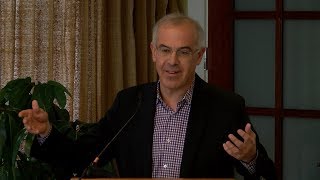
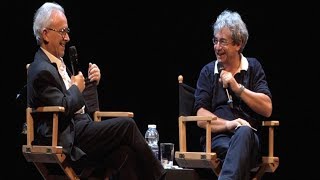
Uh welcome everybody you are all cognitive winners for getting here despite the confusion about the time so you've negotiated the first puzzle uh my name is David Brooks I'm a columnist uh with the New York Times uh I uh my first contact with the Aspen Institute came while I was a student at the University of Chicago and a fellow who was uh very important to running the Aspen Institute or at least founding it was again named Mortimer Adler who wrote a book called six great ideas and I wrote a piece about it for our College
Newspaper and the headline due to a mist transcribed conversation over the phone was sixth grade ideas and I've been dumbing down smart people ever since uh and uh it's a real pleasure to be here with Antonio deasio who is one of the leading uh scientists of brain and social thinkers uh in the country today I came upon his work very Quickly because I till my uh plow in the world of politics and after a while in the world of politics makes you get a little tired of policies that don't work because they have a uh
an inaccurate view of human nature uh in my world economics is the Gateway between the social sciences and policy and one thing you are not allowed to talk about in Washington is emotion uh we are an emotionally avoiding City if you use the word love at a congressional hero Hearing they look at you like your Oprah uh and so I eventually decided it might be a good idea to get a more accurate vision of what human beings are like and so that sent me and I think it sent many people who were frustrated off to
a series of books uh three of which have been written by Antonio one is decart's error which is tremendously important one of the most cited books you come across if you read this literature uh which we will talk about the second is Called the feeling of what happens which is a very original look at the Moby Dick of Neuroscience which is how Consciousness arises from the brain and then the third uh book and I think I have these in order is called looking for Spinosa uh and many of us didn't even know he was lost
but uh there it is uh and I'm going to start by asking you uh just to describe your Genesis as a scientist because I think the course of your Career and especially this first book that you wrote marks not only a personal Journey but a shift and emphasis in the entire the entire field so could you describe what you were originally writing about when you first started and then what led to this book and how the how the field has shifted since good well thank you pleasure to be here um well maybe the best thing
would be to talk about to to to give you a a proper answer to talk about influences And then changes in course um the in terms of influences you know I'm a neurologist and a neuroscientist so is Hana my wife who's here and we we started our work Under the Influence this was late 60s into the 70s under the influence of a remarkable neurologist and neuroscientist called Norman gashin he was a famous neurologist at Harvard uh who took the the field of Neuroscience in a completely new Direction and uh thinking about the Leion method the
study uh of behavior Changed by neurological lesions uh opened an entirely new Vista on brain studies and this happened in late 60s and' 70s and there was an enormous influence on our work and we began by uh studying very much like Norman gashin did uh the phenomenon of language and of memory in fact practically all our first studies were about uh what happens to the human brain when you have damage to the language processing areas and you Come across this phenomenon known as aasia uh and and that was very important in in our lives then
something very important happened which probably leads to the rest and that is in the 1980s we came under the great influence of the sulk Institute that's when our association with the Suk Institute began and there was an association both with Jonah Suk and with Francis Crick um and I think it was it's very interesting because uh when you think about the Glory uh times of science in the 20th century this must certainly have been one of them and it has to do with the with the the sort of the the late effects of the discovery
of DNA structure and of the genetic code and a completely new view of uh what human nature is when you connect it with its genetic uh and molecular Origins uh and and spending many hours talking to both Jonas and to Francis Crick uh did uh you know completely changed my views of what I was doing and it also gave me something very important it gave me a license to do Theory because when you spend time with Francis Crick who is easily the most important scientist of the 20th century but never spent a day in a
laboratory and was through and through a thinker theoretician uh it really gives you an idea that you can contribute not only by doing regular experiments in a laboratory setting but also by thinking about uh data that Others have worked on and your own data in novel ways so that there was quite important can can I stop you there because one of the things that marks the books is before we get to the substance just the style of your writing your thinking is they're very literary they're very philosophical was that is that a are Were You
by by most scientists training are they trained not to be as literary and philosophical as you've been until you meet someone like Crick uh I think that if you if you recognize that in the books I think it it has to do with something else uh I has to do with my early life uh actually not here um but in in Portugal you know I grew up in Portugal and I grew up in an environment uh where uh thinking about philosophy or the humanities uh was an absolute must if you were going to be an
educated person if you were going to be a physician or an engineer you still had to be preoccupied with Those with those issues uh and I think that's where it probably comes from and and and by the way medically it was very interesting because this morning in this in this room we had a very interesting session about health care and we were talking about these different roles that Physicians uh assume now and must assume under the onslaught of technology and one of the things that is very different in medical education uh throughout the world uh
and very different from what it Used to be say 30 40 years ago is that there simply is no time for that human and Humane aspect of the training of a physician and that's that's gone practically everywhere so that answers your that question okay and now to the substance of how you shifted final final step is the is the fact that uh throughout the 1980s and and then of course the '90s we came across a number of cases uh that were extremely um challenging and basically what we were Encountering was patients that had sustained damage
to the brain as a result for example of a tumor or as a result of a stroke who had to make a long story short this incredible dissociation on the one hand they had uh an inability to decide correctly in the social space so the ability to make proper decisions for examp regarding their finances or regarding their moral behavior in the broad ethical sense had been Impaired um on the other hand they did not have any uh detectable intellectual deficits so if you would measure their IQ by conventional means if you would look at their
language abilities their learning capacity and so on their motor abilities all of that was fine uh and this was actually caused by a very small set of areas of damage in the brain largely in the prefrontal cortex uh but also in in a couple of other areas uh in subcortical territories what they did Have and it was really the most blatant aspect of their disturbances uh was a disturbance of emotion and so it was very interesting because it made us think that well there's something very odd here you have a quote unquote normal intellect for
all intents and purposes you have very normal decision making but largely at the level of the the the the social encounters the social relationships uh all the way from interpersonal relationships to things That have to do with again finances moral behavior and so on and then you have this disturbance of emotion and that made us very very interested in the issue of emotion and uh we started uh doing work in this area and eventually over a period of very few years we turned over all the work that had to do for example with facial processing
or memory or language to other colleagues in the lab and we concentrated mostly on the emotional side uh and I'm glad we Did it it was difficult to do at first uh because the the tradition in Neuroscience had been to abandon studies of emotion altogether and the the the first times that we mentioned in public that we were doing this people said well you're going off the deep end I mean but why would you do it you're doing so well in what you do uh and uh and we know perfectly well that emotion doesn't really
count and that's all over and done with look at what happened to William James besides he was wrong and and that was the General attitude and and of course as you know this all has changed and uh curiously uh I think I've told you this once in 1995 as late as 1995 the society for Neuroscience which is the largest group of neuroscientists on the face of the Earth had never had a session a symposium On Emotion in fact there had not even been a special Lecture on the topic of emotion and in 1995 uh myself
and Joe Leo had a symposium on the neurobiology of emotion 1995 this was one year after I published dearer and then of course these days it's one of the uh growing aspects of the neurobiology business bu their sessions on emotion everywhere in every in every meeting and uh it's obviously has done done very well but it was not at first terribly well received largely because people did not think that after A century of rationalism we needed to go from reason to emotion and of course we do right now I I know you're bored of talking
about this but I just to give a concrete example which journalists like me think in one of the most famous patients you had was a fellow named Elliot who was a very successful person suffered this damage and whose life went down the tubes basically made a series of terrible decisions another case that was always fascinating me to seeing you Describe in one of your books one of your patients who also has trouble making decisions and you're asking him at at what point should we schedule the next appointment Tuesday or Wednesday and as you describe it
in the book he spends I think 20 or 30 minutes saying well Tuesday has dis Advantage as Wednesday as disadvantage is unable to make up his mind exactly and and and that is a very illustrative example because it it it shows you on the one Hand that the cognitive abilities the ability to manipulate data and to make analysis of costs and benefits in a very cold way is maintained and people can still do that well you know you know I the thing I most liked in this in these patients when we asked them about restaurants
and this was really quite remarkable and you say what restaurant do you want to go to tonight and said well we could go to this one and this said but uh I I I take it that this Restaurant has been rather empty recently so that's probably a bad sign it's a sign that the food may not be so good on the other hand it's true that it is more empty we're likely to get a table and therefore we should go there but then and and and the thing will go on endlessly until you really feel
like pounding on the table and said well get real and choose but the reason why they can't choose is that they haven't got this sort of lift that comes from Emotion it is emotion that allows you to Mark things as good bad or indifferent literally in the flesh and it is that kind of emotional uh impetus that they are lacking they cannot conjure up for a given situation an emotional state that would decide them in one direction or another and of course this is something that we all can relate to we're constantly being swayed in
what we do by just a little teeny change uh something that comes for example from our past Experience with a certain kind of situation but what we remember from the previous situation that is like that is not just the facts not just the outcome that it may be good or bad we also remember whether or not what we felt was good or bad and this is something that people need to understand is that when you are making decisions any day your life and of course the options you make are going to produce a good or
a bad outcome or something in between you do You do not only remember what the factual result is but also what the emotional result is and that that tandem of uh fact and Associated emotion is critical and of course most of what we construct as wisdom over time is actually a result of cultivating that knowledge about how our our emotions behaved and what we learned from them right and and this is revolutionary to the way many of us think because we have a concept handed Down from Plato that the passions are these unruly things which
reason controls we have modern philosophers a guy named Jee roddenbery created a guy named Dr Spock who was supposed to be wise because he could Purge emotion from his system even today we'll hear people say oh he's thinking with his emotions not with his brain whereas you're saying intelligent decision- making is impossible without emotion because emotion is what marks the value and Draws you toward this and that right but at the same time it it's very important to realize that it's not that we're saying that uh reason uh is not important and that knowledge and
logic are not important on on the on the contrary what what what is important to say is that first of all you cannot have normal decision making without the emotional factors and certainly by the time you're an adult uh without having all that wisdom that comes from from Your accumulated experience especially if you reflected on the experience and that categorization we make of what's good and bad not only factually but also emotionally that's one thing but then you need to preserve uh the great advantages of knowledge and logic and of course the ideal situation is
one in which you're using uh emotion up to a certain point sometimes as a first guide into what you can do uh and then then you use the knowledge and the logic to To literally test whether or not what you're trying to decide makes sense right and this is part of a key distinction you make between emotion and feeling yeah how well what don't you describe what that distinction is well the the the the the distinction between emotion and feeling is very important because most of the time in we we confuse the two Mo most
of the time if you analyze uh uh your language and if I analyze mine because I I think I'm Better now but I used to do the same thing uh you very often talk about emotion but you're really meaning feeling or vice versa so you know I'm I'm I'm not trying to be pedantic and tell you that you're using language incorrectly although most of the time we are uh but let let me tell you what the what the concepts are these are research Concepts and I think they're they're very valuable to orient research so an
emotion is really about without action And what emotion the the best definition that I can produce for you of emotions today this is based on our understanding of of uh of of the problem is that it is a collection of automated actions that are aimed at a particular effect that will have importance for the regulation of life that automated package of actions you could call it an action program is something that has been installed in your brain at Birth obviously under the influence of a Genome with the enormous uh effect of many millions of years
of evolution and that is going to serve as like a little packet of Rapid intelligence to make you solve a problem without you having to think about it so for example if now there would be some cause of alarm and we would be under threat in this room you know perfectly well what we would you would have you would have a reaction of fear and you would act on it uh typical reactions of fear include Freezing in place or running away from the source of threat but whatever they are whatever the program is that is
engaged it's going to be a program of actions some of the actions are very visible for example in the face you have a face of being in Terror you have a posture there is the posture of fear but then there are other things that happen you have your heart rate that goes up and you have the blood pressure that goes up and you have your Hypothalamus uh spritzing uh cortisol into your entire organism and therefore changing a whole aspect of the economy of the interior of the organism all of these are actions some are at
the level of the endocrine system some are at the level of the muscular skeletal system some are at the level of the visc and some are at the level of the Behavior we engage in like I said freezing or running away from from The Source all of this Exists in many many species not just in humans in fact most non-human species for example when you think about birds or when you think about uh mammals they have these reactions in fact you can go all the way to invertebrates and find examples of exactly the same thing
you can have a snail have a reaction of fear that is very similar to all of this now we know perfectly well that the snail doesn't have a brain very organized be beside a few nuclei of neurons that the Brain does the the the snail is unlikely to have a mind let alone Consciousness let alone a sense of the culture uh so obviously what we do dealing with is something that is evolutionary biological intelligence that is prepared to make an organism do the best it can without having to think about it that much now we
have this program in us and we have it not just for fear but we have it for sadness anger uh for Joy uh we have it also for a variety of emotions That we call social emotions for example embarrassment shame contempt uh compassion admiration um Pride um guilt all of these exist as pre packaged uh Arrangements in the biology of your brain what we then also have is this marvelous thing is because we have a mind and on top of it we have a mind that is conscious because we have a sense of self we
also have the possibility of having a perceptual take On what is happening in us so when you have a feeling of fear what that means is that your mind is representing what has has changed in your organism while you are in the emotion of fear and it is also because in humans things are very complex we also have a number of thoughts a number of scenarios that you bring up and a number of cognitive strategies that you can engage but the feeling part is sort of the capping of the process and is something that exists
In us but does not necessarily exist in very low species just to make sure I understand this if if I'm driving down the road a car is coming at me I swerve yeah I slam on the brakes I feel my heart is palpitating I feel breath coming in and out and it's usually after I'm sitting on the side of the road that suddenly this wave this conscious sense of fear comes over that comes later so it's a two-stage it's a two stage right yeah And and and the first and of course it's very good that
it all of this thing gets engaged without you having much control over it because if you did if you were really pondering well what should I do now you you probably would react much in much more slow fashion and of course there would be a cost to to that and and so the the the reaction is really happening uh largely at a non-conscious level although it can very rapidly become conscious as well but and in fact One of the things that you may uh you may think the reason why uh the the distinction between emotion
and feeling is so so important is That Emotion by definition to begin with is non-conscious so it was non-conscious throughout Evolution and is still by and large non-conscious and we learn about it through feeling is when we feel the emotion that we know that we had it so the feeling is sort of the the you know is like the the sea level uh that goes From this this uh uh under the water uh operation which is this very rich operation of the non-conscious brain and the operations that suddenly emerg into Consciousness right I I think
there is such an important emphasis in the work because one of the revolutions we're having across all these spheres is we used to think most of what happened in the brain was what happened consciously we're now discovering through a whole range of writers that most of what's Happening is non-conscious including all sorts of decision-making processes but that leads some people to the emphasis that we were were practically animals that the the basest part of our life is the lowest the pene era part and but when you talk about the conscious expression of feeling that gives
you the chance to learn from feeling and that really ennobles human beings and gives them much more control even while understanding the importance of what's Happening down here right right yeah it's it's actually a very important guide because you know the the the the issue with emotions is that even the most complex of the emotions go only so far in the solution of the problems of human beings in a very complex uh physical and cultural space uh and what you what what what you have to do is invent Solutions which can only come to collectives
of conscious minded individuals that will take care of Problems that biology has not taken care uh for has not taken care of of until now so you could you know I I I like to see it in a sort of uh two- tiered way although two- tiered makes it too simple and it's much more than two tiers but you can say that Evolution has handed over to us a a very rich automatic system to solve intelligently a whole slow of problems that we can be faced with and then because we have feeling and because we
are conscious uh Individual and we have constructed uh a a cultural uh history and uh we we we have memory and we have records of the events then we have the possibility of inventing other Solutions what I think is so fascinating is that the solutions that we invent in the social Arena are largely modeled on solutions that biology at first uh hit upon so uh I I like to see it in terms of uh the the the idea of homeostasis homeostasis in a nutshell is the concept That we need in order to survive we need
to regulate our life within certain parameters uh for example we're here at 8,000 ft and we're not meant to be at 8,000 ft unless we've lived here all our lives uh and there are lots of things that happen in terms of the pressure of oxygen that is going to change the way our acid base mechanisms are operating and our organisms are changing as rapidly as possible to adapt us to this new situation and you have different Effects of alcohol different effects of exercise very different if you were at 5,000 fet or at 200 ft and
homeostasis is what automatically regulates us to achieve the possibility of surviving in spite of being put in situations that are not the ones where we normally would be most comfortable now homeostasis has been incredibly successful that's why we're here uh and has its own set ways we don't really interfere that much and should not in the way we regulate our Circulation our uh um heart rhythm and so on we can interfere with it to a certain degree by training exercise all sorts of things but fundamentally nature is doing a beautiful job in in succeeding what
we are not good at in terms of the the the basic biology is all the the trouble all the problems that come when you now have a society with many individuals and those individuals are going to do things that Can fundamentally harm others or on the contrary bring uh bring uh Wellness to others and that's when the conscious impulse is going to you know in the invention the imagination of a social space uh starts operating and and I I i' like to call this social homeostasis but I I I I suspect that when we think
about moral systems uh and ethical rules and uh law jurist Prudence in general when we think about medicine when we think about social and political systems we Are in fact thinking about homeostatic mechanisms because the purpose through and through is to make life possible in a situation where in fact it might not because you could have Warfare you could have all sorts of suffering uh caused by the wrong actions of a few on others and so on so we are we are still aiming now very consciously at the same set of problems that biology set
out to solve millions of years ago except that now we know a little bit about uh about now we Can interfere you know with our own volition in the process and I think the the fact that when you read the the headlines any day you realize that things are not really going perfectly simply means that this is a work in progress we are we have succeeded in our basic biological homeostasis but we're very far from succeeding in the General Social homeostasis all I think another ennobling theme because a lot of and we've talked about this
a lot of the Behavioral some of the evolutionary people think survival is the is the end of human life or our main goal is survival as long as we can pass along our genes and I'm not sure what the Aspen ideas Festival has to do with passing along our genes why we're here why we're motivated to do this but in when you talk about social homeostasis you're talking about a much higher level of goals which you've described as wellbeing Y and I think I I might push It farther than you that that the desire to
to merge with other people to achieve synchronicity or harmony with other people uh is is a primary goal of human nature to be with other people to be with people like us to fall in love in the ecstatic feelings that creates is the apothe or the the height of of social wellbeing and the height of social of social homeostasis I I I I I think I would I would agree with you and I think that probably by now we actually Have at least the tendency to to yearn for that and to to seek that in
our genes too I mean there there's quite a lot of evidence that would go in that favor and there's certainly uh human uh activities uh that do not seem to be terribly uh essential for Gene passing but are very important for all of us in this room and they have to do with for example the Arts uh you know it's it's it's debatable uh that Arts are adapt s and and that really function in in terms Of uh in terms of strict survival in the darwinian sense although I think one could argue that point um
but I think I don't care the subject doesn't interest me that much whether or not their adaptations they certainly are incredibly important and they certainly are incredibly important in terms of generating well-being and all of those things that you have just talked about human Fellowship uh for example and of course we know of something that has Pretty much the same status uh and that's religion a lot of the religious impulse I think has exactly the same so people have called the Arts the education of the emotions do you believe it is possible to structure one's
life to educate one's emotions in a more elevated way as one goes through life or are these so basic that they're basically impermeable to whatever we do oh I I I think they're educable I I think that the but but but you have to Keep in mind that you really don't learn them to begin with I mean you don't learn fear and you don't learn Joy uh what what you can do is educate better and better by reflection and repeated by repeated experience and reflection you can it you can establish better and better connections between
certain emotions and certain causes of emotion so for example if you think you know I I like the term uh emotionally competent stimulus so we we just to to to Define Uh call attention to the fact that emotions have causes uh so you you will react to a certain stimulus in a certain way and of course as I mentioned the emotion is there as a potentiality uh and it will or will not be triggered depending on whether or not you have an emotionally competent stimulus something that can actually do it now we can we cannot
interfere on the side of the emotion package itself that's a physiological given you can of Course interfere with the expression of the emotion we know that in numerous cultures there's an enormous effort to suppress the expression of emotion which does not mean that the emotion disappears altogether the fact that you might have a blank face rather than crying does not mean that inside you're not crying and that does not mean that you're uh other physiological reactions that are all in the interior of the organism are not still taking place but You may have through education
you may change the mask of a person the same way you change the mask of an actor um but what you can change for sure is how you connect certain stimuli with certain emotions and it's totally in our control if we're going to be governed by things that we regard as beautiful and um admirable or things that are trite and uh stupid and and and that that job is totally in our control because it's very important that we we realize sometimes When when you talk about emotion being a set physiological package sometimes people get very
alarmed and say oh my God you're saying that uh this is all the same for everyone and that there's no this is totally determined there's no way of personal Iz in it and and of course this is not the case if you would take this room I will bet you that there are numerous stimuli that would cause fear or joy in many of you but not in all of you so one thing that we do Customize and we make very very particular for each and every one of us is uh exactly the kind of stimuli
that are capable in our indiv idual situation of producing an emotion and uh David you mentioned the the Arts you know you you can obviously surround yourself by uh the kind of poetry or the kind of music that will actually bring to you uh certain kinds of states that that's totally under your control okay in two minutes we're going to open the floor up To questions and I also wanted to invite if Hana tazio who's a very important colleague wants to chip in i' I'd certainly well welcome that uh uh so but the final topic
before we uh get to that you've written more recently about morality and how emotions uh affect moral decisions and there is a school of thought uh including Michael gazan an important neuroscientist that that morality is essentially like Aesthetics that when we look at something we have a Visceral and immediate reaction to whether it is moral or immoral good or bad is that is that your view is that consistent with how you think moral decisions are made with with a part of it yes uh I mean there there's something um for example there's someone who's work
I like very much Jonathan height uh who has basically that view for the beginning of the process so uh a lot of our moral judgments for example Deciding whether or not something is you know uh acceptable morally or not um can be engaged rather automatically on the basis of uh very old social emotions that that that we have so there there can be a sort of immediate reaction that is emotional uh but I don't think that that explains or accounts for the entire field of moral Behavior because the the point is that we may have
been guided historically long long time ago by those basic Reactions um but then we were smart enough to invent other injunctions to invent uh rules and to ask people to behave according to th to to those rules I don't think that the uh laws or uh fine ethical um principle uh are written in our genes uh although we do have for example when you look just take something like social emotions like embarrassment and shame or guilt uh or compassion you you you have moral values embedded there and all you need to do is Think about
what those reactions cause why is it that and of course this are this are by the way a reaction like Compassion or or to certain degree guilt or embarrassment is something that is not confined to the human species you can find it in other primates uh so clearly uh the evolution was already taking care of the beginnings the forerunners of moral systems in the form of emotions that could be engaged automatically and that could for example Promote uh reciprocal altruism which clearly has had a role that is very important in the evolution of biology but
then you have all this other stuff that we layered on top of it and that comes from a lot of wisdom and a lot of reflection and that actually varies very much culturally and varies very much with for example the kind of religion that one practices within a certain culture uh and philosophically there's a there's sort of a a classical opposition Between Canan views and hum humi views uh and in one case you have views that are very much based and On Emotion you know uh y had that idea that you know fundamentally emotions are
going to guide you through uh and I don't think that that's quite enough and then you have the Cent view where he says no no no no we we we actually have to put rules on this system and we and there are things that may be difficult to do but are ideal and there's no reason why We should not strive to achieve th those ideals so I think that a view of the moral system that stays with the emotions only is going to be a rather Limited one and I don't think it's going to really
serve so if I'm if I'm a Texan and I see uh income inequality of 100 to1 and I'm not offended but if I'm Swedish and I see it at 100 to1 I'm completely offended is that offense is that moral judgment is that where where in the where in the realm of my morality Is that in in what you've just described well it's certainly the the realm of a different uh culture that that that that has been uh you know uh cooked up for for for a particular area and where you know a sizable number of
the uh inhabitants you subscribe to those Val yeah you could call it moral but you know I'm I'm I I I I tend to be very traditional I think about moral in somewhat other but that too yeah that's fine okay I'll take it If there are questions there must be microphon somewhere in the house I see one too so if there are questions please appr Ro a microphone uh in the meantime I wanted to emphas I wanted to come back to the automatic process uh and and that's to emphasize the the wisdom of part of
it and the fallacy of part of it one of the important experiments you've done involves uh two packs of playing cards and this is a test of the wisdom of some of the automatic emotional Responses could you just quickly describe what that tells us about yeah so the that was a an experiment that we did in 1990s uh known as the the gambling task experiment and and pretty complicated but been a nutshell it involves different packs of cards and there there's a game that you play by picking up cards and you're given very little instruction
on on what the game is you're given one idea that picking up a Card will bring in a certain amount of reward and a certain amount of penalty uh but you we're not going to tell you which card which deck is going to be good or bad we're going to be more less advantageous and the the purpose of the game is to make as much money or lose as little money as possible and the game The Experiment begins with the experimental lending money uh in a perfectly you know sort of classical mortgage not not nothing
subprime here Uh lending money to the uh to the um subject and what happens is that people who are normal who do not have brain damage uh will uh go by the way there are two Decks that are very advantageous and two Decks that are fundamentally disadvantageous and if you play on two of the decks you're going to end up losing your shirt uh if you are going to play on the other deck you're going to end up making money and coming out ahead and since you have very little Information this is a little bit
like the game of life you just you you you're handed a certain pack of cards and you're going to have to learn by experience what is good and what is bad that's why we we designed it that way um so what happens is that normal individuals fairly rapidly uh that there are only a 100 plays that you can have but sometimes within the first 20 or so they are already veering towards the good decks and they still do not know Why and all they have been given is some the schedule of Rewards or punishments in
other words they have either made money or lost money while that is happening as as the subjects are hooked to skin conductance monitoring you realize that the brain is responding to the bad cards by sending an alarm signal which corresponds to a differential electrophysiological response and people are not aware at that point that they have the strategy to go into the good Direction nor do they feel the skin conductance response because one of the interesting aspects of the skin conductions response which is just a minimal alteration of uh of the amount of water that you
can have in your skin uh they don't know that so they don't know that that is happening and yet it is happening and it is a sign that there is something non-conscious that is making you biasing you in a certain direction and of course How did you get to be that wise and to be biased that way by repeated exposure to certain situations of gains or losses and acquiring that wisdom uh and then being able to deploy it but in a non-conscious way just to conclude the story if you take patients with ventromedial prefrontal damage
so that's that old part of the prefrontal cortex uh and they play the game not only do they play in a disadvantageous way so they're going to be Financial losers but They also do not have any kind of skin conductance response that is differential so you you actually see that their brain is lacking that kind of response but this by the way is not a response that is in the genes and is there in the given biology it's a response that in normal individuals is gained through experience is gained through learning what's in the genes
is the fact that we for example prefer gains to losses and that we're going to Make uh everything possible to maximize th those gains that's certainly a given of our nature a man thank you so much for being a Pioneer I think we're beginning to see more and more variables uh one would be gender another U book written by a colleague at Georgetown Candace F the molecules of emotion um and I wonder what you're seeing on the horizon uh Bruce Lipton wrote a book uh the biology of belief that's recent and contributes to what you're
telling Us uh what do you see um hormonally uh I think I'll just speak for the women in the room we we do feel emotion based on uh hormonal levels and so what is the New Frontier that you see emerging uh through decision making and emotions driven by other variables right it's a very interesting question so what the the well first of all there are of course gender differences although when it comes to to emotions uh I think that the gender differences have more to do With style and intensity than with fundamental difference in other
words I doubt very much that there is uh any emotion that uh women have that men don't have and vice versa I think that the the the the range the the the roster of possible emotions is the same and all you need to to to think is what is is the you know the the the great cultists of emotion have been poets playwrights and novelists for for uh ever since there there was such a thing on the face Of the Earth of the earth and um and so it's perfectly obvious that and by way most
of them were men for reasons that have to do also with obvious social fact uh so I think that the the the the the the range of possible emotions and the and and their deployment the system is the same but the intensity and the style is of course quite quite different and there's also another difference there which has to do with culture uh which may be tied to it too that's another Story now in decision making quite specifically we already have evidence that for example the kinds of brain leisure that lead to altered decision making
in men and in women are actually different so there there there a couple of papers that have been published on this uh more than a couple probably a dozen papers that have been published on this even in in relation to the uh the utilization of fear for example uh in this processes There's a difference between uh between women and men and we'll we'll probably come to learn far more about that and of course the the hormonal aspect is a key here because that is one aspect in which there are quite clear physiological differences so more
to be explored more to come hi I work with senior level Executives and um they are constantly being driven by making very difficult decisions and I use Neuroscience as the basis upon which I help them and one of Their major complaints is that they get in a situation and their emotions take over and it could be very detrimental to the company and what they come to me for is to help them at those crucial moments be able to get on top of their emotions be able to get to stop their unconscious behavior and um learn
a new kind of a behavior the way in which I work with them and I'm very interested to know how you would F fill in on this process is I begin with the thinking and helping them In the prefrontal cortex and with their um everyday thoughts to then go down into the unconscious and help change their emotions and that knee-jerk reaction so they can make better decisions yeah so first thing to to to say to your question is that um clearly emotions if they're excessive they're going to have a very dis disruptive effect on anything
including decisions of course uh memory uh there all sorts of you know it's quite interesting let Me just give you an example which I think will fit uh and will will be illustrative for for the others um when you're learn in a learning situation if you would be neutralized in your emotions your learning situation like for example for an exam you would you would actually learn less than if you would have a moderate degree of emotion if you have some emotion a little bit of fear of the exam or excitement about the exam probably will
actually allow you to Acquire more information but if the emotion is extremely intense and if you go into a situation of panic about the exam your learning actually declines uh and you see this for example in situations of what people remember after a traumatic event uh so too too little emotion is bad too much emotion is bad as well uh you know this sounds extremely banel but you actually actually have to find somewhere in the middle the situation where you will be Helped so I think your Executives should really be prevented from getting hysterical uh
and and uh doing wrong things on top of their uh you know their emotions in control uh but don't don't you know don't give them so much valume that they will they will be too calm you you you need a little bit tension do you have breathing exercises you can help us with to get that golden I wish that would be very good marketing device you could afford a House here I think Sydney has a question Sydney I am Sydney Haron in less than full disclosure a modest colleague a great admirer in um your early
exchange with David you spoke about a way of thinking that used data out of the lab in original ways and that brought Noble Albert Einstein to mind it's the essence of how he worked creatively he said at one point that the most beautiful thing we can experience Is the mysterious it is the source of all true Art and Science would you talk to us for a minute about the mysterious very good that's wonderful that that's a tall order but a good one um so first of all thank you for bringing up Einstein uh who had
this reverence for the mysterious and uh actually a reverence for reverence which is very important because I think one one one thing that is critical Especially when you're talking about neuroscience and you have all of these new uh very fascinating results you know all the the the the latest new scan with lots of colors uh and uh New Revelations about our our uh molecular operations and and so on uh there there is a very big risk of losing the sense of reverence um and uh the the the the risk of looking at this field of
of science is not only dehumanized but dehumanizing because you're just sort of explaining Everything and without having any kind of reserve for things that you ought to be reverent for and so my my first uh point in relation to reverence and mystery is that no matter how we know how much we know about what is going on in the brain the mystery remains I mean after all we have to be modest and realize that we don't even understand how life is produced we we are understanding more and more about it but we still don't understand
how life is Produced so we we it's not that we are you know we're successful but it's not that we are a runaway success and we have explained everything um and then the other thing that happens is that if you are working especially on something like the brain uh and you uh are aware of what is going on not just on the surface of the brain but on neural systems on on for example certain regions made up of cells uh hooked in a certain way and aware of the cells Themselves what we we find is
a world of Marvel uh no matter how much we know about what is going on there in terms of what is going on in the nucleus of the cell or in the cytoplasm and The Marvelous relationships between this unit and the other units the only thing you can be is in awe you know and it is still mysterious and you have to be in awe you have to be in reverence of the incredible complexity that you're dealing with and you you also become Especially if you realize that most of our activity is in all likelihood
non-conscious and that we have this little aperture of vision over what we are you have to realize that whatever we know is small and uh we can um we we we we we have planty mystery to to last um probably hundreds of Aspen in festivals of ideas into the future uh one more thing on on uh Einstein and that is it actually connects with Spinosa who happens to be one of my uh favorite Philosophers a very hermatic pH philosopher not exactly badtime reading but it was full of incredible insights and it's probably no coincidence that
he was Einstein's favorite philosopher as well and that and that Einstein's attitude towards um towards uh science uh and by the way towards um anything that could be conceived as Divine was very much spinosi um and final Point Einstein was very aware of his emotions which is very interesting when you think About Einstein with his brilliant work in in physics and Mathematics and you think well this is obviously a hyper cognitive person concerned with facts measurements numbers not so he was actually you know he a person that talked about equations as being beautiful or ugly
uh and he talked about uh about his mode of thinking as being muscular and related to emotional states uh which is really quite uh quite remarkable so he was he was not only a Good user but he was very aware that there was something there that also of course also transmitted to his other passion which was music yeah just a few minutes left so we'll do these two questions um at the uh ideas Festival we've had a whole track on Darwin and I think with the change in government it's being decriminalized that we can talk
about Evolution um your work in terms of tying it to morality or to religion I'm just curious If you've taken the time to try to understand the biological evolutionary thought that might be about the creation of emotion and what what part it's playing in the sociology we're we're also getting a lot of information here about these kind of tracks of uh global warming of thinking globally you know acting locally and thinking globally and I'm just curious if we have the biology to be able to make a transition like that to with Emotions and and neurology
well I think in relation to emotions here's something one can say with some confidence um emotions uh you know the term emotion is a little bit of a grab bag uh and it hides a number of phenomena a number of processes that you could itemize as follows uh reward and Punishment systems drives motivations and basic life regulation all of those things are under the the term of emotion uh when we talk about an emotion such as fear or Pride Or what have you uh we were talking about the sort of the most developed the most
refined aspect of that um automated Action Program to solve a certain problem but you have all these other routines that are there before and when you think in evolutionary terms and you think about for example uh a single cell uh that would be uh you know in a world millions and millions of years ago and you you think about what if in fact the the the there is this totally Non-conscious non-m minded quote unquote desire of the genes to remain and be passed on what would the genes uh this is sounds like an absurd question
but it's not what would the genes do in order to create organisms that would be the most effective to pass on themselves and the answer is emotion is comes very very high with all of these things like reward and Punishment mechanisms and drives and motivations because emotions are that sort of automatic intelligence That would guide an organism to do the most convenient thing for that organism to survive during the time that its genome would allow it to Sur survive so very early on emotion must have been one of the very first things to develop so
we're really dealing with something that is now part and parcel of our lives but has been here for a long long time and that of course is part of the problem because we we need to deal with this very old system that has all sorts Of misleading cues but also very useful ones and then you have to layer on top of it this new thing that we have evolved with cultures and civilizations that will allow us to be more pointed and create the best possible Behavior but I think that what evolution gave us very rapidly
was different kinds of behaviors that were all of the EM processes that were all of the emotion flavor and they made life more possible for a longer period first For single cells then for multi small multicell organisms and eventually for complex creatures like we are and it's good that Darwin has been decriminalized isn't it I came here to stay away from politics but as a human being and a and a psychotherapist I was drawn to the book emotional awareness which is a elongated um conversation between the Dal Lama and Paul emman who is probably the
world's expert on emotion and facial expression And um there was a very long portion of the book which was the dialogue about how difficult it is for both westerners and even easterners who are practicing meditation for long periods of time to to be able to build in that delay between the experience of of emotion and reactivity and I think that so much of of what goes wrong whether it's a small interaction between people or large major things that that go wrong with the homeostasis Seems to or could depend on being able to elongate that that
place between a an experience coming in and how it is going to be responded to as opposed to reacted to so I guess I'm wondering if if you would comment on that because it seems to be a major stumbling block for most people yeah I I think it would depend of course on the on on the kind of emotion that you're reacting to so there there are certain uh aspects that would probably not be a great problem there's Certain the the some of the most complex social emotions uh I I think the the the more
we the more we um intervene between the uh deployment of the emotion and further later actions the the better let me give you an example we have recently concluded a study this was just published in the proceedings of the National Academy uh two months ago uh in which we analyzed uh different kinds of compassion something that Dal Lama likes uh we Talked a lot about that uh and we one one of them is compassion for physical pain and the other is compassion for mental pain now this is very interesting because you may say what's what's
the big difference what's the big deal the deal is huge because we know that non-human species are compassionate for physical pain so you know if you if a dog uh walks by another animal or by a human that is in physical pain the dog may well lick the the other creature uh In a response that denotes some kind of resp in other words there was an emotionally competent stimulus which was the pred predicament physical predicament of another living creature and there is a response I'm not arguing here about whether or not the dog is thinking
oh my God he's suffering let me give him a lick I don't think that that's what happens but that's the response that you see now will the dog be very compassionate or the monkey or The chimpanzee if you have lost your house to foreclosure or if you have lost a loved one to cancer and the answer is no so there's something very interesting that is taking place here that has to do with different points at which certain kinds of situation enter the repertoire of uh Evolution and allow the brain to respond and so now we
know that we definitely respond to mental anguish in a very uh interesting way and we do have compassion and we also know Something which is in this study and that is that it takes longer for the brain to organize the response to mental pain than the response for physical pain and this is quite beautiful we're talking about about the the in internal brain response uh being offset by something like six seconds now 6 seconds is Fast by the likes of us but in brain time is eternity just use it takes 5 milliseconds for a neuron
to fire so this is big time Uh so here it is this this huge difference so it's kind the I think your question aims at something like this we're going to be able to know more and more about what's different in the way we respond to these different situations and then be able to intervene at that point and create something which may be better and beautiful and once again uh it's not just dealing with what genetics gave us which is fine to begin with and not so fine sometimes it's also what We're going to be
bringing to the biology which is of course what what we're here for uh and and and I think that's a very important uh very important point to emphasize okay well after each of your 6 seconds after each of your sentences I've experienced a jolt of social pleasure um sometimes 8 seconds I'm slow that way uh I should mention which I didn't mention at the beginning that you direct the brain and creativity Institute of USC and directs The neuroimaging center at USC so we should give some props to the Trojans and to the USC and thank
you Antonio thank you