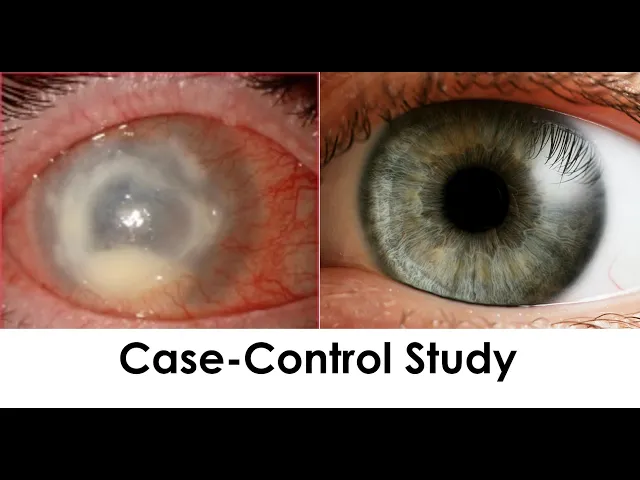
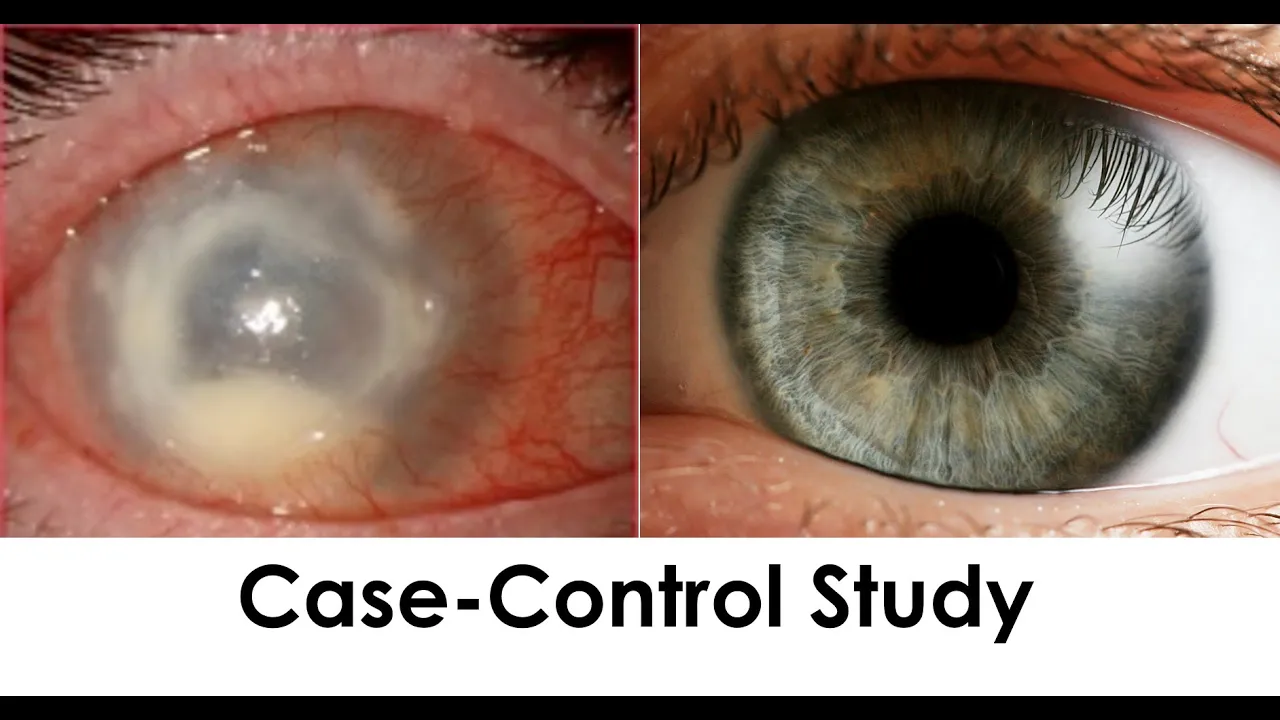
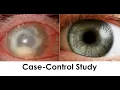
Now let's take a look at the example case-control study. So there was a report of a potential outbreak of Acanthamoeba Keratitis in America in 2007 which is caused by this single-cell living organism Acanthamoeba shown in this picture. So this is a very rare condition and the estimated annual incidence in America is 1 or 2 cases per million contact lens wearers.
However, this is potentially blinding and a very serious type of corneal infection, which is almost always associated with contact lens used. So an investigation team sent out a national request to report the cases of AK to ophthalmology and optometry across the country and indeed there was an unusual increase in AK detected within two years between 2004 and 2006 across 30 states. So in 2007 a case-control study by CDC, the centre for disease control and prevention, was initiated to identify the potential risk factors.
So in this outbreak example, a total of 105 cases were identified. So this is a characteristic of a case-control study where you start your investigation with disease-end first. Now you need to have a control group for comparison in fact selecting the appropriate group of controls is known to be one of the most demanding aspects of a case-control study.
In the ideal universe, you want to have a control group that is exactly the same as the case group except that the control group does not have the disease. But we know that we cannot have such a control group. So in practice, controls are selected to be similar to cases only on some key characteristics that are known to be confounders or effect modifiers.
So confounding variables are extraneous variables that are correlated with both dependent and independent variables or exposure and disease. So if not controlled for, we'll misunderstand the relationship between them under the investigation. So it is almost always the case that the age, sex and/or ethnicity play as confounders or effect modifiers in studying health outcomes.
So the controls are usually matched on these variables and matching is an effort to addressing these confounding issues at the design stage even though this is not a direct means of preventing confounding. You want to be very careful about what to match because once matched, then the matched variable cannot be analysed as a potential exposure. For example, let's say you recruited your controls from the neighbourhood of cases, then so you may also be matching on socio-economic status because neighbourhood is frequently correlated with socio-economic status.
But by doing so, now you cannot analyse socioeconomic status as a potential exposure variable because you have matched the cases and controls on this variable. Sometimes over matching can happen if we make cases and controls too similar in many ways. If we do that then the chances are that we will find nothing because stronger exposure or the disease you're looking for might have been one of those matched variables.
So an overmatching leads to the loss of validity. There are different methods of matching controls. In individual matching, one case is typically matched against the n number of controls whereas in frequency matching cases are matched based on the characteristics you are interested in matching and in the frequency matching, you try to match the the proportion of such characteristics of the case group and the amount of time to match increases as a function of number of characteristics you try to match and the number of controls per case you want to employ.
And the non-matched control is rarely used in case-control study. Now back to the study and this is the diagram of their matching scheme. So in this study cases were matched for the type of lens used and 14 cases were excluded because of the matching failure and later on, they restricted their analysis to the soft lens wearers.
So in the ideal and the simplest universe, you should get sick when you are exposed to a risk factor and you should not, if you aren't exposed, right? But because disease results from multiple risk factors and their interactions, not all the cases are necessarily exposed to the same risk factor. And by the same token, some people don't get sick even after they are exposed to the risk factor because of the individual differences in resilience.
Therefore the disease occurrence is inherently probabilistic interplay between different factors. From this and we should estimate risks with the given exposure for these four different possibilities to determine how more likely it is to catch the disease when exposed to a certain risk factor against when not exposed. So here is the list of risk factors they considered with respect to the disease.
So the exposures they considered was like ocular traumas, so the previous experience of ocular traumas or the behaviour - washing face with lens on, and the year of contact lens use less than five years, they saw this as a risk factor, and use of a specific multi-purpose solution, and ever topped off solution in the contact lens case or swimming in a lake or river while wearing lenses. These are the list of exposures they considered. And they calculate the odds of having the disease given each risk factors.
So the odds ratio is typically used in the case-control study which we will talk about later but among these risk factors three exposures were highly associated with the disease, which were the use of a specific brand of the multi-purpose solution, ever topping off solution, and people who used contact lens less than five years. So from these three, the cases had whopping 17 times the odds of using a specific brand of multi-purpose solution compared to the controls whereas other two risk factors at less than three times the odds compared to the controls. So later it turned out that most patients who use the specific solution developed the eye disease within a month.
So these results prompted the company who made the product to recall and completely withdraw their product from the market. So what actually happened was that the solution itself was not contaminated - so they actually first thought that maybe the solution was contaminated but then it was not. But it was just not effective enough to kill the organism.
So in a case-control study, the direction of inquiry is going against the actual sequence of events as indicated by the arrows. So this is kind of an example of how a case-control study is conducted and next time, we're going to talk about how the measures of association between the exposures and the disease occurrence is calculated in the case-control study.