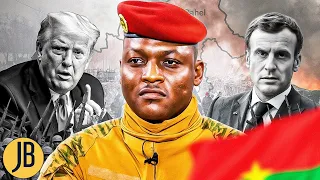
In a moment that reverberated across continents, General Michael Langley, head of the US Africa Command, Ariccom, delivered a stunning accusation before the US Senate Armed Services Committee. Speaking with calm authority, he alleged that Captain Ibrahim Troué, the transitional leader of Burkina Faso, was stockpiling his country's gold reserves to strengthen his personal grip on power. No hard evidence was provided, no data, no audit trail, but the damage was done.
The accusation was now public record and the implications were explosive. Um, ask a few more questions here as we hopefully recess. Um, Africa is a mineralrich, resourcerich continent.
Is that correct? Yes, chairman. Okay.
And you can you can leave the microphone on. This wasn't just about gold. It was about a shifting world order and a new generation of African leaders no longer playing by the old rules.
Why gold and why now? The timing of Langley's accusation was no coincidence. Weeks before the statement, Burkina Faso had shaken the global gold market by announcing that it would stop exporting raw gold.
Instead, the government declared it would refine and process its own gold domestically, keeping the wealth within its borders. Even more radical was the idea that followed. A potential new African currency backed by physical gold was being discussed behind closed doors in Wagadugo and in neighboring capitals like Bamakco and Name.
This would mean severing ties with the CFA Frank, a colonial era currency still controlled by the French Treasury. To Western powers, this was not mere economic policy. It was a direct threat to financial dominance in West Africa.
What Traay was building in Burkina Faso was more than a transitional government. It was a movement, a bold, unapologetically sovereign movement aimed at breaking from decades of foreign dependence. His decisions were electrifying the youth across Africa.
His expulsion of French troops, his rejection of IMF packages, and his nationalization of key resources were inspiring a new generation to imagine an Africa no longer dictated to by Paris, Brussels, or Washington. That was the real danger. Not gold, not policies, but inspiration.
If Burkina Faso succeeded, others would follow, and the West knew it. Despite the international pressure, Burkina Faso responded with poise. A brief government statement refuted the allegations calmly, stating that the country's goal was being processed through state-owned institutions, fully documented and within public financial oversight.
There was no outrage, no fiery press conference, just a clear message. We are accountable to our people, not to your committee. This quiet dignity only strengthened Trroway's image at home and abroad.
He wasn't just fighting for power, he was defending sovereignty. what Afrecom really represents. To understand the gravity of Langley's comment, one must understand the deeper role ARICOM plays in Africa.
Officially, it operates under the guise of security cooperation, fighting terrorism, and training local forces. But in practice, ARICOM has become an extension of US's strategic interests, protecting access to resources, monitoring rivals like China and Russia, and maintaining influence in key regions. Wherever leaders begin to challenge the economic status quo, be it Gaddafi in Libya, Dumbuya in Guinea, or now Trouer in Bkinaaso, Apham's shadow looms large.
It offers partnership with one hand and surveillance with the other. Trore's refusal to cooperate made him a problem that had to be contained. Echoes of Sankara.
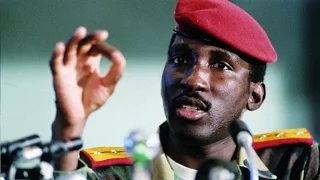
To many in Burkina Faso, Ibrahim Trrowé is more than a president. He is a rebirth of a legend. The spirit of Thomas Sankura, the revolutionary who renamed the country and declared its independence from neoc colonial control lives on in him.
Sankura ruled from 1983 to 1987 and implemented radical reforms, land redistribution, anti-corruption drives, women's emancipation, and rejection of foreign aid. For this, he was assassinated. Many believe with foreign complicity.
Now nearly 40 years later, Troure is reviving Sankara's dream and that terrifies those who orchestrated Sankura's fall. Gold has always been Africa's paradox, a glittering curse that brings wealth to outsiders and suffering to the people. Under colonialism, it was extracted by force.
In the modern era, it is siphoned off through multinational corporations and rigged contracts. Trouay's decision to anchor Burkina Faso's economic future in gold under national control was revolutionary. He wasn't just managing a resource.
He was using it as a shield against economic colonialism. A currency backed by gold would free his country from foreign dominated banking systems and debt traps. And that's why gold became the target of smear campaigns.
Economic warfare begins. Shortly after Bkina Faso's economic announcement, the US State Department issued a level 4 do not travel advisory warning citizens to avoid the country due to terrorist threats. But security experts noted that the actual threat levels had not changed dramatically.
The travel ban was in effect an act of economic sabotage. It discouraged investment, raised insurance premiums, and frightened away international partnerships. It was warfare just without the bullets.
As history has shown, the West rarely allows a resourcerich country to walk away unpunished. Soon, whispers of covert action began to surface. Intelligence rumors, leaked cables, talk of instability, and the need for restoration of order.
The pattern was familiar. destabilize the economy, fuel civil unrest, push for international condemnation, then if necessary, back a coup. But this time, the people were watching and Traor was ready.
A new alliance is born. Faced with growing threats, Burkina Faso began to tighten its regional alliances. Alongside Mali and Niger, the country formed what many now call the Sahelian Resistance Axis, a coalition of military-led states rejecting foreign interference and seeking to build independent institutions.
These nations have all expelled French forces. They are discussing joint security operations. They are exploring shared infrastructure and economic integration.
Most importantly, they are talking about a postca Africa, a future free from the currency chains of empire. The stakes couldn't be higher. This is not just a national story.
It is continental. What happens in Bkina Faso will ripple through Africa's youth, its diasporas, its underground economies, its universities, and its borderlands. If Trior Ray succeeds in creating a self-reliant goldbacked economy, the myth of African dependency will shatter.
But if he fails or is taken down, the message will be equally clear. Sovereignty has limits and they are enforced. As tanks and planes remain silent, the war intensifies in the domain of narratives.
International media, long dominated by Western outlets, begin to portray Traé as a potential desperate. Phrases like populist strongman, anti-Western agitator, and youthful revolutionary with questionable legitimacy fill headlines. But back home and across much of Africa, a different story is being told through encrypted apps, community radios, and a surge in independent Panaffrican media.
Trore is cast not as a villain, but as a symbol of resistance. His speeches, often raw and emotionally charged, echo across borders. They speak of honor, of memory, of reclaiming what was stolen.
This media war becomes the new battleground. And in it, truth and propaganda dance closely, each trying to shape Africa's future in its image. The quiet diplomacy of the axis.
While the west engages with public accusations and press briefings, the Sahelian trio, Bkina Faso, Mali, and Niger are moving with a different rhythm. Behind closed doors, the transitional governments are drafting joint security protocols, shared development banks, and a sovereign commodities exchange that would allow them to trade outside the dollar and euro systems. They're exploring partnerships with non-western nations, Russia, Turkey, Iran, China on equal terms, not as aid recipients, but as negotiating peers.
These leaders know that the biggest threat isn't military invasion, it's economic isolation. So they are racing to create a new ecosystem before the old one chokes them. What is forming is not just a political alliance but the embryo of a new African block.
One rooted not in colonial borders but in revolutionary purpose. The role of the African diaspora. Meanwhile in Paris, Atlanta, Johannesburg, and Kingston, the African diaspora is awakening.
Young pan-Africanists, scholars, musicians, and influencers begin rallying behind Trior and the Axis. They organize webinars and fundraisers. They break down goldbacked currencies and neoc colonial contracts on Tik Tok and YouTube.
They counter Western narratives with history lessons and economic breakdowns. They push for accountability, not just of African leaders, but of former empires. This transcontinental consciousness, often fragmented in the past, is now aligning.
The diaspora, long seen as observers, are becoming participants, agitating, fundraising, amplifying. For the first time in decades, the African struggle feels truly global again. Sensing the momentum, Western powers ramp up their pressure.
Sanctions are proposed under vague terms of human rights violations. Aid packages are frozen. International courts begin whispering about transitional overreach and military-led abuse.
Some NOS's are quietly encouraged to amplify local disscent. Where criticism exists, and it does in any country, it is magnified into a crisis. Yet through it all, the Burken Bay people remain surprisingly calm.
Not because there are no hardships, but because for the first time, they believe those sacrifices are leading somewhere. They know they are not just pawns in someone else's game. They are writing the rules.
A continent at a crossroads across Africa. Something is shifting. In Sagal, opposition movements chant about sovereignty.
In Congo, youth speak of reclaiming cobalt. In Ghana and Kenya, questions are being raised about IMF debt, foreign leases, and currency dependence. Trouay's Burkina Faso may be small, but its actions have reverberated across the African imagination.
The choice now facing the continent is stark. Reform within the system that has failed them or rebuild a new system with all the risks and rewards it brings. One is slow death by debt and dependency.
The other is a chaotic birth of something new. Bkina Faso has chosen the latter. Others are watching closely.
Troures's road will not be easy. He faces internal challenges, economic limitations, logistical bottlenecks, political opposition, and the real fear of betrayal from within. Not every ally can be trusted.
Not every soldier is loyal. Not every foreign handshake is innocent. But the spirit of the revolution is resilient.
It lives in rural farmers refusing to sell land to foreign buyers. It lives in young soldiers patrolling with pride, not paychecks. It lives in school teachers rewriting textbooks, replacing colonial narratives with stories of African brilliance.
And it lives in the eyes of a continent daring to believe again. Building the new order inside Burkina Faso's provisional parliament, a modest but determined group of thinkers, elders, youth activists, and military advisers gather late into the night. They're not discussing politics as usual.
These are blueprints for transformation. Not just governance reforms, but cultural rewiring. Education is at the heart of it all.
The transitional government begins overhauling the curriculum. French colonial narratives are stripped out. In their place, African history, Sahelian kingdoms, the legacy of anti-colonial resistance, and the contributions of forgotten African philosophers and scientists.
Children are no longer being taught to look outward to find greatness. They are being taught to recognize it within. Land reform discussions grow tense but progressive.
Trial Ray insists that no foreign entity should be allowed to own Burkinabay soil. Not anymore. Large tracks of land previously leased or sold to foreign companies begin returning to community control.
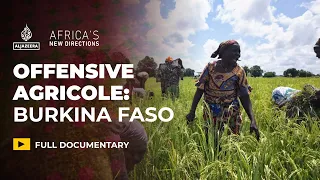
A wave of agroecological farming is launched backed by local knowledge and traditional techniques supplemented by cooperative innovation from Cuban and Malayan aronomists. And at the center of it all, gold. Burkina Faso begins rolling out its first experimental goldback savings note.
Not a national currency yet, but a test bed of sovereignty. Small-scale miners are now given priority. The government purchases raw gold directly, creating reserves.
It's slow, clunky, and draws heavy criticism from global markets, but it sends a clear signal. We will no longer export our soul to import survival. The ghosts of Thomas Sanka.
Every step forward reminds the people of a man who once dared to do the same. In murals, classrooms, and political speeches, Thomas Sankara's legacy returns, not as nostalgia, but as instruction. Trrower often quotes him not with romanticism, but as a road map.
He visits Sankara's grave in silence. He invites former comrades of the revolution to consult on governance models. But Troure is no carbon copy.
He knows that Sankara's downfall was not just foreign interference. It was internal betrayal, disunityity, and premature isolation. He is learning from those missteps.
To prevent internal collapse, Trroway establishes rotating civilian councils in each province. Community-driven platforms where elders, women's cooperatives, youth groups, and religious leaders contribute directly to policym. This isn't mere consultation.
It's power sharing Sahelian style. The question now is simple. Can Africa reclaim what is hers?
Her gold, her voice, her destiny in Waga Dugu, the answer is already being written.