hi there and welcome to another online video Lesson giving you important principles and helpful tips to improve your study and practice of public speaking in this lesson we're going to take a look at what I like to think of as the unsung hero of the public speaking process now I can't guarantee that speech outlining is going to be the most exciting gripping Edge ofyour seat topic you've ever examined but I can guarantee you that if you take the process of speech outlining seriously you practice at it and get good at it not not only are
your speeches going to be better organized but you're going to be a more confident public speaker because your speech content will be much easier for you to remember and present in a clear and organized fashion and as a helpful side byproduct of this process by becoming a better speech outliner you're going to become a better essay writer as well and that's pretty cool so in this lesson we're going to take a brief look at why you need to outline your speech in the first place we're going to spend the bulk of our attention focus ing
on what's known as the working outline and then we'll spend a little bit of time at the end talking about the aftermath of the working outline the speaking outline that you'll prepare as you get ready to actually present your speech but first of all all of this begs an important question why is it that we're going to outline a speech in the first place well as the public speaking textbook authors fry and tuman put it there's a really important principle underlying the speech outline process and that's an outline help speakers organize their thinking the classical
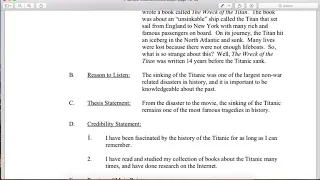
Canon of arrangement or how a public speaker organizes their thoughts into a coherent message is something that's been part of the program of rhetorical education for thousands of years and the most important thing to think of when you consider effective Arrangements of a public speech is to think about how the order of your points actually presents a coherent structure to your thought process so as this little excerpt of an outline from the frolly and tuman textbook illustrates a good outline shows the relationship between ideas it shows ideas in the order of their presentation which ones
comes first which ones come later and it also shows which ideas are the most important now for many things I tend to be a very visually motivated person and what's really helpful about a speaking outline is that if you construct it the right way it actually enables you to see The Logical structure of your ideas and how your points support one another and Lead towards the support and proof of even larger ideas and over the course of this lesson we'll talk about how that really works but this is the important thing to remember outlining is
not just a hoop you have to jump through in order to prepare a speech it really makes a difference writing out a working outline for your speech using the right kind of format and structure will lead to a much more successful speech than if you try to write out the speech in an essay typee manuscript format so how do you go about actually doing this well first of all we have to make sure that we're clear between two different types of outlines you're going to be working with the first is the working outline and that's
going to take the bulk of our attention in this lesson once you establish your working outline you've gotten the speech where you want it to be in terms of its construction and its organization then you're going to start practicing your speech with that working outline eventually weaning your way onto a speaking outline line and we'll talk about that towards the end of this lesson but we really need to focus on the working out line because it can mean success or failure in an effect of public speech so what does the working outline do well according
to fry and tuman it's also referred to as a detailed or a preparation outline and it's a thorough outline used to craft your speech so what sometimes people think of when they think of the outline of a presentation just like the outline of a paper is it's just going to be a sketchy structure of what the primary ideas are going to be and that's not what you want to think about when you write a working out line you are essentially writing the speech as much detail as possible to be as complete as possible it should
be according to frol and tuman relatively detailed to include your entire speech so by the time you're finished with your working outline there really isn't going to be anything in the speech that isn't in the text of the working outline and because you want to make sure that your thoughts are thoroughly and completely expressed according to frol and tumin you need to have each idea written down in full sentences sentence fragments and brief fragmente phrases are not going to get it done if you want to be able to be sure that you've actually said what
you mean to say you need to write down the complete thought and that means full sentences so so far so good but where a lot of people get intimidated by the outlining process is all of those Roman numerals and letters numbers and how in the world do I keep all of that stuff straight well here's how you keep all of that stuff straight the best way to focus on how to learn this process is to focus on outlining the body of the speech which is at first glance the most complicated part of the speech outline
but when you stop and really break it down all you're really doing is constructing chunks of your speech in well ordered logical patterns and so how do you do this well here's an illustration from Folly and tumin and it gives us a visualization of the primary structure where you're going to have a couple of main points in your speech each of those main points is going to be supported by individual subp points in other words supporting ideas or clarifying ideas that will help you prove your main point those sub points are supported by Sub sub
points uh perhaps those Sub sub points will be supported by Sub Sub sub points and when you start getting down into this level of detail this is where folks start to what but it's really important to think about the structure and to make sure when you construct your working outline you use proper labeling and indentation because if you do this the right way it's going to make sure you've got a tight clear and well organized logical structure for your points that you can literally visualize just by looking at the page so how does this play
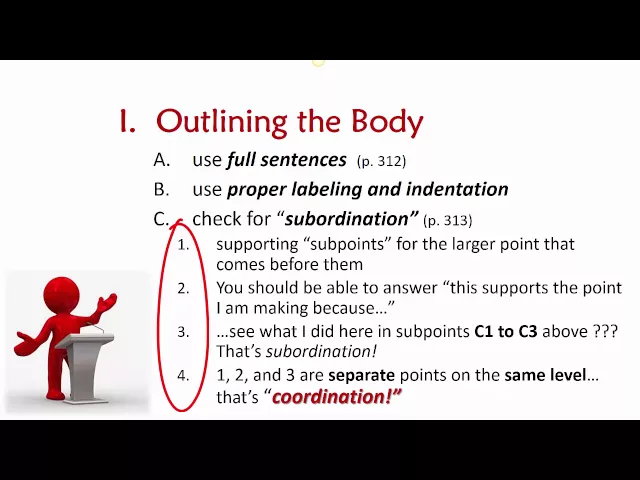
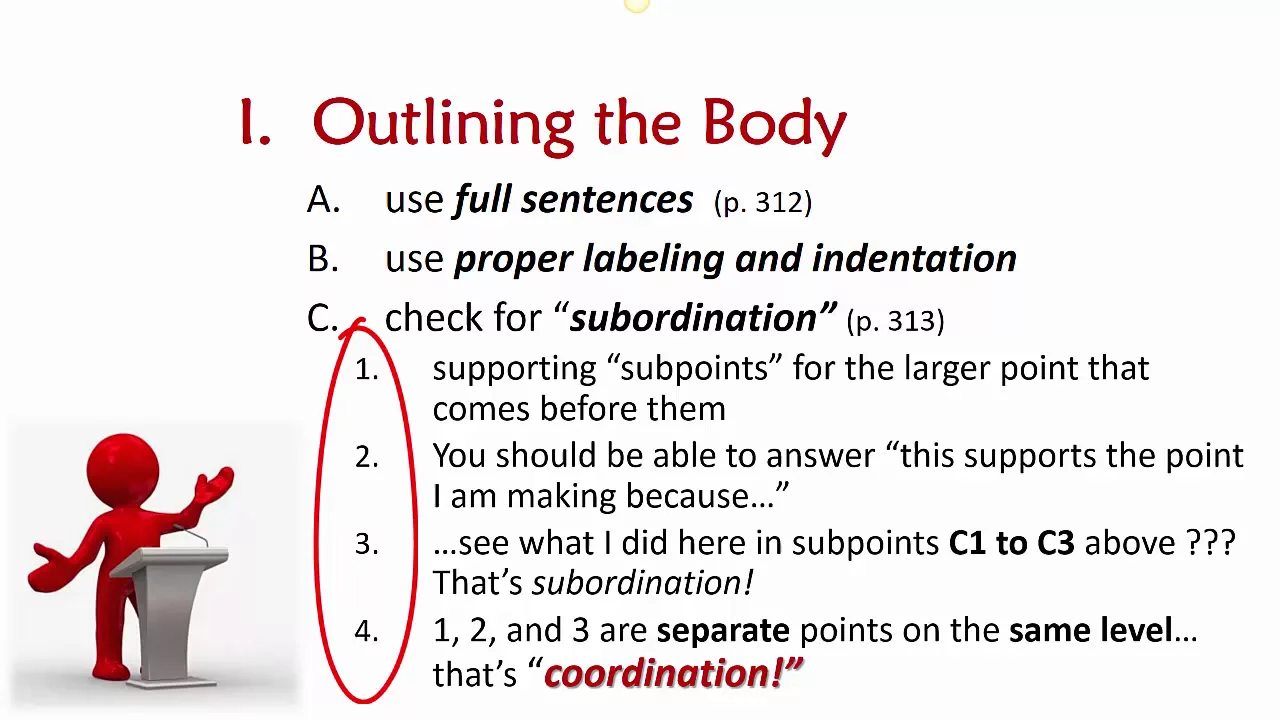
out well let's say that I'm constructing a portion of a working out line on this slide and so I've got a main point outlining the body um you'll just have to bear with me for the purposes of the PowerPoint medium I'm actually violating one of the rules I just told you about which is to make sure that you use full sentences I'll show you an example of what this is going to look like in just a moment but you want to make sure you're using full sentences you want to make sure you're using proper labeling
and indentation now the question you're asking is well how do I know that I'm using proper labeling and indentation well the labeling part's easy just follow this model you're always going to use Roman numerals for main points you're always going to use capital letters for primary sub points you're always going to use Arabic numerals in other words regular looking digits for your Sub sub points and then so forth so what is this going to look like well in order to make sure that you're indenting and labeling the right way you need to make sure that
you're clear on the concepts of subordination and coordination jargoning sounding words but they're actually really simple when you take a look at it when you're outlining a main point you want to make sure that you're checking for subordination now what does subordination mean well subordinated points are supporting subp points for the larger point that comes before them and so in order to determine whether or not a point should be a subo that's subordinated you need to be able to answer the question this supports the point I'm making because and be able to fill in that
blank so take a look at what I'm doing in these subp points 1 2 and three that are underneath the C subo check for subordination in the first one I'm providing you an essential definition of what you're going to do when you subordinate points you're putting down supporting sub points for the larger point so I've supported the main idea in subo C with a definition then what I've done is I've followed that up with a clarifying explanation so this is another Point that's going to develop and explain and support the point that I'm making in
subo C and then finally in this third sub subo I'm providing an example and the example is illustrating what I've presented in the previous definition and explanation so points 1 2 and three are subordinated under subo C because each of those supports the point that I'm making in C checking for subordination now what you can also see in the structure of the outline so far is that we have subo a subo b and subo c each of those are making independent points Each of which supports the main point that I'm making with Roman numeral one
on outlining the body of the speech so this is another example of what subordination means all it means is it's a point that you use to support the point that came before it so you always want to make sure that you're using the label and indenting those sub points and subub points so we can literally see which points support what points now by contrast take a look at the sub points 1 2 and three again you'll notice that those points are on the same level I haven't indented any of those sub points underneath the previous
ones because each of those points the definition the explanation and the example are all separate points that are on the same logical level all three of them those are supporting subo C just in a different way so when those points are on the same level like that making separate points on the same logical level that's what we call coordination those points are coordinated because they're all on the same level we also have coordinated points in subo a subo b and subo c all of those are separate points uh the point on proper labeling is not
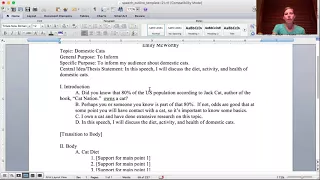
supporting the idea for using full sentences otherwise I would have made made that a sub subo and used a one and indented it but they're separate points so they're on the same level C is on the same level is B but those points 1 two 3 and four are providing support for what subordination is and what subordination is not so this is what it looks like now what would this potentially look like on an actual speech working outline okay so at this point we know that the working outline needs to use full sentences it needs
to use proper labeling and indentation and it needs to check for subordination what else do we need in this working outline well we need to make sure that we're including all of the information for our supporting material and so that includes not just providing the evidence itself uh whether it be facts or quotations or examples or whatever it is but we need to make sure that we're providing complete information on that evidence such as Source citations uh a properly ident identifying which elements are direct quotations and which are paraphrases and other forms of evidence everything
that you need to provide to provide a complete speech needs to go in this outline we also need to make sure once we've got our main point body sections put together we're going to need to insert transitions in between those main points a transition according to far and tuman is a sentence that indicates you're moving from one part of your speech to another this is an absolutely essential part of an effective outline and an effective public speech remember that a key difference between writing that you do in order for someone to read it and writing
that you do in order for somebody to listen to it as a speech is that well what happens if your audience gets stuck or gets lost or can't see the relation ship between one point and another Point well if they're reading they can just move their eyes back to the beginning of the paragraph they can reread a section that they didn't understand the first time when you're delivering a speech your audience can't rewind you they can't make you repeat entire sections so you need to make sure you make very clear to your audience when you're
finished with one mainpoint section and when you're moving on to the next section and an effectively crafted transition can do just that in a way that's short and simple but really effective here's an example let's say that I've got two main points for a speech uh the first main point is going to be a section in which I develop the idea that working outlines are totally awesome and I provide all the support and I provide all the evidence yada y yada now once I'm finished with that mainpoint section I'm going to want to develop a
second mainpoint section that speaking outlines are totally awesome what I want to do with a transition is what I like to refer to as a summary preview format in other words words it should be a sentence or maybe two sentences although you can usually get it done with one that's going to reinforce and tie shut the main point idea that you just finished and then it's going to provide a segue or a little preview to the point that's coming up so a transition that might be appropriate between these two Maino sections might sound something like
this now that we have a better understanding of the power of working outlines let's see why speaking outlines are Amaze balls too and then I would move on to the second main point speaking outlines are totally awesome now it's important to note that when you uh start practicing the speech using the working outline one thing that a lot of public speakers do for some reason is they'll present a complete transition but then they'll end up skipping the topic sentence for the second main point and jump right into their sub points you want to make sure
that not only are your transitions completely presented but your main point topic sentences should be completely presented as well remember each of those topic sentences for those main points those Roman numeral items on the outline are key Concepts or key ideas that support the thesis of your speech so you want to make sure you clearly articulate those so while it may feel a little bit repetitive to you that you've just previewed the second main point and now you're providing a complete topic sentence for the second main point if you're an audience member that's never heard
that speech before and doesn't have a transcript sitting in front of them that little bit of strategic repetition is really going to help you make the mental segue from one section to the next section it's tremendously helpful for your audience so you want to make sure you do it right okay so what might this look like in an actual speech outline okay once you finish outlining the body of your speech then you're going to want to outline the introduction and the conclusion from your speech now you'll be getting into what goes into effective introductions and
conclusions in more detail when we get to that particular unit in the course the primary elements of it are covered in your textbook early on when it discusses all of the primary elements uh for your first speech so this lesson isn't going to get into all of those specific details one thing that you do want to note though is that when you outline the introduction and you outline the conclusion you want to make sure that you label all of the specific parts so for the introduction you don't just want to provide these pieces you want
to label which part is the attention getter which part is the audience relevant connection which part is the appeal to speaker credibility which part is your thesis which part is the road map preview of your main points the reason why you want to label them on your speech outline is because when you're practicing it this is something that you're going to internalize as you go over it and over it and over it so that you can provide the right kind of delivery emphasis when you actually present it in the speech the same is going to
be true for the conclusion that follows the end of the body you're going to out outline it separate from the body structure and you're going to label the two key parts of that conclusion very clearly so label the summary of your thesis and Main body points and label the Clincher statement that's going to leave a powerful last thought for your audience what might this look like in an actual working outline now once we've completed the introduction and the conclusion we're still not finished with our working outline there's a little bit of simple but very important
material that you're going to want to put at the top of your working out line before the introduction it's important to include this to not only provide a sense for your instructor that you have a clear Focus for the speech but but also as a tool for you to make sure that you stay on track so that everything you do as you prepare the speech is moving toward your centrally intended goal so this pre- inro material is going to include the title of your speech and this is not an insignificant thing for the purpose of
classroom speeches the title isn't necessarily that big of a deal but if you do go into public speaking that's going to be involved for instance in a conference program or something that's open to the public the title of your speech can be pretty important not just to let people know what the speech is about but to also provide something intriguing and interesting that might attract people to want to listen to the speech in the first place so give the title of your speech some thought after the title you're want to provide a sense of your
specific rhetorical purpose and as we've talked about previously the purpose is not the same thing as your topic remember the rhetorical purpose takes your topic and focuses it on the following what is the particular outcome or result I want to have for my audience so once you have the title of the speech and the specific rhetorical purpose the final bit of pre- inro material you're going to include is the thesis now the thesis is not the same thing as your specific rhetorical purpose and it's definitely not the same thing as your topic the thesis is
essentially the most important propositional claim of your speech in other words if your audience were to forget every else what is the one single declarative sentence that this speech is about that statement is your thesis and you can see that if your audience understands your thesis and everything that goes into supporting it then you will have achieved your specific rhetorical purpose and so that's why you want to have all of these elements clearly articulated what might this look like in a real working out line for a speech now it's important to note that you're not
actually going to start the speech by presenting the title and the specific rhetorical purpose and your thesis you're going to start the speech with the introduction specifically with your attention getting material but you want to have this material before the introduction remember as a help to your instructor but also more important L as a tool for yourself to keep yourself focused and on track as you prepare the speech and as you revise and edit it in order to get it into its final version now once we finish with the pre-int material there is going to
be a bit of postc conclusion material that you need to include and essentially what we're talking about here is the references list anytime that you're going to be using evidence sources as supporting material for whatever you're talking about in your speech and that's going to take place in pretty much most most if not all of your speeches you're going to want to have a list of your references at the end of your outline part of this for classroom purposes is to make sure that you communicate to your instructor here's where I got all of my
information but this has practical real world applications as well what if somebody really likes your speech and comes up to you afterwards and says you know that was a really amazing book that you mentioned uh at that one part of the speech what's the name of that book again I want to go find it if you don't have your references list then if anybody in your audience wants to double check on or find out more about the supporting sources that you cited in your speech you're going to be out of luck and your credibility after
the fact is going to be hurt so you need to have a complete references list so how do you do this well you want to make sure that it includes all of the sources cited in the speech and by the same token you want to make sure that there aren't any sources in your reference list that you didn't site in speech and what you need to do is to make sure that those uh references are organized in a way that is very clear and not only easy to read but easy for people who are reading
the sources to go and find them themselves so for the purposes of our public speaking class we want to make sure that you format this reference list using correct APA Citation style uh the citation style of the American Psychological Association which is what social scientists including communication Scholars use now in other kinds of public speaking contexts you might end up using a different kind of citation style maybe MLA style maybe Chicago style but for the purposes of our course you want to learn APA Citation style and use it correctly not just in the references list
but also in any citations to evidence that you uh provide earlier in your working outline now if you need some assistance on how to set up a reference list and how to use APA style correctly you can look at our course syllabus you can look for the resources in our course canvas site and the com 1200 Library course guide provide a whole host of help resources to make sure that you can take your evidence sources and format them correctly using APA style so that's what we've got for the working outline so once you've got all
that done the next part of the speech process is going to be to start practicing your speech going over it rehearsing it again and again using your working outline until such time as you feel confident to transform your working outline into a speaking outline now what's a speaking outline according to froley and tumin a speaking outline is a very brief version of your working outline essentially a set of notes to Aid you in extemporaneous delivery of your speech you might recall from a previous lesson that we defined extemporaneous speaking as speaking that is both very
well prepared and rehearsed in advance but at the same time sounds natural and conversational you don't want it to sound like you have memorized a script word for word like an actor that doesn't really sound all that natural or authentic and you also do not want to read your speech to us the class is public speaking after all not creative reading so what you need to do is take all of the explicit verbatim detail that's in your working outline and boil it down specifically boiling it down to brief phrases key words and abbreviations you just
want enough notes on your note cards or on your note sheet so that it will spark your memory and help you remember all the stuff that's in your speech now to help you remember it's going to be important because after all we call this a speaking outline not just speaking notes that you want to use a similar structure to the working outline so that means using Roman numerals for your main points capital letters and Arabic numerals for your sub points and subub points even though you're just going to be using brief words and phrases to
remind you of what those bigger points are you still want to use the outline structure because you still want to be able to visualize very quickly what the structure of your speech is now besides just having the keywords and phrases you can also have additional information on these speaking notes to help you so Source citations of course are going to be very important you don't want to forget those if you do have specific things like quotations or more complicated statistics of course you can provide that additional detail where you need to have it you don't
necessarily have to and indeed you don't really want to have to memorize everything in your speech another good thing to include on your speaking outline are what I refer to as delivery notes essentially those can be little notes to yourself in the margin to remind you about things that you want to do when you deliver the speech there might be sections for instance where you might want to tell yourself to slow down or speak up there might be complicated words that are hard to pronounce that you might need to write out phonetically so that you
have an easier time pronouncing them anything that's going to help you deliver the speech put down in your notes so a sample note card for speaking outline might look something like this now this isn't necessarily a perfect version yours may look a little different but note what the speaker has done uh they've got the primary topic that this uh main point of the speech is dealing with and then they've got their sub points marked and then they've got their supporting Sub sub points for each of those sub points marked as well so A B and
C are the main subp points that are backing up this larger point about David McCulla 1776 and each of those sub points has a subordinated sub subo that has additional historical details at the same time you'll notice that this speaker is going to be talking about much more than just those very brief words on the card these phrases are really enough for this speaker to remember what they prepared in their working outline and then extemporaneously fill in the det detail themselves this is the point that you want to be at when you move your working
outline to your speaking outline ideally and for the purposes of our course this is the requirement you want to take your working outline and boil it down to no more than five index cards one index card for your introduction one index card for your conclusion and then one index card for each of your up to three main points for your speech if you can get your working outline down to a speaking outline of just five index cards using keywords and phrases in an outline format you're going to be not only a very organized speaker but
also a very well prepared and rehearsed speaker and that's going to mean audiences will be quite impressed with you and that of course is one of our big goals all right so this should give you a pretty good sense of why we want to outline in the first place the very important elements of how you construct and organize a working outline for your speech and then what you're going to do to take that working outline and translate it into a speaking outline when you actually deliver the presentation if you've got any questions or concerns about
this process please feel free to let me know otherwise I'll see you in our next lesson