♫ Music ♫ opening Hello, welcome the first class of its PHP Course My name is Gustavo Guanabara, I am your teacher. And finally we are beginning a course of more applications Video Course. Thus, two courses are very ordered: PHP and Java.
We will make these two courses at sequence, but I chose PHP for a simple reason, we have seen HTML and we saw algorithm. Also no good I give the course of PHP without having the course Algorithm, because a lot of people want to build sites, want to learn PHP, but do not know programming logic. So without further ado, let PHP Course.
This first module we are starting today, it is the course of PHP for beginners, is based, it is the first steps of language, so you can understand the language, so you need not memorize commands and more forward not see utility language. So we'll start by answering a question simple: how PHP has emerged? And for that, we need our timeline.
It all started in 1970 with the emergence of the Internet. And I'm not here to tell new internet history. If you now arrived at the course PHP, know that there HTML course I told the whole history of the internet.
If you have curiosity, it is important that you watch the video. Go on the website, sign up for HTML Course. Search is one of the first lessons if I'm not mistaken the second is the history of the internet.
And it's very important that you know the history of the network, because you will start developing for it, then you need to know the structure, know how it works. One of the lessons, also in HTML course, is how the internet works. So it's also important that you know it.
So I dating to where it all began in 1970, but I'm going to jump now to the emergence of something very important and you really need to know to start learning PHP. Then after the emergence of the evolution of the Internet, the main landmark that I create here, is from 1990 with the emergence of the World Wide Web (www). If you watched the history lesson of the Internet, surely you know this guy who is appearing there.
It is Tim Berners-Lee. He was responsible for the creation of the HTTP protocol making hypertext transfer, which allows you to view sites. In addition, he was responsible for the creation of HTML.
That allows the construction of the sites that will be displayed by the HTTP protocol. And here it is very important information. For you to learn PHP, you need to know HTML and algorithms.
If you do not have this knowledge, you just sign up for Video Course, make the two courses before starting this. It is very important that this happens why do not you will end up frustrating not learning a programming language not knowing algorithm, and not HTML. And believe me, no HTML, PHP does not serve anything.
Basically, HTTP and HTML, They work together to talk to the conversation between servers and clients Understand the following: all HTML, you create, and wants to provide greater amount of customers possible You have to be on the server. The role of HTTP, is to get a copy of HTML, and send pro client. From there, the customer will be able, through your browser, display the contents on the screen.
The whole basis for this knowledge, was created from 1990 to Tim Berners-Lee, and its technologies. The technology emerged in 1990, It was simple. Basically, I have an HTML, that is in my server, and my client that is.
Then the server will pick up this data, and send Pro client. Simple like that. This works for HTML files, photos, images, sounds, what you need to send.
And for four years, this was the only technology available. you had a file, the file was sent pro client. Only that.
And not another type of interactivity. It was here that in 1994, a user has the following question: and if I want to know how many people are visiting my site? The user who asked this question, has a name.
It Rasmus Lerdorf. You may be wondering his name. Or even amused.
But Rasmus has this name because of its origin. He was born in Greenland, and raised in Denmark, when young and later went to Canada. When I lived in Canada, Rasmus felt this need.
He wanted to know how many people were visiting your website at that time. And as Rasmus was an experienced programmer C language, decided to create an interface I could afford it. He named his creation as, Personal Home Page Tools, and if you've watched the letters that I have highlighted, noticed that this little creation Rasmus, It gave rise to the PHP name.
And do not be confused! In this first version of PHP, he was not a programming language. It was simply an interface to check power, how many visitors were accessing the site that moment.
In fact, this was called CGI within HTML comments, and used very simple commands. These simple commands, were based a language that Rasmus also knew very well. Perl.
So much so that even today many uses PHP commands which are used in Perl. And this functionality created by Rasmus, made a relatively successful and inspired him, to create the second version. With a few more things, for example: Creating a guestbook for a site.
Today, when you enter a site, You can leave very simple comments down there. In 1994, it worked not so. Rasmus has created a way for users interact with the owners of the sites, leaving messages through custom forms.
Then, from the second version of PHP, he allowed features such as: the interpretation of forms. This made Rasmus renomeasse your project Of Personal Home Page Tools, for Personal Home Page Forms Interpreter. Which are forms of interpreters.
The tool became even more popular and version 2. 0 of the PHP has become well known as phpfi. Note the following: to this point, PHP is not considered a language.
It is a library. It is an interface. CGI, which assists in the creation of some features to your personal page.
Your "Personal Home Page". What was the original meaning of PHP. The first step for PHP to transform In a language, it was given unconsciously by Rasmus.
He wanted her to grow tool. And for that, he released access to other programmers, the PHP source code. Right away, the phpfi, which is the second version of PHP, It gained additional and very important features.
Like for example: Access to the database. From that point, many developers began to add features in PHP, and make it increasingly popular. And the popularity was so great that in 1997, Netcraft, a company responsible for making statistics on the Internet, already noted that more than 60,000 domains already using PHP to create interactivity with its members.
And from 1997 we can set a milestone. This was the hallmark of the great popularity of PHP. With so many developers helping the tool has grown, and gained new features.
But the main contribution came from Israel. In 1998, two Israeli friends, The Zeev Suraski and Andi Gutmans, they were programmers They decided to completely rewrite the PHP. Giving it actually programming language features, PHP was already winning so it was like, the first version of PHP, I had only users of a site.
The second version, already interpreted forms. When Rasmus released the code For programmers auxiliassem he in the development of the tool, the Zeev and Andi, rewrote the language code. And from that moment, PHP has turned into something much bigger, much larger than his little name, it was personal pages.
So, the community decided to rename the language. But the PHP name was already known too. It would be a shot in the foot, changing the language name.
But then they decided, let's change the name of the language, but we will not change its acronym. From version 3. 0, PHP has ceased to be called "Personal Home Page" and it came to be called, "PHP: Hypertext Peprocessor" That's what you're seeing!
The first P PHP, It means PHP. This feature is widely used in the free software crowd And calls, recursive acronym. Where a letter is the very acronym.
This also works on GNU, which is an acronym for "GNU's Not Unix. " so well, in php, the first P is PHP. thus, there is the 3rd version of the language, created by several developers, especially with the contribution of Zeev and Andi.
The version was so popular, in 1999, it was estimated that 10% of the sites were the World Wide Web, PHP used in some way. And from 99, PHP only it has grown more and more and more and like all popular tool, users have begun to discover a quantity errors, and language security flaws. To solve this, the Zeev and Andi team, aided by several other programmers They decided to create ways to ensure greater security.
And from there, in 2000, only a year later Version 3 have come out, comes the version 4 of PHP. So the version 4, she had three subversions within your life. The main focus was the resolution of security problems.
Of course, other things came. But as this is an introductory class, I will not stay here describing each the steps of the language. What matters now, It is knowing that language It had its birth, and had its evolution.
From the end of version 4, The Zeev and Andi decided to create a new engine, a new core to the language Then comes four years later, five version of the PHP And five PHP version that appeared in 2004, was the one that lasted the market. So far, there are 32 (thirty-two) versions, that's right. PHP 5 was 32 (thirty-two) versions in your life that lasts until today, when I'm recording this video Throughout his life PHP had over a thousand patches / security flaws And he had the framework of its appearance, its engine 2.
0, created by Zeev and Andi It was this version that we are using here, that absurdly popular PHP language So today, the PHP language is one of the most famous in the world thanks to that we came in 5th version and its 32 sub-versions of PHP. But already in 2004, it has already discussed the great "callus in the shoe" of PHP unicode. And if you did our course of HTML5, you must surely remember when I spoke of unicode.
When we used the UTF-8, "UTF" it is an acronym for Unicode Text Formatting. It allows compatibility regardless of the language texts. PHP still has unicode interpretation problems today, but truth be told, It is still a thorn in the side.
So in 2006, he has started to speak in version 6. 0 of the language Its main objective would be to solve the problems created by the incompatibility with unicode The problem is that this promise made since 2006 have not been fulfilled, and by the end of 2013 The most we had left was the 5. 5 version of the language Of course, many promises that were made from 5 to 6, have already been implemented these versions prior to version 5.
5, but PHP in version 6, is still a promise The course you are about to do, will address the functions and features created by the 5. 5 version of the language. Interrupt your class to give two very important messages.
PHP course for beginners that you began to see today and is completely free to you, only happened because of these two great companies, Hostnet WebHost and T1 Site These were the two who believed in the PHP course of the project and brought it to you for free But we have a whole structure to be able to put together good classes and with the highest quality of those courses that you pay for what I know. Hostnet hosting sites, it is where you will put your site. It's starting to learn PHP, you will need a place to put your website in PHP So, you can trust whom?
Hostnet hosting sites The Video Course, if you are on the course platform Video, so all you're seeing If you are on YouTube is not so much, but if you are on the course platform Video Everything you see around here, staying in Hostnet. If you are working, it's cute, it's in the air, you're getting to see, download the packages, Thanks to Hostnet web hosting because it is hosting and it is what ensures a professional service And T1Site is a newcomer family Course in Video What does she do? It creates websites in PHP, because creating websites in PHP is not only know HTML and PHP You have to know design, it has to taste good, you must be able to create a new brand create all cute.
Then T1Site will help you with that. So it's nice, you hire the T1Site they will create from the contract to the time they deliver, is very little time, it's really cool their service. And then you'll have a whole site in PHP and you will be able to move it.
Then the site will be professionally created with a price you do not believe. Dude, it's worth. Worth it "T1site" (have a website) Contact the guys, they will build a website for you real quick, it will be all in PHP.
And you, at the end of this course will be able to move your site to be beautiful and professional. You will be able to touch it, because you know PHP thanks to Video Course. So I wanted to leave a big hug to all the companies that sponsor and help the Course Video We have several supporting companies, you saw there at the beginning, in the opening.
But these two here, it is with love that I speak. Hostnet and T1Site, thank you for everything, thank you for your support. Turn your small class grasshopper!
Study boy! And before closing I have some very interesting trivia to show you. The first is the relative popularity of language You must remember the moment I said that PHP has reached 10% of the installed base of servers.
Today, it is estimated that this figure already exceeds 75% of the servers that host sites and using the PHP functionality. I spoke here also several versions of linguagem. Você can have access to all of them since version 1.
0 To 5. 5 in museum. php.
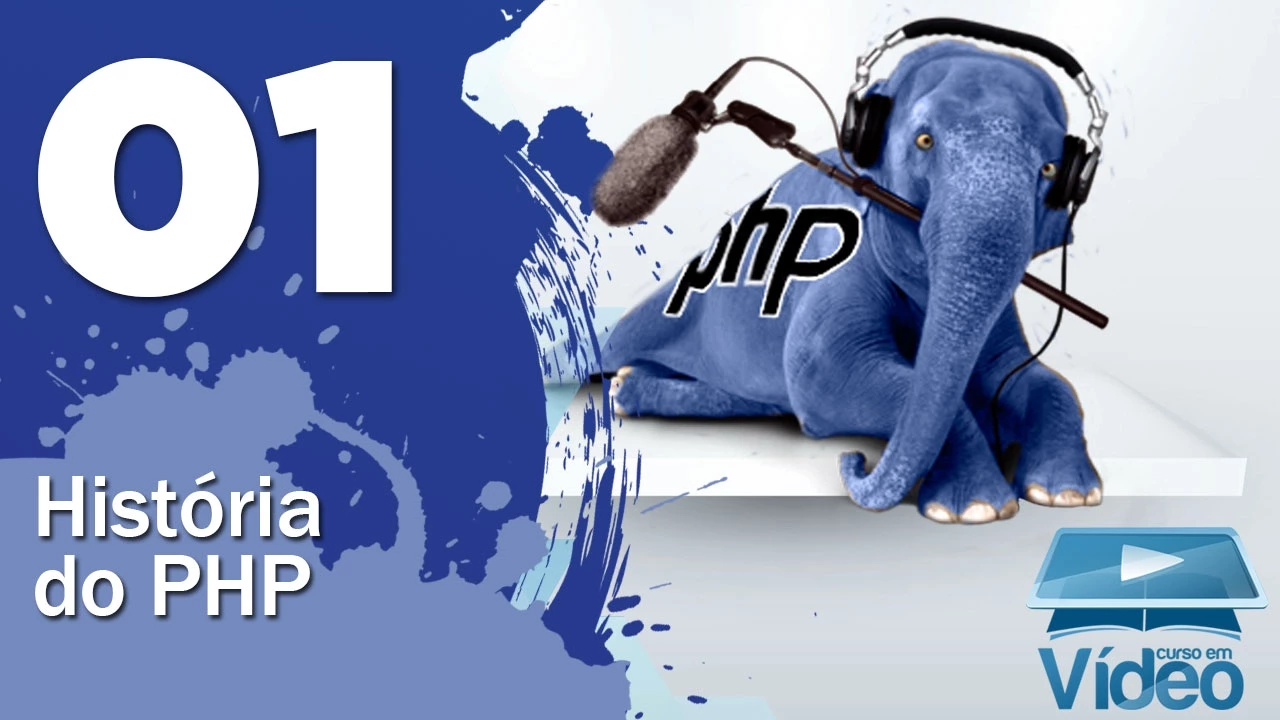
net site There, you can download all versions and understand this evolution Another very interesting curiosity, is relative to the mascot of the PHP language, if you searched for, if you took a look around, Have you seen the mascot of PHP is a friendly elephant He was chosen because of the name of language structure, PHP, It looks like an elephant. And I'm not going crazy. From a look here, PHP .
. . Not look like a baby elephant?
Can not you see? Now look again and see if it does not. You see?
And you said I was crazy. So this is the mascot of the PHP language. Because PHP name, looks like a baby elephant.
And another very important curiosity is the following, a lot of people who create sites in PHP, without knowing a PHP line. As the language has become very popular, many developers began to create content management system. And today, you can create a complete website using WordPress, Joomla, Drpal, you can create an electronic store using Magento, Prestashop, you can manage your business with SugarCRM, can create a collaborative network of content using MediaWiki, can create social networks using Elgg, forums using PHPBB, and educational environments using Moodle.
All these tools have one thing in common. All of them are created in PHP language. So when you take a tool like this, the creation of sites, which is free, you can be sure, PHP's there.
You do not need to know move, but if you know, you can customize. You know those people who create custom themes for Wordpress? Creating Joomla modules?
All this is created using PHP And that's why you have to learn this very important language. And finally: I'll take a question that many people ask me. "Guanabara, and the guys who created the PHP, where did they go to?
" Well, Zeev and Andi are still together. And so together they created a company with the addition of their names. Joining Zeev and Andi, they created Zend.
Zend is the company responsible for maintaining the PHP core and create one of the most famous frameworks of language, Zend Framework. Already Rasmus, who was the creator of the language is no longer so attached to the project. He spent seven years working at Yahoo !
, and now works in the infrastructure of Etsy, which is a famous e-commerce store dedicated to artists. so it is with these information Property reached the end of the first class of his course of PHP In the next lesson, you will learn how a PHP server and what is the difference from traditional servers that only support HTML. I hope you enjoyed this lesson and I hope also that you share this information with as many people as possible go there on your Facebook, go there on your Twitter, go there in your Google + .
. . And show people, looks just started a PHP course here .
. . Attends class with me.
Share knowledge as well as I'm doing. And the simplest way to access all the information is by going here "cursoemvideo. com" why there is where you will get the full experience there you can already download the packages with the tools you will need to watch the PHP classes Click here .
. . you will sign the channel and the side of the "sign" .
. . after you click on "subscribe" you'll get a "engrenagenzinha".
Click there and says, 'I want to receive the new information by email' Whenever you have a new class, out on YouTube you will receive an email saying you have new class PHP is a great way to be remembered every time you have new content and do not worry . . .
you will only receive e-mails with educational content. I guarantee to you! By clicking here, you will have access to full playlist of this course PHP, and do not forget .
. . if you are learning PHP now, and still do not know HTML or algorithm .
. . stop watching these classes, watch there at the course site in Video, in that order I'm telling you The first course of HTML, which is much more "facilzinho" after the course algorithm .
. . practice enough, and then yes you get to class PHP .
. . So I hope I have helped again the current video aims to create quality classes to form better and better professionals and it all just depends on you!
a big hug, and good studies to the next. ★ ★ Recording Errors Hello. .
. [Clearing his throat] . .
. Prepares hello . .
. Hello! .
. . Welcome to first class .
. . .
[Clearing his throat] . . .
Throat. . .
So no more . . .
(͡͡ ° ͜ ʖ ͡ °) And here it is . . .
[lost] From this point, a number Program . . .
[Angry] . . .
. . .
. . .
. . .
. . .
And here it is . . .
more And here it is important information . . .
(͡͡ ° ͜ ʖ ͡ °) . . .
Pereba . . .
Starting the course like? [Laughter] Do not speak . .
. [Laughter] [Laughter] I can not stand face, okay in my head . .
. [With funny voice] "Straightening the little hair . .
. " [Laughter] [Laughter] . .
. Delayed . .
. [Laughter] You know what I'm thinking . .
. Clapper . .
.