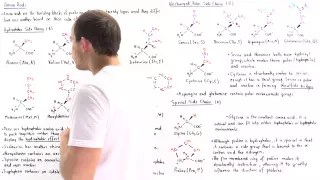
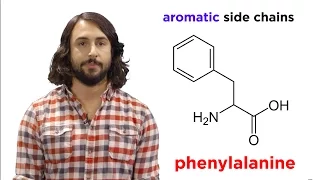
welcome to this episode of real chemistry today we're going to be talking about side chains on amino acids remember that amino acids are the building blocks of protein and we're going to quickly learn how to identify amino acids as polar non-polar or charged in most cases this is relatively straightforward if you already know how to identify an organic molecule as polar or non-polar it can be a little more complicated in a few examples and we'll highlight those so first up recall that the side chains are the part of an amino acid that varies and they're
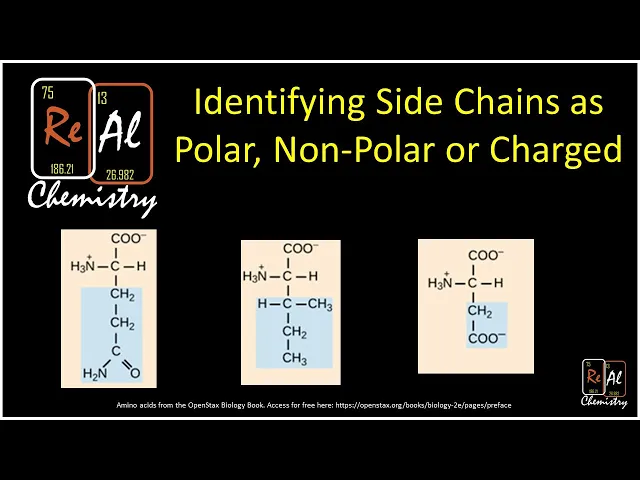
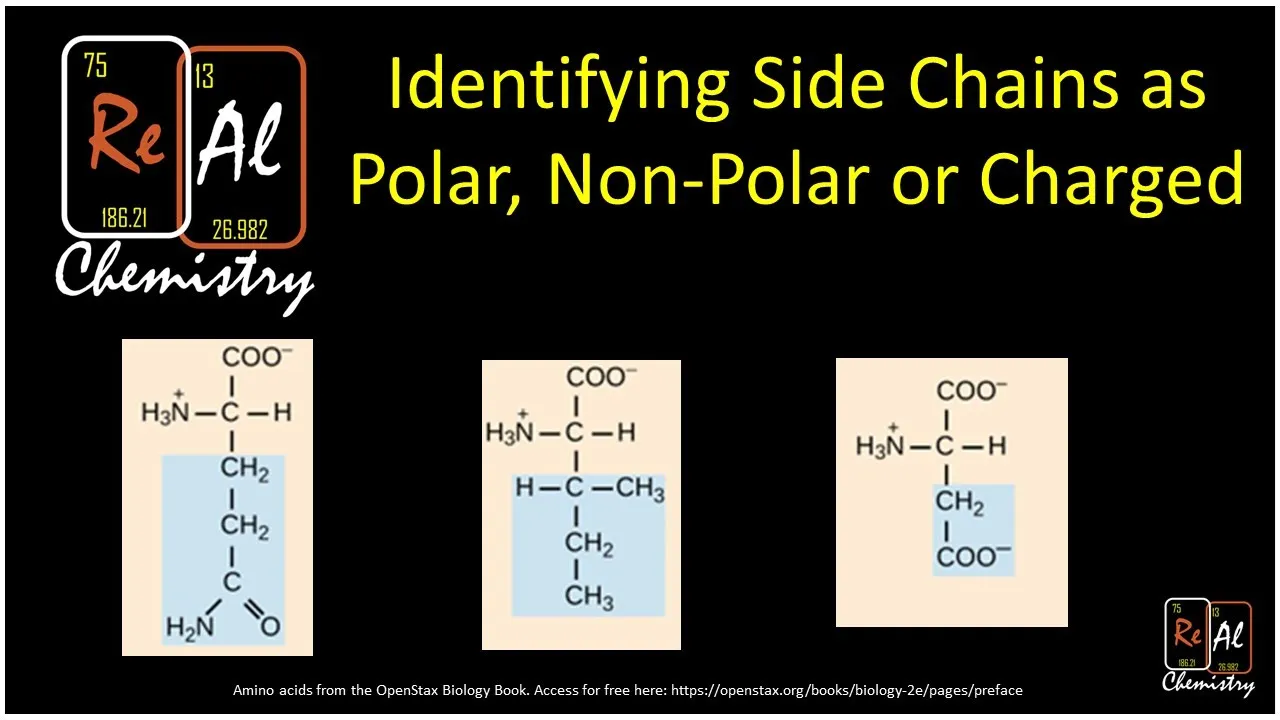
highlighted in orange here so this very first side chain we see contains nitrogen and oxygen things that are going to generally make an organic molecule polar and that in fact makes our side chain polar next up we have an amino acid with only carbon and hydrogen in its side chain and that's gonna make it nine polar not nine polar what's nine polar it's gonna make it non-polar maybe i was speaking german in any case that might be a little confusing because you might say hey isn't there some oxygen up here and some nitrogen up there
and what that highlights is we're only looking at the side chains amino acids as a whole are polar but we want to identify just what the properties of the side chains are and that turns out to be important because when you combine amino acids into a protein then those side chains will actually interact with each other and the types of interactions they can do depend on the side chain okay charge is the easiest if you have an amino acid list that shows charges okay and that's the amino acid list i always use because then it's
really easy you just see a charge hanging out and if you see a charge hanging out on the side chain you know it's charged okay if you don't have an amino acid list with those on it then you may just want to google one if you have to memorize your amino acids then you should definitely memorize which ones are charged okay so now we've got polar nonpolar and charged let's just go through a few rules to identify those more generally and then do a practice problem okay here's all the polar side chains so the polar
side chains the way we can identify them is that they contain oxygen so almost always our polar side chains contain oxygen notice there's an oxygen an oxygen an oxygen and oxygen and oxygen the only exception to that is cysteine so cysteine has a sulfur and a hydrogen right on the end of its side chain and that turns out to be polar as well so cysteine is polar even though it doesn't have an oxygen so that's one of those important ones that you might get wrong uh unless you are careful to remember that so cysteine falls
in the category of a polar side chain okay so if it contains oxygen or if it's cysteine it's generally a polar side chain the only other exception to this is if there's a charge shown if there's a charge shown explicitly then that would be a charged amino acid as we'll see here in a second okay next up is our non-polar side chains non-polarized chains have a really good rule to identify them they just contain all carbon and hydrogen with two small little itty-bitty exceptions okay so in almost all cases so here we have nine amino
acids seven of them contain just carbon and hydrogen so that's a really good rule of thumb the two exceptions are methionine and methionine has a sulfur in the middle of the carbon chain which is different than our cysteine which has it at the end of a carbon chain so it turns out that that sulfur being in the middle of a bunch of carbons gives you a nonpolar bond and so methionine is nonpolar the other important exception here is tryptophan it has a nitrogen hanging out on it so you might initially think oh that's going to
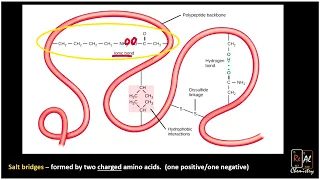
be either charged or polar but it turns out that tryptophan is non-polar so i would recommend just memorizing methionine and tryptophan those are probably the two trickiest of our side chains to recognize as polar non-polar or charged okay last up are charged amino acids and again if you have the right amino acid list that shows the charges then this is really trivial because all you got to do is look in your chain and if you see a charge then you know it's a charged side chain now this supersedes our rule about containing oxygen so you
will notice if you take close look some of these have oxygen and so you might want to be like hey they're polar the truth is they are polar they're also polar but the charged characteristic of the side chain is the dominant feature that's going to determine their side chain interactions and so we categorize them as charged though it would be not incorrect to say they're polar and charged that's totally true but we categorize these as charge so here's the five charged amino acids okay let's quickly identify a few amino acids as charged polar or non-polar
first up our amino acid on the top left we take a look at it and you might be like oh a snap there's oxygen there is but there's also explicitly a charge drum very often when there's a charged drawn it'll be either like this or something like this okay so keep an eye out if you see nh2 or coo definitely take a look for a charge there so that guy turns out to be a charged amino acid all right sweet now let's go to our next one here we got oxygen and there's no charge explicitly
drawn so since we have oxygen and there's no charge explicitly drawn then this is going to be a polar side chain so remember that our polar side chains contain oxygen or our cysteine so if you see cysteine in there then you definitely want to remember to throw that in the polar camp okay amino acid c here has a charge explicitly shown so again it's charged and lastly i bet you can guess by the process of elimination what this one will be here we have only carbon and hydrogen and so that's going to make this nonpolar
so that's just a brief introduction to thinking through the properties of side chains which we'll build on in a future video where we look at side chain interactions thanks for watching this episode of real chemistry