Your consciousness vibrates at a certain level. It can be accelerated, it can be decelerated. Your inner name, at what vibrational level is your consciousness?
Because dense matter vibrates so slowly that it seems still. The spirit vibrates so rapidly that it seems still. These are the two extremes.
And accelerating a being is simply increasing its vibratory level. You must have heard of Plato, for example, in his Republic, when he dreamed of an ideal city, he said, beware of the music the government gives to the people. Do you know why?
He even said, I know a state by the music the rulers give to the people. Because music is pure vibratory pattern. And it has the ability to tune you to its vibratory pattern.
Don't think, nothing is without consequence in our lives. A person who is used to listening to music with very coarse, very aggressive vibrations, and says, this has nothing to do with my life, I am a person of principles, but I like this music. Forget about it; at some point, when faced with life's difficulties , your consciousness will gravitate toward the vibrational pattern it's drawn to.
Plato spoke of music as a fundamental element of education. There was a philosopher from the last century, Sri Ram, who said that evolution is nothing more than the refinement of taste. Be careful of things that pull your consciousness toward coarser vibrations.
This doesn't go unpunished; nothing in life is unpunished . Evolution is an acceleration of vibration. It's vibrating more and more toward things that are more subtle, nobler, more celestial, more spiritual.
I don't vibrate much toward certain rhythms that are too coarse or violent. I vibrate toward things that are a little more refined. I vibrate toward deeper things that speak of human nature.
I am refining my vibrational level. I am growing. And your vibrational level, at a given moment, is your identity.
It's your inner name. It's the deepest thing you can tell someone. If they ask you, "Who are you?
" Do you understand? If you have before you a philosopher, a true sage, which is very rare these days, but imagine you did. The most profound thing you could tell him about yourself is: what do you vibrate with?
That's your inner name. Beauty is the result of harmony. Harmony both external and internal.
And it's logical that if we know how to perceive a pattern of harmony, we also know how to produce it. Again, this author I quoted, Sri Ram, he said that evolution is nothing more than the refinement of taste. That is, increasingly perceiving beauty in a deeper way, in human gestures, in human values, in human work.
Increasingly being able to go beyond appearances and perceive this intimate beauty that exists in practically all things. A child is very interesting because if you ask her if a person she loves is beautiful, she will always tell you yes, she is beautiful. She goes beyond this superficiality, which isn't just about loving; it's also good to cherish our physical beauty.
There's nothing wrong with that. But it's bad when it becomes a mask covering up a world that is anything but harmonious. Superficiality isn't something that just appeared now.
It has existed in all eras. Now it remains to be seen whether that cultural context encourages superficiality, or tries to pull humanity out of it. I need music, I need a movie, I need entertainment.
But can't that music and that movie also be something that makes you think? They can, right? Does it have to be something so superficial?
So superficiality has always existed since. . .
There is man. But there have been civilizational contexts where there was an invitation for man to delve deeper. Today we don't have that invitation.
We have an invitation to be even more superficial. Increasingly on edge, increasingly thinking less, increasingly buying ready-made life software , just press play. When you are embedded in a culture that encourages superficiality, going against your environment, against your cultural context to develop something deeper is very difficult.
There is something heroic in that, it requires a lot of courage. When you do it alone, against the grain of your culture, your civilization. Our physical body, every day we go and bathe it, to remove all the impurities that adhere to it , to purify it.
In your mental plane, at some point do you go there to remove all the impurities that are in it and throw them away to purify it, or do you carry all these things throughout life? It makes no effort to leave behind moments of anger, moments of violence, all the heavy things you've witnessed in your life, all the heavy things you've received as information, no kind of purification. How would the physical body be in those conditions?
How will our bodies be? Everything we do can have a dose of vanity, any work. Now, the meaning of art is to want to bring beauty to the world, to want to bring harmony to the world.
This brings a great sense of accomplishment when you realize that beauty used you as a vehicle. Harmony used you as a vehicle to come into the world. As if these ideas were all gravitating in the realm of ideas, as Plato said, and needed an intermediary to come into the world.
Through the eyes of the artist, any human being sees beauty. Many times I look at a landscape and see nothing. If an artist paints that landscape, I will see tremendous beauty through his eyes.
So, it is very beautiful and very powerful the experience of beauty passing through us to come into the world. To be vehicles for beautifying the world. 99% of songs talk about love, romantic love.
In general, it has nothing to do with love, sometimes even less than romantic love. And you've probably seen that famous line in every romantic song: " You are everything I need to be happy. " What do you think of that?
Do you know what everything you need is? Yourself. The other person can walk alongside you, but you can't replace your spine with a crutch.
You can't look outside for something you can only achieve within. They can walk alongside you, but they can't give you yourself. They can help you walk together.
This fantasy leads to disappointment in the face of coexistence. Why did he deceive me? No, you deceived yourself.
The other human being is another human being. What you lack is yourself. You can walk together.
And if you expect the other person to give you yourself, yourself is something only you can achieve. And this will necessarily generate disillusionment. Why?
The other one tricked me, not you. Rhythm. You 'll realize that this is another secret of nature that I find incredible.
You can see the planets revolving around the sun, each at a different speed, each at a different distance, each at its own pace. The harmony of a solar system. You see the rhythm of nature, both in a year, the seasons that allow us to have food and survive, and in a day, also the moments that allow us to rest, recharge, and return to waking activity.
Nature is cyclical. Then you go inside your own body. You'll see it's the same thing.
The body doesn't respect any kind of inertia. It functions by rhythm. It's the rhythm of your heart, the rhythm of your breathing, the peristaltic rhythm of your intestines.
All life functions based on rhythms. But when we act in the world, we fall into inertia very easily, we don't respect any rhythm, and we think we won't lose our lives because if our heart decides to fall into inertia, then physical life is over. Inertia also kills other types of life —life in the psychological, moral, and spiritual fields—because life is always sustained by rhythms.
If you don't know how to create and maintain them, you won't vitalize any field, whether it 's your inner life or the external life of the environments where you participate. You won't be a contributing factor to life. You'll notice, those who watched Caibalho, we talked a bit about this.
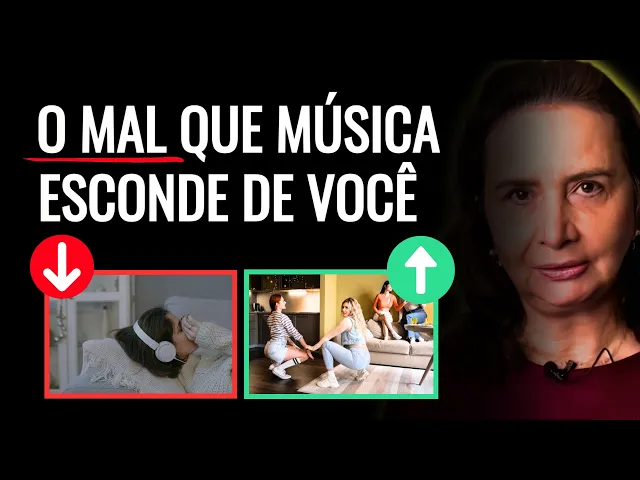
Plato, he talked a lot about music. Music is vibration , and this vibration pulls your consciousness into tune with that vibration. We don't need to be synesthetic or paranormal to realize, for example, that a person who likes vulgar music will, at some point, be vulgar.
A person who likes violent music will, at some point, express violence, and their consciousness has attuned itself to that level of vibration. At some point, they will express similar things. Nothing in life is without consequence.
Those who watched Caibalho told you that our essence, according to Egyptian tradition—this is complicated, but we can imagine it—says that our essence is the pattern in which our consciousness vibrates. That's you. The Egyptians called this the inner name.
My consciousness vibrates on this plane ; it vibrates in the face of beauty, goodness, and justice. Well, that's me, and what do I have to do? To pick things that vibrate at the same frequency so I can settle my consciousness or pull it forward, and I start to attune myself to things that vibrate down here, I'm going to pull my consciousness down.
Then you'll realize that throughout history there's always been talk about refining your taste, that taste doesn't impunity what you read, what you hear, the company you keep, because everything is vibration, and when you create attunement with a very low vibration, your consciousness will revert there. You'll realize it's such a complex thing. For us in the past it was obvious; Greek theater was very careful when a person was going to play a villainous character; it needed to be a mature person, with a lot of identity, a lot of self-control.
An immature person, who interprets the character of a villain very well, their consciousness identifies with that, and then they can take that as a possibility. This can generate madness, this can generate delinquency, this can generate a lot of things. Batman, exactly Batman, you know that Batman where the Joker committed suicide at the end of the movie?
He was an immature boy, and it's said that he locked himself in a hotel studying the character, simulating it. He created a pathological identity because the character is pathological, and he wasn't mature enough for it. These Greek playwrights, like Aeschylus, were very careful with their actors.
You can't cast an immature person because you've created an affinity with a vibration that their consciousness can revert to. It needs to be a mature enough person to disidentify. And the Joker is a psychopath; he acquired a psychopath's mental pattern.
The Joker is a psychopath and created that as a possibility in his psyche and identified with it. For a Greek, it would be irresponsible to do that to a person. In other words, the type of music you listen to, the type of reading you do—all of that generates consequences in your life.
So when you. . .
By cultivating habits of good music, you will actually generate, sometimes, if you are an architect, constructions in that, you are not a musician, you will generate constructions in what is proper to you, you are a philosopher, works in your life, you are a person of values, you will generate values, but from that vibratory pattern you will realize that there is a relationship between the house you build, the values you have, and the music you listen to, although they are different things , they are all vibrating in the same pattern, in the same harmony. Art, beauty is always a lesson in harmony, and we always need lessons in harmony. Art gives us a pattern of harmony that we can reproduce in various environments of our lives, in our words, in our thoughts, in our actions, in our coexistence above all, the harmony of coexistence is a great human dream because through harmony in coexistence we can reach unity where all beings complement each other instead of competing with each other, that is, art is a fundamental tool for the elevation of consciousness, and this was already said by Plato.
Plato worked a lot with music in his dialogue The Republic, music as a fundamental element for the Harmonizing people's consciousness, so I would say that human feelings depend a lot on art, true human feelings depend a lot on art to be well-formed. When we combine culture and technology, what do we get? What brings out the best in humanity with skill, intelligence, and ability —look how incredible—and these ingredients only exist within human beings.
True culture and true technology are our capacity for imagination, creativity, innovation, but also compassion, collaboration, and empathy. These two things together create the necessary association between humanistic culture and technology, extremely necessary for us to take the next step. Imagine if we are inside a vehicle and the landscape seems boring, it's because the vehicle is stationary.
If it were in motion, the landscape would always be renewing itself. The same thing happens in our lives. If we are walking, if we are on a path of self-improvement, of course the landscape is interesting, it's always changing.
When we stagnate, when we become frozen, the first thing that happens is that life starts to become boring, life starts to become dull. Then, at some point, fantasies and methods of escaping life begin to unfold, and then come addictions of all kinds, from the mildest to the most critical. It's curious because we have the impression that our purposes are a choice that we have to make.
What we have to do, what we have to search for, when in fact the answer is much simpler: nature made human beings to reach a common peak, like imagining a pyramid with several faces, that is, each with a personality, each with a vocation, but as they grow, they move towards a single point, which is the maximum fulfillment as a human being, a human being with values, virtues, and wisdom. That is the goal, the fulfillment, the purpose of all humanity. There is no doubt about it.
We are lost because we do not seek a greater purpose that justifies our entire lives; we only seek to survive in a pleasurable way. If we tried to imagine what nature expects of us, why it built us, we would realize that it expects us to finish its work, to build ourselves as complete human beings. And a complete human being is exactly that: values, virtues, wisdom.
That is your purpose, it is mine, it is everyone's. The path we will take to get there will be very different, basically one for each human being. But in the end, up there we all meet at the same point, which is the complete human being, the ideal human being.