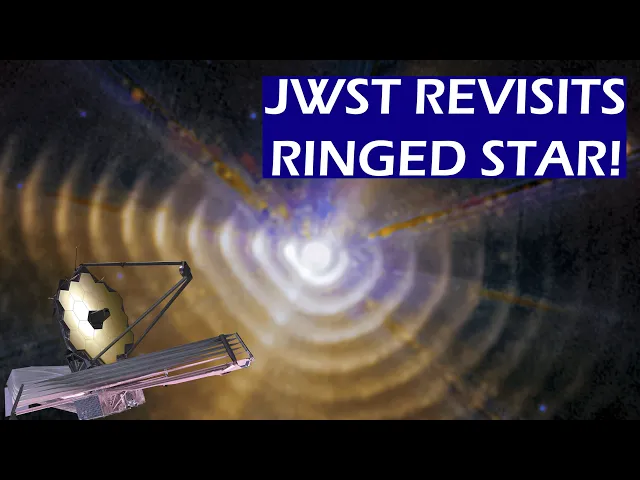
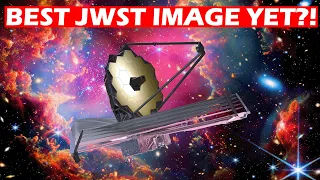
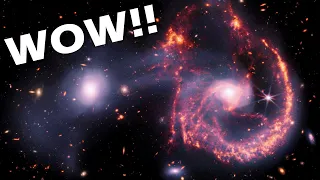
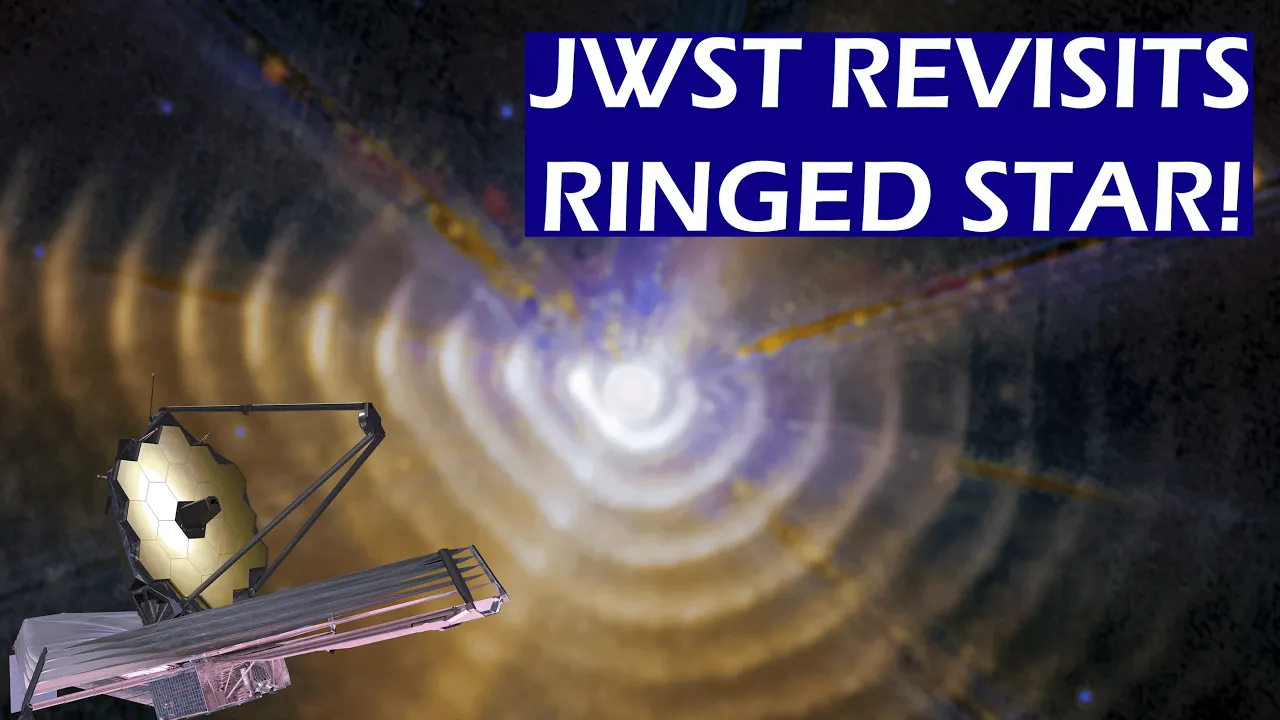
this is the first brand new jwst image of 2025 it shows rings around a star well actually two stars are hidden at the center of this image what's especially cool is that this system has been imaged by jwst before and by comparing the two images we can see the rings around the stars move and expand letting us watch the physics of star interactions happen before our eyes [Music] this is a star system called wolf rat 140 it's 5,000 light years away from us which is a long way but it's still in our home galaxy The
Milky Way a wolf rot or WR star are typically colder stars that are at least 25 times more massive than Aram and more likely either collapse into a black hole or explode as a supernova once it reaches the end of its life WR Stars Burn hotter than they did when they were younger and weren't yet classified as wolf rot stars and this heat generates powerful winds away from the star that can push huge amounts of gas outwards into space that will be important in just a moment the obvious and beautiful thing to notice in the
new jwst image are the shells of dust and gas forming the stunning ring structure around the Stars these are very unusual and very real they are formed thanks to the interaction between the two stars in the center one of these stars is a wolf rat star the other one isn't but is instead classified as an O type star the most massive type of star known these two stars are orbiting around each other in a tight but elongated dance I don't think it's possible to resolve the two stars in the image but we're pretty sure there
are two in there thanks to the shape of the Rings which quite frankly we can't explain in any other way those stars live in the central white dot of this image and as they swing past each other the Stellar winds from each star slam together the dust and gas in these winds compress as they Collide forming dust that is rich in carbon and forming these Rings these images were taken with mid infrared light now our eyes can't see this type of light but jwst can detect it and it's then been translated into colors that we
can see for this image we can count 17 shells of dust at regular intervals thanks to the interaction and the orbit or at least I count 17 so do let me know if you count a different number of rings in the image for a few months every eight years when the stars are close enough together a new shell of dust forms and moves outwards creating a new one of the partial rings that we can see we can even tell when the dust formation stops when the stars are further apart in the darker regions in the
top left where the Rings fade away because no dust was slamming together one day the dust in these Rings may even go on to form other stars in our G Galaxy to be honest the life cycle of dust and stars is truly awesome in this sense I know I didn't think dust was awesome until pretty recently even within astronomy sometimes dust is amazing and sometimes it is the biggest pain when it's blocking the things you're trying to image each of the shells is moving away from the stars at more than 2,600 km/ second which is
almost 1% the speed of light what's amazing is that in this case we can actually see this happening the data for this new image was actually taken back in September 2023 but jwst also imaged this same star system back in July 2022 by comparing the two images we can see how the dusty rings have evolved in a reasonably short 13 or 14 months while we normally think about astronomical events taking place over millions or billions of years even much longer than a human life so we rarely get to watch them in real time here we
can see the shells expanding from one year to the next in this zoom in you can compare really easily and see how much the shells of dust have moved and evolved over the last year and a bit we can also see shells in the image that have persisted for more than 130 years but older shells have dimmed and dissipated until they're now too dim to detect we believe that over hundreds of thousands of years the Stars will generate tens of thousands of Dusty shells we also think that this wolf Riot star along with its companion
may have already sheded more than half of their original mass in in this outgassing process we also know that the dust in the Rings isn't uniform it's pretty hard to see in this jwst picture but some of the Dust has collected into delicate clouds within those Rings some of those clouds are even as large as our entire solar system each Speck of dust is as small as one 100th the width of a human hair and some of those specks remain free floating all on their own but some have become part of something much much larger
which has a nice poetry to it I kind of like that whether the dust is in a clump or all alone it seems to all be moving at the same speed and it's all full of carbon being full of carbon is a big deal too carbon is essential for building planets and life but seeding the universe with enough carbon and dust for this to emerge can be difficult this kind of process spraying carbon all over the place might be a great source of carbon and so it's exciting to see this if in the future the
star explodes at the end of its life as a supernova it might destroy all of the dust that it's been creating which would definitely Scupper this as a source of carbon for planets and for Life many astronomers instead hope that this star collapses to a black hole this would leave the carbon more or less intact and it could help us explain some of the origins for the building blocks of planets and of Life at the moment we don't know which one of those will happen it's a cosmic mystery unfolding in front of us almost in
real time leave me any more question questions or comments you have down below feel free to tell me what else you hope jwst images this year and let me know what you think of this image until next time stay safe team I'll see you soon bye [Music]