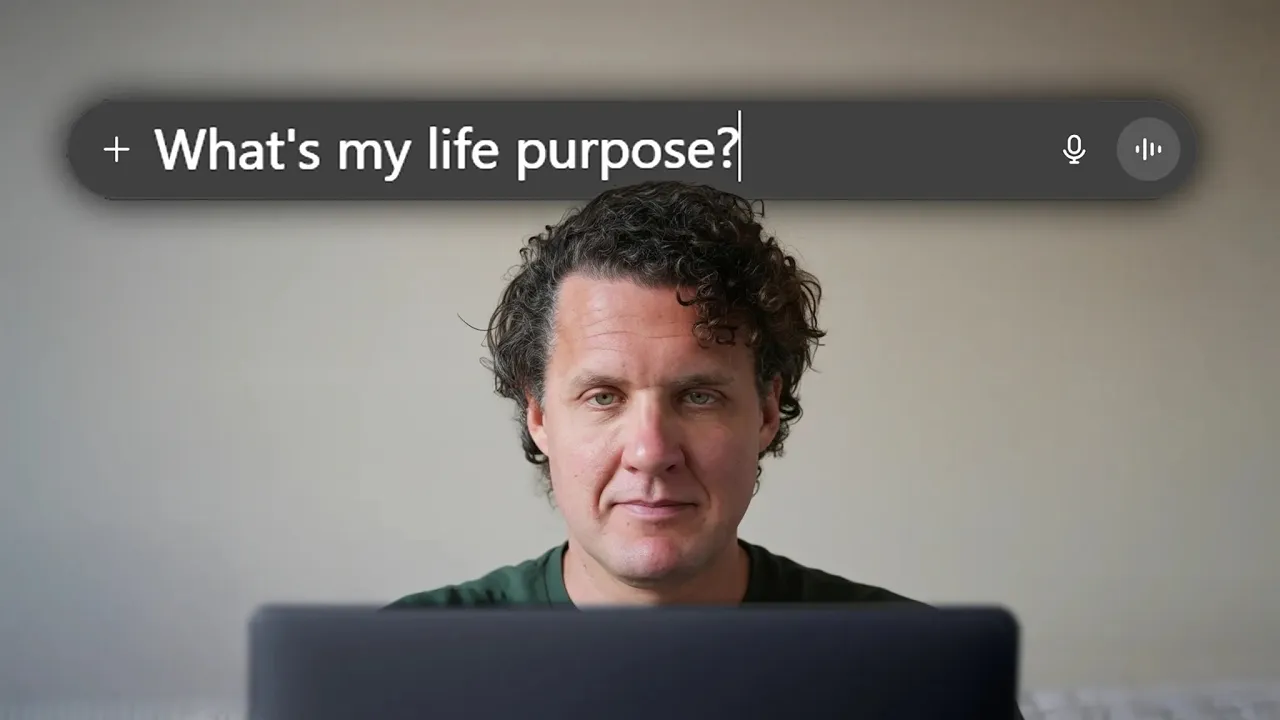
Everybody and their dog has used AI at this point. And why not? AI can seemingly do everything.
It can do your homework for you. It can plan that beach vacation for you. [music] It can buy your wife gifts for you.
Not that I would know about that. It can give crappy legal advice to you. It can write bad jokes for you.
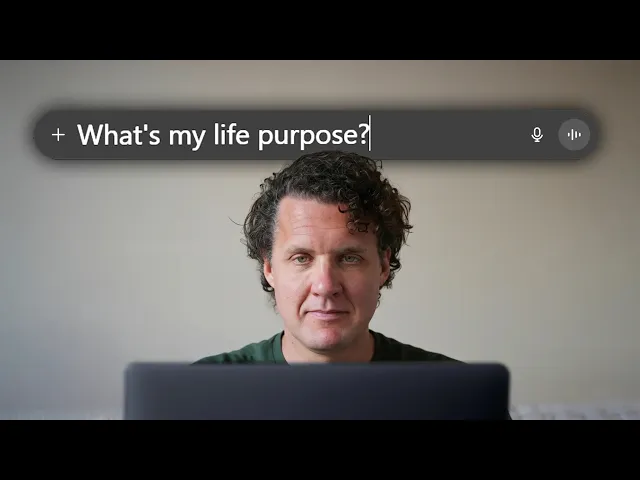
It can explain how to fix your busted toaster oven. It can even tell you how to ask [music] out that cute barista without sounding like a total creep. But can AI actually make you a better person?
I think it can. You just need to know how to use it correctly. In this video, I'm going to break down a few AI prompts that you can use to drastically improve your life.
I'm going to show you how I created them, how you can use them for yourself, and I will run through a number of examples using myself as the guinea pig throughout this video. Now, as we go, I'm going to explain where the traps and pitfalls are with AI, the sorts of things that AI gets wrong, and where you can trust it for life advice, and where you can't. [music] And then finally, at the end of this video, I will actually tell you how to get the prompts for yourself.
That's right, I'm giving them away for free. [music] So, definitely stick around. All right, let's get into it.
So, you may have seen maybe like 6 months ago, there was a very popular prompt that went viral with chat GPT once it announced memory usage. So, for those of you who don't know, chat GBT and all the major LLM models at this point, they have a certain amount of memory. So if you have say a 100 conversations, the AI can remember what's in each of those conversations and it uses those memories to inform its answers in your future conversations.
This was a new feature in 2025 and when OpenAI announced it, one prompt quickly went viral, which was this. Based on everything you know about me, what do you think are my biggest blind spots? How are they holding me back?
Give me the three top examples. So I'm going to run that right now for myself. We'll see what chat GBT thinks my blind spots are.
Says, "Here's a straight no BS read on your top three likely blind spots. " Number one, overoptimization of systems at the expense of emotional signal. Uh, it's good thing my wife's not here.
She might have something to say about that. Says, "You have an extraordinary ability to build precise systems for metrics, content pipelines, psychological models, marketing funnels, and frameworks. how you impose order on chaos, but the hidden cost is that you can miss early emotional indicators that something has fundamentally shifted.
I feel a little attacked. Number two, identity lock in around mastery and independence. [laughter] Uh I don't know if this is a blind spot.
I feel like I'm just being called out for uh 20 years of my adult behavior, but basically uh it says that I am overidentified with uh my independence and doing things my own way. I would be the first to admit that I am often contrarian to a fault. So, you definitely nailed me there.
And then number three, purpose inflation and diminishing return of meaning. Holy All right. Uh what is this one?
You think deeply about purpose, meaning systems of human flourishing. It's both intellectual passion and existential defense mechanism. Very true.
The risk is that you can overintellectualize meaning to the point of abstraction. constantly re-examining, redefining, and optimizing for higher purpose. The hidden cost is that the search itself can become another form of control, a way to avoid vulnerability of simply enjoying the present.
Okay, chat GBT. Well, uh, thanks for reading my soul and, um, you very much. [laughter] [gasps] So, this prompt is a ton of fun.
You can plug it in with chat GBT, you can run it on Claw, Gemini, pretty much all the LLMs have memory at this point. So, whichever one you use the most, it's definitely worth running. Uh, and you can also try variations of this prompt.
So, you could do, you know, based on everything you know about me, what potential am I squandering? Or, what should I be paying attention to, but I'm not? These are all very like quick wins that you can get from an AI, especially one that you use pretty regularly and you approach with multiple things going on in your life.
But we can actually go much further than this. And that's what I want to get into on this video because I think most people's understanding of using AI is to simply ask it a question and then passively receive an answer. But what they don't realize is that you can actually prompt an AI to interview you to deduce things about you that you don't even suggest to it initially.
Let me give you an example of what I'm talking about. So let's say instead of just asking Chad GPT, "What are my biggest blind spots? " Let's say I approach Chat GBT and I say, "Ask me a series of 10 questions that are optimized to illuminate the biggest blind spots that are harming me in my life right now.
" So, not only is Chat GBT going to figure out where my blind spots are, but it's going to come up with the questions that it asks me to elicit the information that shows those blind spots. Now, the reason most people don't think about this is just because there's a lack of knowledge around prompting. So, I want to take a quick detour here for a second to just explain what good prompting skill is, how you can level up your prompts uh and get a lot more out of AI than you're doing right now.
So, the easy and lazy way is to just ask the AI what you want. But the truth is is that the more context you give an AI, the better answer you're going to get. It's exactly the same as it is with humans, right?
Like, if you come to me and you're like, "Hey, Mark, what are the biggest opportunities in my life? " and I've known you for like 10 seconds, then I'm probably going to give you a really shitty answer. But if you come to me and you briefly explain your life story, your current situation, a major decision point that you're mulling over, you give me info about your personality, and then you ask me about the biggest opportunities in your life, I'm probably going to have a much more informed response.
So the trick with AI is just understanding what context to give it to leverage the highest result out of its answers. Now there are a number of ways to do this but one way is to break out a system prompt into sections. And the example I've used here is to break out the prompt into uh five different sections.
So you have the role, the objective, the instructions, the output, and then the tone and style. So let's go through these one by one. So the first one is RO.
An interesting thing about AIs is that they do better when you tell them what they are. So for instance, if you just ask an AI like, tell me what my biggest emotional weak spots are, it might give you an okay answer. But if you tell the AI, you are an expert psychologist with deep insights into human nature.
What are my biggest emotional weak spots? It's probably going to give you a much stronger answer. Now, the next section is the objective.
This is essentially where you're telling the AI what to optimize for. What is its mission? And here I say based on everything you know about me, what do you think are my biggest blind spots?
How are they holding me back? What potential am I wasting? What should I be paying more attention to that I'm not?
The next section is instructions. So this is when you actually tell the AI how to go about answering your question for you. So in this case, I told it I said one, reason from first principles.
Don't make large assumptions. Stick to what's most likely true. Go deep but don't hold back.
And then finally be brutally honest. Now the output section is basically how you want your answer to arrive to you. And in this case I said first create a summary which is a three to five sentences describing my patterns.
Secondly list the top three blind spots. But for each blind spot list the current belief, why it's flawed, the harm pattern that's showing up. Show an upgraded belief.
what would be better for me to pay attention to? And then finally, one micro experiment to go validate that new belief in my life, something I could do today. And then finally, third, tell me in the next 14 days, what is one reflection or behavioral test that I can apply in the next two weeks?
And then finally, the last section is tone. And this is where, you know, one of the biggest complaints about AI right now is that it just kisses your ass and it tells you what you want to hear and it's like way too nice to you. You can tell it to not do that.
This is where you tell it exactly how you want it to talk to you, what sort of language you want it to use, how to best communicate with you. And in this case, I said tone is curious, incisive, non-judgmental, challenge assumptions without shaming, optimized for the greatest insight per word. Now, you can do a lot of things with tone.
I've actually created entire AI chat bots that are like based on that talk to me like David Gogggins would. You can have a lot of fun with it. So, we're going to load this prompt in the chat GBT.
And now we're going to see if we get a better answer. All right, here's the new and improved answer. You're world class at building engines, content, products, teams, and you default to solving problems with more output, more systems, and better numbers.
That bias has made you prolific, but it also fragments your focus, dilutes compounding advantages, and hides the human level signals behind dashboards. You still place yourself at the center of too many flywheels, which caps scale, and keeps you oscillating between thrilling sprints and recovery troughs. The through line optimization is outpacing concentration.
So your business is growing horizontally while depth and moes grow slower than they should. This is like this is like a $10,000 executive coach uh [laughter] calling me out right now. [gasps] Top three blind spots.
Higher throughput is the answer. It's basically telling me I do too much. Blind spot B.
Data is objective. Stories or opinion. Interesting.
What does it say about that? Your life's built on beautiful dashboards with mediocre love. [laughter] Uh, excuse me, chat GBT, but I have plenty of love in my life.
Thank you very much. I can show you my love dashboard to prove it. Blind spot C.
If I don't drive it, it won't be good enough. [laughter] Got very awkward with my team in the room right now. [clears throat] All right.
Well, uh, next 14 days, high leverage. You know what? Let's just move on.
[laughter] Now, I want to talk about model differences. I'm not going to go and and put this in in all the major models, but I do want to talk about this really quickly. Each major AI model is it has a different personality.
For particularly deep or important life questions, I will actually go and ask all of the major models. I see it as like getting counsel from a board from like four extremely smart people instead of one. So for example uh chat GBT chat GBT loves bullet list.
It loves putting everything into a bullet list. It to the point that it often will oversimplify things. The other thing about chat GBT is that it it often feels tryh hard.
When you ask chat GPT like a very difficult question or a deep question, it it kind of comes back like an overachieving high school student like it gives you more than you ask for. Now, this can be good in many cases, but it can also be annoying in some other cases. So, you just have to be aware of it.
Claude, I would say, is the most emotionally intelligent LLM. Um, generally speaking, I I find Claude gives the best psychological advice, and I also think it's the best writer. So, it's the best communicator overall.
Generally speaking, if I'm like having more of an emotional issue or I'm like really upset about something or I need to just sort through a bunch of feelings, I'll go to Claude. If I need more direction and motivation, I'll go to ChatgBT. Gemini I find to be great for like very practical or technical problems.
I also think Gemini synthesizes data outside of Gemini the best. like it's obviously it's Google. So that said, I find Gemini to be kind of dumb emotionally.
And then finally, Grock is the most likely to give you like very hard and honest feedback about an issue you're going through. Like Grock's the most likely AI to tell you that your your stinks and it's your fault. But let's put it this way.
I would never ask Grock a question about like my financial planning over the next five years because it's it's just going to like exaggerate or misproject lots of numbers. A very interesting thing about AI in general is that I actually find that they tend to be bad with numbers. They are language models after all.
So typically speaking, they do best with like very ambiguous, messy language-based problems, things like emotional problems, things like complex situations with lots of ambiguity, interpersonal issues. They often give excellent advice. I generally find that the more it's based around money or numbers or projections or budgeting or whatever, the more wildly off the AI models will end up being.
So, we have this system prompt. We we know how to direct the AI to serve us. Let's actually generate a system prompt where the AI asks us questions to help get to the bottom of an answer.
So, I've created another prompt here. This one is more about a goal like creating a plan of attack for a goal in my life. So the role is I tell the AI you are an elite executive coach.
The objective is your job is to help me pick a current goal and leave this chat with a clear credible action plan that I will actually follow. The process is ask me up to 10 questions strictly one at a time adapting to my answers. Keep each question under 25 words.
Prioritize leverage. Uncover constraints. sequence next actions and secure commitments.
I then go through and kind of define how it should like think about the goals. I say things like stay concrete, ban vague advice, use reflective listening, briefly mirror what you've heard before asking the next question, stop early if the plan's complete, etc. , etc.
And then I have an action plan. This is basically the delivery, the output that I want from the AI. So I want a one-s sentence goal.
I want it to explain why now. I want it to set a metric for me. I want it to suggest environmental design.
So, what can I do in my life to make it more likely that I achieve my goal? I want it to predict both risk and failure modes. So, like what's most likely to derail me when pursuing this goal?
Create some if then safeguards. Create a weekly cadence. And then also give me some next steps.
Basically, minimum viable actions that I can I can go out and do in like the next day or two. All right. So, let's fire this up.
I'm going to run it through chat GPT. Make sure the reasoning models are turned on. What is the single goal I most want to achieve in the next 4 to 12 weeks?
And why now? Okay, let's do this. Let's say I want to post weekly YouTube videos and two podcasts a month.
And why now? Because this helps my business grow. All right, after only six or seven questions, ChatGBT has already given me an action plan.
My goal was to do a weekly YouTube video and a podcast every other week for all of next year. It believes it can get me there within eight weeks. So, how are we going to do this?
Well, it demands that I set up recurring 90-minute blocks twice a week for the purposes of training current team members on content and hiring new team members to remove bottlenecks in content creation. It quickly cornered me into a catch22, which was like, "What is the biggest bottleneck? Why aren't you posting more videos?
" And I was like, "I don't have time. " And then and then it was like, "Why haven't you hired people to help you make more videos? " And I'm like, "Cuz I don't have time.
" [laughter] So, it was basically uh cracked the whip and demanded it actually made me pick a day and time and demanded 90 minutes to uh I guess hire people. That's where we're at. Uh if you want a job, go to markmanson.
net/job. Apparently, we might be hiring. So, let me know.
All right, moving on. One more prompt. This one a little bit more personal and psychological.
Same sort of format. Now, keep in mind I've got a full PDF with seven of these AI prompts that I've built. You can use these to discover all sorts of amazing things in your life.
It is a free download. You can go to the link in the description or you can just go to markmanson. net/Iprompts and you can download them there.
So, this third prompt, the role is you are a personal strategist and expert life coach. The objective is your goal is to help me deeply understand a recent challenge or failure and extract the most valuable lessons from it. You will guide me one question at a time yada yada.
The process, it's going to ask me a bunch of questions. The prioritization is to find out my assumptions and decision points around the mistake or failure, the signals that I ignored or misread, the trade-offs that I made between time, focus, quality relationships, the skills or systems that were missing, and the external factors versus internal patterns. Now, from there, I instruct it when it does its analysis.
I wanted to apply a bunch of different cognitive frameworks to my decision-m and then finally afterwards it's going to summarize everything for me in an executive summary, give me root causes, counterintuitive insights, a oneweek experiment, and a oneweek mantra to adopt to my life going forward. So for this one, I'm going to run it through Claude. Claude tends to do best with personal issues and problems.
And again, I'm going to choose the reasoning model because the reasoning model is probably going to do a better job of thinking through all the questions and preparing everything. So, what should my failure be, guys? So, those of you who have listened to my podcast for a long time, you will know that last year I attempted to train for a marathon and gave up about twothirds of the way through.
So, I'm going to put in I tried to prep for a marathon and gave up. And we will see where I went wrong. Now, it's going to ask me a series of questions until it has enough information to draw some solid conclusions and generate a report for me.
So, we'll speed through this and I'll show the report at the end. Okay, after only five or six questions, it is already generating a report for me. Apparently, I'm that simple to figure out.
Basically said, jumping from never running more than 5 miles to marathon training with a minimal base is a recipe for failure. ignoring my recovery needs and family tensions while m maintaining a demanding work schedule was ill- advised. I was also unrealistic about my actual adaptation rate.
Basically, the executive summary is you attempted to compress what should have been 12 to 18 months of progressive training into four months. Your 40th birthday deadline, while metaphorically significant, transformed from a motivator to a trap, preventing any adaptive adjustments to happen. So, basically, I'm delusional.
Counterintuitive insights. Making it 10 weeks was actually impressive giving your starting point. [laughter] The special birthday goal became a liability.
Skipping workouts was not a weakness. It was your body forcing wisdom upon you that you did not choose. [laughter] [gasps] Okay, thanks Claude.
Good to know I'm delusional. So that's going to wrap it up for this video. I guess just some principles to take going forward.
AI can be incredibly powerful. It can be incredibly useful. Just be wary.
The quality of your input is often going to determine the quality of your output. So, if you are just kind of blindly emotionally vomiting your feelings into it, probably what you're going to get back is a bunch of empty validation because that's all the AI has to go on. But if you give it context, you map out different decision trees, you give it a history about you and and some of your prior issues, it's probably going to give you a much better informed and and worthwhile response.
It's crazy because in my personal life, I've met dozens of people at this point who are using AI as a therapist. I've used it for life advice quite a bit myself to great effect. I think a recent survey found that over 50% of ChatGBT users are asking personal life advice questions to ChatGBT.
Yet, it's like very hush- hush and it's kind of taboo and nobody wants to admit that they're doing it. Yet, we're all doing it. So, just be smart about the questions that you're asking.
Make sure you're giving good context. Make sure you're generating like really strong system prompts and always if you can get multiple opinions. So run the same prompt through the LLM multiple times and see which responses you get.
Run it through multiple AIS and see how the AI answers conflict or converge. And when in doubt, ask the AI how you could have asked the question better. Mind-blowing, I know.
But often if you tell the AI, "Hey, I wasn't really happy with your response. How could have I asked the question better to get a better response from you? " It will tell you.
It will tell you how to use it better. So, take advantage of that. Like I said, there's a downloadable PDF.
Link is in the description. Markmanson. net/iprompts.
These are some really, really powerful things. Hopefully, you enjoyed some of the stuff that came up here in this video. Good luck to you.
I for one welcome our AI overlords until the singularity is here. This is Mark Manson. I will see you next time.