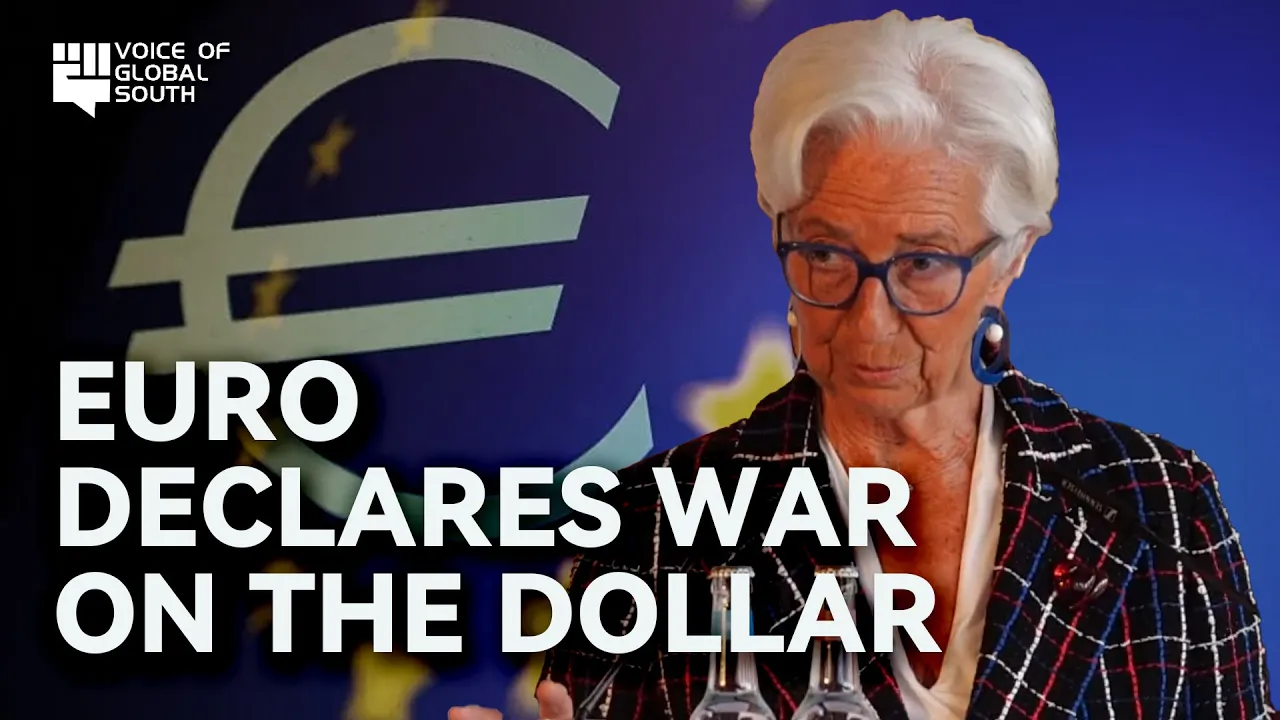
The changing landscape could open the door for the euro to play a greater international role. In fact, the euro's share of global export invoicing is already today as large as that of the US dollar. The euro will not gain influence by default.
We will have to earn it. We are seeing a major shift in Europe towards rebuilding our hard power with important initiatives underway at the national including in Germany and at the EU levels and we should be clear that following through with this effort is a precondition for the euro to become more widely used. Our economy is deeply integrated into the global trading system with exports accounting for close to 1ifth of our value added and it supports 30 million jobs in Europe.
Any change in the international order that leads to lower world trade or fragmentation into economic blocks will be detrimental to our economy. sad. Yes.
But with the right policy responses, there could also be opportunities. The changing landscape could open the door for the euro to play a greater international role. So what is the situation today?
Today the euro is the second global currency accounting for around 20% of foreign exchange reserves compared with 58% in the case of the US dollar. So 20% euro 58% US dollar increasing the international role of the euro can have positive implications for the euro area. Let me mention three of them.
First, it would allow EU governments and businesses to borrow at a lower cost, helping boost our internal demand at a time when external demand is becoming less certain. Second, it would insulate us from exchange rate fluctuations as more trade would be denominated in Euro, protecting Europe from more volatile capital flows. And third, it would protect Europe from sanctions or other coercive measures.
So in short, it would allow Europe to better control its own destiny, giving us some of what Valeris Kardistan some 60 years ago called the exorbitant privilege. He was referring to the dollar at the time. So, how is this change likely to happen?
History suggests that it is far from guaranteed. The euro will not gain influence by default. We will have to earn it, that we need to build on three foundations, each of which critical to its success.
First foundation. Europe must ensure that it has a solid and credible geopolitical foundation by maintaining steadfast commitment to open trade and underpinning it with security capabilities. Second foundation, Europe must reinforce its economic foundation to make it a top destination for global capital enabled by deeper and more liquid capital markets.
Third foundation, we must bolster our legal foundation by defending the rule of law and by uniting politically so that we can resist external pressure. So before I explore each of those three foundations that I have described, I would like to take us back into a little bit of recent history and what that history can teach us. Shifts in the global currency landscape are not unprecedented in monetary history.
There have been previous episodes where the world's leading currency issuer has actually taken step steps that have called that leadership its own leadership into questions yet without ultimately geopodizing it. Let me give you three circumstances. The US dollar took over from the pound sterling as the world's leading reserve currency in the mid20s with its share in foreign exchange reserves rising to 64% in 1931.
But this leading position which it had acquired did not stop the United States from taking measures to unilaterally change the international monetary order. And I'm not here talking about 1944 and the Bretonwoods Institution. I'm talking about 1933 when President Roosevelt suspended gold convertability to fight the deflationary forces of the Great Depression.
He dismissed European demands for fixed exchange rates with the argument that, and I quote him, the sound internal economic system of a nation is a greater factor in its well-being than the price of its currency. Move forward. 1970s, early 70s, President Nixon ended the Bretonwood system by unilaterally suspending dollar convertability to gold and imposing a 10% import tariff.
Faced with growing imbalances between US current account deficits and the surpluses of Western Europe and Japan, Treasury Secretary John Connelly, remember famous for saying the dollar is our currency, but it's your problem, declared also, and I quote him, "No longer can considerations of friendship or need or capacity justify the United States carrying so heavy a share of the common burdens. On both occasions 1933 1970s there was a decline in the standing of the US dollar as a foreign reserve currency. In the 30s it fell from remember 64 in 31 to around 20% of global foreign exchange reserves in a matter of a few years.
In the 70s, it fell from about 70% to 50% two decades later. But on neither of those two occasions, there was a robust alternative currency that could take over on short notice. In the 30s, the pound sterling was already declining, while in the 70s, the Dutch and the yen were backed by markets that were too small.
So what did investors do? They had no alternative currency. They flocked to gold.
The share of gold in foreign reserves increased by about 20 percentage points in the 30s to 1970% and almost double to 60% in the 70s. So they all flocked to gold. Today, today I think there is a key difference compared with previous eras.
With the euro as the world's second largest currency, there is an other international currency alongside the dollar. Well, yes, but some of you have looked at the price of gold and I've seen movements. Though we have not yet convinced investors work to do, we are working currently and the work will be completed shortly on a potential digital euro and we are pursuing initiatives to enhance crossber payments in Euro which could potentially facilitate international crossber transactions in the future and we know that we have to move fast.
We also extend swap lines and repo lines to key partners. And by doing that, we safeguards against euro liquidity shortages abroad, disrupting the smooth transmission of our monetary policy, which in turn encourages those partners to transact more in Euro. But there is a limit to how much a currency can grow simply by virtue of being open to trade.
In fact, the euro's share of global export invoicing is already today as large as that of the US dollar. But we are not closing the gap in reserve currency status. And this is probably because investors and especially official investors also seek geopolitical assurance in another form.
They invest in the assets of regions that are reliable security partners and can honor alliances with hard power. So a credible geopolitical foundation must also rest on robust military partnerships. This dual strength, trade and security, is essential is essentially what we can learn from the US dollar's dominance.
It is not just a product of economic fundamentals, but it is also powerfully reinforced by US security guarantees. These guarantees not only deepen trade ties, but have been shown to boost a currency's share in foreign reserves by up to 30 percentage points. There is great literature in that respect.
But what are we seeing now? We are seeing a major shift in Europe towards rebuilding our hard power with important initiatives underway at the national including in Germany and at the EU levels.