dov'è the most dangerous man in Europe is about to arrive on Britain's shores [Music] his preachings are sowing century he's been forced out of his native country [Music] only liberal Britain will tolerate his presence on her soil he heads to London to live in exile the year is 18-49 and the man is Karl Marx incredibly this most dangerous of thinkers might offer the key to understanding the mess we're in today most people know Marx as the father of communism you might be surprised to hear that most of what he wrote was about capitalism and today
his ideas about that are being taken seriously right at the heart of global business his analysis was pretty on the button and and explains a lot I think about some of the things that we see going on around in our economy today for marks the best argument against capitalism was that it was inherently unfair his ideas on inequality have more resonance than ever today what March did do is to install this sense of urgency things cannot go on forever the way they are in this series we'll explore the lives and revolutionary thinking of three extraordinary
men John Maynard Keynes Friedrich Hayek and Karl Marx their worlds were changing as never before they saw that the fate of Nations would hang on the power of money may had radically different ideas about how to control it [Music] today the stakes could hardly be higher of all the great thinkers who analyzed capitalism Marx had the most radical advice of all get rid of it in 1989 Karl Marx's reputation lay in ruins [Music] for most of us the fall of the Berlin Wall met the end of Marx millions rejected the horrors of a violent and
repressive police state and because the communist countries claimed Marx as their inspiration his ideas were cast aside as well Marx became associated with communism indelibly associated with communism and indelibly associated with communist regimes because these regimes did their work in the name of Marx so the association was was very very powerful in fact it was they who were claiming Marx rather than Marx as it were claiming them but in the last few years something strange has happened it's like the global financial crisis has brought Karl Marx back from the dead now we still don't care
what he said about communism but people are going back to see what he said about capitalism all its deep-seated flaws with a nagging doubt is it all now coming true when times were good marks was nowhere but now the Western economies are in crisis he's attracting new interest right at the heart of the economic establishment from a former IMF chief economist Marx is right on a number of dimensions he certainly is right that income inequality can be a source of tremendous tension to the man who saw the 2008 crisis coming he understood that there are
situation in which capitalism and globalization can lead to economic crisis and an economist at one of the world's leading banks it's quite hard to convince people who live in Chelsea or Chelmsford that this is of great relevance to them but actually it's worth a bash [Music] Marx's key insight was that capitalism was inherently unstable he said we'd lurch from crisis to crisis and that society would become increasingly unequal marks divided the world into bosses and workers for him they would always be at odds and that battle was a recipe for crises to make profit bosses
squeeze what they pay workers the crisis comes when workers then don't have enough money to buy what bosses are trying to sell them for decades after World War two all of that looked completely wrong we'd had years of stable growth and workers were taking a larger share of the pie but not anymore Marx would explain this crisis in terms of the fact that ordinary people haven't got enough money to spend why haven't they got enough money to spend because there's been a big redistribution over the last few decades away from ordinary people towards capital towards
wealth and for Marx there's no turning back capitalism would produce bigger and bigger crises and then it would collapse marx had a very simple formulation about crises which is that they are manifestations of the fundamental flaws or contradictions as he called them of capitalism how would Marx have suggested solving the crisis is of course by abolishing capitalism to understand the Marxist view of the mess we're in we first have to see the world today as Marx might have seen it capitalism's most implacable critic was born in the picture-postcard town of creer in what is now
South West Germany Marx comes across as a young man as this sort of energetic fiery hairy figure he was known as the wild boar of the moor which sort of points to his Levantine complex he was full of ideas he was full of debate he liked big drinking sessions and then deep philosophical debate about the nature of Christ and German Romanticism and and politics as he studied Marx came to believe the world was sharply divided into those who owned the means of production the capitalists and those who owned nothing for workers the conflict between these
two groups for Marx shapes how society works the foundations of Marxist thinking was was materialism that when you cut away religion ideology politics at its root were the material relations between man the need for food the need to have a roof over your head this is what ultimately drives so much of human interaction what was unique in Marx he didn't see economy just as a special sphere he saw economy as the structuring principle of the entire social totality and so that what happens in economy the way it structures our ideologies and so on this again
is another lesson today maybe even more pertinent than in the time of times of Marx we might see a complex modern economy which all of us have a stake in but Marxist would say the same old rules still apply for them the divided society Marx saw is still broadly here today they see workers still slaving away and capitalists or bourgeoisie still exploiting them always striving to make more profit in Marx's world any capitalist that doesn't seek maximum profit is soon replaced by one who does so the system follows a completely predictable course he would say
to its own destruction it's not an idea that many people accept he was completely wrong including the idea that capitalism was merely a phase and contained within the seeds of its own destruction that's not the case well everything is bound to collapse if you wait long enough I mean you're suspended you know sucked into the Sun some day and of course what we're really talking about when we talk about capitalism is individual liberty and property rights could those come to an end well they have in places it's possible but I'm not seeing any signs of
it you'd be forgiven for thinking the total collapse of capitalism sounds a little implausible how could seeking profit be so disastrous when it's done such amazing things just look at how we eat under capitalism we get fresh fruit flown in from all over the world we can choose from 700 types of breakfast cereal we have enough of it and it's all safe to eat this incredible plenty and the technology it depends on didn't come from the state it's what happens when you let capitalists compete for profit they didn't do it for our benefit they did
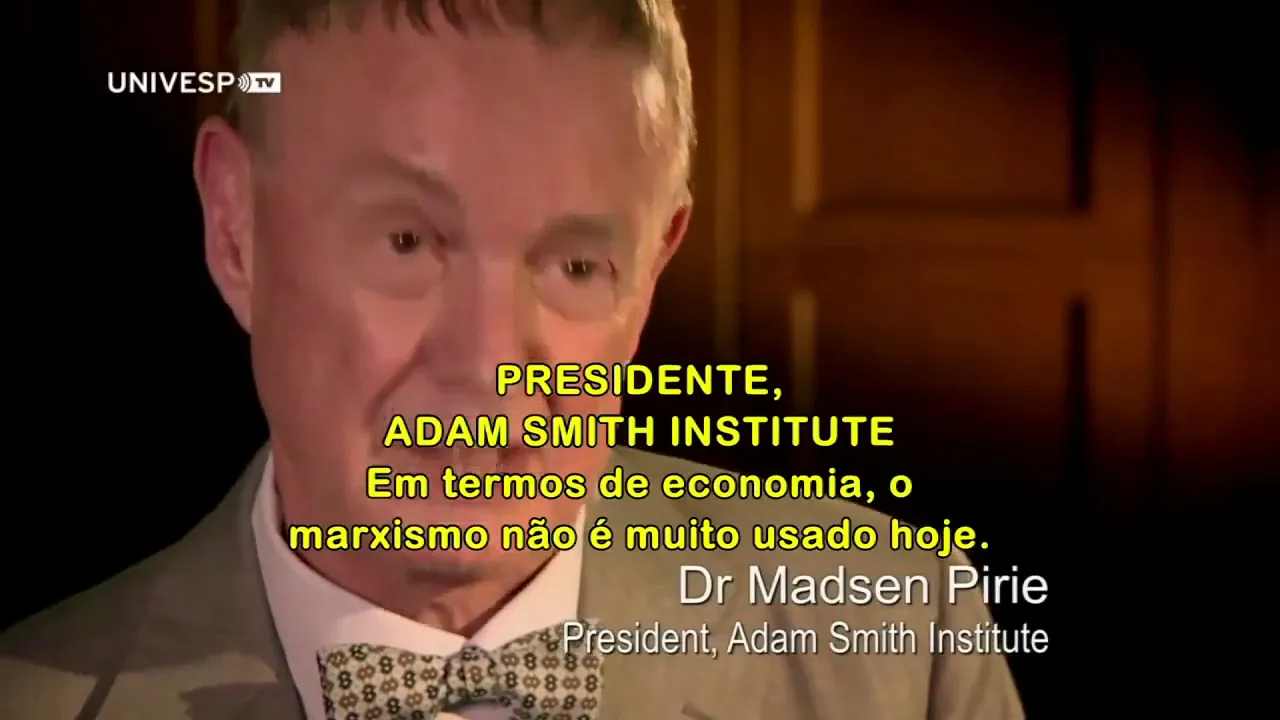
it because it made them rich so at first glance Marx's idea that capitalism search for profit would be its downfall sounds absurd profit may often sound venal it may often sound wrong but it is what pushes progress ahead profit is actually what drives the world forward and that's what Marx could never quite handle the profit motive is essential I mean after all what is the profit motive it's just a way of achieving a better society by people wanting to better their own individual lot in terms of economics Marxism is not very much used today and
that's because he was wrong on several of the fundamentals and if you erect a building on cracked foundations the building itself is cracked when you think of how fundamentally the profit motive has shaped and enriched our world snowonder Marx fell out of favor but we shouldn't dismiss dr. Marx quite yet it's true he talked quite a lot about class exploitation misery chaos but he didn't think capitalism was all bad far from it [Music] this cocktail bar in London Soho hides a revolutionary past it used to be the Red Lion pub size of a clandestine meeting
of communists in 1847 that would echo down the ages it was at that meeting that they commissioned Karl Marx and his sidekick friedrich engels to write one of the most incendiary pamphlets of all time the communist manifesto it goes through a number of drafts angles is the key draft on the texts but then Marx takes it away and in a sort of you know massive sort of sa crisis style just sits down and writes the thing and that's the beauty of it because it might have been organized by committee but it's written by one man
and that energy that Brio that passion which is in the manifest that comes from the fact it has a single author in the final stages which is Marx you may know it for its revolutionary calls for a new age what might surprise you is it it also contains very perceptive and admiring writing about capitalism I think what's surprising if a lot of Marx's writing is that you find in amongst the communism a lot of good analysis of capitalism and actually also find within it quite a lot of praise for capitalism Marxist attitude towards capitalism is
basically ambiguous he at the same time he was honest earmarks ultra fascinated he was fully aware that this is the most productive dynamic system in the history of humanity and so on he praises it for its huge force for as far as he can see it for progress for tossing aside the traditions and the customs of the old world and making way for a new one and I think it's it's quite interesting the more intelligent modern Marxist feel much the same way the truth is marked did understand that the drive for profit would achieve incredible
things it's been the first to show what man's activity can bring about it has accomplished wonders far surpassing Egyptian pyramids Roman aqueducts and Gothic cathedrals [Music] he did really get the kind of global aspect he got the idea that people were suddenly able to get things from all the way around the world in a completely new way and the impact of that the need of a constantly expanding market for its products chases the bourgeoisie over the entire surface of the globe it must Nestle everywhere settle everywhere established connections everywhere it creates a world after its
own image but you know there's got to be a down side for the bourgeoisie modern bourgeois society is like the sorcerer who is no longer able to control the powers of the nether world whom he is called up by his spells what the bourgeoisie therefore produces above all is its own gravediggers its fall and the victory of the polity reott are equally inevitable how can Marx think capitalism is so brilliant and also so doomed well the answer lies in how it treats the workers to understand Marx's analysis of crises we have to first understand the
capitalism that he new 19th century capitalists might have built wonders surpassing Egyptian pyramids but they also forced their workers to endure terrible conditions and pay it is difficult to overstate the horror of industrialization in Europe in 1829 Liverpool for example a life expectancy at birth was about 28 years and that was the lowest age since the Black Death so the impact of the Industrial Revolution on life chances on life expectancy in the great cities of Europe in Hamburg in Berlin in Manchester in Liverpool in Birmingham in London was absolutely terrifying this was a a revolutionary
epoch of change which for the working classes which for the proletariat in the 1820s and 1830s had devastating consequences for their standards of living Marxist certainly revered amongst historians as the preeminent analysts of mid 19th century capitalism no one before Marx or possibly since had really you know has really been able to get into that system of mid 19th century Western European capitalism based on a kind of urban manufacturing set of relationships whether that's relevant today is a very interesting question the horrors of Victorian working conditions clearly shaped Marx's economics [Music] in his time minimum
pay for prowls meant maximum profits for bosses and any bosses who did choose to pay more usually went bust subsistence wages will always be paid in the Marxian system so now subsistence wages of course is a little bit of a flexible object right we what we think of a subsistence wage now might not be the same as Marx thought it was in the mid nineteenth century but still there's no obvious way that wages will arrive above a subsistence level he thought that always be downward pressure on wages and that wages would come down to the
minimum that enabled bare survival they couldn't go lower than that otherwise the workers would die but he thought the mid had pressed down to that minimum the reality of course has been the opposite it has been a continual advancement in wages year in year out decade in decade out Marx was wrong he thought it would all get so bad the workers would overthrow the system yet even as he was writing reformers were beginning to get rid of the worst employment practices capitalism got kinder not nastier but the idea that the competing interests of bosses and
workers would cause crises well that does seem relevant today Marx wrote that the ultimate cause of all real crises always remains the poverty and restricted consumption of the masses put simply if workers aren't paid enough they don't have enough money to spend in shops and the economy doesn't stay afloat some believe this idea is very useful in understanding the crisis we're living through today [Music] let's take a look at the last 40 years of history through the prism of Marxist theories to show how they might explain the mess we're in an imaginary Marxist Broadcasting Corporation
would see it all as a good old 1970s style class struggle [Music] the fight is over wages capitalists want to pay less the workers want to get more [Music] in the 70s powerful trade unions battled to keep wages high but then we come to the 80s fight that time for the capitalists Marx would have seen Margaret Thatcher and Ronald Reagan as acting purely in the interest of the capitalist bosses it was their governments that helped business by getting rid of the obstacles that made it hard to cut wages the violence intimidation we have seen should
never have happened it is the work of extremists it is the enemy within if they do not report for work within 48 hours they have forfeited their jobs and will be terminated so for the Marxist Broadcasting Corporation the capitalists won in the 1980s and they kept on winning the guaranteed high wages and job security that workers had enjoyed until the 70s had gone and downward pressure on wages started to lay the seeds of the crisis we see today it's an appealing ly simple story is there in it well we know the Marxist view of history's
right about one thing at least in Britain and America earnings at the very top have soared in the last few years and everyone else has been squeezed in Britain real earnings have been flat or falling for the best part of 10 years since before the crisis in America that's been happening since the 1970s in the United States a full-time male worker median income has stagnated for a third of a century no increase household income today is the same as it was 15 years ago all the increase of the income has gone to the top the
share of income in the United States that was going to the top one percent of the households 20 years ago was around 12% today that share is closer to 23% things haven't gone that far in the UK but inequality certainly creeping up the agenda but rather than see it as a deliberate strategy on the part of greedy capitalists we have to recognize there are bigger forces at work a lot of it's down to new technology work previously done by hand it's now done by machines with fewer workers needed there are more competing for every job
meaning bosses can pay them less but perhaps the most significant factor is globalization with falling barriers to trade around the world global business has gained access to a giant new pool of cheaper labor you have brought into the market now millions and millions of new workers in China in India in other parts of Asia in parts of South America Brazil for instance so that process has transformed the capital labour ratio on a global scale clearly competition from countries around the world has put pressure on on certain jobs typically jobs that can be done in distance
so for example an analyst can as well be sitting in the Philippines or in Mumbai to do the job that is done at a much higher price in New York [Music] many workers in the rich countries are now competing with an industrial reserve army running into the billions I think in emerging market economies there be an overwhelming vote in favor of what has happened because almost everyone is better off than they were and would have been but that's less evidence in the industrialized world and many lower paid people have become even lower paid relative to
those who prospered and that is a concern it's an analysis that rings true even for the leader of the world's biggest economy long before the recession jobs and manufacturing began leaving our shores technology made businesses more efficient but also made some jobs obsolete folks at the top saw their incomes rise like never before but most hardworking Americans struggled with costs that were growing paychecks that work and personal debt that kept piling up safe amongst low wages would be the root cause of the crisis we're living through today even leaving aside the morality question of whether
is fair to have a highly unequal distribution of income and wealth even purely in terms of economic efficiency having that redistribution of income from labor capital from wages to profit there's a negative economic effect because it tends to reduce aggregate demand because it reduces the income of those who tend to spend more of course in the late 20th century that problem could be solved temporarily of course step forward the credit card you had more inequality you'd more concern amongst the public and I think that put pressure to do something democracies work well with pressure put
pressure for the politicians to do something for the people being left behind the right thing to do in my view would have been focused much more on education on skill building what happened was a more shorter term solution which was give them credit with consumer credit people can carry on spending even if they haven't got the money the economy stays afloat and the capitalist still make their profit as we know it went well beyond credit cards what ultimately brought the crisis to a head was the billions borrowed on mortgages people thought the value of their
house would keep going up forever housing credit is beautiful because if your house price is increasing and you're borrowing against the increase in value of your house you don't feel you're boring away into debt but of course you are in America it happened on a massive scale there as we know the capitalists were getting richer and richer they couldn't spend all of their extra money driven as ever by the desire to make more profit they lent it out in riskier and riskier ways the name given to this lending might well be familiar subprime what we
did is as the incomes of most Americans were stagnating or even declining we said don't let it bother you keep spending as if your income was going up and they did that very well I mean who would oppose it the banks are making money the households who getting their their house the politicians who have happy constituents I mean there is no nobody who's going to be unhappy in this process until it collapses subprime is the endgame if you like of the debt solution to the lack of a market and it's it's the culmination of trying
to evade crises which arise out of lack of effective demand in the market and then what you do is you end up creating a credit crisis instead so subprime is the end of that process and we all know how it ended in retrospect it seems obvious lending to people who couldn't afford it wasn't a lasting solution to anything it led to a housing bubble which burst threatening some of the world's biggest banks and thanks to our integrated world what started in the United States spread and infected the entire system causing a global recession Capital One
is faced with the problem usually seeks to move it around it moves it from one sector to another or for one geographical region from another any part of the world that's in economic difficulties will seek to unload those difficulties of another part of the world what will also happen is that if there's a problem in the banking system they will seek to move it into the state system and it's the problem in the state system they'll try and move it on to the taxation and austerity of the people to extract the wealth from from a
population it's an extraordinary tale and a lot of people would say it's completely wrong Marxism doesn't actually work but it keeps coming back because it makes it makes for a good story I don't think low wages paid any role at all in causing the crisis the crisis was caused by governments and central banks flooding the market with cheap credit and cheap money because politicians don't like the downturn in an economy that throws people out of work I think it may have to some degree increase the level of indebtedness that people went into the crisis with
which I think intensified how deep the crisis became but it wasn't the underlying cause it was a contextual factor which made it a bit worse but the idea that low wages may have contributed to the crisis is gaining ground in some surprising places it was on this trading floor it was probably the weekend before Lehman's went bust and it's normally a little bit noisy but at the time it was you could hear a pin drop it was that deathly quiet and I could almost feel you know that the global system was frozen and it was
quite a scary thought it took me back to a lot of the things that I used to read about and study when I was much younger the days when I actually read Marx for fun it was a comment that I posted up on a news wire and and it was it was one of the most commented upon pieces for quite a few weeks but there are a lot of people who were quite opposed to the idea of that anything that was socialistic or Marxist you know could be at all considered serious in the mainstream a
lot of this hate mail after say came from the United States and I was accused of being you know an Obama clone so there was a lot of negative reaction from I think people that probably predictably you know had already tied their own ideological colors to the most but the people who do find value in Marx aren't necessarily going to follow him all the way I don't think anybody seriously believes that you know this is all about the you know dawn of the dictatorship of the proletariat or anything like this I think Marx helps in
framing the problem but I think the solutions have to be different given the different environment we are in except Marx would insist the trap is inescapable capitalists must seek profit above all else or they'll go out of business so why would they ever choose to give workers a bigger share of the pie what Marx would say is that we have to look for ways out of this crisis which look beyond the restoration of capitalist class power and I think this is a time when we actually need to start thinking about the revolutionary solution again [Music]
but who exactly is revolting against whom marks divided the world neatly into workers and capitalists but today his stark distinction is incredibly blurred bosses work for themselves and workers own shares in our modern world enough of us do have a stake in the system where the mobile phones or pension plans to stave off talk of armed revolt I think capitalism survives because it is core it works it pushes progress it pushes people forward it appeals to basic thing in people's lives which is to try and get ahead to try and improve things for their children
the fact that more people win from it and lose from it is the thing which keeps on pushing it ahead but what about the people capitalism's failing what does Marx have to say to them incredibly for all his criticism of capitalism he offers us next to no idea of what a fairer alternative might look like as marks entered his final years he's seen quite content with the way things were he'd been poor for a lot of his life but by 1856 he had enough money to move to London suburbs the young firebrand now looked like
part of the establishment he would spend his day walking around Hampstead Heath he would spend his day correspondence he would spend his day you know reading that the times he would worry about personal finances he would worry about his his daughters and the expense of their piano lessons I mean he he lived a a remarkably bush wildlife in in in many ways Marx didn't want a rush revolution to understand why we need to understand his analysis of world history [Music] he saw the great sweep of humanity's endeavors from the caveman to the slave societies of
Greece and Rome to the feudalism of kings and castles all of which was replaced in turn by our own capitalist system of bosses and workers incredibly unfair but also incredibly productive Marx said only when we've got everything we could out of capitalism could we afford to have a revolution in his words the knell of capitalist private property sounds the expropriate errs are expropriated all to be replaced by more or less nothing irritatingly there's next to no alternative laid out much basically what's not the one who simply give gave us a blueprint you know five stages
after capitalism communism here you have the basic guidelines what to do and so on no no it's up to us he just opened up the field is there an alternative to capitalism I have no idea I suppose it could be home console so has a dead silence starvation or the end of the world or I think I simply have no idea if there is an alternative it doesn't it doesn't occur to me doesn't seem to me to be an important thing is there an alternative to whether I think he would have written a lot more
had he lived ten years more on what a Socialist Republic would look like and who knows but that might have saved the world a lot of bother without his blueprint we all know what happened next [Music] there weren't any revolutions in the rich developed countries as Marx predicted instead it happened in one of the world's poorest nations [Music] Soviet Russia may have left marks far behind but it was an attempt to try something else many have drawn lessons from its failure the truth is at the moment there are different forms of capitalism some have slightly
more social democracy some are closer to less a fair and there's a continuum between them but on the big argument about whether you really want to have a communist system or a capitalist one that is pretty much one everywhere I think there are more humane versions of capitalism or more Baba barbaric forms of capitalism but I don't think there's a systemic alternative to capitalism will there ever be yes I would think so I mean you know nothing is forever absolutely nothing and capitalism is not forever but anyone looking for a fairer alternative knows they can't
ever repeat what happened east of the Berlin Wall dictatorship political oppression and millions of ruined lives [Music] from 1945 till 1989 this was the main room and Center for political prisoners in communist East Germany today it's been turned into a memorial it's possible that places like this explain why even capitalism's toughest critics today seldom talks seriously about replacing it [Music] you can submit all these protests in Europe Greece and so on I was in Spain in Greece I think always the same question okay what do you want apart from some purely moralistic answers I didn't
get any good concrete proposals you know answers like Oh money should serve people not people serving money may God Hitler and everyone would have agreed with this I'm sure he would have thought but with this implosion of the banking system at the heart of the capitalism in the United States was the United Kingdom and so on there would be a huge rush the to Marxism and extreme socialism that hasn't really happened it is quite surprising and I'm very pleased but if memories of this place do fade could there ever be an alternative to capitalism or
should what happened here be a lesson for all time I think if you remove the free market you're removing people's ability freely to trade with each other to acquire the things they want and sacrifice for them the things that they value less you're removing people's ability to enrich and improve their lives is a perfectly natural part of the human condition Adam Smith said the effort of every person to improve their condition you know he thought it was so basic if you deny people the opportunity to do that then you'll have to build some kind of
compulsion into it you have to make people behave in a way in which they would not spontaneously behave if someone wants to seek an alternative to capitalism and they're saying by seeking that alternative that capitalism is a system rather than a fact of life and they're saying that versus that human nature can be also fundamentally they're revealing themselves as a utopian and the problem with utopia is that it can only ever be approached across a sea of blood and you never arrive this is my big mantra when we left these are accused of utopians maybe
but the only real utopia is to think that with some cosmetic changes things can go on indefinitely the way they are now [Music] Marx died in 1883 in a speech at his grave his longtime friend and collaborator Friedrich Engels declared his name and work will endure through the ages for most of the 20th century his name did endure there usually for all the wrong reasons still there are plenty of people today who still believe we should strive for an alternative to capitalism Marx did bring together concrete economic analysis with a certain amount separatory hope the
message is still a beautiful one maybe you ordinary people have a chance I'm not a great eulogize actually of anyone to tell you the truth but if one were to write a tribute to him one would go back to Marx's favorite character in Greek mythology Prometheus who gave the Earthlings fire and that is what Marx gave citizens all over the globe the the fire necessary to transform their lives forever [Music] but what value does Marx have for those less inclined to revolution fundamentally Marx reminds us if capitalism doesn't work for everyone it might not work
at all there's no doubt that there have been significant changes in inequality and in the distribution of income which make you pause about the benefits of the development of output and prosperity that we've seen I don't think you can afford to believe that the benefits of a market economy and bringing prosperity will be there unless there is a collective commitment to keep the system going and that does require people to believe that everyone will benefit in the end I think some of the the ugliness of capitalism that he saw and the 19th century seems to
be reappearing in the 20th in 21st and in a way we have to keep our perspective on this health conditions are much better living standards are starting from a higher level but it is still the case that things aren't the way they ought to be and they're not moving in the way they should be we have to find a way of creating jobs which are broad-based which be reasonable amounts but at the same time you know without sort of going against the basic laws of competition Marx was right to see capitalism is inherently unstable and
often unfair Keynes and Hayek saw that too but Marx was the first and unlike them he didn't think we should find a wait and live with it he said capitalism would bounce back from crises and reinvent itself but in the end a compelling alternative would appear and capitalism would collapse for all that rings true now in Marx on that he seems to have been dead wrong [Music]