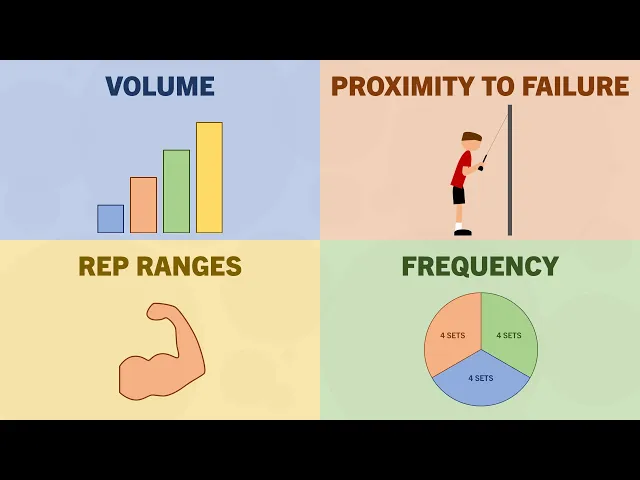
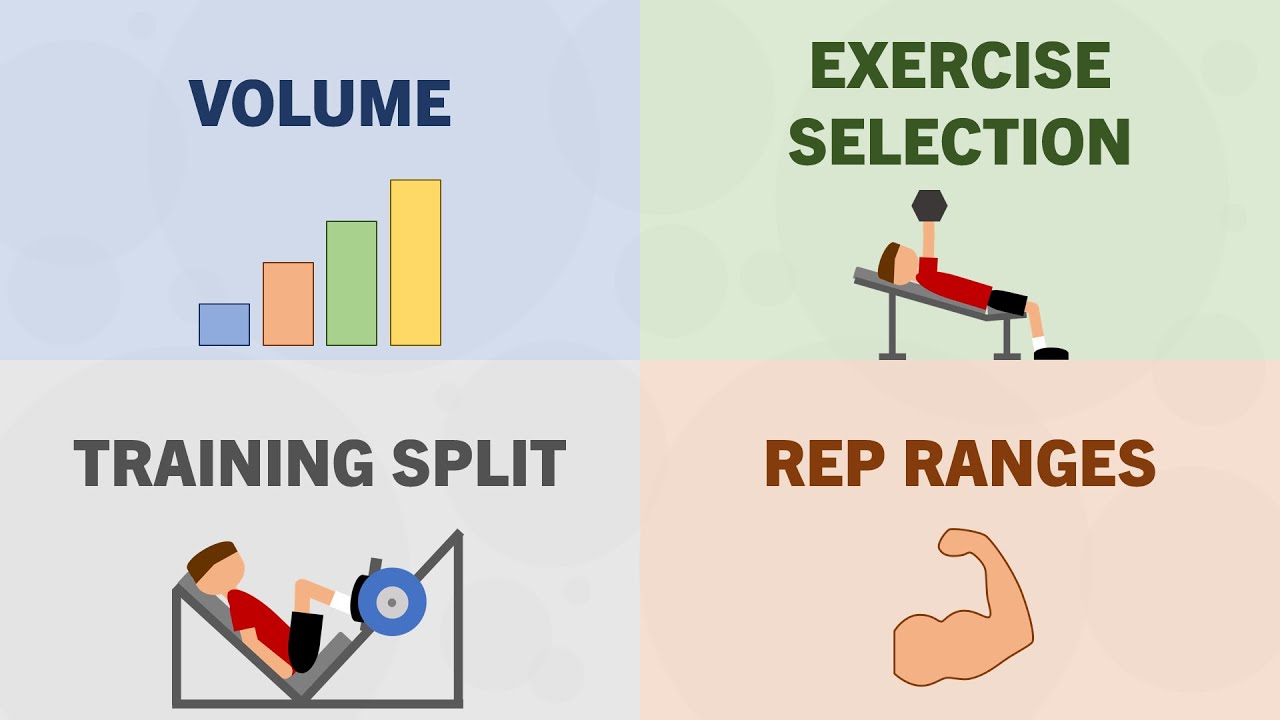
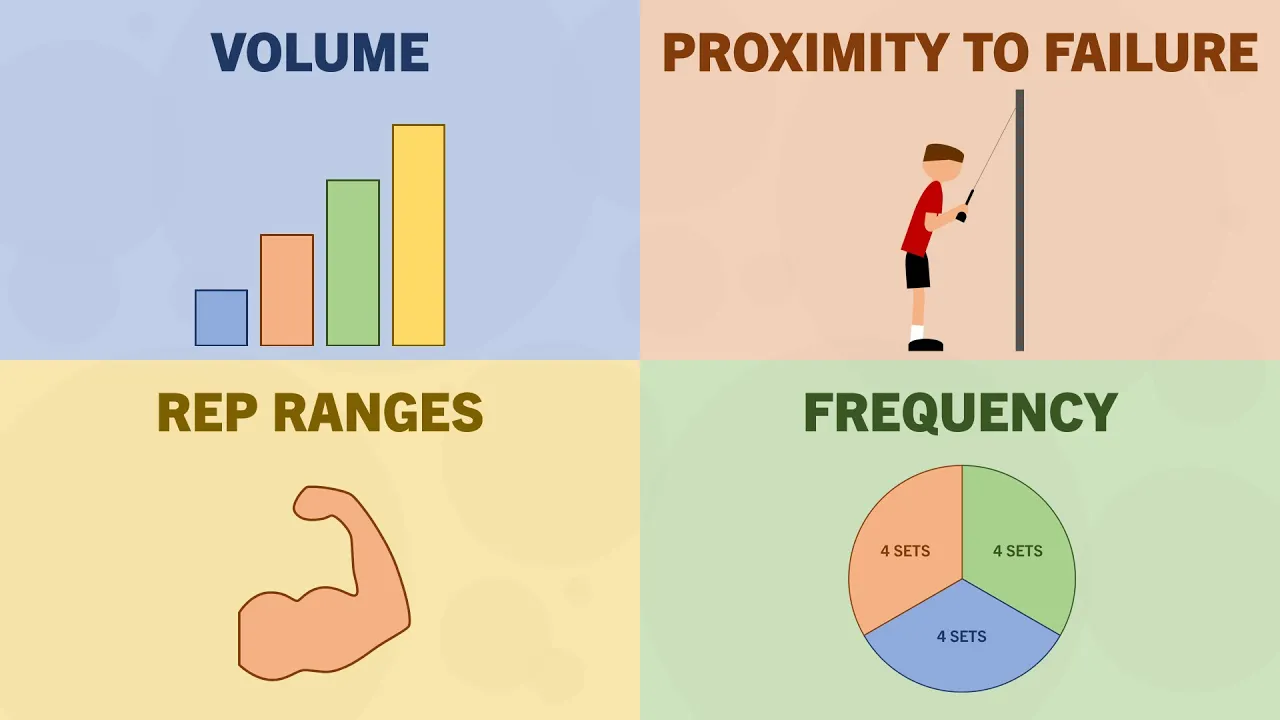
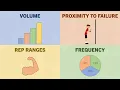
we often discuss different training variables and how they influence muscle growth however it can become somewhat confusing if these variables aren't ranked in a priority list so in this video we will discuss which training variables are most and least important for hypertrophy training so that we can make sure to put the most effort into the variables that have the biggest impact first let's explore the variables that will be discussed in this video and provide a general overview of how they influence muscle growth so in no particular order let's now explore these variables first is volume
this refers to the total number of sets performed per muscle group per week we generally find that more volume tends to result in superior muscle growth for example this study explored the effects of training with 16 versus 24 versus 32 sets per muscle group per week and as we can see more volume resulted in greater muscle growth even up to extremely high volumes however there are likely diminishing returns meaning more volume may result in less additional muscle growth this was established in the systematic review which gathered the data on low versus moderate versus high volume
training it was found that while moderate volumes tended to be significantly superior to low volumes high volume training was only marginally more effective than moderate volumes so the volume hypertrophy relationship probably looks something like this as we can see more volume is likely superior but each additional set per week may be less additionally effective so at the extreme end of the spectrum doing more volume may simply not be worth the time and effort next we have proximity to failure this refers to how close to failure we take each set this is usually quantified using the
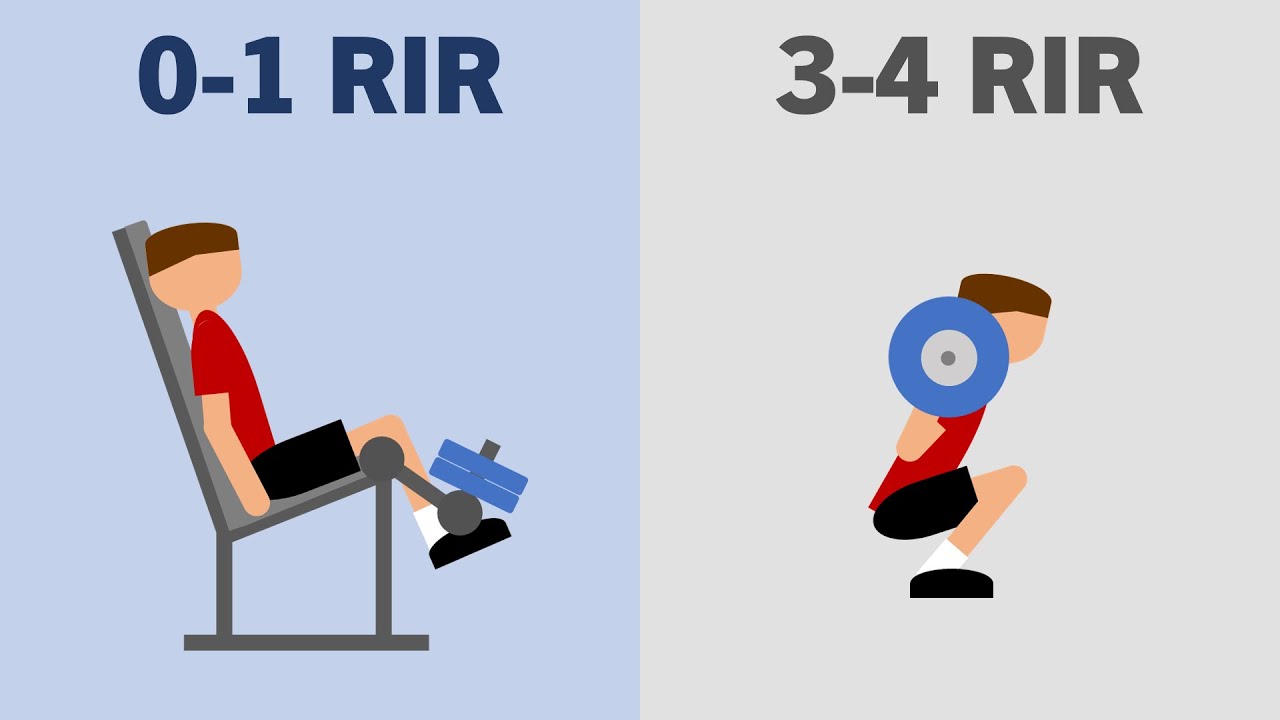
reps in reserve scale or rir for short zero reps in reserve means we couldn't have performed any more good quality reps in the set one rir means we could have performed one more rep in that set two rar means we could have performed two more reps and so on while we don't need to train to complete failure all the time we probably want to take all sets fairly close to failure to maximize muscle growth this is because motor unit recruitment follows what we call the size principle this suggests that muscle fibers are only recruited as
they are needed throughout a set so when we begin a set only some of the motor units are initially involved to lift the weight and as we get closer and closer to failure more and more motor units are involved as the initial muscle fibers fatigue so by the end of a set if we train close enough to failure all muscle fibers will be recruited and trained as a general rule when training with heavier loads in the approximate 6 to 10 rep range we don't need to train quite as close to failure probably around two to
three reps in reserve for all motor units to be recruited when we train with moderate loads in the approximate 10 to 15 rep range we probably need to train a little closer to failure to ensure all muscle fibers are trained probably around one to two reps in reserve and with lighter loads in the approximate 15 to 20 plus rep range we probably need to train very close to failure to ensure all motor units are recruited and all muscle fibers are trained probably around 0 to 1 reps in reserve next let's discuss frequency frequency refers to
how many times per week a muscle is trained however it should be noted that whenever we discuss frequency we are assuming that volume is equated so frequency is essentially a factor of volume for example if we trained a muscle with 12 sets per week training this muscle once per week would mean that all 12 sets are performed in a single session if we train this muscle two times per week we would perform six sets per session and if we train the same muscle three times per week we would perform four sets per session so as
we can see total weekly volume is the same in all cases although it is distributed differently across the week so how does frequency influence muscle growth well according to this research review frequency doesn't seem to have much of an effect on muscle growth at all when volume is equated however there does seem to be a slight trend in favor of higher frequencies as we can see training a muscle two or three times per week is probably a little more hypertrophic compared with training a muscle only once per week next let's discuss rep ranges and load
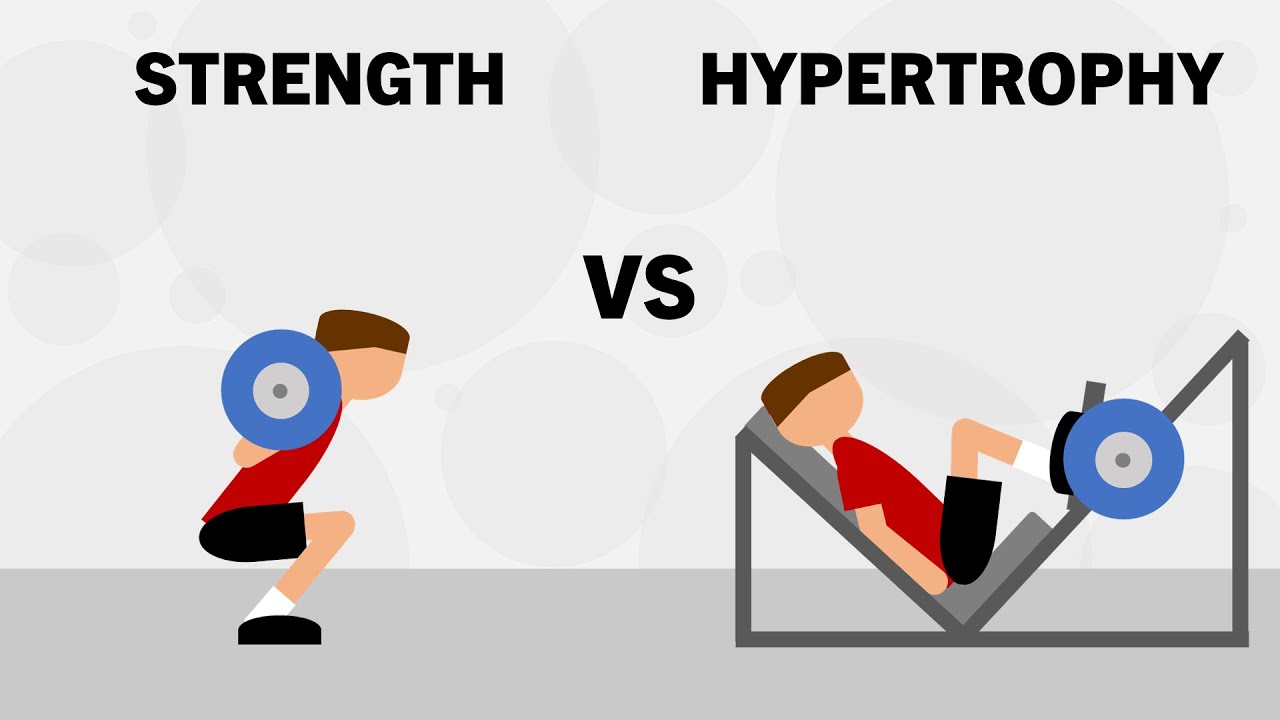
we have combined rep ranges and load together into one category here because they have an inverse relationship with each other in other words if we train with a heavier load we can't perform as many reps and if we train with a lighter load we will perform more reps assuming we are training fairly close to failure traditionally it was thought that the approximate 8-12 rep range was the sweet spot for muscle growth however recent evidence suggests that this isn't the only rep range that can be maximally effective for hypertrophy training while strength gains are certainly superior
when training with heavier loads hypertrophy doesn't necessarily follow the same principle it has been well established that hypertrophy can be equally achieved across a large spectrum of different rep ranges and loads assuming we are training close to failure this latest meta-analysis compiled the evidence on load lifted and muscle growth the authors concluded that hypertrophy gains are likely to be similar on a per set basis regardless of load lifted assuming we are training close to failure however this doesn't mean we can just lift with any rep range that we like and see equal muscle growth there
are still limits as to how heavy and how light we can train the effective hypertrophy range is just much larger than we once thought without going into too much detail about where exactly these limits lie this systematic review provides a good practical summary the researchers suggested that when training anywhere in the approximate 6 to 20 rep range seems to be equally effective for muscle growth on a per set basis assuming we are training close to failure there is even evidence suggesting we can actually train with even higher rep ranges than this but i don't think
it is very practical in most cases to train above 20 reps per set so i think that this rough 6 to 20 rep range is a good practical guideline next let's discuss lifting technique technique is difficult to define as a single variable because it incorporates many different components technique encompasses factors such as tempo range of motion and biomechanics so we won't be going into too much detail about each component in this video rather we will just refer to technique as a whole as a general guide we usually want to lift in the following way to
maximize muscle growth first we want to lift in a way that puts maximum tension on the target muscle and minimum tension on other accessory muscles this will ensure the target muscle is the limiting factor of each set so that it is maximally stressed and no other systems limit performance second we want to train with a full range of motion for whatever lift we are performing this has been clearly shown to be superior for muscle growth for most exercises likely because it usually stresses the muscle at longer lengths we also want to use a controlled eccentric
tempo the exact duration or cadence isn't all that important as long as it is somewhat controlled so that the muscle is doing work not just falling under gravity and lastly we want technique to be strict throughout the entire set this means we should stay composed and avoid any momentum or deviation in form simply put the last rep of a set should look exactly the same as the first rep only slower lifting with these general technique guidelines in mind will have an effect on both muscle growth directly but also on fatigue and injury risk strict and
effective technique will be more effective to stress the target muscle and will usually result in greater muscle growth this technique will also usually mean that we get a better stimulus even with lighter loads compared with cutting range of motion using momentum etc also because loads are lighter we are inducing less joint stress and probably reducing our risk of both acute and chronic injury so improving lifting technique allows us to get a better hypertrophic stimulus on the target muscle with less joint and connective tissue stress next let's discuss exercise selection this refers to which exercises we
implement into our program to train each muscle group obviously we want to select exercises which train the target muscle although there is more nuance to exercise selection than just this should we implement a compound or isolation lift a free weight or machine based exercise how many exercises should we perform for each muscle and much more as a general overview let's briefly cover some important considerations for exercise selection first and most important we want to make sure the exercise requires the target muscle to contract against resistance this will be based on the anatomy of the muscle
and the movement pattern of the exercise second we probably want to prioritize exercises which have a higher chance of the target muscle being the limiting factor this is to ensure that target muscle is maximally stressed for example an overhead press will train the triceps to some extent but they are unlikely to limit performance before the delts we also want to prioritize exercises which train the muscle at long muscle lengths or in a stretched position training a muscle at longer lengths is generally going to be more hypertrophic than training at shorter lengths for example deep squats
and leg extensions both train the quads but deep squats will train the quads at a longer length in the bottom position compared with the leg extension and lastly we want to prioritize exercises which have a fairly even tension curve throughout the entire range of motion this means the resistance on the muscle is similar at all portions of the movement rather than being very difficult at one portion and very easy at another portion so while there are many different exercises that we can choose to train each muscle group some may be more or less effective than
others based on these factors therefore trainees should try to implement the exercises that provide the best hypertrophic stimulus specifically for them and the last variable we will discuss in this video is rest periods or intercept rest this refers to the time taken between each set of an exercise it is generally found that muscle growth can be achieved with both longer and shorter rest periods however we usually find that longer interset rest is slightly superior in most cases this was established in this systematic review which analyzed the evidence on rest periods for muscle growth it was
concluded that significant muscle growth can be achieved with both short and long rest periods but longer rest periods are generally a little bit more effective however most of the studies included in this analysis used full body workouts with mainly compound lifts however when we look at a single muscle group trained in isolation the results we find are different for example this study explored the effects of traditional training with 90 seconds rest between sets versus drop sets with no rest between sets while performing tricep push downs as we can see the drop set training resulted in
superior muscle growth of the triceps compared with the traditional training although this study and a few other similar studies didn't isolate the variable of rest periods specifically they do suggest that shorter rest periods may be superior for isolation lifts while longer rest periods tend to result in greater muscle growth for compound lifts in either case both longer and shorter rest periods can both be effective for muscle growth although the exact time taken between sets may differ slightly based on what exercises we are performing now that we have covered the fundamentals of each training variable let's
now put them into a priority list we will rank each variable on how important it is relative to the other variables and try to give a rational explanation why before we do this it is important to understand that no single variable is effective in isolation rather all of these variables are interrelated and each one will influence the other so we should never focus all of our attention on a single variable we should probably try to maximize each one for the best chances of maximal muscle growth with this being said let's now explore the priority list
first on the list i have put proximity to failure i believe this is the most important variable for hypertrophy training this is because you could implement all the other variables perfectly in a program but without sufficient effort they won't have much if any effect at all we could lift with perfect technique and very high volumes but if we aren't training anywhere close to failure this will hardly induce any disruption to homeostasis and therefore minimal adaptation second on the list i have put volume as we know more volume tends to result in superior muscle growth so
volume essentially refers to the dosage of training in other words how much we do so assuming we are training close to failure doing more volume is likely going to be beneficial for muscle growth this has been put in second place because if we train with a close proximity to failure and high volumes we are likely to see some muscle growth even if technique is poor or the exercises we select aren't the most effective next on the priority list i have put lifting technique once we've ensured that we are training close to failure with a sufficient
amount of volume technique becomes very important lifting with strict and effective technique will improve the stimulus of each set and reduce overall joint stress this will essentially make each set slightly more hypertrophic and minimize our risk of injury next i have chosen exercise selection as we know hypertrophy can be achieved using many different exercises which train the same muscle group so there are no mandatory exercises which is why it doesn't rank very high on the priority list however exercise selection is still important because like we mentioned earlier in the video we can improve the hypertrophic
stimulus of each set by selecting the exercises which provide the greatest stress to the target muscle now getting towards the less important variables for hypertrophy training we have rep ranges and load as we know there is a very large spectrum of rep ranges and loads that can be used to maximize muscle growth so for this reason it doesn't really matter too much what specific rep ranges we train in provided that we are somewhere within the approximate 6 to 20 rep range some exercises will be better suited to different rep ranges over others but ultimately it
isn't the most important variable to be concerned with in second last position we have interset rest periods once again we can achieve great muscle growth with both short and long intercept rest as long as we train close to failure for most exercises longer rest periods are probably going to be slightly superior and for some isolation lifts shorter rest periods may be slightly superior but overall even if we pay no conscious attention to interset rest we will probably see great muscle growth by ensuring the variables above this are performed well and this brings us to the
last variable on our priority list which is frequency this could arguably be above rest periods depending on how you look at it but i have placed it as least important on our list this is because all the research gathered together still hardly finds any difference in hypertrophy outcomes when volume is equated even hitting each muscle once per week will still likely result in almost as much muscle growth compared with distributing this volume across two or more sessions per week frequency can definitely have indirect benefits such as allowing us to accumulate more volume but as an
independent variable alone it probably doesn't have a very large influence on hypertrophy outcomes so to summarize this video let's establish some practical recommendations there are many training variables that are often discussed but very rarely do we consider which ones are more important than others some variables have a large influence on muscle growth while others are less important therefore we should ensure that we are taking care of the most important variables first such as proximity to failure and volume before putting too much thought into less important variables such as rest periods and training frequency trainees can
use this priority list to make sure they are spending the most amount of effort on the variables which have the largest effect and the least amount of effort on the variables which have minimal effect thanks for watching and hopefully you got something out of this video check out flowhighperformance.com for online coaching training templates ebooks and more