Welcome to week three of Christian ethics, intro to Christian ethics. Today we're going to talk about when obedience replaces relationships. Um before we start, let's pray. Father, we thank you for this day that you've given to us. And Lord, we pray that today we would be filled with your Holy Spirit. Give us understanding. I know sometimes these things are difficult to understand but help us to have understanding and we pray that uh we would serve you and love you. We pray in Jesus name. Amen. This week we're going to talk about obedience and when obedience
replaces relationship. Now let me tell you something. Ethics, Christian ethics fail when obedience replaces relationship. In other words, if we do things only for obedience and not from relationships, ethics will always fail because you will never be able to maintain the ethical standard. Ethical standards cannot be maintained out of relationship from God. And so we have the problem. Most people assume that ethics fail because people disobey. That that that seems to be the most logical thing that we say. But scripture exposes a much deeper problem in the human condition. Ethics fail when obedience, when the
rules that we keep replaces the relationship we have with God. Human beings do not reject morality because they love evil. They reject moral systems because rules alone cannot carry trust, meaning or life. We reject moral systems, we do wrong because the rules that we live our lives by, if you if they are the only thing that you have, if they are the only guiding influence in your life, they cannot carry trust, meaning or life itself. And that tension about rules and relationship is not modern. In fact, it's it's really incredibly ancient. It's been around since
the Garden of Eden. And the Bible names it in its origin very very early. So let's start with this. The image comes before the instruction. In Genesis 1:26 and 27, God said, "Let us make man in our image, after our likeness." So God created man in his own image. In the image of God, he created him. Male and female he created them. And so what we see is the rules of living, if you could put it that way, or ethics, how we should live, begin with identity, not instruction. Genesis does not start by telling humans,
here are the 10 things that you must do. Genesis starts by telling humans, "This is who you are. This is who we are. We are beings made in God's image." And when we understand that moral life flows, in other words, doing the right thing flows from that identity. And so, identity always comes before obedience. We have to understand who we are. Now, as a Christian, if you know anything about Christianity, you know that you were made in the image of God and that you have value and worth. Now if you really know that that's going
to be a huge control over our behavior because we will know that we are in relationship to the living God and on top of that God has given us his holy spirit. And so we have to understand that ethics right living how we should live begins with begins with identity not instruction. The second thing we have to understand about image is the image of God is relational not individualistic. What do you mean? I I we we always understand the Bible as being for me. Now here I'm going to say something that Dr. Michael Heiser said.
The Bible was written for you but not to you. And the Bible is written to people groups. Very few letters in the Bible in the New Testament are written to individuals Titus and Timothy. But the Bible was written to churches or to people groups. And so the first thing that God tells us as he is as we open up the book of Genesis is male and female he created them. And that shows that God's image is expressed in relationship, community, and mutual responsibility. In other words, the image of God isn't just me. It's our church
community. And in that community, there is a mutual shared responsibility. In other words, we cannot live life independent of of other people or other Christians. And when we try to be what they say in America, a lone wolf or a lone cowboy, ethics collapse because it's reduced to private ruleskeeping instead of shared covenant life. Now, when I was growing up, I had a family and I had a mom and dad. I was adopted. I'm from Korea, but I was adopted to America. And I had a family. And in that family, I had been given the
nameraton. C R E I G H T O N. My father gave me the nameraton. Now, having given me the nameraton, that name came with relationship to my mom and my dad. And then I had my sister. And in that we had a small community. That community was what kept me. That relationship was what kept me. Those rules and regulations that my mom and dad taught me and I like to call them principles of living that my mom and dad taught me were learned in community in covenant life. And then we had our church and
we had a pastor and elders and the members of the church and we lived in community with them and they also taught us and they also were that mutual responsibility that we had together. And so the image of God is the people of God, not just you. And so we have to understand that human authority comes from God. It's not something that we just have autonomously. We're made in God's image. And that means that you and I reflect God's character and we reflect his rule under his authority. Ethics fail. Community life fails when people begin
to treat the image of God as permission to decide for themselves what is good and evil rather than how do I faithfully represent God in my world? That's an interesting question. How do I faithfully represent God in my world? So, as we've learned over the last few weeks, the Bible begins with identity, not instruction. Humans are created in God's image. You and I are designed to reflect God, to live with God, to depend on God. Ethics begins here. Right and wrong do not come from people. They come from God. We live rightly when our lives
stay close to him. Did you get that? Right and wrong do not come from people. I know we think society created these rules, but good comes from God and God defines what is wrong. And so we live in harmony, in peace when we stay close to God. Therefore, these commands are rooted in relationship. These are the commands rooted in relationship. Did you get that? These are the commands rooted in relationship. Now, let's add something. Let's as we begin to build this equation uh command comes inside of trust. So now we begin to talk about the
creator and we look at the our identity and then we're looking at trust. In Genesis 2:15-17, the Bible says, "The Lord took the man, put him in the Garden of Eden to work it and keep it." And the Lord commanded the man, saying, "You may surely eat of every tree of the garden, but you can't eat of the tree of knowledge of good and evil. and in that day that you eat, you will die. So God places Adam in [clears throat] the garden. He gives him an identity. He gives him authority. He gives him power.
He gives him relationship. And then he gives him a command. He said, "You can eat anything in here. There's the command. Don't eat that." You see, he places him before he gives command. God places you in in our lives. God places us. See, in this text, we see that Adam already had a relationship with the living God. And within God's care, within God's love, within God's relationship, that command is spoken to Adam. He's not standing outside of the garden. He's not standing away from God. He's in close proximity in relationship to God. And nothing in
the text here suggests that he has to earn his place. And I want you to think about that for a minute because that's so often how we are. We believe that if we do the right thing, if we say the right thing, if we keep the rules perfectly, God will be pleased with us and he will love us more. But nothing in the beginning of the Bible ever suggests that Adam had to earn God's love or God's place or the authority or anything else that God had given that to him inside of relationship inside of
his identity. And so we see that we have to be careful that we don't live our lives in the sense of transaction. In other words, let me give you an example. We go to church and we tithe and we put our our our money either in the basket or in the back or somehow online. And then we expect something in return from from God. We go I give because I want God to bless me. I give because I want to have a better job. I give because of this. I expect something from God. Now God
gave to us not expecting. God gave to us. He created us. He loved us because of who we are. And we give to God and we give sing him praises not because of what we can get but because of who he is because of our relationship with him. And so God God gives instruction and that instruction is giving within an established situation. In other words, God already acted for Adam's good before setting the boundaries. God had already set all the parameters. He set up all the blessing. He had already acted for Adam's good. And so
when God gives him this command, eat and don't eat that, it doesn't establish Adam's value, it assumes his value. Isn't that wonderful? God has has already said you are valuable. And this order matters for how obedience is understood in the Bible. The order that we talked about identity and and and relationship and command all the the how we have gone down through this matters because ethics how we should live obedience operates within trust that already exists. We trust God. And God is giving us command. God is giving us responsibility. It's not a test designed to
prove your worth. No. No. That doesn't mean there isn't tests in the Bible. There is. The Bible will test us to build our faith. But it's not a test to prove your worth or to prove your dignity or to prove that God is something wonderful. He already is wonderful. And he considers us wonderful and he considers the community wonderful. So we have to be very very clear how God's instructions function. We need to be clear about how ethics functions. They're given within the parameters of provision, not pressure. In other words, God had made everything. Today,
God has given you everything you need. The Bible says in Ephesians that we have been blessed with every blessing in the heavenlies. So God has given us provision. Now our problem is not provision. Our problem is fantasy. We have a fantasy of how we think God ought to rule, how we think God ought to live with us. We think we know how God ought ought to act. We don't have any right to dictate to God. But what we need to do is faithful faithfully respond to what God has already done. He's given us provision and
we don't need to secure God's acceptance. Now what does this mean? If you try to secure God's acceptance, then ethics will be the rules will be the way that you try to do that. Especially as Christians, I I will follow all the rules and I will have love and acceptance from God. No, no. We faithfully behave as representatives of the living God because we're already accepted and loved. Now, understand something. When God gives this command, it's it's it's framed by generosity. I mean, the command begins with what the man is allowed to do. Here's here's
what you can do. You can eat anything except that one tree. God first speaks about eating freely without any boundaries mentioned. Permission comes before the restriction. Now that then God gives us a restriction and he why does he do? He does it for for our good. But you have to understand that the order is important. The command is given in a setting where God has provided. That provision is present. Man is not to be micromanaged or tested. He's being addressed within a life that has already been given to him. And so we need to remember
that there's no scarcity. There's no threat of scarcity. There's just abundance. There's no I won't have enough food or I won't have enough this or I won't have enough that. There's all there is is abundance in the beginning. It's amazing how we understand that God has started out with abundance and yet we live in poverty in poverty of spirit in poverty of faith when God has provided that abundance. You see ethically obedience is not presented as fear of losing something. In other words, the life how we should live in Christ. How we should live isn't
about losing something. It's about representing the living God. It's about becoming representatives. And it's our responding in relationship in love. And in love, we carry out the ethics of God's word and living according to God's word. You see, work and obedience describe shared life with God. What we're seeing here isn't something that God is saying, "I want you to do this because I want to get rich." Understand for God to be God, he has no need. He doesn't need man. He doesn't need Eden. He doesn't need love. He has everything that he wants within the
Godhead. this perfect love, this perfect understanding, this perfect contentment, this perfect obedience. But God wanted a family. And so God creates a family and he wants a shared life with that family. In Genesis 2, God placed the man in the garden and gives him work to do. And and the work is caring for what has been given. It's not presented as watching for mistakes or avoiding failure. God doesn't say to him, "I'm going to keep close eye on you and boy, if you fail, woo, you're going to be in trouble." The only thing God gives
is the command in abundance and then a restriction. But there's a but there's a consequence. As always, there's a consequence for disobeying God. There's a consequence for not living according to the biblical ethic. So, Adam doesn't work in order to earn God's approval. He already has God's approval. Adam [snorts] works because he belongs to God and God belongs to him and he is living within the life that he has been given by God. And then that's a wonderful thing. It takes away all the stress. See, when when we live in relationship, when we live with
the idea that ethics deals with our identity, it takes all the stress off us. We no longer are filled with stress because we know that God is going to work in and through us and we don't have to be worried about that. See, the command fits inside of relationship. The command fits inside of the relationship. I hope you're getting this. Identity, relationship, love, family, community, all before the rules. And so the rules fit inside of all those relationships. Obedience is not described as anxiety about something doing wrong. It makes sense only because the man already
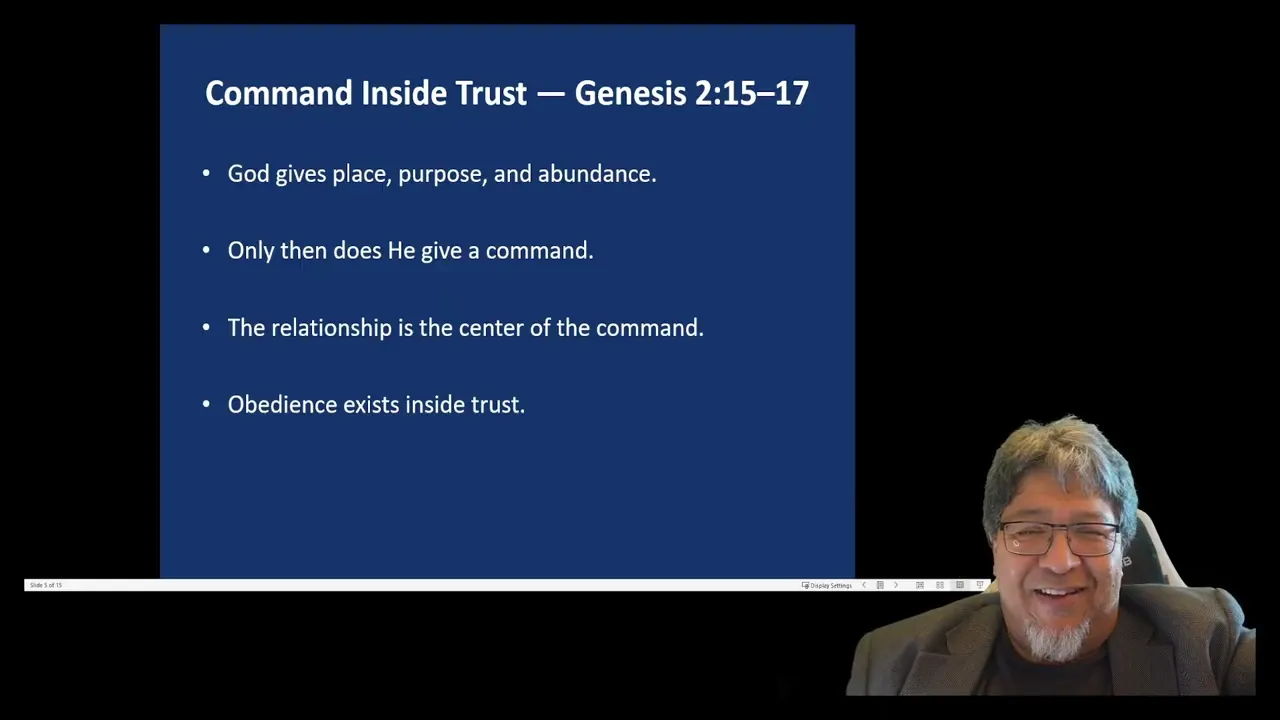
lives with God and receives life for him. There is no worry about doing anything wrong. So I want you to notice the order. God gives a place. God gives a purpose and God gives abundance. Only then does he give a command and the command is not the center of the relationship. The relationship is the center of the command. Let me say that again. The command is not the center of relationship. The relationship is the center of the command. It's because of relationship. Obedience exists inside trust of the living God. Thi this really matters. And if
you miss it, it's it's you're going to miss a lot of understanding about ethics because obedience that is detached from relationship becomes something that is entirely corrupted from what God originally intended. But man, he he just questions the trust. And so all of a sudden, if we go to Genesis chapter 3, a rebel shows up, a serpent, and the serpent begins to have Adam and Eve, Eve, and Adam's probably standing there, so I will say Adam and Eve. Uh, and he begins to have Eve question [clears throat] the trust, the trust that she had in
God. And so the serpent said, "Did God really say that?" And [clears throat] she's beginning to think, "Did did God really really say that?" She knew he did. You see the temptation attacks trust and when trust is violated the behavior becomes corrupt. The serpent Satan did not begin by denying God's command at all or by questioning God's reliability or even questioning his you know his his goodness. The ethic, the ethical collapse begins when confidence in God's character is undermined. Is God really good? How many times have you asked that because things haven't gone well? You
see, the issue wasn't the rule. The issue was trust. And when trust fractures, obedience loses meaning. It's not that there wasn't clarity. It's not like God was kind of vague in what he said. The problem was God's credibility was brought into question and trust was brought into question. Did God really say that? It doesn't when when Satan said that he's not introducing confusion about the rule. He's introducing suspicion about the God who gave the rule. And when that happens, trust begins to erode. And then obedience now begins to feel unreasonable. It's just it's kind of
unreasonable and even oppressive that that this this rule is oppressive and and it's unreasonable. And when that begins to happen, there's this cascade of things that happen and then moral failure starts and relational distance starts. You see, the question begins to create space between Adam and Eve and God. Humanity and God now begin to have space between them. There's not close relationship, but there's questions and all of a sudden the command becomes obligation rather than a loving command inside of relationship. And so there's no longer a relational response from Adam and Eve. Once the relationship
has been weakened and there's space between God and his creation, obedience can't endure. Satan, the serpent, doesn't deny God's existence. He questions God's word. The issue is not the rule. The issue is do you trust the rule giver? And once trust is questioned, obedience loses its meaning. You begin to trust lose trust and the things that are said now begin to be questioned. Do you really love me? Are you really concerned about me? Isn't that so often something that happens in our life? [snorts] We get space between us and God and all of a sudden
we begin to question God and [clears throat] his character. I I've done it. I'm guilty of it. And then when that happens, I don't want to obey anymore because ethics begins to fracture. And when trust is being lost, disobedience doesn't happen right away. But there's a fracture, a distance. ethics fracture before obedience occurs and then and then the disobedience occurs. And so all of a sudden, man goes from leaning totally on what God says to what is called moral autonomy. Genesis 3:6. So when the woman saw that the tree was good for food, she took
up its fruit and ate. She saw the tree was good. Human Humans now start claiming authority for themselves. This is not rulebreaking. It's obedience severed from relationship. You see, moral judgment moves from God to the person. No longer is it is this God who is doing this. It's it's my decision. So the woman looks at the tree and decides for herself that it's good. The text gives us the whole story. She saw that the tree was good. And and this is really an important moment. Until now, God had been the one who defined what is
good. And here now the human be the human being Eve begins to make that judgment alone apart from God. Any judgment that you make alone apart from God is incredibly dangerous. The problem here isn't that she sees the tree. The problem is that she trusts her own judgment instead of God's word. And this is where things go wrong. When people decide what is good and what is wrong without trusting God, the relationship breaks and then the decision making becomes corrupt and the decisions become wrong. They're just wrong. Another thing that we begin to see is
desire begins to lead when trust weakens. desire. The inward desire to want something began to leave to lead Eve because she had a weakened trust with her creator. She doesn't listen to God's word. She looks at the tree and thinks about what it can give her. What can I get from this? And the text describes what she sees and wants. What did she see? So was good. Lust the eyes. Pride of life. You see before this moment happened. Life was received by trusting what God said. Now the decision is made by looking, wanting and choosing
for oneself. And this really matters. When trust in God weakens, desire begins to guide decisions. People start asking what something looks like, what it promises, what it offers them. Says in Judges, every man did what was right in his own eyes. And that's really what we do. When we lose the identity, when we lose the relationship, when we lose the command, when we lose the idea of abundance, when we lose authority, when we lose all those things because we have questioned, we trust, we lose trust in God. When that happens, then we begin to do
what's right in our own eyes. And Christian ethics falls away. And that's why there are just as many divorces in the Christian church as there are in the world. That's why immorality reigns or is at least prevalent in the Christian church because we do what's right in our own eyes. I am lustful for this man or for this woman. I want to have this. This looks good to me. And this is how the story explains the problem. Desire takes the lead because the relationship is broken because trust is questioned. They begin to question God. And
the cho this choice so show shows the separation from God, not just rulebreaking. This this begins to show if you if they were if you were in the Antarctica and you were to see an iceberg. This is where parts of that iceberg begin to break off and move away from the original iceberg. Separation from God. It's not just rulebreaking. That's just the symptom of the sickness. In Genesis 3, the act of eating is more than breaking a rule. It shows in a change in how humans begin to relate to God. The men and the women
don't eat because they have forgotten the command. They had just gotten the command not long ago. They eat because they choose to act without trusting God. They decide to move forward on their own. And this is why the problem is incredibly serious. Life was meant to be lived in trust with God. When that trust is set aside, why obey? What's what's the purpose of obeying? I don't trust the creator. And this story shows that things fall apart not simply because a command is broken, but because people choose to live apart from God instead of with
him. See, you're beginning to see an emphasis on human judgment. She saw the tree. She made judgment. She saw the tree and she goes, "Wow, I that's good." And then she takes moral authority not from God, but from herself. I have the authority to say what's right or what's wrong. Now, I many times I would love to say what is right and what's wrong. But when God says it's wrong, then it's wrong and we don't do it because we're in relationship. Not because we're keeping the rules just because we want to keep the rules and
get some brownie points. No, because we love God and we want to serve him and we want to be his representative in the world and we want to spread the message of Jesus Christ. And then if you don't get this right, you're never going to be effective in spreading the message of Jesus Christ. Humans, Adam and Eve, take moral authority into their own hands. You and I don't have the right to take moral authority into our own hands. The Bible is the inspired word of God and has absolute authority for life and practice. And we
don't do it to get brownie points. We do it because we've been given identity. We've been given authority. We've been given command. We've been given abundance. And so it's very important that you understand this. This is the core of the fall of man. Not just rulebreaking, but severed relationships. So what we have a broken alignment. We we've seen that man is severed from relationship with God. And so we have this this alignment that's broken. Genesis 3:8 says, "They heard the sound of the Lord walking in the garden. The man and his wife hid themselves." Now,
here's the interesting thing. We see a number of things. God still seeks. The image still remains, but relationship is fractured. Ethics become difficult because the alignment is broken. And here's what we have to understand something about the God that we serve is this. God still comes towards people after disobedience. After the man and the woman disobeyed, God did not disappear. He didn't go, "Oh, okay. We're done with you." And he was gone. The text says that they hear the sound of God. They hear his sound. He's walking in the garden. And this really matters if
we understand and we begin to look at scripture because God is still moving towards them. He's not described as uh rushing away in anger or rushing towards them in anger. But what we see is a God who is present and who is near. And before God speaks about what went wrong, he comes looking for his creation and he asks them a question. Where are you? And that shows that the relationship still matters to him. And if I could just stop there for a minute, that's a question that God is still asking us today is where
are you? Where are you today? God is always looking for repentance. God is always looking for his people. God is always looking to restore the relationships. And in Christian ethics, what that means is that we as the people of God have to always be looking to restore the relationship. We have to look to restore the things that are broken. We have to come near to people and still seek out people cuz honestly people will not seek us out. We have to seek them out. And this is how healing actually begins in this story. God comes
first, correction comes later. God seeks people before he addresses their failures. And that's what we have to do. We always seem to want to bring the hand of correction so quickly, but we need to bring the love and relationship and then we bring the correction. Now we see that Adam and his wife are hiding and that shows that the relationship is broken. It's fractured after the man and the women eat the fruit and whatever it is. Some people, you know, we have said it's an apple, but it was some kind of fruit. And after they
eat the fruit, something new happens to them. They begin to see good and evil. And they are afraid. They are afraid to be seen by God. And so they hide. And the Bible says that they they actually put on uh fig leaves to cover themselves up. And they didn't hide because they forgot the command. They hid because something had changed. Something had changed between them and God. They no longer felt safe being close to God because that's what sin does. When sin is in our lives and when it rules our lives, we no longer feel
safe being close to God. Isn't that a shame? You see, God desires a family and he desires closeness. So often when we do things that are wrong, we try to put fig leaves over them, we try to hide them. What Adam and Eve should have done is run to God and say, "Hey, we made a huge mistake." And seek forgiveness. But they didn't. They they hid their sin. And so often we we often hide our sin. Again, Christian ethics working in our own life does not allow us to hide our own sin. That's not something
that God wants us to do. We need to expose the sin into the sunlight. When things are one of the best disinfectants is sunlight. And when we bring our sin before God, then there's a vastly different outcome than when we try to hide our sin. And that's what this story is showing. When the relationship with God is damaged, people pull away. Even being seen by God feels dangerous. And when there's habitual sin, even seeing being seen by God, we don't even want to be seen by God, which is foolish because God always sees us. And
he never doesn't not see us. And the problem grows when people avoid God. Ethics becomes difficult because the alignment is broken. Right? The problem grows because we don't seek God. Because we avoid God. We avoid the the cure to the problem. After the man and the woman hide themselves, their thinking changes. They're no longer calm. They're no longer peace. They're afraid. They feel full of shame. And they begin to try to protect ourselves. And that's what we do. We try to protect ourselves by hiding our sin. And this happens over and over and over again
when we are no longer close to God. Instead of coming towards God, towards the cure, we move away from him. A and this story, this scripture shows us this this principle really clearly. When people avoid God, fear begins to guide their choices. Let me say that again. When people avoid God, fear begins to guide their choices. They stop trusting and they stop seeing clearly. There isn't anything more dangerous than when you let fear make your decisions. I've trained dogs for years and one of the things and I I trained dogs to do protection work, bite
work. And one of the things that we don't want in a dog is unhealthy fear. Now, there is a healthy fear and we'll go into that another time. But if a dog is making all its decisions out of fear, they will never make the right decision in the protection phase because they will stop trusting their master that's behind them. They'll stop trusting their training and [clears throat] they will start to use their heads and find and frankly when a dog uses his own head that's not too good. you know, their brains are only this big.
Now, you think, well, my brain's bigger. Okay, so your brain is as big as my fist or maybe a little bigger. Some of you have bigger heads, some may have smaller heads. But when people move away from God, their choices begin to change. After the man and the woman sin, they hide and fear becomes prevalent and shame becomes prevalent and they try to protect themselves. So what happens? Hiding, fear, shame, self-p protection. And this happens because they are no longer close to God. When people hide from God, they stop seeing clearly. Fear begins to guide
what they do. Now, here's the interesting thing. Even all though all that happens, God still seeks the imo day, the image of God remains, but the relationship with God is fractured. Now, after Adam and Eve sin, there are three distinct fallouts. Now, write these down. They're not in your slides, but I want you to write them down. Number one, desire is distorted. No longer is there a pure desire, but there is a distorted desire. The desire for one another gets distorted. The desire for power gets distorted. Judgment gets clouded. No longer can they make right
judgments and good judgments because judgments are made out of fear. And when you work out of fear, you will always end up in the wrong place. And thirdly, trust between them and God is broken. Making good choices becomes hard because the relationship with God is broken. You can't really make good rel big big good decisions when you're outside of God. And so all of a sudden we come to this thing called conscience. And there's this conscience after the fall. Romans 2:14-15 says, "They show that the work of the law is written on [clears throat] their
hearts while their conscience also bears witness. We have conscience. Everyone whether they know Jesus or not has conscience and things are written in us and it bears our conscience bear witness. So here's what that shows. Number one, when we begin to think about our conscience, how we should live and having a good conscience, conscience shows that people were made by God. We innately know that it's wrong to kill. We innately know that it's wrong to steal. We innately know when it's wrong to lie. We have to be taught not to, but we innately kind of
know that those things are there. The Bible teaches that human pe beings still know something is right and something is wrong. And this inner sense does not disappear after Adam and Eve sin. It shows that humans were created by God and still carry his design. But this inner sense is not enough anymore because we're fallen. We're sinful. Knowing right and wrong does not fix the broken relationship with God. In fact, nothing can. And that's why Jesus had to come because we couldn't fix that broken relationship ourself. Conscience can tell a person that something is missing.
But it cannot bring the relationship back. Only God can do that. And God did that when God sent Jesus, God the Son, into the world to live a perfect life. to die the perfect sacrifice to carry my sin. God treated Jesus like a sinner. He bore my sin, paid my price, rose again, and he is lord of lords, king of kings. Now conscience that we have shows inner struggle. When we have conscience we we know that there's an inner struggle but it does not give clear direction. Conscience does not give clear directions. Again back to
ethics. Paul explains that people often feel divided inside. [snorts] Sometimes their thoughts say that they're doing wrong. Other times their thoughts try to defend what they do. I can talk myself into almost anything, can't I? As I've gotten older, I' I've gotten a little heavier. And so, I'm on this thing called the perpetual diet. And my wife says I'm on a seafood diet. I see food and I eat it. But we're we're on a diet and often times we'll be out and there'll be some type of really good food that I shouldn't eat. And my
conscience says, "Hey, Chubby, don't eat that." So, I know I shouldn't, but I can talk myself into it. Oh, I won't eat a lot. I I I'll I'll only do it this one time. See, we begin to reason in this circular way that's destructive. And that's why conscience doesn't give clear guidance. What we need is something that transcends us. We need something that transcends culture, which is the word of God. And this struggle that we have with conscience continues. And it continues because the relationship with God is still broken. And even when we come to
know Jesus, we're not perfected yet. We will be. Without trust restored, people feel pulled in different directions and they remain unsure of what is right. And that's why we need the Bible. Now, conscience for a Christian, it might not work great because we're fallen. But at least we have the word of God. But conscience when people are separated from God really doesn't work very well at all. Conscience only works well when God is involved with our conscience. When people are not close to God, their inner sense of right and wrong becomes very unreliable and it
can change over time. It it really can that conscience can become quite quiet. It can also lead people in the wrong direction. This is why conscience really alone is not enough. Feeling inside a person cannot carry the weight of faithful living. In other words, you can't live by your feelings. And we do, don't we? That's why we get such trouble with the car when we're driving along in our car, right? And there's somebody that does something and we don't not happy with it and and so they cut us off. So what do we do? We
zoom around them and cut them off. Conscience isn't working well. common sense isn't working well. Our feelings aren't working well. We're actually living by our feelings. And our feelings can vary dayto-day. We some days we feel great and other days we don't feel great. And so Paul in Romans and this story in Genesis, they both are showing us good choices can only come. ethical living, ethics, how we should live can only come out of growing close to God. It's that abiding men know abide. Jesus said in John 15, abide not from listening to your inner
feelings cuz your inner feelings are not reliable. I've been married for 48 years. Some days I feel very in love with my wife. Other days maybe not so much. But I have made a commitment of the will to love her no matter how I feel. That's biblical. Even after the fall, people still have an inner sense of right and wrong. Yes, they feel guilt. They they recognize harm. They care about justice. That's the image of God at work. But that's not enough. That's no longer enough. In other words, just that conscience doesn't work because the
conscience is corrupted. Conscience in itself apart from God can be manipulated, can be shaped, can be silenced and can be misdirected. Now again write this down. Conscience by itself apart from God can be manipulated, shaped, silenced or misdirected misdirected. And that explains why moral systems exist everywhere and they're different moral systems and they are in conflict with each other. And so we as Christians tend to get this thing called legalism, moralism, and we try to live by rules. Now the law is good. The Bible said the law is good. The law is holy, but rules
outside of the life in Christ always fail. Look at the different religions of the world, the different things of the world. Their rules and religion and regulations, their their moralism does not work because it is outside of Christ. When relationship is broken, humans try to manage behavior. In other words, we try to manage our behavior. And so to do that, we make rules and then we make rules cuz that rule doesn't work. And then we make more more rules because those rules didn't work. And there there is no trust. There's just rules that multiply and
they multiply and they multiply. And so now human beings want to what? Control. They want to get alignment. And so they make social contracts written and unwritten. And what do we do? We break them on a regular basis. And that's moralism. You see rules. Moralism promises clarity and safety. And I will tell you that rules are not necessarily bad. Rules can bring reformation, but only God can bring transformation. Again, write this down. Rules can bring reformation, but never transformation. Only God can transform. Here's the problem with the reformation. It does not last. when John Calvin
and Luther and Meen and those other great reformers created the re this thing called the reformation where a tremendous tremendous amount of our theology comes from. You notice that reformation didn't last because a reformation never can. Only the only thing that can last is transformation. The only way we can move away from rules and regulations is into is to go into relationship to the living God. And then we can live by the ethic that God has through his word. Man's rules, man's moralism cannot restore what was lost at the Garden of Eden. morality without covenant.
Morality without covenant, laws without God, ethics, if you would without God don't work. And so what we have is morality without covenant. We have law without true transformation and restoration and we have ethics without God acting first. In other words, God moves towards us and we respond to him. Rules can't restrain behavior. Rules the law can limit damage but it cannot cure the disease of sin. Moralism cannot heal the rupture. And that's the key word, rupture. They cannot heal the rupture. As you can see in the outline here, the problem is not ignorance. The problem
is separation from God. Now, here's the issue. We love the law. We love the law because it gives us a box to put God in. Here's what Galatians 3:21 says. If a law had been given that could give life, then righteousness would indeed be by the law. We can't follow enough rules. We can't be good enough in and of ourselves to enter into the kingdom of God. We can't please God by rules. We talk about obedience from relationship. Now, that pleases God. But rules in and of themselves and keeping rules apart from God do not
please God in any way, shape or form. You see, the problem isn't the law, but the limits of the law. The law could not give life. It says in Galatians, Paul Paul is here. The law is not evil. And Paul's really clear that the law is not opposed to God's promises at all. The is the issue is that the law was never designed to generate life or restore broken relationships. The law was meant as a tutor to guide us to the one who could bring us back to where we need to be. You see, the
law can expose failure, but it cannot heal the rupture between man and God. One of the great things about the ten commandments is it really identifies what's wrong in our life. Honor your mother and your father. You will have no other gods before me. That's idolatry. It's where sin comes from. Though all those things that the ten commandments talks about, they're holy and good and righteous. But the law by itself cannot repair what has been fractured between God and humanity. Ethics collapses when we ask the law to do what only relationship can do. Ethics collapses
when we ask the law to do what only relationship can do. You see, when people focus on obeying rules and not on living with God, the law feels really burdensome and tiring. It's not helpful. And so, what do we do? We try harder and then we get more frustrated. Then we try harder and then we get more frustrated. Then we try harder and then we quit because obeying the law does not fix the problem. The law is not evil. But the law cannot give life. And so ethics fail when people obey rules. Ethics, remember, starts
with identity and we're given and we're in relationship and there's a covenant bond and then we're given an authority and we're given work to do and we obey faithfully. That's ethics. Those things fail when we try to do that by obeying rules instead of living in relationship with God. And so what we really need is what is called covenant obedience. If you're going to have Christian ethics, you have to have covenant obedience. Remember we talked about covenant being relational. That God binds himself to us as our father, as our king, as our lord. Deuteronomy 6:4
and5. Here, O Israel, the Lord our God, the Lord is one. You shall love Yahweh, your Elohim, with all your heart. You shall love the Lord your God with all your heart. You see, covenant obedience begins with loyalty and love, not rulekeeping. God said, "Here, O Israel." He calls for relational attentiveness before there's action. Here, here, O Israel, be attentive to the God who made you. And obedience in scripture always flows from belonging to one God, not from managing your moral performance. In other words, [snorts] obedience will flow naturally because you love God. You are
loyal to him. You belong to him. He belongs to you. And it's it's not going to come from trying to manage your moral performances or trying to keep the rules. In the covenant, love means giving your whole life to God, not just having strong feelings about God. Now, we should have strong feelings and those feelings will come. But covenant means you're giving your whole life to God. To love the Lord with your heart, soul, strength. That means to live every part of life with God in mind. That means your marriage with God in mind. That
means your relationship with your friends with God in mind. That means your relationship to your uncles or your aunts or your mom and your dad with God in mind. Faithful living grows out of loving God, not just following the rules. God wants a family. God wants relationship. God wants to be loved. He doesn't need it. There's perfect love, perfect agreement, perfect peace, perfect contentment with inside the Godhead itself. For God to be God, he has no need. But God wants it. He wants a family. He wants to superintend this world with us. commands rules make
sense only when they're inside the covenant relationship. The shema frames obedience as a response to God. Did you catch that? It the shema defines obedience as a response to God. Who is Israel to God? His family love. He loves his people. Now when relationship is removed, the obedience collapses into just rules. You see, biblical obedience flows from loyalty, not fear, not performance, not rulekeeping for approval. covenant obedience, living a moral life, living an ethical life, learning to make good decisions with inside the the the word of God is relational before its behavior. In other words,
it comes it flows out of that deep personal relationship to God. So, let's kind of close things up with this. Christ, Jesus Christ. Colossians 1:15 says, "He is the image of the invisible God." And what that means is he is God. He's the exact representation. He He's the exact thing that is God. And so Jesus does not merely show the image of God. He is the image of God. He is God. where humani where humanity uh reflected God imperfectly and then fractured that reflection. So what it is, here's what it is. We're to reflect God.
And when Adam sinned, then the reflection fractured. But Christ came to show us the perfect image. He embodied that image fully. And if you're going to have ethical clarity, it doesn't begin with rules. It begins at looking with Jesus. You see, true obedience grows out of a faithful relationship with God, not trying to keep rules perfectly. And we we want to keep rules perfectly. My wife is really good about uh keeping rules and keeping things within the guidelines. Uh she talks about uh drawing inside the lines and she does and she tells me I I
don't draw. I have no lines. But what what we're seeing what we want to see here is that um rules without Jesus don't make any sense. And so Jesus doesn't merely show the image of God. He is the image of God. True obedience grows out of faithful relationship with God, not in just keeping the rules perfectly because it can't be done. People learn to live rightly because of being joined to Christ, not by keeping the law. Again, living close to Christ brings new life, and rules alone do not fix the problem. Ethics will always fail
when obedience replaces relationship. So you need to keep this in mind and that should make you uncomfortable rules will ethics will fail when uh obedience replaces relationship. All right, let's let's talk about assignments. Uh this week, I want you to read very carefully. Genesis 3 1-13. Uh Genesis 4 1-12, James 1 13-15. And I want you to read these slowly at least once all the way through. And then I have a writing assignment for you. And here here it is. Uh the length is two or three pages double spaced. Uh it's it's on Genesis chapters
1-3 and Exodus 6 7 through uh 6 6 and 7 and explain how the Bible shows the ethical living grows out of relationship with the God not keeping rules alone alone. Address these three points. Relationship before command. What breaks when relationship is lost? Ethics today. How does relationship with God shape real life choices? And give an example. I want you to write clearly and simply. Short sentences are fine. I use scripture and explain it in your own words. No outside sources. The grading is based on understanding and clarity, not academic style. I am not going
to uh make make you uh adhere to a certain academic style. But I want you to have understanding and clarity. Let's let me pray for you. Father, we thank you for the day you've given to us and what we learned today. And I pray that we would continue to love and serve you. I pray that each one would be blessed. Bless them as they do their homework and their reading. And I pray in Jesus name. Amen. All right. God bless. I'll see you next week. It's going to be great. Uh we will talk to you
later. God bless you now.







![1 A.M Study Session 📚 [lofi hip hop]](https://img.youtube.com/vi/lTRiuFIWV54/mqdefault.jpg)