Day 4 Linguist and thinker Dr Samuel Johnson once said, “Patriotism is the last refuge of the scoundrel,” as a warning to not seek simple solutions to complex problems. Sci-Fi author Isaac Asimov later paraphrased it as, “violence is the last refuge of the incompetent. ” But today, on the 19th of October, 1962, President John F.
Kennedy receives very competent advice as to why violence should be the simplest and most patriotic response to the Cuban Missile Crisis. I’m Indy Neidell; this is Time Ghost with the Cuban Missile Crisis, Yesterday, Kennedy leaned towards not going to war with Cuba, but declaring a blockade instead, and Defense Secretary Robert McNamara had seemed to get some support from the military for that idea. Today, the Joint Chiefs of Staff of the US Armed Forces try hard to sway Kennedy back to the path of military action.
On Cuba, there were many more Soviets than US intelligence presumes, and they were hard at work readying their missiles for deployment. The CIA has been trying to work out where the Soviet nuclear warheads were stored. Obviously, knowing this is the prerequisite for the US Air Force taking them out with targeted strikes, and would significantly increase the appeal of a limited air strike as a solution.
One location they have been observing for months is a bunker complex near Bejucal about a 45 minute drive south of Havana, but they have by now discarded this as a possible option since they didn’t see any recent improvements to the facility, it wasn’t very well guarded, and was in fact only protected by a chain link fence. Bejucal surrounds a small township founded in 1831. Other than being the terminal station of Cuba’s first railroad and hosting a very popular carnival festival, it’s a fairly insignificant place.
On a random side note, actor Andy Garcia was born there six years before the crisis, but he and his family fled to the US last year. Anyway, the CIA are very much mistaken - this is where the warheads are in fact stored. In a modified hillside bunker complex, there are now 160 nuclear warheads being prepared to be mounted on missiles and armed.
A veteran of the Soviet nuclear armed forces, Colonel Sergei Romanov, is in charge of the operation. The working conditions are abysmal. In Cuba, the warm and humid tropical climate makes it difficult to maintain the right conditions for what is a very sensitive and very dangerous job.
Romanov scrounges whatever air conditioners his Cuban hosts can lay their hands on, but finally resorts to requisitioning loads and loads of ice to cool the inside of the bunker. Much worse still is the imperceivable radiation- many of the workers will develop cancer and die from this radioactive exposure over the coming months and years. There’s also the stress of maybe being discovered and bombed by the US.
There is hardly any time, or any peace of mind, to sleep. The strain is already taking its toll on Romanov’s health, and he will die of a heart attack shortly after returning to Russia. His second in command, Major Boris Boltenko, also a nuclear force veteran, is even now suffering from undiagnosed brain cancer from prolonged exposure and will also die in a few months.
Today, they are finally getting rid of at least some of the warheads. The first batch of ‘the gadgets’, as they call them, is ready to be shipped to the missile sites. The chosen destination is a remote missile location at the center of the island.
Unit commander Colonel Sidorov has made progress there far more quickly than expected with preparing the rockets. His unit is also the best-concealed and most difficult to strike from the air. The warheads are loaded onto a convoy of twenty trucks that will travel fourteen hours by night on primitive jungle roads.
To avoid detection, they use no headlights and only every fourth truck uses sidelights to allow the convoy to stay on the road. Sidorov finalizes preparations so that the first warheads can be mounted already tomorrow. The Soviets will then only need a 30-minute window to arm and launch the missiles.
In the White House, the assumption, or should we say hope, is that this window is 18 hours, which would allow the US to act without the danger of immediate nuclear retaliation, though as of today, the US does correctly assume the total Cuban nuclear arsenal- including ICBMs- will be deployable some time in the next two months. At 9:45 AM, President Kennedy receives the Joint Chiefs of Staff. They still want to convince him to make a military strike, as I said before.
Chairman of the Joint Chiefs, General Taylor, says: From the outset I would say that we felt we were united on the military requirement: we could not accept Cuba as a missile base; that we should either eliminate or neutralize the missiles there and prevent any others coming in. From a military point of view that meant three things. First, attack with the benefit of surprise those known missiles and offensive weapons that we knew about.
Secondly, continued surveillance then to see what the effect would be. And third, a blockade to prevent the others from coming in. I would say, again, from a military point of view, that seemed clear.
We were united on that. He goes on to say that they are not unanimous regarding invasion, and what political action to also take in parallel. Kennedy replies: Let me just say a little, first, about what the problem is, from my point of view.
First, I think we ought to think of why the Russians did this. Well, actually, it was a rather dangerous but rather useful play of theirs. If we do nothing, they have a missile base there with all the pressure that brings to bear on the United States and damage to our prestige.
If we attack Cuba, the missiles, or Cuba, in any way then it gives them a clear line to take Berlin, as they were able to do in Hungary under the Anglo war in Egypt. We will have been regarded as—they think we’ve got this fixation about Cuba anyway— we would be regarded as the trigger-happy Americans who lost Berlin. We would have no support among our allies.
Kennedy goes on to weigh the options at hand, explaining why he might prefer a blockade, but he also says: On the other hand, we’ve got to do something. Because if we do nothing, we’re going to have the problem of Berlin anyway. That was very clear last night [in the meeting with Gromyko].
We’re going to have this thing stuck right in our guts, in about two months. And so we’ve got to do something. He then outlines all of the difficulties that they’re presented with on a diplomatic level if they should attack Cuba, especially regarding Berlin.
Then Taylor says, We recognize all these things, Mr President. But I think we’d all be unanimous in saying that really our strength in Berlin, our strength anyplace in the world, is the credibility of our response under certain conditions. And if we don’t respond here in Cuba, we think the credibility of our response in Berlin is endangered.
That’s right. That’s right. So that’s why we’ve got to respond.
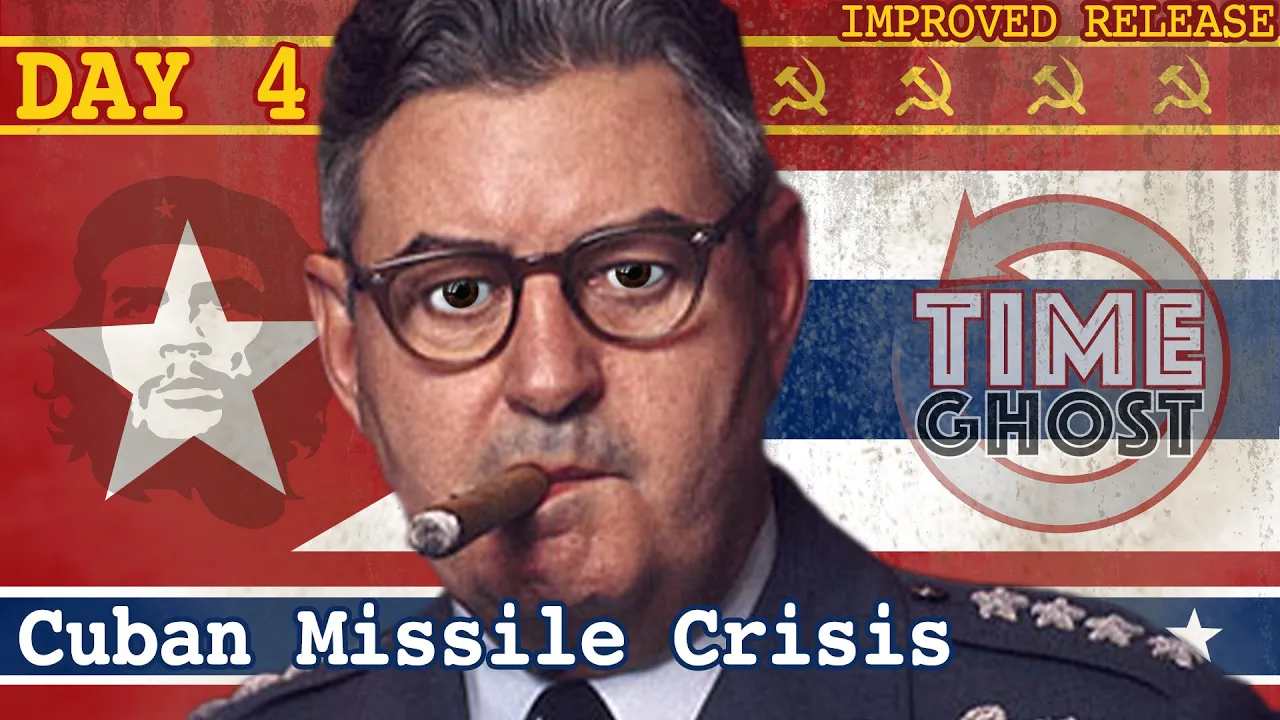
Now the question is: What kind of response? General Curtis LeMay, chief of the US Air Force, shares his views. I’d emphasize, a little strongly perhaps, that we don’t have any choice except direct military action.
If we do this blockade that’s proposed and political action, the first thing that’s going to happen is your missiles are going to disappear into the woods, particularly your mobile ones. Admiral Gorge Anderson, Chief of Naval Operations, explains that he could carry out the blockade, and it would be easier to enforce complete blockade than partial but… If we institute a complete blockade, we are immediately having a confrontation with the Soviet Union because it’s the Soviet-bloc ships which are taking the material to Cuba. So he too thinks decisive pre-emptive military action is preferable.
Chief of Staff of the US Army General Earl “Bus” Wheeler wants his forces to join in with boots on the ground: Mr President, in my judgment, from a military point of view, the lowest-risk course of action if we’re thinking of protecting the people of the United States against a possible strike on us is to go ahead with a surprise air strike, the blockade, and an invasion […] The conversation gets testier. Le May says, I think that a blockade and political talk would be considered by a lot of our friends and neutrals as being a pretty weak response to this. And I’m sure a lot of our own citizens would feel that way, too.
In other words, you’re in a pretty bad fix at the present time. What did you say? You’re in a pretty bad fix.
You’re in there with me. [Slight laughter, a bit forced. ] Personally.
They debate how certain they can be of Soviet missiles being ready, and when and how to deal with fallout against Guantanamo, the US base on Cuba. The conversation moves more and more towards the practicalities of military action until finally they start looking at dates. They conclude that the military can be ready to begin a blockade and do airstrikes the day after tomorrow - on Sunday the 21st.
To really get it right, though, they’d prefer Tuesday the 23rd. Then there’s the question of invasion: Then, now the invasion would take . .
. Seven days after the air strike you could start the invasion going on for about 11 days. Obviously, Taylor doesn’t know about the tens of thousands of Soviet forces armed with tactical nuclear weapons that are awaiting them on Cuba.
No matter what, the Joint Chefs of Staff are anxious to move ahead, but Kennedy still isn’t sure to even respond at all. Wheeler asks, Today . .
. am I clear that you are addressing yourself as to whether anything at all should be done? That’s right.
But that if military action is to be taken, you agree with us. Yeah. They sum up the meeting and conclude that for all eventualities, they will continue preparing the military options.
Kennedy leaves for his waiting helicopter. Not knowing that they’re still being recorded, the chiefs wait until they think the coast is clear and then air their frustration about not being able to decisively move ahead. Expressing an astonishing amount of wishful thinking, they interpret the President’s noncommittal statements as a discrete way of telling them that they should move ahead, at least with airstrike to take out the missiles.
Even Genial David M. Shop of the US Marines, who is the only military man there opposed to an invasion, feels they have Kennedy’s unspoken support for airstrikes, while acknowledging that no matter what you do in this situation you’re screwed. You’re screwed, screwed, screwed.
And if some goddamn thing, some way, he could say: “Either do this son of a bitch and do it right, and quit friggin’ around. ” That was my conclusion. Don’t frig around and go take a missile out.
In fact Kennedy is not at all convinced of any military action, and still the preparations go ahead. As we’ve said earlier, when you let out the slack on the leash of the dogs of war, there’s a real risk they might slip out of your hand. By the time Kennedy lands for campaign rallies in Ohio, the world has taken yet another few steps towards nuclear war.
See you tomorrow on day five as Kennedy tries to unring the bells that he inadvertently rung today. If you just joined us, you can see the first daily episode - day zero, right here. And if you want more great content, join our TG army and support us at tg.
tv or patreon. com Good night and good luck.