[Music] And we are in the middle of a series, uh, in the Book of Matthew on The Sermon on the Mount, this being a sermon that Jesus, uh, would have preached in from chapters 5 to 7. We're really getting into the center of this sermon today as we jump into a text most commonly known as The Lord's Prayer. Um, tomorrow we will honor, uh, the life of Martin Luther King Jr.
, a man, uh, uh, who called our country to the better treatment of all people. He called to see all men are created in the image of God and therefore have great value, as image bearers of our Creator God, regardless of whatever differences they have. That call is one that is aligned with the kingdom, that every person has value in the eyes of God and should, for us as well.
But Martin Luther King was also a man who was dedicated to prayer and saw prayer as a vital, uh, component of the life for those who follow Jesus. In fact, he said, "To be a Christian without prayer is no more possible than to be alive without breathing. " To be a Christian without prayer is no more possible than it is to be alive without breathing.
And we'll see in just a second that prayer is not optional for the Christian life; it's as necessary as it is for us to breathe air into our lungs. This morning, I want to invite you, uh, to stand with me as we read from God's Word, uh, Matthew chapter 6, and we're going to start in verse 5. We stand in Journey to honor the reading of God's Word, to set it aside as different from everything else that we read in our life.
To honor it, and in doing so, we put ourselves in a posture to better receive. And so, if you have your Bible, I hope that you'll turn with me there. The words will also be on the screen, and we're going to back up to start in verse 5, because as we remember, all of these passages are not disconnected from one another.
So, as we jump into the Lord's Prayer, last week we were in the first part of a sermon titled "Learning to Pray: How Not to Pray," and today is "Learning to Pray: How to Pray, Part One. " It became a three-part sermon. Matthew, servant of the Lord, recounts the words of Jesus: "And when you pray, you must not be like the hypocrites, for they love to stand and pray in the synagogues and at the street corners that they may be seen by others.
Truly, I say to you, they have received their reward. But when you pray, go into your room and shut the door and pray to your Father who is in secret, and your Father who sees in secret will reward you. And when you pray, do not heap up empty phrases as the Gentiles do, for they think that they will be heard for their many words.
Do not be like them, for your Father knows what you need before you ask Him. Pray then like this: Our Father in heaven, hallowed be your name. Your kingdom come, your will be done on earth as it is in heaven.
Give us this day our daily bread and forgive us our debts, as we have forgiven our debtors. And lead us not into temptation, but deliver us from evil. For if you forgive others their trespasses, your heavenly Father will also forgive you.
But if you do not forgive others their trespasses, neither will your Father forgive your trespasses. " This is the word of the Lord. Then, Father, this morning we thank you for your Word, and God, we thank you for the opportunity to come together, to sit around the teaching of your Word, to sit around that which you have given to us through your servant Jesus that has come to us.
We ask that through the power of your Spirit, Lord, you would do a work in us, refining us today. That we would see not only this beautiful model of prayer that Jesus gives to us, but, Father, that we would see and experience that prayer is like breath to our lungs. That in our life with you, we cannot live and move and breathe without it.
God, would you be with us now? And it’s in the power of your Son Jesus that we pray. Amen.
You guys can grab a seat. This week's sermon is not going to be a thorough exposition of this passage because we don't have time to do that in one sermon. In fact, so much so that just last night, I decided to make today's sermon two different sermons.
There was so much there; I just didn't feel like we could get through it. I didn't really feel like it was faithful to split it up a little bit. So, we're going to be back in the Lord's Prayer again, uh, next week as well.
And so, it's going to be a little bit more of a flyby of the heart of Jesus's model in prayer for us, and we may come back to the Lord's Prayer at a later time and do a deeper dive and work through it a little bit more deeply. But for today, we'll have to move fairly quickly through this very deep well. But before we do, I want to acknowledge two things.
First, this prayer—when I'm saying this prayer, I'm talking about verses 9 to 13—where after Jesus says, "Pray then like this," he's saying, "Here's how to do it. Pray then like this. " In those verses, there are two distinct focuses.
The first focus is on God; it's on Him. The second focus is on our personal petitions. The first half of this sermon orients us toward God to praise and to worship Him, to submit our wills to Him, and all of this comes before we bring our own requests to Him.
As a friend, Pastor John Anua, says it this way: God is not here to simply grant wishes, nor is He here to fund idolatry. God does serve us, but He exists for His glory; we exist for Him, not the other way around. In prayer, we embrace the right posture of longing for His glory before provision.
Our right posture would be to long for the glory of God more than we are concerned about our provision. That's the first thing. The second thing that we see is, if you'll remember back in verses 7 and 8, Jesus says, "Do not heap up empty phrases.
" It’s a little ironic that many Christians then have taken the following words and recited them over and over again. I don't know about you guys, but growing up, for me, pretty much any time we had a sports practice, at the end of it we said the Lord's Prayer: "Our Father who art in heaven, hallowed be Thy name. Thy kingdom come, Thy will be done," except we used King James version English.
Y'all know many of us have it memorized. So, the irony is, "Do not heap up empty phrases. " We talked about that last week, a lot of times being like empty and meaningless and unintentional formation in the lives of believers.
Others have avoided saying it verbatim at all so as to not get close to those empty phrases. Now, maybe you fall into one of these categories this morning or into something else altogether, but either way, this prayer is an excellent model for us. How could it not be?
This is the teaching of our King, Jesus. So let's read it again: Verse 9: "Pray then like this: Our Father in heaven, hallowed be Your name. Your kingdom come, Your will be done on earth as it is in heaven.
Give us this day our daily bread and forgive us our debts, as we also have forgiven our debtors. And lead us not into temptation, but deliver us from evil. " There are two postures that we're going to see in this prayer this morning: adoring our Father and desiring God's will.
The first, adoring our Father, we see in verse 9. The beginning of a prayer is called an invocation; it’s what initiates our prayer. The invocation is to invoke God directly, to call upon Him.
Here, Jesus begins His model of prayer with an invocation, and in this invocation, He identifies who He is praying to, and He's identifying the relationship that He and we have to the one He's praying to. He's calling God our Father in heaven. He's calling upon the Creator of the universe; He's calling upon, amongst the Jews, the people of God who would have been sitting there and hearing this, to the God of Abraham, and the God of Isaac, and the God of Jacob.
He’s calling to the One they've always known, the God of the Jewish people who had been their Creator, their Sustainer, their Redeemer, and their Deliverer. This is the God who had the promise to send a Messiah to make things right and good and reconciled once and for all. Jesus is calling upon this same God, the One reigning and ruling over all creation.
Now, this is the right setting of our prayers; it’s the proper reorientation to the source of our prayers: Our Father in heaven. But not only is it a phrase to point to God, it’s one backed up with a proper acknowledgment of His character and the nature of that Father God: "Hallowed be Your name. " Now, obviously, "hallowed" is not a word we use in our vernacular today.
I don't think I've ever heard anyone say it outside of this prayer. Have you guys ever heard "hallowed"? Or like the "hallowed halls" of the college you went to?
Come on, it’s not the same! To a point, we might be able to assume what Jesus is getting at here, but to be sure, I want us to look at some definitions. Merriam-Webster says "hallowed" is defined as sacred, consecrated, or revered, and the Cambridge Dictionary defines "hallowed" as very respected and praised because of great importance or because of great age.
But when we dive into the meaning of the original language, we find something slightly different. The root word of "hallowed" here is the word for being sanctified. Essentially, it’s saying, "Holy, holy is Your name.
" His name is His character; His name is holy. That is who He is and that is what He’s about. Our Father in heaven, holy is Your name; holy are You.
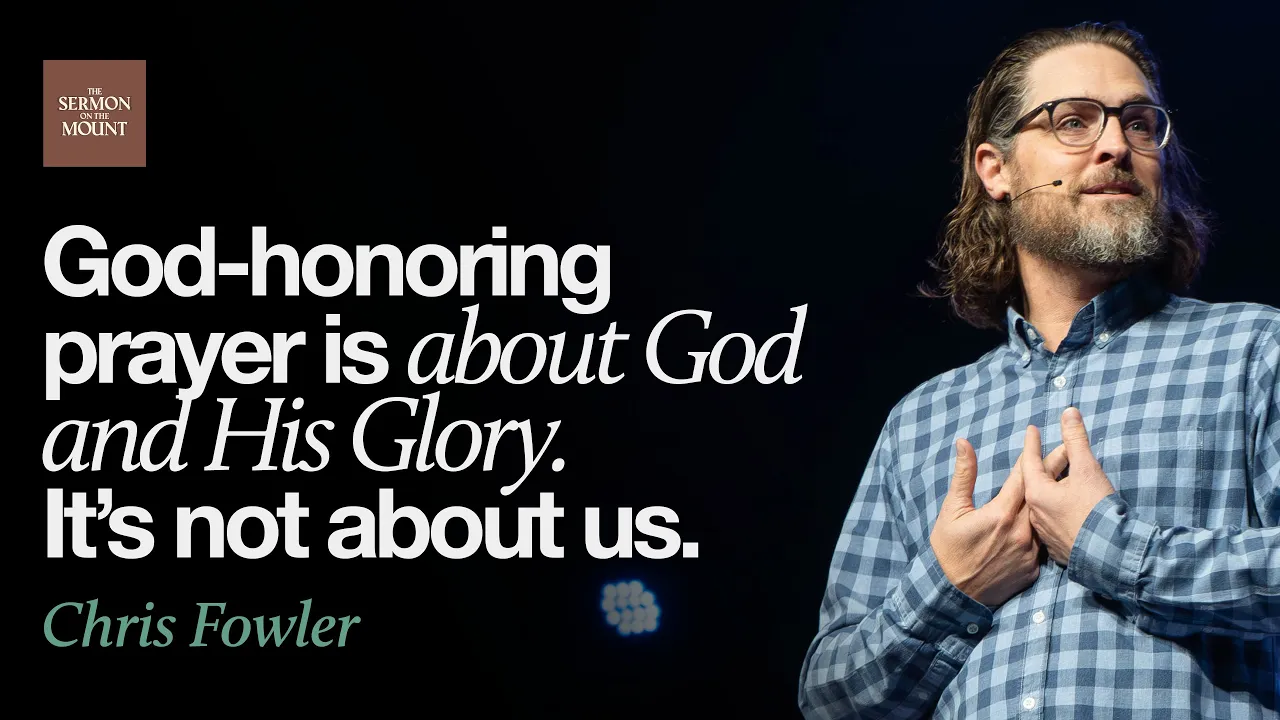
We approach You with reverence, for we are seeing You rightly, and we see ourselves rightly in light of seeing You rightly. God-honoring prayer is about God and His glory; it’s not about me, it’s not about you, it’s about honoring God in His glory. This is essentially what Jesus is saying to us.
Now, but before we move on, I want to recognize something quite deep here that we might breeze past. Jesus says, "Our Father in heaven. " Our Father.
He doesn't say "my Father in heaven. " He doesn't say "your Father in heaven. " He says, "our Father.
" Term for Father: Here is most likely the Aramaic word for "Abba," a term of relational closeness and intimacy. It's the equivalent of what we would use today when we would say "Daddy. " This would not have been used—this term "Abba" would not have been used—amongst the Jewish people when addressing their God.
But this was the nearness that Jesus declared existed between He and the Father, which also existed between God's people and the Father. Though He was in heaven, reigning and ruling in sovereign power, we, the people of God, have this nearness and closeness to Him. Now, Jesus here is most likely speaking to a predominantly Jewish audience.
The Jews at this time were not the sociopolitical nation that we know them as today, but they had been known as the people of God. From the Old Testament, we read that the Jews are the people of God. He is also speaking to the Gentiles who are around and who are now coming to saving faith in this good news of the Gospel that Jesus is proclaiming.
This is a reminder that we desperately need to hear today: If you have come to hear and believe in the good news of the Gospel of Jesus, then you are united with all believers in this room, united with all believers to the ends of this earth today, and you are united with all believers who have lived, who are living, and who will live over the course of thousands of years. Looking back and those to come, our faith is not an individualistic one; it is very much a communal reality. That's why we say what God has done in bringing a people who, in many ways, have no business being a people.
We are from different ethnic backgrounds, different cultural backgrounds, different life experiences, different stories, and different socioeconomic realities— all of these things that should divide and separate us. In God's family, He brings us together. Though we were once not a people, He has made us a people, and in uniting us together with Him and uniting us together with one another, we can boldly proclaim: "Our Father in heaven, hallowed be Your name.
" Now, this is not the way that we have treated matters of faith in the U. S. —not in my experience, anyway.
Faith is very much a private thing: "This is my personal relationship with Jesus; my faith is my personal relationship with Him. " "I'm going to go have my personal quiet time with Him this morning. " While there is a personal reality to your faith, meaning that it can't be yours if it's not yours—your faith is not yours because it was the faith of your parents or your grandparents—your faith isn't simply and solely yours; your faith is communal.
It is ours together. "Our Father" is a reminder that we are not disconnected from one another, nor are we disconnected from our Father. I know I go to Acts 2 all the time when talking about the early church, and after a while, you're all probably going to have it memorized because I'm going to keep going back to it over and over again.
Paul gives this beautiful picture of the early church, and he says there in Acts 2 that they devoted themselves to the apostles' teaching, to the fellowship, to the breaking of bread, and to the prayers. All who believed were together and had all things in common because their identity was rooted in this Father in heaven. Brothers and sisters, if you are living your faith in a personalized bubble apart from the family of God, you are not living faithfully in His family.
We were never intended to live in isolation. We need to fight the drift into isolation, and we need to run into the community of the family of God. Your faith was never intended for that.
We have become content trying to live out our Christian walks in silos when there are big, beautiful barns where we can live together with God's people. Are you striving at your walk with Jesus alone? Are you living in isolation, or are you walking and toiling and striving with one another in pursuit of our Father and of His way?
As I was thinking about this family reality and us getting this proper reorientation around God—our Creator, our Sustainer, our Redeemer, our Savior, our Reconciler, our Lord, who sent Jesus to come and live amongst us to do that which we could not do for ourselves—and thinking through that reality that does make us a family, I couldn't help but think about our nuclear families. I have some friends, and as I've done life with them and been around them, I've heard them say things about parenting. They'll say, "I remind my kids every time they leave the house that they are an image-bearer of their Creator God, and they're an image-bearer of me.
So when you go out in public, you better not act a fool; don't disrespect the Lord, and don't you dare disrespect my name. " You guys ever heard that before? Maybe your dad said that to you or your grandfather.
Maybe you just heard somebody around you say that. One of the things that we've tried to teach our kids is, "Don't forget who you are, and don't forget whose you are. " Yes, you're a Fowler, and that's good, but don't forget whose you are: you're a child of the King; you're a son or daughter; you're an image-bearer; and you're an ambassador of the good news of the Gospel.
So as you go out, don't forget who you are. Are you? And don't forget who you are.
I want them to remember these two things when they go: the Fowlers are Jesus people. You need to represent Jesus well, and don't you dare embarrass me. Represent me well too.
I really don't care as much about that. It's not about trying to manipulate their behavior; it's a reminder that we have a shared identity. Our individual actions reflect not only personal character, but they also represent the reputation of the family.
This is true in all areas of life for them—in school, in sports, and in hanging out with their friends. It's true for us as parents, too. It's true when we go to work, when we're in the grocery store, and when we're driving.
Now, unlike some parents, I don't believe my kids are perfect. I don't expect them to be. They're going to mess up, and when they mess up, they may not reflect our family values well.
They may be a poor representation of who they are, but I'm not kicking them out of the family. I'm going to step toward them in love and remind them of their identity. There may be consequences and discipline, and for sure I'm going to provide guidance, but I want them to be restored, and I want them to remember the name that we carry in God's family.
We call him Father; we recognize that our identity is as his sons, our identity is as his daughters. The relationship isn't some distant and impersonal one; it's one of nearness and care. His name has been given to us, so we must honor his name.
We must represent the family well. Are you hallowing God's name in your prayers? Our Father, are you hallowing him well?
Are you hallowing his name in your daily life? Are you working in integrity that gives honor to his name? Do your relationships at home reflect the love of our Father?
Are you proclaiming his goodness in all the places and spaces that you go? Let's be reminded that though we all fall short, God has not disowned us. He forgives, he restores, and he empowers us through his Spirit to live for him and with him, and to hallow his name.
Jesus models for us the proper way to initiate our prayers by adoring our Father, and then he prays that we would be ones who are desiring God's will. Look with me at verse 10: "Your kingdom come, your will be done on earth as it is in heaven. " If we're honest with ourselves this morning, this line, this segment, this phrase—whatever we want to call it—probably stands in the most contrast to our prayers than any of the other ones.
Maybe you think I'm wrong, but hear me out. When you think about your prayers, how often are you asking God to do something for you, to give something to you that will usher in his kingdom versus how often are you asking for him to do or to give you something that's going to build your little "k" kingdom? I find that more of my prayers than I'd care to admit are oriented around my little "k" kingdom than building his big "K" kingdom.
What about you? "Lord, will you move in ____? " Why are we asking for my good?
"Lord, will you provide for ____? " Why? For my good?
"Lord, will you make a way for this thing to happen? " Why? For my good?
That's what our prayers sound like, and that's what they're rooted in—that's the posture of our heart. When I was reflecting this week and got really honest, I saw few prayers recently that were for his glory rather than all the ones that were for my glory and my good. I think we can apply the same reality to our wills.
Our prayers are focused on our wills, what we see as the next best thing for us. Proverbs 16:9 begins: "The heart of man plans his ways. " This is what our prayers sound like: "The heart of man plans a way; I've planned my ways, Lord, now make it happen.
" We forget the second half of the verse: "But the Lord establishes his steps. " The heart of man plans his ways, but the Lord establishes his steps. It's his will be done.
God's will is greater than our will. Do you genuinely believe that this morning? Do your prayers reflect that you believe that this morning?
Do your actions reflect that you believe that God's will is greater than your will, or do you need to confess to the Lord this morning that you are living and praying as if your will is greater than his will? Do we need to confess the sin of seeing ourselves far too big and seeing him far too small? Listen, I think that is a pretty normal reality; it's a product of our flawed and sinful humanity.
But we've been called to something far greater. We've been called into God's family; we've been adopted and united to him, and no plan or will that we could ever design for our life—no matter how good, grand, or beautiful—could ever be better than what he has designed for us. Yet we still slog through our human experience, and we struggle with it.
You've probably heard me say before that Jesus is our great high priest who can relate to our human experience. The author of Hebrews tells us about a perfect example of Jesus relating to us in his own human experience when he's in the Garden of Gethsemane, just before Judas is going to betray him. He is in the garden, and he's praying in Matthew 26:39.
He says, "My Father, if it is possible, let this cup pass from me. " He knows the cross is coming; he knows that it's coming quickly. He's there with his disciples, and he prays, "If it is possible, let this cup pass from me.
" Jesus communicates his will to the Father. "If there's any other way than for me to have to go to the cross and die, for my body to be broken and my blood to be shed; if there's any way that my flesh cannot be torn and ripped for me, let this bitter cup pass. " But his prayer doesn't end there.
He says, "Nevertheless, not as I will, but as you will," because even in this moment, he acknowledges that God's will is greater than the will of the flesh. Again he prays in verse 42, "My Father, if this cannot pass unless I drink it, your will be done. " His desire is clear: if there is no other way, then the will of the Father is more important.
This scene is one that makes the humanity of Jesus so real and comes alive for me. The Jesus who is teaching us to pray, who models for us the right way to pray in his teaching, also applies this teaching. He’s not just one who says what to do; he's one who does it.
"Your will be done on earth as it is in heaven. " Just as God is reigning and ruling in heaven over all of creation, Jesus longs to see that same thing on earth. This should be the prayer of our hearts this morning, church: that just as God is reigning and ruling over heaven, we would experience his rule over the earth— in Charleston, as it is in heaven; in Somerville, as it is in heaven; that his kingdom would be present in Goose Creek, in Moncks Corner, and in North Charleston, and in Ladson, as it is in heaven.
This is the powerful longing for us—that we would experience God's reign on earth now, as it is in heaven. Though we may see glimpses of it in this lifetime, we will only see it fully when he returns, when all things have been made new, when we live with him in the new earth, in the new heavens, where all things are redeemed and restored once and for all. In the meantime, we should continue to call out for his kingdom to come.
Are your prayers oriented around desiring God's will or around desiring your will? Now wait a minute, Chris, I don't think you remember what Psalm 37:4 says. What do you have to say about that, Pastor?
Psalm 37:4 says, "Delight yourself in the Lord, and he will give you the desires of your heart. " Oh, so if we delight in the Lord, then he'll give us our will; he'll give us all those things that we want; he'll give us our will, right? Taking a verse out of context like this can be quite dangerous, and if you do so, you can absolutely get to this place.
But if we read it in context, we see the bigger picture. Look with me at Psalm 37:3: "Trust in the Lord and do good; dwell in the land and befriend faithfulness. Delight yourself in the Lord, and he will give you the desires of your heart.
Commit your way to the Lord; trust in him, and he will act. " The context of the Lord giving you the desires of your heart is predicated on you trusting in the Lord, which means that you will trust in his will, and dwell with him, and commit yourself to him, and trust in him. When we do these things, our fleshly desires will change, and our fleshly desires will reorient around the desires of our great God and our God-oriented desires.
When this happens, he will surely give us those desires; he will act. The psalmist says, "Your kingdom come; your will be done on earth as it is in heaven. " Desiring God's will in our hearts and in our prayers is a crucial component to a vibrant prayer life.
Have you guys ever been driving around and seen a community garden? You know what I'm talking about. It's like maybe a city or a neighborhood.
Sometimes you'll see it in an urban context where, after 15 blocks of nothing but buildings, there's this block of land that is set aside for a community garden. They're kind of laid out for different people to come and have different plots of that land and to plant things. You can walk by and drive by and look, and they can be really quite beautiful, or they can be an absolute mess—completely overgrown.
What we know to be true is that that didn't just happen overnight. The weeds didn't come in overnight. One day, there was tending being done to the garden, and the next day it wasn't, and now it's utter chaos.
The weeds were small and scattered around at one point, and for the most part, the garden still looked good from a distance. As you drive by, it still looks like everything is growing and happy. But in time, the weeds spread, their roots begin to grow deep, and their foliage begins to spread out.
They end up choking out the plants. Finally, the gardener steps in, and they have to pull out the weeds one by one. It's really hard work because the roots have gotten so deep and are intertwined and intermingled with all of the plants, but the work has to be done to bring health back to the garden.
Slowly, the garden begins to flourish again. In praying "Your kingdom come," we're inviting God to be the master gardener in our lives and in our world. We're asking Him to weed out sin, injustice, and brokenness that have choked out the goodness that God intended in His creation; that have choked out the goodness that He intended for His sons and daughters to experience in relationship with Him.
But His kingdom is about restoration, so we pray, "Your kingdom come. " What are the weeds in your life and in the world around you that need to be uprooted today? Are you inviting God to be the master gardener that brings restoration, or are you trying to manage the weeds all on your own?
Do you find that your prayers lay out your will alone, or do they also include, "Not my will, Lord, but Yours be done"? May it be here on Earth, here in my heart, here in my life, here in the earth around me—may it be as it is in heaven. Lord, Your will is greater than mine; move according to Your will.
Church, may we be a people who repent of the ways that we pray only, "Our will be done," and may we become a people who desire and pray that God's will is far superior to our will. Our prayers must begin with the source of life; they must begin oriented toward God, for He is our Father. He is holy and hallowed to be praised.
He is reigning and ruling over all creation, and He is bringing restoration and reconciliation. He brings life from death, and this is why our prayers must begin with Him. This is why we come to the family table each week, to be reminded that it is our Father in heaven who brings life from death.
He is hallowed to be praised, and so we come to the family table. Just as Jesus modeled for us when He was dining with His disciples the night He was betrayed, after dinner He took a loaf of bread, and He tore it, saying, "This is My body that is broken for you. " Afterward, He took a cup of wine and said, "This is the cup of the New Covenant; this is My blood that was shed for you, and anytime you eat this bread and drink this cup, you proclaim this good news that I have come to bring life out of death for you.
" Why? Because He is the Creator God who looked upon His creation, who looked upon humankind and saw that we were insufficient in ourselves to be reconciled to Him. Because of the great love that He had for us, He sends Jesus, who comes to live our life; who was born just as we are born; who grows up through infancy, being a toddler, a kid, a teenager, and into adulthood.
This Jesus resisted the temptation to sin at every opportunity, and in doing so, He becomes the perfect sacrifice who gives His life for us. As we hear and believe this good news of the Gospel—that God in Christ has done for us what we could not do for ourselves—we find that we can be restored, redeemed, and reconciled. The sin, rebellion, rejection, and debts that separated us from our Creator God are removed from us, and what is given to us in exchange is the identity of Jesus, who is pure, holy, and righteous with our great God—a Son who is fully known and fully loved.
In doing so, when we hear and believe this good news, we are united together with Christ and God's family, so that we can come in prayer before the Lord and say, "Our Father in heaven, hallowed be Your name; Your kingdom come; Your will be done on earth as it is in heaven. " If you're here today and you're a follower of Jesus, I want to invite you to come and take this meal with us. There will be five stations around the room: two at the back of the risers and three down front.
There will be gluten-free options on the outsides in the front. We come and take and tear off a piece of the bread, being reminded that Christ's body was torn for you. You'll dip it in the cup, being reminded that Christ's blood was shed for you.
In doing so, we proclaim the good news of the Gospel to ourselves yet again. We reorient our hearts and our minds yet again to our Father in heaven; hallowed be His name. We proclaim that good news of the Gospel of Truth to those around us, and we see that we have this shared communal reality—that's why we call it the family meal.
If you're here today and you're a follower of Jesus, we encourage you to come and take. But before you do, we say, don't do this lightly. Don't just pop up and run; confess your sin before the Lord first.
Prepare your heart to come to the table. If there's someone in the room that you need to go and reconcile with, confess sin before you come and take; go and do that. But then come and take this meal and let us worship together through the family meal this morning.
Then we will go into worship through song again. If you're here today and you're not a follower of Jesus, I would just say, don't take this meal today—not because we want to exclude you; we would love for you to be a part of it, but because we. .
. Know it won't mean anything for you today; instead, we say, take Christ. Hear this good news of the Gospel: that though you were once separated, abandoned, and an orphan, God has stepped in and made a way for you to be adopted into His family.
He has made a way for you to be made right with Him, to pay the debt for your sin that you were never going to be able to pay. Take this good news and feast on it this morning, and then come and take this meal with us next week. Oh Father, Our Father, Lord, we praise You this morning for who You are: holy, righteous, and good.
And not one of us is worthy. Yet, Lord, You saw fit, in Your love and kindness towards us, that You sent Jesus. And Lord, for those of us who have responded to the good news of the Gospel, who identify as Your sons and daughters and walk with You, Lord, would we be reminded that it is through Him we have access to You and that we have that nearness that a child has with their father.
Today, God, we have that same access to You. Lord, may we see You rightly in who You are, in Your Holiness, and what You have done for us in Jesus. And may we see ourselves rightly as those who have nothing to offer, but You have freely given to us.
May we remember this as we come and take of the bread and of the cup. And Father, I pray that You would work in this place through Your Spirit to lead us to confession and repentance of our sin, whether we are a follower of Jesus already or not yet. God, may those who don't yet know You confess their sin before You, and may they receive the reconciliation, hope, redemption, and salvation that You alone can offer.
And it's in the name of Your Son, Jesus, that we pray this morning. Amen.