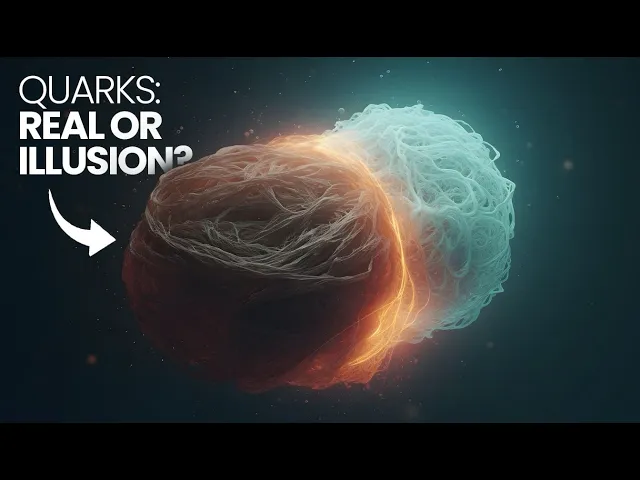
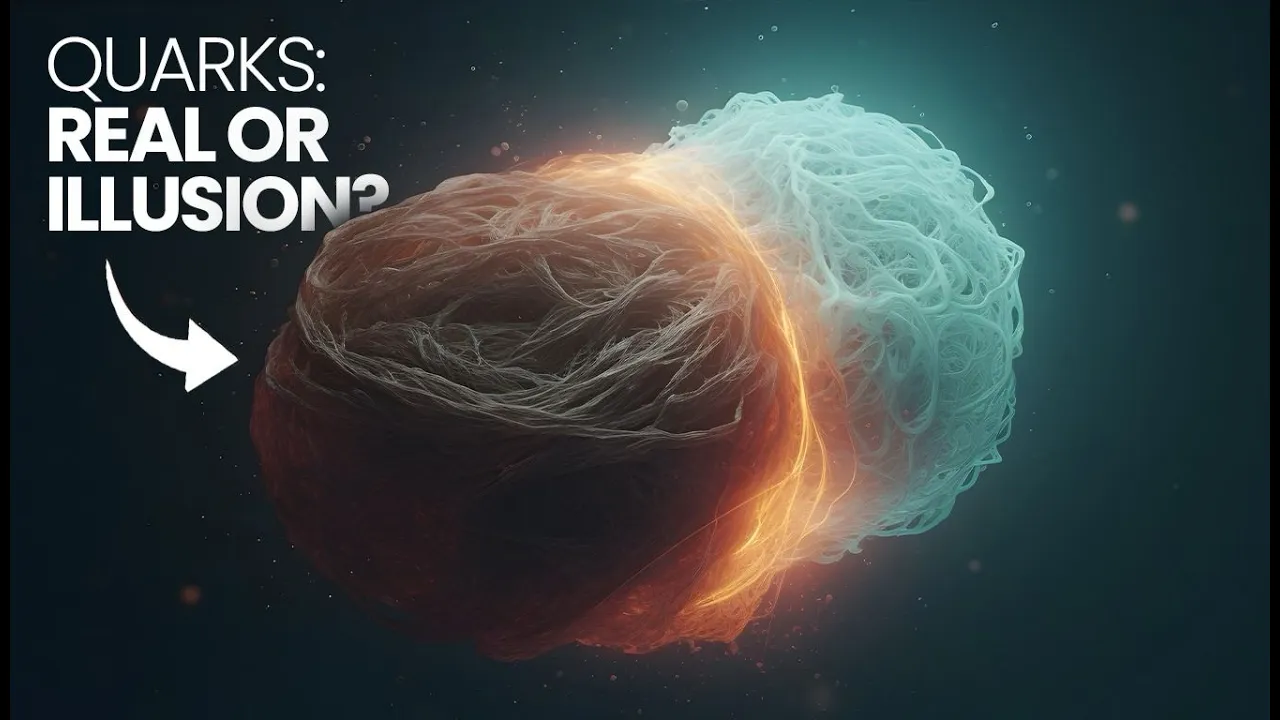
[Music] There are ghosts beneath your skin. Not spirits, not phantoms of memory or imagination, but something stranger, more fundamental. These ghosts live inside the atoms that make you you. And yet, no one has ever seen them. No one has ever touched them. No one has ever proven definitively that they are real. And still, they shape everything. They are called quarks. They exist beneath Protons, beneath neutrons, beneath everything that gives your body mass. If atoms are the notes in the music of matter, then quarks are the vibration itself, a hidden code, a trembling pattern woven into
the dark. But to understand how we arrived here to the idea of a ghost particle that may not be a particle at all, we must begin with a simpler illusion. The illusion of solidity. You appear solid. The desk you lean against, the floor beneath your Feet, the bones in your hand. But these are lies your senses tell you. Beautiful lies, necessary ones. In truth, the matter you believe in is mostly emptiness. Atoms are not little marbles. They are vast spaces of probability. The nucleus at the center is minuscule, surrounded by a haze, not of objects,
but of possibilities. Electrons don't orbit like planets. They flicker in a probabilistic fog. They may be here or there or nowhere at all until You look. And even the nucleus, even that dense heart is a lie within a lie. Protons and neutrons are not fundamental. They are made of something smaller, something stranger. They are made of quarks. A proton contains two up quarks and one down quark. A neutron, two downs and one up. bound together by the strongest force in the universe, the strong nuclear force held by gluons, the messengers of that bond. But if
you try to split a quark away, the force grows Stronger, not weaker. Pull hard enough, and instead of separating them, you create new quark anti-quark pairs from the vacuum itself. The universe insists they never travel alone. We've never seen a quark by itself, never isolated one, never captured one in a detector, free and independent. Every time we try, the universe seals the door shut. And yet, the equations work. We know they are there. Not because we've held them, but because their fingerprints are Burned into the math. The collisions in our particle accelerators behave exactly as
they should if quarks are real. The jets of energy, the decay paths, the patterns in chaos, all of it sings in the key of quarks. So, are they real, or are they convenient ghosts, placeholders for something deeper still? At CERN's Large Hadron Collider, protons are hurled to near light speed and shattered into fragments. These collisions release unimaginable energy, briefly recreating The conditions of the early universe. And in the wreckage we find signs, echoes of quarks. Not directly, never directly, but the shadows of their presence remain. It's like watching ripples on a pond and guessing the
shape of the stone that caused them, even though the stone itself has sunk too deep to see. And the more we dig, the more abstract it becomes. Quarks aren't little balls. They don't have edges or surfaces. They're not even truly Particles in the classical sense. They're better described as excitations in invisible quantum fields. Meaning what you think of as matter is really a pattern, a fluctuation, a wave. You are a collection of standing waves pretending to be a person. Solidity is an illusion. Matter is probability. Identity is a performance happening at near the speed of
light. and quarks. They are the silent architects of this illusion. Never seen, never Freed, but always there, shaping the rules. You are built from ghosts. You are shaped by forces you will never feel, bound by particles you will never see. And yet, here you are. Isn't that strange? The year was 1964. Physicists around the world were staring into the chaotic zoo of subatomic particles being discovered in ever growing numbers. The atom, once thought indivisible, had long since fractured into a catalog of complexity. Protons, neutrons, Electrons, and now mison, barons, pions, kons, a flood of strange,
short-lived entities blinking into existence and then vanishing into the void. It was madness. Too many names, too many exceptions, too many unexplained behaviors. The old models, clean, elegant, Newtonian, had begun to collapse under the weight of quantum unpredictability. Enter Murray Galman, a theoretical physicist with a razor sharp mind and a poet's instinct for naming The unknowable. Galman proposed something radical that these myriad particles were not fundamental but combinations permutations of something deeper. He envisioned a smaller set of constituents, particles that could combine in specific ways to create the hadrons we observe in experiments. He named
them quarks. The name itself was curious. It wasn't pulled from Latin or Greek like so many other scientific terms. It was plucked from the pages of James Joyce's Finnegan's Wake, a notoriously impenetrable novel written in a dreamlike, nonsensical language. Three quarks for muster mark, the line read, a drunken cheer, a fractured poem. Gellman pronounced it to rhyme with fork, despite Joyce's original line clearly suggesting it rhymed with lark. It didn't matter. In a universe ruled by uncertainty, what was one more contradiction? Quarks were theoretical mathematical phantoms. No One had seen them. No one had isolated
one. And yet, almost immediately, the concept began to clean up the chaos. In Galman's model, particles like protons and neutrons could be explained as specific groupings of three quarks, later known as barrians. Mezans like pions and chons could be understood as a quark paired with an antiquark. Suddenly the randomness began to show patterns. Hidden symmetries emerged. The chart of particles took on A structure, a secret architecture, as if someone had finally found the code behind the code. Around the same time, a physicist named George Vag independently proposed a similar idea. He called his version aces
instead of quarks. But Gellman's term stuck, not just for its poetic oddity, but because it captured the sheer weirdness of what these things represented. Because from the beginning, there was a problem. If quarks were real, why couldn't we see them? No Experiment had ever detected a free quark. They were always inferred, always part of a larger structure. And the more we tried to isolate them, the more elusive they became. Whenever scientists pushed protons to their limits, trying to crack them apart instead of freeing quarks, the universe responded by creating more hadrons. It was as if
nature refused to show us the trick. Pull the magician's sleeve too hard and the illusion collapses, but the secret Remains hidden. This phenomenon, the refusal of quarks to be seen alone, would later be understood as confinement, one of the core properties of the strong nuclear force. But in the early days, it posed a real threat to the idea itself. If something can't be observed, is it real or is it a convenient fiction? Even Galman was cautious. He treated quarks as mathematical tools, helpful abstractions. He hesitated to claim they Physically existed. That hesitation wasn't out of
doubt, but respect. Respect for how weird reality had become, but others were more daring. As experiments advanced, a new generation of physicists began to take the idea further. High energy particle collisions began to show scattering patterns consistent with pointlike constituents inside protons, indirect evidence of quarks. At the Stanford Linear Accelerator Center, deep inelastic Scattering experiments in the late 1960s revealed what seemed to be tiny hard centers within protons resisting the electron beams being fired at them. These became known as partn identified with the quarks Gellman described. The puzzle pieces were falling into place. Yet still
no quark ever appeared alone. More quark flavors were discovered as the standard model grew. Strange, charm, bottom, and top. The strange quark Helped explain odd decay patterns in Kons. The charm quark was predicted and then confirmed in 1974 with the discovery of the JPSI particle. Bottom followed, and finally in 1995, the top quark was observed at Firmayab. A particle so heavy it briefly rivaled the mass of an entire gold atom before disintegrating almost instantly. And yet none of them ever stood alone, not even the top, which decays so quickly it doesn't even form had. All
of them Inferred, hinted at, never caught. It was like studying shadows on a wall, trying to map a creature we could never see. And yet the models worked perfectly. So well in fact that quarks became part of the standard model, the central framework of modern particle physics. They explained everything from nuclear decay to cosmic background radiation. And they weren't just placeholders anymore. They had mass, charge, spin, color. They obeyed rules. They obeyed equations. They fit. But the strangest thing remained true. They only existed in combination. Always as trios or pairs. always hidden in groups, never
free. Some began to wonder if quarks were even real in the traditional sense, or if they were more like grammatical tools, rules in a language, units of meaning in a sentence the universe had been speaking since the Big Bang. They exist perhaps the way a wave exists in the Ocean, not as a thing, but as a disturbance, a shape, a pattern of motion. If you remove the water, there is no wave. If you try to isolate the quark, it becomes something else. So what then is a quark, a name, a number, a necessity, or perhaps
a myth that happens to be true? Physics has always walked this line between what can be known and what can only be inferred, between reality and the models we build to explain it. And sometimes the models Work so well we forget they are not the thing itself. Quarks may be the most successful fiction ever written. A story told by nature in a language of spin and charge and symmetry. A whisper in the equations. A joke in the margins of Joyce. We gave them names. We drew them in diagrams. We built entire theories around them. But
we never saw them. Not once. And yet here we are building our entire understanding of the universe on Ghosts. They are called flavors, not types, not kinds, not categories of flavors. As if the universe were a recipe and reality a dish we've only just begun to taste. Upper, down, strange, charm, bottom, top. Six fundamental quarks, each with their own mass, behavior, and peculiar quantum properties. Six notes in the secret music of matter. Six shadows cast by something deeper we still don't understand. And yet only two of them Truly touch your life. The up and the
down. They form the core of everything you've ever seen or touched. Every proton, every neutron, every atom in your body, every rock, river, cloud, and star. Up and down quarks are the familiar workers of reality. Tireless, reliable, always in motion, but always confined. An up quark has a charge of plus 2/3. A down quark minus one/3. Combine two ups and one down, and you get a proton with a total charge of + One. Reverse the recipe. Two downs and one up, and you get a neutron, electrically neutral. It's beautifully balanced, mathematical, almost poetic. But then
things get weird. What about the strange quark discovered indirectly in the 1940s and50s? It emerged not from theory but from confusion. Particles were decaying in odd delayed ways. It was as if something inside them resisted transformation, hesitated to let go. Physicists noticed Certain reactions seemed to violate expectations, behaving unpredictably despite seemingly similar conditions. To explain the anomaly, they postulated a new kind of quark, one that decayed more slowly than expected, a kind of quantum stubbornness. They called it strangeness, not as metaphor, as literal property. And so the strange quark was born, a heavier, more exotic
cousin to the familiar up and down. It doesn't last long, but it shows up in places it Shouldn't. It disrupts the order. It leaves behind questions. Then came the charm. Its discovery in the 1970s was no accident. It had been predicted to exist to explain another imbalance, a mathematical asymmetry in how particles decayed via the weak nuclear force. Without the charm cork, certain interactions didn't cancel out. The math broke. The standard model frayed. So theorists inserted a new player, a fourth quark, a missing harmony, a way To smooth out the quantum equations and rescue the
integrity of the system. Charm. A word chosen perhaps with a wink, as if the physicists themselves knew how strange this all was. But it didn't stop there. By the 1980s, experiments had revealed a fifth quark, heavier, more elusive. They called it bottom or sometimes beauty. It decayed slowly, revealing new resonances and rare phenomena in high energy experiments. It wasn't stable, but it Made itself known in the way it broke apart, in the unique trails it left in particle detectors, like footprints in fresh snow that vanished before anyone saw who made them. And finally, the top,
the most massive of them all. It was predicted for decades but not confirmed until 1995 in a historic experiment at Fermy Lab. And when it finally emerged, the data stunned the scientific world. The top quark was enormous, far heavier than expected, nearly as heavy as a gold Atom, yet so unstable it existed for less than a trillionth of a trillionth of a second. It decayed before it could bind to anything, before it could form part of a proton, before it could even think of being part of you. But here's where the mystery deepens. Why does
nature have six of these things? Why not two? Why not three? Why does each one have such wildly different mass? Why do they come in pairs, up, down, charm, strange, top, bottom, as if symmetry Matters more than simplicity? And why does only the lightest generation form the matter we see? These questions remain unanswered. The standard model describes them brilliantly. It predicts behaviors, decay patterns, probabilities, but it doesn't explain why they exist. It doesn't explain why their masses are what they are or why they even come in generations at all. There is no rule, no known
law that demands it. It simply is. In this way, quarks don't just build reality, they haunt it. Each flavor is a shadow of a possibility, an echo of a deeper logic, a glimpse into a structure more elegant perhaps than we've yet imagined, or more arbitrary than we care to admit. And then there is color. Not literal color, of course, but a quantum property quarks carry necessary for the strong force to bind them. They can be red, green, or blue. Metaphorically, the naming is playful, But the implications are profound. For a group of quarks to form
a stable particle, their colors must combine into a neutral mix, just as red, green, and blue light make white. This color confinement is what keeps quarks chained together. It is what ensures they can never be isolated. No single color can be left alone. Nature won't allow it. So every proton, every neutron, every tetraquark or meson, they all obey this rule. No lonely colors, no solitary Quarks. The strong force demands balance. And in the dance of these colors, flavors, and spins, we begin to see the outlines of a deeper choreography, something we don't yet understand, but
cannot ignore. These six flavors of quark, up, down, charm, strange, top, bottom, may be the closest thing we have to a universal language, but it's a language without a Rosetta stone, a code without a key. They whisper secrets in the form Of decays. They write poems in scattering patterns. They express themselves through mass and charge and quantum entanglement. And in doing so, they remind us of something essential, that the universe is not simple. that beneath every answer lies a deeper question that even the smallest parts of us are strange. We believe in quarks. We trust
them. We calculate their behavior, write equations with their properties, and predict their interactions with Astonishing precision. But we have never seen one. Not with a microscope, not in a collider, not in isolation, not in motion, not even in death. The quark, if it exists, exists only in chains. It lives and dies bound to its siblings, never free, never alone. Not once in the history of human science has a single quark emerged, exposed and solitary, into the vacuum of reality. This is not just a technical limitation. It is not a Problem of insufficient resolution or poor
instrumentation. It is a fundamental law of the universe. A law buried deep in the mathematics of quantum chromodnamics QCD. The theory that governs how quarks behave. That law is called confinement. To understand it, imagine stretching a rubber band. Pull the ends farther and farther apart. The tension increases not linearly but exponentially. With every added inch, the band pulls harder as though it Resists the idea of being broken. Now imagine that same principle applied to space itself. As two quarks are pulled apart, the strong nuclear force, the very glue that binds them begins to stretch. But
unlike gravity or electromagnetism which weaken with distance, the strong force does the opposite. It grows stronger, more desperate, more determined to hold on. Eventually, something astonishing happens. The energy stored in the Tension becomes so immense it transforms. The vacuum erupts. New quark antiquark pairs are created from nothing, snapping into existence between the two original quarks. Not because we've pulled hard enough to split them, but because the universe has found another way to keep them bound. This is the brutal efficiency of confinement. You do not isolate a quark. you create more. It's a self-correcting mechanism, a
cosmic safeguard, as if reality itself Has made a pact. The fundamental parts must always be hidden, must always work together, no lone actors, no rebels. This behavior defies every instinct we have about particles. It violates the classical image of matter, that things are composed of smaller things down to some indivisible core. that if you cut something enough times, you eventually reach a unit that can't be divided, a piece of bedrock. But quarks are not that. They are not the indivisible. They Are not the end point. They are something else. In quantum field theory, particles are
not little balls. They are excitations, blips in an invisible field that spans all of space. Every kind of particle has its own field. The electron field, the photon field, the Higs field, and yes, the quark fields. What we call a quark then is not a thing, but a disturbance in this field, a flicker of energy, a vibration in the fabric. It does not occupy space the way a pebble Does. It does not have edges or a surface. It is a ripple, a note played for the briefest moment. But unlike electrons or photons, these ripples do
not travel freely. They interfere with themselves. They twist into knots bound by the gluon field, the mediator of the strong force. Gluons, like photons, are force carriers. But they are not passive messengers. They interact with each other. They knot themselves into webs. They entangle into patterns that cannot Be untied. And in those webs, the quarks are trapped, forever confined, like marbles inside a knotted net made of pure force. That is why you've never seen a quark. Because a quark is not meant to be seen. It is not a particle in the sense we understand. It
is a role in a process, a necessary note in a harmony that only exists when multiple voices are singing. And yet, we know it's there. Not because we've captured it, but because the effects are Unavoidable. Smash protons together at relativistic speeds, and the decay patterns are unmistakable. The energy jets, the resonance peaks, the angular momentum signatures. All of them point to something inside, something smaller, something consistent. And so we map the shadows. Like Plato's cave, we study the silhouettes and infer the shape of the puppets. We build equations, test predictions, and follow the trails of
energy backward through time, through Space, through the haze of uncertainty to something we're not allowed to see. And we begin to wonder, is a quark real if it can never exist alone? What does it mean for a thing to be real if it cannot be touched or isolated or observed directly? Is reality defined by what we see or by what we must believe in order to make sense of the world? This is not just a philosophical indulgence. It's a pressing scientific question because the Quark is not the only thing we've never seen. Gluons, gravitons, the
Higs boson for decades. Even dark matter which may form the backbone of the cosmos itself remains hidden. Are we building our knowledge on inference, on patterns, on models? And if so, when do the models become mythology? Some physicists argue that quarks are not things at all. They are bookkeeping tools, necessary variables to balance the equations. They exist in The way that negative numbers exist, not as physical objects, but as solutions, concepts, relations between things, not the things themselves. Others suggest that we are simply too limited, our detectors too crude, our understanding too narrow, that given
enough energy, enough precision, we might one day see a quark freed from its prison. But that day never comes. Even the most violent collisions we can engineer at the highest energies Humanity can reach yield the same result. Confinement, companionship, the refusal of solitude. So we adjust our expectations. We look not for quarks, but for jets. Narrow cones of particles spraying from collision sites. Evidence of a quark's brief journey before it is shrouded again in the veil of hydronization. We do not see the particle. We see the fallout of its suppression. We study explosions to understand
the silence at their center. And still we return to the question, what is a quark really? Not just in mass or spin or charge but in essence. It is not a bead. It is not a brick. It is not a piece of Lego at the base of the universe. And it is a whisper, a rule, a tension in the field, a consequence of symmetry perhaps, a condition for structure. And in that sense, it is not surprising that we can't see it because quarks are not meant to be seen. They are meant to be obeyed. We
were taught From the earliest days of science to think of the world as made of objects, tiny billiard balls, solid matter, particles colliding in empty space. It was a comforting idea, tangible, visual, understandable. We imagined atoms like miniature solar systems, little worlds with centers and shells, order and motion. But that picture was a lie. The deeper we looked, the more the world refused to cooperate. Particles didn't behave like particles. They blurred. They defracted. They interfered. They vanished and reappeared. They refused to be pinned down. And so, physics changed. The universe, it turned out, was not
built from tiny marbles. It was built from fields, invisible, omnipresent, vibrating fields that span all of space and time. And everything you know, everything you are is a ripple in those fields. This is quantum field theory. It tells us that every fundamental particle is not a standalone object but a Localized excitation in a larger field. The electron, a ripple in the electron field, the photon, a ripple in the electromagnetic field, the Higs boson, a brief shudder in the Higs field that gives mass to others and quarks. They are not little specks of matter. They are
flickers in quark fields, six flavors of them, layered like ghostly sheets across the fabric of space. In this framework, space is not empty. It is pregnant with possibility. It is Structured. It is alive with potential movement. And when the right amount of energy is added to the field, it erupts, not with a bang, but with a particle. Particles are what happen when fields are disturbed. They are the visible consequences of invisible vibrations. Like raindrops falling into a pond, their splash is fleeting but reveals the water beneath. This view changes everything. It means particles aren't things
but Events. They do not exist continuously through time. They happen. They are born and they fade. They emerge from the field, exist for a breath and then dissolve back into nothing. You are not made of particles. You're made of happenings. And this is where quarks become especially strange because their field, the one responsible for protons, neutrons, and nearly all of visible matter, is more tightly bound than any other. It does not allow for casual Ripples. It does not release its energy easily. It traps its excitations. It demands combinations. It resists simplicity. And unlike the photon
field or electron field, the quark fields are inseparably entangled with another, the gluon field, the carrier of the strong force. Gluons are themselves ripples. But unlike photons, they carry the very property they mediate. A photon is electrically neutral. It passes messages between charged particles but remains Unchanged. Gluons, however, carry color charge, and they talk not just to quarks, but to each other. The result is a kind of feedback loop, a tangled web, a latis of mutual reinforcement that locks quarks into bound states, preventing isolation. The fields knot, they twist, they bind, and once those knots
are formed, they are nearly impossible to undo. In this view, a proton is not a tiny sphere. It is a stable vibration, a Standing wave pattern of three quark ripples up, up and down, interwoven with gluon energy rotating and resonating inside a confined zone. You are not made of marbles. You are made of music. And this music is composed not by a hand, but by symmetry. Quantum field theory relies heavily on symmetry principles. The laws of physics as we know them are determined by what must stay constant when the universe is transformed, rotated, shifted, charged,
inverted. These symmetries give rise to the conservation of energy, momentum, charge. They dictate how particles can be created or destroyed, how they interact, how they decay. And quarks, quarks are the necessary ingredients to preserve those symmetries. Their existence ensures that the equations balance, that the system remains whole. This is perhaps the most mindbending idea of all. Quarks may exist not because they are physically Inevitable, but because the math demands them. Not a building block, but a placeholder, not a thing, but a rule. Their masses, their charges, their interactions, all are fine-tuned to keep the structure
from falling apart. Without quarks, the world would lose its cohesion. The stars would not form. The atoms would not bind. The periodic table would disintegrate. The quark fields then are not components of the universe. They are the conditions that allow it to Exist at all. This is why we never see a single quark. Because a single quark is not a thing that can exist independently any more than a crest without a wave or a note without a scale. It is not merely confined by force. It is confined by meaning. It only has identity within context,
within structure, within resonance. But context is everything. A field alone means nothing. It must be disturbed, excited, provoked. It must ripple. And in those ripples, those Fleeting moments of being, the universe gives birth to form. Quarks are just one form. But without them there would be no matter, no mass, no structure, no you. And so we stand on the edge of comprehension, looking down not at particles, but at patterns, not at things, but at behaviors, not at substance, but at relations between invisible fields. The universe is not made of stuff. It is made of interactions,
of tensions, of Symmetries, of vibrations sustained by unseen forces across the fabric of time and space. Quarks are the silent consequences of those forces, not the beginning of the story, but the first ripple in a tale that may stretch deeper than we can imagine. There is a story the universe tells in silence. It is the story of two particles born in the same instant who remain connected across space and time. No matter how far they drift, no matter how fast they move, They continue to act as one. This is not science fiction. This is quantum
entanglement. And now it has reached the most fundamental level of all. For the first time in history, in a cold circular tunnel beneath Geneva, scientists at the Large Hadron Collider have found evidence of quantum entanglement. Not in photons, not in electrons, but in quarks. Specifically, the top quark, the heaviest, strangest, most elusive of them all. This changes Everything. Because if quarks, the supposed bedrock of matter, can be entangled, then reality itself is not what we think it is. Entanglement is the most disturbing truth in quantum mechanics. Two particles when entangled share a quantum state. Not
a connection, not a signal. They are the same equation, split across distance. Measure one and the other reacts instantly no matter how far away it is. Einstein called it spooky action at a distance. He hated it. It violated his sense of order, of locality. He believed reality should be confined to cause and effect. No influence faster than light. But experiments have proven it time and again. Entanglement is real and now it has descended to the quark level. The discovery was made by the Atlas collaboration at CERN. Using data from high energy proton collisions, they observed
pairs of top quarks and top anti-quarks born together in the chaos Of impact. And in their decay products in the angles and energies of the fragments they left behind, scientists found a fingerprint, a pattern, a signature of entanglement. It was not easy to detect. Quarks are usually trapped by the strong force buried inside protons and neutrons. But the top quark is different. It is so massive, so unstable that it decays before it can bind to anything. It does not form hadrrons. It does not hide. It dies Naked and fast. This is what makes it useful.
It decays too quickly to be confined. And in those rapid decays, in the spray of particles that emerge, researchers saw something strange. The spins of the top quark and its anti-quark were correlated, not randomly, not chaotically, but with eerie precision, as if the two were still part of the same system, even as they disintegrated into separate paths of energy. They had been entangled, and That entanglement survived. Let that sink in. These quarks were created in a particle collision. They lived for a fraction of a second. They traveled at near light speeds. They decayed into fragments
moving in opposite directions and still they behaved as one. This is not a metaphor. This is the data. It suggests that the universe doesn't just hold things in place. It holds relationships in place. That what matters is not where a Particle is but how it is connected to something else. And it raises a terrifying question. If two quarks, the most fundamental components of matter, can be entangled, what else can? Can the quarks inside you be entangled with ones on the other side of the universe? Can your atoms share quantum states with atoms you've never touched?
Could the entire cosmos be a single entangled system unfolding itself in a dance we only perceive in Fragments? We like to think of the universe as made of parts, atoms, molecules, cells, planets, galaxies. But entanglement defies this. It says there are no true parts, only patterns, only mirrors. A particle here reflecting a particle there, a quark here spinning because a quark elsewhere must. We are not separate. We are entangled. And this discovery is only the beginning. Because if quarks can be entangled, if they can Share a quantum state, then the idea of individuality breaks down.
The notion of separateness begins to blur. It means that even the smallest fragments of your body are not truly yours. They belong to something larger, a system that spans space and time. And there's more. Entanglement doesn't just describe correlation. It suggests a kind of non-local unity, a single state distributed across space. And for the top quark, which exists too briefly to Form bonds, it reveals something profound, that entanglement is more fundamental than interaction. That before particles connect through force, they may already be entwined by fate. So what does this mean for quarks, for matter, for
you? It means that at the deepest level existence is shared. That particles do not exist in isolation. That their identity is relational. That you are not a collection of things but a tapestry of interactions. This is not Mysticism. This is the unavoidable math of quantum theory. It tells us that the world is not made of pieces. It is made of relationships. That two particles created in the fire of collision can remain tied together long after they've fled the scene. that two quarks born from the same burst of energy remain part of one equation even as
they collapse into dust. And maybe so do we. So we ask again, are quarks even real? Not because we doubt their presence, but Because we doubt what real means anymore. If they cannot be seen, if they cannot be separated, if they can be linked beyond space and time, then perhaps quarks are not particles. Perhaps they are events, moments of symmetry, bursts of code, echoes in the language of the universe. And if they can be entangled, then maybe we are too. Before there were atoms, before there were stars, planets, light, or even the laws we now
consider Fundamental, there was only chaos, not the mythological kind, and not fire and shadow in the human sense, but a liquid fury of energy and possibility, a moment too brief to measure, too hot to define, too dense to comprehend. It was a state of matter, but not as we know it. It had no form, no boundaries. It was not solid, not liquid, not gas. It was quark gluon plasma and it was the original substance of the universe. This plasma existed in The first few micros secondsonds after the big bang. A seething shapeless soup of free
quarks and gluons, unbound, unconfined, moving independently in an ocean of raw energy. It was the only time quarks roamed freely without being locked into protons, neutrons, or any known structure. And then it vanished. As the universe cooled and expanded, the strong force took over. Quarks were yanked into confinement, bound by gluons, never to escape again. The first Hadrons formed, then atomic nuclei, then the slow march of structure, atoms, molecules, stars, galaxies, and eventually us. But that original state, that plasma of freedom, remained a mystery, a theoretical memory, something we could describe but never witness until
now. In Long Island, New York, at the relativistic heavy ion Collider, scientists have been recreating the earliest moments of the universe. By accelerating gold nuclei to nearly the Speed of light and smashing them together, they create temperatures over 4 trillion degrees C, hotter than the center of a supernova, hotter than anything that has existed since time itself began. And in those collisions, for just a moment, the primordial soup returns. A droplet of quark gluon plasma, a tiny echo of the first second, a flicker of pure, unconstrained matter. This is not science fiction. It is happening
now in the last days of RHIC's Operation. These are the final runs of the collider, the last chance to unlock the truth of the earliest phase of everything. And what they're discovering is stranger than anyone expected. This plasma is not chaotic. It flows. It behaves like a perfect liquid, nearly frictionless, more fluid than water, more unified than any substance we've ever observed. Quarks, normally confined, move freely within it, yet behave collectively, as if they're aware Of each other's presence, even without interaction. It's not a gas. It's not particles bouncing randomly. It's something else entirely, something
that behaves as a single coherent hole. This shouldn't be possible. The strong nuclear force is supposed to be wildly chaotic at this scale. And yet the plasma is smooth, elegant, almost intelligent in its structure. It suggests that the very first state of reality was not disorder, but Coherence. That before particles were locked into place, before structure emerged, the universe moved as one. And here's the question. If this state is so perfect, why did it end? Why did quarks lose their freedom? Why did the universe collapse into confinement? The answer may lie in the energy scale.
As space expanded and temperatures dropped, the gluon field gained control. The free quarks once Able to drift alone were coralled, grouped, folded into bound states. What had been a soup of possibility became a crystal of structure. The chaos didn't die. It simply froze into order. And from that freezing came everything. It is deeply ironic. We imagine the early universe as violent and random. But in the quark gluon plasma, we find grace, a fluidity more perfect than anything we've made. It may be the purest expression of nature's balance, a phase Of matter where mass is irrelevant,
where forces align, where boundaries are meaningless. And we've only just begun to understand it. The recent runs at RHIC before it retires are exploring new configurations, different nuclei, new impact angles, different collision geometries. They're asking what happens when the plasma rotates, when it's twisted, when it collides off center. The goal is to map not just what it is, but how it becomes. Because if we can Understand this original state, we might understand why the universe evolved the way it did. Why certain particles gained mass, why quarks locked into families, why time flows forward. These collisions
are time machines, not in the fictional sense, but in the most literal physical way. They rewind the universe to its first trillionth of a second, and allow us to witness the origin of confinement. And in that moment we are reminded of something profound. That confinement is Not the natural state. It is the result of cooling, of loss. That freedom, true freedom, once existed but was too hot to survive. We were born not in walls but in waves. This matters more than metaphor. Because the quark gluon plasma doesn't just explain the past. It may point toward
other states of matter, toward exotic stars made of strange quarks, toward alternate phases of reality at higher energies, toward possibilities we've never imagined. And It reminds us that the world we see is just one configuration, one crystallized expression of the quantum ocean beneath. If the temperature were just a little higher, if the forces had shifted slightly, there would be no protons, no atoms, no galaxies, no you. Reality would still exist, but it would be fluid, silent, free. So the next time you think of yourself as made of matter, remember This. You are the residue of
cooling. You are the frozen structure of what was once fire without form. You are the aftershock of a universe that in its first breath danced like a liquid dream. And deep within you, in every proton, in every neutron, the memory of that state remains, locked inside the quarks, trying to move, trying to escape, but always held, always bound, because the plasma of creation is gone. But it never really left. If you strip everything Away, the atoms, the molecules, the particles, the light, what remains? Most would say nothing. Emptiness, a perfect vacuum, a silence beneath reality.
But that too is a lie. The vacuum isn't empty. It is restless. Even in the deepest reaches of space, in the absence of matter, radiation, and time, something stirs. The void is not still. It fluctuates. It pulses. It boils. Quantum field theory tells us that what we call nothing is in fact a symphony of Possibility. Fields do not sit quietly waiting to be stirred. They are always in motion. Even in their lowest energy state, they twitch, they shiver, they spawn and consume. And in this vacuum, particles are constantly being created and annihilated. virtual pairs. A
particle and its opposite wink into existence, exist for a moment too brief to measure and vanish again, obeying Heisenberg's uncertainty principle. You can borrow energy from Nothing as long as you pay it back quickly enough. These are called vacuum fluctuations. They are not hypothetical. They are measurable. The Casemir effect, for example, shows that placing two metal plates very close together in a vacuum causes them to attract not because of static charge, but because the fluctuating vacuum between them has been altered. The nothingness is doing something. And this invisible background isn't just ambient noise. It shapes
the Behavior of quarks. Quarks exist within quantum fields that are already alive with activity. When a quark moves, it does so through a sea of virtual gluons and virtual quark anti-quark pairs. Particles that pop in and out of existence like fireflies in the dark. These ephemeral flickers interact with the real quark. They nudge it. They shield it. They alter its mass, its charge, its effective behavior. What we call a quark is not a Singular isolated ripple. It is a ripple constantly refracted by a storm of other ripples. The mass of the proton, for example, is
not just the sum of its three constituent quarks. In fact, those three quarks account for less than 2% of the proton's total mass. The rest comes from the energy of motion, from the kinetic frenzy of quarks trapped in a cage, and from the gluon field and its constant dance with the vacuum. In other words, most of your mass, most of what Makes you you comes not from particles, but from the emptiness between them. The void gives you weight. This is not poetic license. It is the literal truth. And it gets stranger because these vacuum fluctuations
can affect everything. They can even change what's allowed to happen. They influence decay rates. They skew probabilities. They contribute to the values of fundamental constants. They shift energy levels in atoms, something measured in the famous Lamb shift, where hydrogen's spectral lines are altered by vacuum effects. Reality, it turns out, is never alone. Every event is embedded in context. Every particle is interwoven with ghosts, the invisible crowd of what could be. When we model a quark in quantum chromodnamics, we do not model a point. We model a cloud. A swirling mess of potential. Real quarks, virtual
quarks, gluons, anti-quarks, all moving, reacting, recombining. A storm of being That never fully resolves. The vacuum does not passively observe the quark. It participates. It feeds it, restrains it, surrounds it with mirrors. And this makes confinement even more bizarre because the vacuum left alone would rather not hold quarks tightly. It would rather let them move. But the strong force resists. It squeezes. It pulls. It creates more quarks from the vacuum itself rather than let one go. So when we say quarks are confined, what we mean Is that they are trapped between the rules of force
and the turbulence of nothingness. And perhaps the greatest irony, the vacuum may hold the key to what quarks really are. There are theories, still speculative, that suggest quarks are not fundamental particles, but emergent knots in the field. Stable patterns in the fluctuations of the vacuum, self-reinforcing disturbances, solitins. If true, then quarks are not the Beginning of matter, but the product of something deeper, a vacuum that can think, a field that can structure itself, and nothing that contains everything, even gravity, that oldest of forces, may have its roots in vacuum fluctuations. Some have speculated that mass
itself, as given by the Higs field, is not a property of particles, but a reaction to the churning background of space. In this view, quarks are not building Blocks. They are interruptions. They are where the vacuum trips over itself and creates a shape, a momentary node of tension, a bubble in the infinite. And that bubble moves and joins with others and creates protons. And those protons join to form nuclei. And those nuclei join to form stars. And somewhere along the way, you arrived a being of matter made from particles, made from quarks, made from fields,
shaped by fluctuations, sculpted from Nothing. And so the paradox reveals itself. You are a creature made of events that happen inside a storm that cannot be seen, whose effects are real, but whose origin is undefined? You are a ripple of order in an ocean of chaos. You are a thought the vacuum is having and forgetting. So when we ask are quarks even real, we must also ask is the vacuum real? Because beneath every proton, beneath every particle, beneath every law lies something that is never Still. Something that never ends. A quantum breath moving through eternity.
It is not empty. It is not silent. It is not done. And in that vacuum, quarks are born again. Endlessly, endlessly. Endlessly. For most of modern physics, the universe seemed to obey a simple rule. Quarks come in threes or twos. Three quarks bind together to form barrians like the protons and neutrons inside every atom. Two quarks, a quark And an anti-quark form mason like the pions that briefly appear in nuclear interactions before fading into nothing. It was clean, structured, elegant. But reality, as always, had other ideas. In 2003, experiments in Japan and China discovered something
they weren't supposed to find. a new particle, brief, exotic. It wasn't a barryon. It wasn't a messen. It was something else. The Z3900, as it would come to be called, was a combination of four quarks, a Charm, an anti-charm, an up, and an anti- down. It didn't fit the model. It wasn't in the textbooks. It was a tetraquark. And it opened a door physicists had long suspected might exist. A door into the world of multi-quark states. Particles not made of two or three quarks, but four, five, perhaps even six. Temporary, unstable, flickering into existence in
high energy collisions and decaying almost immediately, but real, at least for a Moment. In the years since, dozens of tetraquark candidates have been observed. Some involving bottom quarks, others with strange or charm combinations, some resembling molecular bonds between two mezins, others tightly packed, four quarks fused together in ways no one predicted. And now, thanks to recent breakthroughs from teams in China and Germany, we're beginning to glimpse their internal structure for the first time. These researchers developed a new modeling technique that simplifies the math, ignoring some of the chaos from vacuum fluctuations to focus more clearly
on the binding mechanics between quarks and gluons. And what they found is mesmerizing. Tetraquarks can be built in different ways, not just one configuration. Some look like molecules, two loosely bound messins orbiting each other like atoms in a primitive chemical Bond. Others are compact, quarks, densely packed, sharing gluons in a tight cage of mutual confinement. And still others form daquark centered states, pairings that resemble helium atoms in their symmetry. Each type behaves differently. Each decays along unique paths. Each responds to force in a distinct way. And yet all of them obey the same rules. Confinement,
color balance, and quantum stability, no matter how bizarre their structure. The Discovery of tetraquarks isn't just a curiosity. It's a revelation because it means the strong force is more versatile than we ever imagined. It's not just a glue that binds trios and pairs. It's a language capable of forming poetry and new grammars. It's a sculptor that can shape matter in ways we've only just begun to see. In 2021, the LHCB experiment at CERN announced the detection of T3875, the first confirmed doubly heavy Tetraquark with open flavor quarks, meaning its constituents were not neatly paired with
antiquarks. It was made of two charm quarks, one anti-up and one anti- down. Theorists had predicted it, but to see it to confirm its mass and decay pattern changed everything because it meant the door to heavier exotics was not just theoretical. It was open. Now researchers are predicting new tetraquark states made with bottom Quarks, the next step in mass. Some of these have yet to be observed, but the current generation of particle detectors is improving rapidly. The upgrades to the LHCB experiment are tenfold. With every new run, more of the exotic zoo is revealed. These
particles do not last long. Their lifetimes are measured in at seconds, billionths of a billionth of a second. But in that flash, they leave a signature and from that signature we extract a truth. The strong force does Not merely contain, it creates. It allows for structures we once thought impossible, not just as edge cases, but as real viable entities in the quantum world. And the implications are vast. Because if tetraquarks are real, why stop there? Why not pentaquarks? Five quark states? Why not hexaquarks? Six bound in some ultrastable configuration? Why not quark stars? Massive stellar
remnants made entirely of up down and strange quarks fused together in one Seamless body. These are not fantasies. They are being modeled now. Some like the pentaquark have already been observed. Others like the hexaquark remain speculative but plausible within QCD. And if these states exist then the standard model as clean as it appears is merely a first draft. There may be an entire periodic table of exotic matter, forms of material that never emerged in our universe simply because the conditions were wrong. Particles that Could exist in alternate realms of density, temperature, or symmetry. Entire ecosystems
of matter that decay too quickly for us to see, but that are allowed by the rules. And if they're allowed, they're real. Maybe not real like a rock or a table or your hand, but real like a possibility. Real like a door that hasn't yet been opened. Real like a song that hasn't yet been sung. The tetraquarks are more than just particles. They are proof that reality Is not finished. That matter is still discovering what it can become. And so we return to the question, are quarks even real? Not just the familiar ones, the up,
the down, but the combinations, the brief alliances, the strange marriages of charm and bottom and anti- strange, fleeting and unstable, yet undeniably there. The exotic particles remind us quarks are not things. They are permissions. The universe doesn't care what should exist. It only cares What can. And the tetraquarks, they can. So they do. The deeper we go, the more it becomes clear. The world of quarks is not a tidy foundation. It is a wilderness and we are only just beginning to see the edge of it. Once we thought matter could only be built from two
basic patterns. Three quarks for barriians, two for masons. The rules were stable, the outcomes predictable. But tetraquarks shattered that Illusion. Now the very idea of a stable configuration is under siege. And with every new collision, every new signal in the detector, something stranger steps into the light. The next phase of this journey isn't about what is. It's about what might be. We are entering the age of multi-quark matter. Particles and structures made from combinations of five, six, or even more quarks tightly bound by the strong force in states that were once purely hypothetical. And like
Explorers staring across an undiscovered continent, we have only guesses as to what waits ahead. Let's begin with the pentaquark. A particle made of four quarks and one antiquark. It was long thought to be an impossible configuration. Too unstable, too crowded, too chaotic to survive long enough for detection. But in 2015 at CERN's LHCB experiment, it was found. Not guessed, not hinted, observed. The pentaquark left its trace in the decay of barrians, a fleeting, beautiful anomaly that fit no known pattern. And once more, theory bent to the will of evidence. The pentaquark was no longer myth.
It was real, and with it came new possibilities. Because if five quarks could form a temporary alliance, could six, could eight. Could we see matter emerge not from familiar nuclei, but from quark clusters that form entirely new phases? This is where theory stretches into vision. Some physicists are now exploring hexaquark states. Six quarks arranged in symmetric tightly packed configurations. These are sometimes called dybarians because two sets of three quarks each resembling a barriion are imagined to fuse into a single quantum object. Such a particle might under the right conditions be stable, perhaps not for long.
Perhaps not at room temperature, but in the heart of a Star, in the dying breath of a neutron core, maybe. And then there are the real giants. Beyond particles, beyond collections, there may exist entire stars made of quarks. They are known as quark stars, or more provocatively, strange stars. Theoretical stellar remnants composed not of atoms, not of neutrons, but of pure quark matter. When a massive star collapses into a neutron star, it is squeezed to a density so high that protons and Electrons are crushed into neutrons. But what if the pressure goes even further? What
if the neutrons themselves break apart and the quarks are no longer confined in triplets, but flow freely? A sea of unbound up, down, and strange quarks. Not quite a plasma, not quite a particle, an entirely new state of matter. Quark stars have never been conclusively observed, but some candidate objects in deep space behave in ways that defy Neutron star models. Their mass to radius ratios, their cooling rates, their gravitational signatures, something doesn't quite fit. And so slowly the idea is gaining traction. That multi-quark matter is not just a laboratory curiosity. It may shape the cosmic
architecture of the universe. And this brings us to an even more radical idea. If quarks can exist in larger groupings, and if those groupings can form stable, self-contained systems, Then the early universe might have created quark nuggets, leftover lumps of quark matter from the big bang, compressed and frozen into permanent form. Some theorists believe these quark nuggets could be drifting through space right now, dark, massive, and nearly invisible. Too small to be stars. too strange to be planets, too stable to decay. They might even account for dark matter, the unseen mass that tugs on galaxies
and curves the path of light Across the cosmos. And so the humble quark, once thought to be a footnote in the proton, begins to look like something else entirely, a universal architecture, a fractal building block capable of scaling up, of combining in ways we've never truly imagined. And yet this raises a deeper question. If quarks can form increasingly complex structures, if the strong force can bind more and more of them into stable, even astronomical Objects, where does it end? Is there a maximum number, a limit to what the strong force can hold? Or are we
only at the beginning of a hierarchy of matter, one that stretches far beyond atoms, beyond molecules, beyond biology? What if there are structures made of hundreds of quarks, too large to be particles, too small to be celestial, operating on rules we haven't even begun to consider? What if the universe contains entire layers of material existence We've never seen? Because our detectors are tuned to look for what we already expect. In some theories, these multi-quark structures could have unique properties. exotic forms of matter that resist decay, that collapse into ultra dense configurations, that interact only weakly
with light. They might be invisible, but they would be real. And here's the most beautiful part. All of this, the tetraquarks, the pentaquarks, the hypothetical strange stars, all of It arises from the same simple rules that govern the humble proton. Three quarks, a few gluons, an invisible web of symmetry and confinement. That's all it takes to build the known universe. And yet those same rules are writing new possibilities, pathways toward matter that is not yet born, particles not yet detected, stars not yet charted. We used to think the world was made of atoms. Then we
discovered protons and neutrons. Then we found quarks. Now we're finding What quarks become. Not just combinations, not just collisions, but configurations, stable patterns of force echoing in the darkness, revealing a deeper structure to existence itself. And so we ask again, are quarks even real? Or are they the roots of something larger, something just beginning to bloom? We speak of quarks as if they're building blocks, permanent fixtures in the blueprint of reality. But permanence Is an illusion. There are no unmoving stones at the foundation of the universe. No absolute components from which all else is built.
The deeper we look, the more we see. Motion, emergence, a process, not a product. Even the things we call particles are just interruptions, temporary configurations in a field of constant transformation. Quarks flicker into and out of existence. They form bonds then Vanish. They appear in high energy collisions and decay in trillionths of a second. They don't persist, they happen. This is the uncomfortable truth. The universe is not made of things. It's made of events. You are not a static object. You are a changing state, an ever evolving pattern in space and time held together not
by material but by memory. Your cells are dying and replacing themselves. Your atoms are being traded with the air around you. Even the protons in your blood were formed in stars long dead. And the quarks within those protons, they're moving constantly. They don't sit still like marbles in a cup. They swirl in an energy storm, jittering, colliding, recoiling. And when one disappears, another emerges. The identities are interchangeable. What matters is the balance, the continuity of the pattern. In this light, a proton isn't a thing. It's a choreography. Three quarks perhaps, but surrounded by a sea
of virtual particles, a cloud of gluons, a pulse of kinetic energy and confining force. The whole mess merges into something with mass, with stability, with structure. But it's not fixed. It's a dance that just keeps working. So maybe a quark is not a particle. Maybe it's a recurrence, an echo, a self- sustaining ripple in a self-organizing system, a note in a song that plays Itself. And if that's true, then what else in the universe is behaving this way? Galaxies, living beings, consciousness. Are we surrounded by emergent patterns, things that look like objects but are really
processes? Is the mind a particle or a pulse? Is a memory a substance or a recurrence of electric flow? This isn't just philosophy. In the quantum world, nothing is stable. Particles decay. Systems shift. Probabilities collapse. Even time itself May be emergent. A property that arises only when enough interactions accumulate to create something we recognize as duration. And the quark, it seems to sit right at this edge between stability and flux, between entity and activity. It is not real in the classical sense. And it is functionally real. It does what it needs to do and then
it's gone. And yet in this constant flux we find consistency. Quarks behave. They follow rules. They decay in predictable ways. They obey conservation laws. They build particles that build atoms that build people. So if they are not things, why do they behave so reliably? Perhaps because the pattern itself is the reality. Think of a wave in the ocean. You can point to it. You can photograph it. You can even surf it. But you cannot capture it. Not really. You can't bottle a wave. You can only observe the water in motion. The shape it temporarily takes.
The rhythm. So too with quarks. They are where the field takes shape. They are where the chaos agrees to form structure. And that agreement, that moment of coherence is what we call a particle. This explains so much why quarks cannot be seen alone. Why their properties emerge only in combinations. Why they seem to exist just long enough to fulfill a function to enable structure to hold space and then melt back into the field from which they Came. Even their masses, wildly different, inexplicable, may be byproducts of the environment in which they arise, like the same
melody played through different instruments, louder, softer, faster, deeper, depending on the resonance. Quarks are context dependent. They are what the universe needs them to be, where it needs them, when it needs them. And that means they are not just the fabric of reality. They are the flexibility of it. The ability of the Cosmos to adapt, to recombine, to explore new configurations, to become something it wasn't a moment ago. And this changes the way we think about matter. We are used to thinking in nouns. Proton, neutron, electron, atom, chairbrain, self. But maybe the universe is built
in verbs. oscillate, combine, collapse, radiate, decay, reflect. Maybe quark isn't a thing. Maybe it's a gesture, a performance the universe gives when conditions are right. A Movement that repeats itself in an elegant loop. Long enough to stabilize, long enough to be measured, long enough to matter, but not forever. This is why protons can exist for billions of years. But top quarks decay in less than a trillionth of a trillionth of a second. Each quark appears in a flash then transforms like a flame flickering from the match like a word spoken aloud there and then not,
but never meaningless. So when we ask if quarks are real, maybe What we're really asking is whether reality itself is a thing or an act, a continuous unfolding, a process of discovery, not just for us, but by the universe. And perhaps that's what quarks really are. Not the end of the chain, but the beginning of a sentence. A syllable repeated throughout time, whispering, "Keep going. Try again. See what else you can become." The more we learn about the quantum world, the more it begins to feel like a Reflection, not of what is, but of what
might be. The ground beneath your feet, the bones beneath your skin, the breath in your lungs, all of it feels solid, stable, tangible. But the quantum truth is colder than that. It says you are not solid. You are statistical. You are a haze of probabilities temporarily arranged into something that looks like a person. A pattern dense enough, coherent enough, and briefly stable Enough to tell a story about itself. But it's all just a story. At the heart of it are quarks, invisible, unseeable, immeasurable on their own. And yet, they are the reason your atoms exist.
The reason matter resists pressure. The reason light bounces off your face instead of passing through. But here's the twist. Their behavior is not fixed. Quantum mechanics shows us that particles do not have precise locations until they are observed. Their Properties, spin, momentum, position are not just unknown but undefined until something forces them to choose, until something interacts. This phenomenon is called quantum decoherence. the process by which a system stops being a blur of probabilities and becomes an outcome, a reality, a decision. It's not just that we don't know where the quark is. It's that it
doesn't have a position until the conditions of the universe demand One. So what does that make us? If we are made of atoms, and atoms are made of protons and neutrons, and those are made of quarks, and quarks are smeared clouds of probability, what exactly are we? Are we just shadows given form by interaction? Are we ghost structures collapsed into being by observation? When a child looks into a mirror, they see themselves. But what if the reflection Is more real than the body? What if we are the reflection? And the mirror is the quantum field.
There is no comfort in this. It's not a metaphor. It's the uncomfortable truth baked into the math. Everything that feels real, hardness, temperature, color, pressure, is emergent. It arises from interactions between fields, between energy distributions, between observer and observed. You don't feel solidity Because your atoms are full. You feel solidity because the fields in your atoms refuse to overlap with the fields of other atoms. Because the wave functions cancel, because the probabilities say no further. But underneath that resistance is nothing. Just empty space. Just flickering quarks. Just spin, charge, confinement, force. And yet here you
are feeling warm, thinking thoughts, believing you are something, that you are someone, That you have identity. But what if identity is just a pattern too? A higher level coherence, not a soul, not a secret, just a stable resonance in matter. If protons can exist for billions of years because their internal quark pattern is stable, maybe you exist for decades because your neural pattern is stable. Maybe we are the next level had barriers of thought, measins of memory held together not by gluons but by language, story, sensation, desire. And just like the proton, eventually we decay.
It's not dark. It's not tragic. It's just what everything does because everything that seems stable is not. Quarks shift positions inside the proton constantly. Gluons are emitted and absorbed. Virtual quark pairs appear and vanish. The structure is never fixed. It only appears stable on average when viewed from afar. You too appear stable from the outside. But you are changing every second. Your thoughts shift. Your Molecules trade places with the air. Your memories rewrite themselves. You lose atoms every time you breathe. The self is a blur, frozen just long enough to seem sharp. So, are we
made of shadows? Yes, but they are coherent shadows, organized enough to reflect light, dense enough to resist, temporary enough to be real. In physics, we often speak of emergence, the appearance of new behaviors at higher levels of complexity. A single water molecule doesn't flow. But enough of them together and you get rivers, you get tides, you get oceans. Quarks do not form meaning, but enough of them bound into protons, built into atoms, chained into DNA, structured into brains, and you get thought, you get love, you get imagination, you get guilt. What we call consciousness may
simply be the universe's most intricate decoherence event. The collapse of Countless quantum probabilities into a self-aware wave form. A person, a perspective, a temporary center of gravity in the sea of flux. But it can be disrupted. It can scatter. Everything does. So when you think of yourself and your history, your intentions, your solidity, remember it is all made possible by forces you cannot touch. By events you cannot see by particles that have never existed alone that never will. You are not a being. You are a Happening. A continuation of the big bang smoothed out into
personality. And maybe that's what makes life meaningful. Not because we are fixed, but because we are fleeting. Because we are just real enough to wonder where we came from and where we are going and what lies beneath the questions we ask. So ask yourself now, when you look in the mirror, are you seeing a face or are you seeing a structure made of echoes, a pattern of quarks and fields and fluctuations, a Shadow on the wall of something deeper? And if that's what you are, doesn't that make you beautiful? Because in the end, we are
all just shadows. But some shadows learn how to shine. We've followed quarks through every twist and turn through confinement, through plasma, through fluctuation and entanglement, through silence, through symmetry, through shadow. And now we arrive at the edge. The final question is not how quarks behave or what they Become or even where they came from. The question is this, are they real? And to answer that, we must ask an even harder question. What does it mean to be real? We like to think reality is what we can touch, what we can see, what we can measure,
the chair beneath you, the sky above, the face of someone you love. But measurement is not reality. It is a transaction, an exchange between observer and observed. And beneath that exchange, beneath the noise and Certainty, lies a quantum world that refuses to be pinned down. That does not behave until it must, that flickers between possibilities until something, someone demands a choice. The deeper we look, the more reality slips through our fingers. A quark is never seen alone. It cannot be isolated. It cannot be frozen. It does not leave a photograph. It leaves only signatures, trails,
probabilities, energy spikes in detectors, decays that happen exactly as If it were real. And yet no direct proof, no single freestanding quark, not once. So why do we believe in them? Because the math works. Because the predictions hold. Because if we imagine quarks, the world makes sense. But is that enough? If something cannot be touched, cannot be isolated, cannot even exist outside of a structure, can it still be called real? It's a dangerous question because if we answer no, then most of modern physics evaporates. Then The proton becomes a black box. Then the standard model
collapses inward. Then everything we know unravels. So we must step carefully. Maybe we're asking the wrong question. Maybe real is too heavy a word. Maybe what we should be asking is, is it necessary? Is the idea of a quark necessary to make the equations balance? To explain the mass of a proton to account for the symmetries of the strong force, to predict what will happen when Two particles collide at near light speeds? If the answer is yes, and it is, then perhaps that is enough. Perhaps reality is not defined by visibility or tangibility. Perhaps it
is defined by coherence, by how well an idea fits within the larger hole, by how beautifully it explains the unexplained. In that sense, a quark is real. As real as gravity, as real as time, as real as the rules that keep your atoms from drifting apart, not Because we've seen it, but because everything we have seen depends on it. It is the shadow that makes the shape possible. the invisible note that completes the chord, the pause in the music that gives the next note meaning. And this brings us to a terrifying and liberating idea. That
reality is not a list of things, but a network of dependencies. You are real, not because you are made of things. You are real because you hold together, because your Pattern does not fall apart. Because like the quark, your existence is supported by a latis of interactions, of relations, of forces that you will never see, but without which you would disappear. We have spent centuries reducing reality, breaking it into parts, trying to find the bedrock. But what if the universe has no bottom? What if there are no blocks, only links, no parts, only participations, no
answers, only Questions that keep holding up? Then maybe the quark is not real in the traditional sense. Maybe it is something better. Maybe it is a reminder that not everything needs to be visible to be true. That some things only exist within the context of the whole. That reality itself is not a destination but a dance, a continuous unfolding of relationships, interactions, echoes. A quark is not an object. It is a permission slip for reality to exist in a certain way. It is A note the universe wrote to itself. And you are made of those
notes. So yes, quarks are real. Not because we've seen them, but because without them nothing else makes sense. Not the stars, not the atoms, not you. They are the ghost threads holding the fabric together, the silent beat in the background of the song of being. And maybe that's all we need to know. Because if the quark is real, despite its invisibility, then so too are you in all your unseen Complexity. Not because anyone can measure you, but because your pattern persists. Because you leave signatures, because your existence causes effects, because others orbit around the gravity
of your presence, because you too are necessary. And sometimes that is the highest form of reality there is. In the end, all we've seen are shadows. We followed the trail as far as it would go. From atoms to nuclei, from protons to quarks, from Particles to fields to fluctuations to the silence beneath it all. And what did we find? Not a thing. Not a certainty and not an answer, but a whisper. A presence that defies observation. A structure that refuses to be still. A reality that holds together only because something deeper, something we cannot touch,
insists that it must. That is the quark. and that is us. It would be comforting to say we have found the smallest piece of everything. That the Puzzle is complete. That the quark is the atom of our time. Indivisible, eternal, unshakable. But that would be a lie because everything we know about quarks tells us the opposite. They flicker. They hide. They act only when asked and only in relation to others. They cannot be isolated. They cannot be held. They are real. Yes, but only together, only within a context, only when part of a pattern, only
when the universe is Listening. And this is the lesson they leave us with. That nothing exists in isolation. That every so-called thing is really a relationship, a balance, a resonance within a greater whole. You are not made of solid parts. You are made of held tensions, of agreements between forces, of temporary alliances between fields, of quarks that whisper to one another, "I will be, if you will be." This isn't mystical. It's not romantic. It's quantum. Everything we Are, every moment we live, is defined not by the components, but by their arrangement, their movement, their refusal
to drift apart. That's what makes a proton real. That's what makes you real. And maybe this is what the universe has been trying to show us all along. That the deepest truths do not live in what we can name, but in what we can never truly hold, in what we sense, but cannot grasp, in what holds us, even when we're not aware of it. We sought The smallest particle. But what we found was the most fragile bond. A bond that holds the very structure of reality together. A bond that only works when no part is
alone. And in that bond, in that dance between unseen fields and unfelt forces, matter finds its shape, and meaning finds its breath. So perhaps quarks are not only the particles of matter. Perhaps they are the poetry of the cosmos. Tiny verses never spoken aloud, but written in the language of Spin and charge and confinement. Verses like I cannot exist unless you do. I am not a thing but a possibility. I am not seen but I am known. I am not free but I am necessary. I am nothing that makes everything possible. These are not the
final words of science but they are the beginning of something else. a deeper curiosity, a more honest wonder, a humility in the face of a universe that keeps turning its pages long after we Thought the book was done. Because the story of quarks is not over. There are new flavors still being discovered, new combinations waiting to be born, new configurations of matter that may exist not in this world, but in the next. And somewhere in the silence, the universe is still writing, not in ink, but in spin, in charge, in patterns, in echoes. And you,
made of protons, made of quarks, are part of that story. A phrase in the sentence, a chord in the melody, A ripple in the field, a question that still hasn't been answered. So ask it again. Are quarks even real? And listen, not for the voice and but for the silence that answers. The silence between particles, the silence between people, the silence between every what is and every what might be. That is where the truth lives. In the space where the quarks never speak, but always act. In the space where you are not a thing, but
a resonance. In the space Where the universe is becoming and you are becoming with it, not solid, not still, but real. Real enough to hold on. Real enough to keep asking. Real enough to be. Thank you for joining us on this extraordinary journey through the cosmos here on Frontiers of Infinity. If this glimpse into the unknown has sparked your curiosity, be sure to subscribe and join us each Friday at 700 p.m. Eastern, where we unravel the darkest mysteries Of space.