I'm going to preface this video by saying the universe is a very weird place for us simple mortals. Our lifespans are just a blink of an eye compared to the age of the universe. And things we expect to be constant like space and time behave very differently from what you may initially expect.
So keep this in mind throughout the video. To answer the question of where the big bang originated, I'm going to have to provide some context. The leading theory regarding the beginning of the universe is the big bang theory.
And without going into all the complicated details, I'll summarize it like this. About 13. 7 billion years ago, everything that is in the universe today was crammed together into a space the effective size of zero.
At the very beginning, not even atoms existed. It was just a hot and dense soup of fundamental particles. Since the beginning, the universe has expanded rapidly.
As it expanded and cooled, atoms formed and stars were born. Now, the universe's expansion combined with the constant speed of light has turned the universe into a time machine. If we look at any region of space, we don't see galaxies as they are, but as they were.
Galaxies we see in the foreground are much more developed, forming the more elegant and defined shapes you see here. That is because we are seeing these galaxies as they were only millions of years ago. They've had billions of years to form since the start of the universe and so they look much more mature and developed.
On the other hand, as we look at more and more distant galaxies, these galaxies appear younger. [Music] Galaxies that are billions of light years away appear as they would have shortly after the Big Bang because the light emitted by them has taken that long to get to us. They look misshapen and there is a lot of star formation going on within them.
But in reality, it's important to remember that these galaxies are just as old as ours and they no longer occupy the location where we can see them. They are probably much further away now because of the expansion of the universe. It is also important to realize that there is no center of the universe or conversely that everywhere is the center of the universe because it doesn't matter where you are here or a billion lighty years away.
Everything is expanding away from you. Everything is expanding away from everything. Just as a side note though, gravity combats the effects of the universe expanding.
That's why superclusters of galaxies exist and the universe has a filamentary structure. The gravity from galaxies is attempting to keep clumps of them together even though the expansion of the universe is also pulling them apart. What you end up with are filaments with empty bubbles or voids in between that will only get bigger as the universe expands further.
You may have heard of the term the Hubble constant. This is how fast the universe is expanding. Currently thought to be around 80,000 kmh per million lightyear.
So for a section of space 1 million lightyears across, it expands by 80,000 km every hour. A section 100 million lightyears across would expand by 8 million km every hour. The current value of Hubble's constant implies that the entire universe is expanding faster than the speed of light.
Meaning there is a sphere around us that we will not be able to see beyond. Past this sphere, galaxies are moving away from us faster than the speed of light. Meaning light emitted by them can never reach us.
Everything within this sphere is the observable universe. Another term you've probably heard before. We can't see or detect anything beyond the observable universe, which is why we don't know if the universe is infinite or finite.
Even if it is finite, it couldn't have an edge and would have to loop around because well, the universe is just that. Everything that exists, what would be beyond the edge of the universe otherwise? So, we want to know where the Big Bang originated.
Where in the night sky do astronomers look to see where the universe started? Well, the answer is everywhere. Because the universe always has been the whole universe.
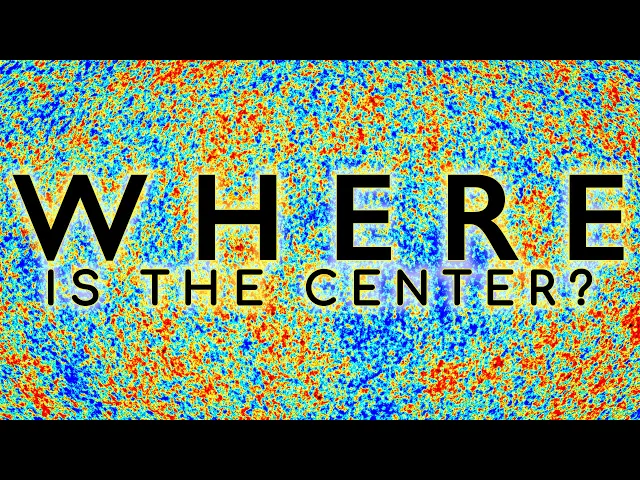
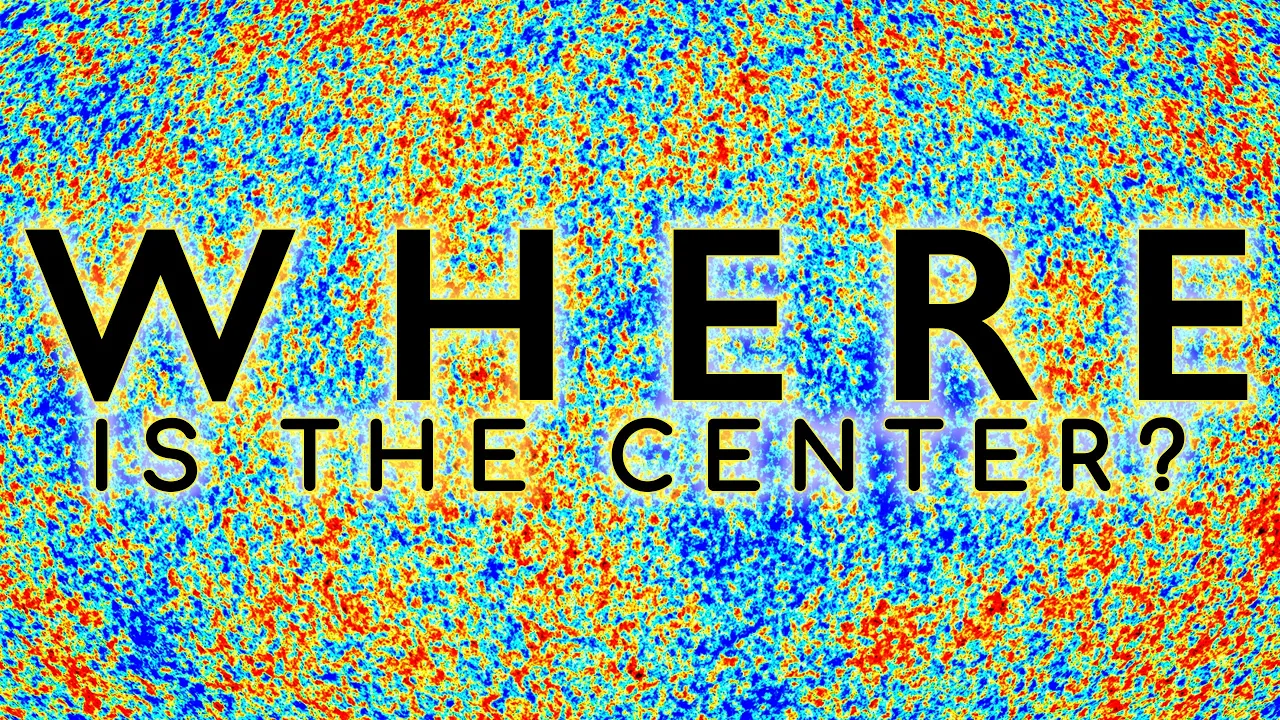
It has just changed in size from being very small to very big. It doesn't have specific coordinates because it is an explosion of the coordinate system itself. And this is what shortly after the big bang looked like, albeit in microwaves.
This is what we call cosmic microwave background radiation. And you can see it anywhere you look into space, assuming you have a space telescope that can detect microwaves because Earth's atmosphere is really good at blocking microwave radiation. 350,000 years after the Big Bang, the universe was hot, around 2,500°.
Even though this heat would have emitted visible light, we can't see it because the expansion of the universe has stretched the wavelengths of electromagnetic radiation by a factor of 1,000. Meaning the photons no longer arrive at Earth as visible light, but rather as microwaves. [Music] So, just like seeing those distant galaxies billions of light years away using visible light, we can see what the universe looked like before galaxies even existed by observing these microwaves.
This makes this image effectively the oldest thing we have ever seen. Fascinatingly, the slight variations in the image are the precursors to the filamentary structure of the universe you've seen earlier in the video. We are quite lucky in that there are not really any bright sources of microwaves in the universe apart from the cosmic microwave background radiation which means this view is a relatively uncontaminated view of the universe 350,000 years after the big bang.
Can we see beyond that? No, not really. Before that, atoms were just becoming a thing and light couldn't travel through the soup of fundamental particles.
So, the center of the universe is everywhere and nowhere in particular. Look at any part of space with a microwave telescope and you're effectively looking at shortly after the Big Bang. Like I said, the universe is weird.
You have probably heard that modern-day science believes the universe to be 13. 8 billion years old. It seems rather unfathomable how anyone can come to that conclusion.
But actually, the how is not too difficult to understand. People just don't generally ask the question. Either they scoff at it or they accept it as truth.
In this video, we will explore this how, but also throw a spanner in the works due to the newly discovered age of one of our local stars called the Methusela star, which apparently is older than the age of the universe. So, 13. 8 billion years old.
How did we come to that figure? We currently see the universe is expanding and cooling. Everything is moving away from everything excluding forces like gravity keeping things together.
The speed of this expansion is known as the Hubble constant. And currently the universe is expanding at a rate of 80,000 kmh per million lightyear. So the obvious conclusion from an expanding universe is that matter is becoming diluted.
There's more space in between things. A less obvious result of the universe expanding is the stretching of light wavelengths known as red shift. What started off as extremely high energy and high frequency waves emitted soon after the big bang have become stretched finally reaching us as less energetic microwaves known as the cosmic microwave background radiation.
It's also why the James Web Space Telescope is an infrared telescope. As photons of light emitted by galaxies billions of light years away have had their frequency shifted to the red so much that we need an infrared telescope to observe them. A photon contains energy and a higher frequency wavelength means more energy which means it is hotter.
Lower frequencies mean it is less hot. Hence why we say the universe was once dense and hot, but now it's bigger but cooler. But how does knowing this help us work out the age of the universe?
Well, we do need to assume a few things about the universe first. One, the universe is uniformly dense on the largest scales. This seems wrong.
It's clearly not uniform. There are superclusters full of densely packed galaxies and super voids containing not much at all. However, like stars in a galaxy, zoom out far enough and suddenly everywhere looks the same.
So, we assume the universe is homogeneous. As a result of that, not only is matter distributed evenly, but two, we also assume the universe's laws and properties are the same throughout in any direction. And three, we assume the Big Bang occurred in all locations everywhere at once.
If you hadn't heard that before, you can check out my video about it here. Under the laws of general relativity, if these three things are true, then there is a connection between how old the universe is and how it expanded throughout its history. With these assumptions, we can get distance and brightness measurements between objects like stars, supernova, and galaxies.
For instance, white dwarf supernova always appear about the same brightness. If an observed supernova is dim compared to what we expect, it is because it is further away. Finding out how dim tells us how far away it is and thus how far back in time we are looking.
We can also look for fluctuations in the cosmic microwave background radiation which is a snapshot of the universe only a few hundred million years after the big bang. Comparing it to galaxy clusters we see today, there is a correlation. So we can see how it's fluctuated to understand how the universe evolved and expanded.
Based on the expansion of the universe today and how it did expand, we now know the universe is 68% dark energy, 27% dark matter, and 5% observable matter. But what is dark matter and dark energy? We really don't have much of an idea.
However, we can see their effects. Dark energy is believed to be the driving force behind the universe's expansion as the expansion would have slowed down by now without it. And dark matter is gravitational force we can't account for.
Galaxies and galaxy clusters in particular seem to have a lot more mass than they should, meaning the gravitational pull is stronger. Dark matter is what must keep galaxy filaments together. We can observe its influence.
In fact, we can even map out its mass distribution like in this image. But we don't know what it is. We can't observe it.
But for the purposes of this video, we don't need to know what it is, only what it does to be able to work out the universe's age. So, we know the current rate of the universe's expansion or the Hubble constant. We know how that redshifts light.
We know the composition of the universe, and we know its properties. We can see how galaxies have evolved over time. We look for fluctuations in the cosmic microwave background radiation.
We can use all of this together to extrapolate back to the earliest stages of the Big Bang. Using three different instruments, all looking at different aspects of the universe, all the answers have come back roughly the same, 13. 8 billion years, with an estimated 99% accuracy.
But there's another method which has thrown a bit of a spanner in the works and that is to measure the age of stars. Certain types of stars are very short-lived going supernova in a matter of a few million years. Others could last for trillions of years.
Not that we've seen one that old for obvious reasons. In fact, following the evolution of stars, we haven't really seen any older than about 13. 2 billion years old.
But this does mean that long live stars that formed as matter was coalescing shortly after the big bang would certainly still be around today. And this is where our friend Methusela comes in. Methusela is a metal pore star, meaning it is very old and incredibly rare.
And most special of all, it is only about 200 light years away from us, which means we can examine it relatively closely. Based on its evolution, it is an estimated 14. 5 billion years old, give or take about 800 million years.
This means it might have disproved the 13. 8 billion figure. So, do we really know how old the universe is?
Roughly, it wouldn't be surprising to see this figure change as our technology improves. We have the W first and James Webb space telescopes coming out soon with specific mission objectives to peer deep into the universe's past. Exciting times, although I don't think we'll see this figure vary than more than about 1 billion years in either direction.
Research is still in very early days in this field, even if it has been a topic of research for a while. To be honest though, I'm so impressed we have got this far. Who would have even thought we could come up with any figure a few hundred years ago?
All this may throw up more questions than it answered, but that is science in a nutshell. The ongoing search for truth. Few questions hold greater importance in science than how it all began.
What did the beginning of the universe look like? Why did it happen in the first place? And although we are a long way off from having a complete answer, scientists have learned enough that a theory has been conceived, the Big Bang.
By examining stars and the spectrographic data given off by matter when light passes through it, we have assembled the jigsaw pieces of the Big Bang and have begun to form a picture of those first explosive moments. But here's the thing about jigsaws. Sometimes you find a piece that just doesn't fit.
At that moment, you realize with a sinking heart you've made a mistake somewhere along the way, and you have no idea where. Is this what's happening to the Big Bang Theory? Or are we looking at our puzzle piece the wrong way round?
It all comes down to an element we use every day in medicines, alloys, and most importantly, the batteries in our phones. One that is strangely missing from the universe, at least in the amounts we would expect. So, here's the big question.
Where is all the lithium? I'm Alex Mccoan and you're watching Astramm. Join me today as we examine the lithium discrepancy.
A mystery that continues to confound scientists to this day and might force us to re-evaluate our models if we ever hope to answer the question of where we came [Music] from. To begin with, let's cover some of the basics about lithium. Lithium is a relatively simple element.
It's one of the alkaline metals and for a metal is surprisingly soft, capable of being cut with just an ordinary steel knife. You might have seen it used in science experiments in school as it reacts quite satisfyingly when mixed with water, producing lithium hydroxide and hydrogen gas. More commonly is used in phone batteries, laptop batteries, and in other electronic devices due to its high electrochemical potential.
But the feature of lithium that makes it so important for our discussion is its internal structure. It's made with just three protons in the nucleus, meaning it's one of only a handful of very lightweight elements that could be created in the early moments of the universe. But it's the expected presence of lithium in the universe's beginning that causes our problem with the big bang model.
So what do we think was going on back then? How exactly does lithium prove it's wrong? Well, the universe's origin is murky to us.
After the discovery in the 1920s that our universe was expanding, a Belgian cosmologist Gor Lmetra theorized that if the universe was getting larger and cooler, it used to be smaller and hotter with all that energy being squeezed into a smaller and smaller area. The logical conclusion to this was that if you rewound the universe back to its very beginning, all of the universe's energy would exist in a single point in space. This singularity would be infinitely hot and dense, which makes sense.
Based on that heat, this idea is known as the hot big bang model. But it's this infinity that causes the murkiness to creep in. Einstein's theory of relativity can be used to predict the motions of objects under the effects of gravity.
But no equation tends to function when you start adding infinity into the mix. Hence, at the very first moment of the universe's origin, we don't have the equations to describe very well what was going on or what caused the universe to start expanding. And with an infinitely hot and dense singularity, there's no way of knowing what might have gone on before it.
Any evidence or signals from before that time would have been met with the hottest incinerator the universe has ever created. It happened somehow. That's all we can say for sure.
At this point, there would be no lithium. The very start of the universe would have been simply too hot. After that though, even just 1 second after the universe begins to expand, the picture becomes much clearer.
1 second after the universe's expansion began, the temperature of the universe dropped down to a mere 10 billion° C, which is actually only 1,000 times the temperature at the center of our sun. This was still hot enough that matter couldn't form yet. The fundamental force that holds together the nuclei of atoms would have been overwhelmed by this intense energy.
So everything would have existed in the form of radiation instead. The remnants of which we can still see today in the cosmic background radiation. Discovering this became one of the proofs that scientists are on to something with this model.
The universe didn't remain as just radiation for long. Just 99 seconds later, it would have cooled to 1 billion° C and the strong force would have kicked in. The universe's first protons by then had started forming and began binding with neutrons, creating hydrogen and the one proton, one neutron isotope of hydrogen known as dutyium.
Hydrogen and its isotopes, or versions of hydrogen that had the same number of protons, but more or less neutrons, were the most common element in the universe. But hydrogen wasn't the only one. Everything was still filled with so much energy that the hydrogen protons frequently smashed into each other, underwent nuclear fusion, and soon created the larger, more complex element helium with two protons.
Once you run the equations, in the primeval universe, matter was nearly 76% hydrogen and nearly 24% helium. But sometimes, very rarely, another proton would merge with the other two and would form isotopes of lithium, bringing the number of protons up to three in these atoms. By mass, this made up only 0.
0000 000 0 07% of matter in the early universe. But here is where the mystery comes in. By examining the spectroscopic data from stars or by evaluating that same light as it passes through clouds of matter, we can evaluate the distributions of elements in the universe today.
And what we see roughly matches this prediction. Our own sun is by mass 71% hydrogen, 27% helium, and 2% other heavy elements, which makes sense as the sun would have had time to undergo more nuclear fusion in its lifetime, slightly altering the ratios of these elements. These ratios are mirrored throughout the universe as a whole.
Another strong proof that the hot big bang model and our equations are right and that the universe did evolve in this way. And yet our predictions about lithium are wrong. Although the prediction for the amount of lithium in the early universe is really low, the prediction is actually still too high compared to what we see.
Three times too high. Or to put it another way, as we study the spectroscopy of primordial stars, the further away the star, the earlier in time the light would have left it. We don't see anywhere near the amount of lithium we ought to be seeing if our prediction was correct.
There are further mysteries surrounding lithium. Lithium 7 is the isotope that we tend to see in the early universe. This means that a lithium atom has three protons and four neutrons in its nucleus.
But there is another isotope of lithium known as lithium 6 with one fewer neutron that is meant to be much less stable and much less common than its counterpart. Supposedly making up only two out of every 100,000 lithium nuclei. While the amount of lithium in the universe is too low, the ratio of lithium 6 to lithium 7 is much too high.
Lithium 6 is a staggering 1,000 times more prevalent in the early universe than it should be. So, what does this mean for the hot big bang model? Is it really back to the drawing board for our most trusted theory about the universe's origins?
Not necessarily. Two possibilities exist. One that involves rewriting the Big Bang theory as we know it.
But there is another explanation that might just hold the answer to it all. When faced with something like this, one of two things must be true. Either our observations are wrong or our models are wrong.
Let's consider each possibility. It's difficult to throw out the hot big bang model completely. Nothing else does as good a job at explaining the existence of the cosmic background radiation or the amounts of hydrogen and helium that we see in our universe.
The quantities of those elements check out almost exactly with the hot big bangs predictions which seems to be too perfect to be a coincidence. That said, scientists are becoming less certain about the model as it stands. Steven Hawking, who was once one of the leading advocates of the idea that our universe began with a singularity, later went off the idea.
In his book, A Brief History of Time, he stated, "Roger Penrose's and my work became generally accepted, and nowadays nearly everyone assumes that the universe started with a big bang singularity. It is perhaps ironic that having changed my mind, I am now trying to convince other physicists that there was in fact no singularity at the beginning of the universe. As we shall see later, it can disappear once quantum effects are taken into account.
Those quantum effects are too complicated to go into for this video, and this doesn't necessarily solve the lithium problem, even if true. But it does highlight that the origin of the universe is an evolving branch of physics and cosmology where the full explanation of it has not yet been found. Perhaps our models will one day adjust in such a way that the lithium problem falls away even as the broad brush strokes of the theory remain in place letting the jigsaw piece of the lithium numbers fit nicely with hydrogen and helium.
The other option is that there is something wrong with our observations and there may well be some grounds to this. Because of the small amounts of lithium being discussed, it is quite difficult to see the exact amounts of it that exist in the interstellar medium once you look far back enough. The only way to probe the interstellar medium's makeup is to shine a light through it and then see which lines in your spectrograph get blocked out.
This can tell scientists what elements might make up a particular nebula or dust cloud. But this gets harder and harder to do the further away the target is. Eventually, it becomes completely impossible to get an exact estimate.
Instead, scientists are left looking at the spectrographs of primordial stars which are not necessarily representative of the universe as a whole at that time. A star is a special case. Something going on inside there might be altering the amount of lithium present within, converting the lithium into something else while boosting the amount of lithium 6.
Although it's difficult to guess what that process might be. If our observations could improve and we could better measure the amount of lithium in the early universe as a whole, perhaps the numbers would come back into line on their own. Maybe the lithium problem never existed in the first place.
Ultimately, no answer to how the universe came to be will ever be complete until all the available data matches the theory's predictions. Whether that's lithium or other problematic elements in the universe like the overabundance of gold out there, which I talk about in this video here. All these numbers have to be brought into line.
There is still so much to learn about the universe's origins. I do find it incredible just how much we are able to learn and deduce about events that happened billions of years ago back before matter itself had properly formed using just our telescopes and our minds. That picture, the grand picture of how it all began is waiting to be assembled.
However the universe came to be, it is built on a foundation of an underlying order that allows us to unlock its principles, tease out its mysteries, and reconstruct the configuration of its individual pieces. One day, I am confident we will solve the lithium problem, too. How can we resist when the answer to our ultimate origins awaits?
Some questions are just too important to leave unanswered. And I, for one, can't wait for the day this jigsaw piece is ultimately [Music] completed. In ancient times, tribes of humans would huddle around the flickering light of a solitary campfire, wondering about what might lurk out in the darkness.
And in that respect, things haven't changed. Our campfires might be larger now. Our vision reaching across the globe and even further out to the very edges of the observable universe thanks to telescopes like the James Web.
And yet there is always an edge where darkness falls and it's left to our imaginations to fill what lies beyond it. The observable universe's edge is an impenetrable barrier. It is the section of space that is accelerating away from us so quickly nothing not even light can approach us from beyond that line and so nothing beyond it can interact with us causally.
So unlike the darkness that came before whatever lay on the other side of this particular edge seemed destined to remain a mystery because it could never reach us and we could never reach it. Or so we thought. But in 2008, hundreds of galaxy clusters were analyzed to be drifting towards a section of that edge faster than science could account for.
Almost like something beyond that point was pulling them or had once pulled them with a reach that extends across billions of light years. Something massive lurking beyond that final dark. This drift of galaxy clusters that spans across the universe has a name, dark flow.
What do we know about it? What could be causing it? And what are its ramifications on cosmology?
I'm Alex Mccoan and you're watching Astramm. Today, let's dive into the mystery of dark flow and its modelbreaking implications for our theories concerning the origin of the universe. Dark flow is a controversial topic, so we'll start with what we know for sure.
In 2001, the Wilkinson Microwave Anastropy Probe was launched by NASA to map out the cosmic microwave background radiation, the fizzling echoes of the Big Bang itself that quietly radiate across all of space to help us understand better the features of our universe. This map was completed in 2010. Although it released its data in installments before that point and was hugely influential on cosmology as it helped scientists to answer questions like how flat was the universe or how much of the universe is made up of physical matter compared to dark matter or dark energy.
Alexander Kashlinski was one scientist eager to get his hands on this data. Leading a team of researchers at the NASA Goddard Space Flight Center, Alexander was excited to try to compare the cosmic background radiation map with the motion of galaxy clusters to see if there were any interesting patterns in the flow being witnessed. It was a difficult task to tackle it.
Kashlinsky and his team were taking advantage of something called the kinematic Zyv Zeldorvich effect which was very tiny. This technique essentially makes use of the fact that when cosmic background radiation passes through a high energy galaxy cluster, it gains a little of that energy. This works whether the galaxy cluster is very hot, thus heating up the cooler cosmic radiation, or whether the galaxy cluster is moving quickly and thus has a lot of kinetic energy to impart.
Either way, the radiation gets a little boost and you can use this information to infer things about the existence or motion of galaxy clusters. The problem is this boost is so tiny, it's necessary to use multiple galaxy clusters and some statistical calculations to notice it at all. The researchers needed a detailed enough map of the CMBB to then be able to compare 1,000 known galaxy clusters against to try to find movement.
And to their surprise, they found a pattern. a massive bulk flow of galaxy clusters in comparison to the CNB stretching 2. 5 billion lightyears away from us across the universe with clusters moving between 600 to 1,000 km/s in the direction of the constellation Centurus and Hydra.
The mystery is there is nothing out there to account for this motion. Some massive source or sources of gravity presumably had to be pulling these galaxies towards them. But it was outside of our vision, which led to the implication that a particularly large source of mass likely had to exist at or beyond the edge of our universe, just out of sight.
And this is a very controversial idea. But first, is it even possible for something beyond the edge of the universe to influence us gravitationally? You might think the answer would be no.
As I said in the beginning of this video, nothing that exists out there can now affect us causally, and we can't affect anything out there. That's just what happens when space expands between two points so quickly that the expansion outpaces the speed of light. You lose the ability to interact even gravitationally.
I talk about this in more detail in my video on the end of the universe. But there is a loophole if you do that interacting before a period of time in the Big Bang known as the cosmic inflation. For those of you unfamiliar with this concept, essentially scientists back in the 1970s were wondering why most parts of the universe looked very flat and very much the same in terms of temperature and distribution of mass if you zoomed out enough.
Even parts that never interacted with each other before. For instance, the edge of our universe to our left and the edge to our right are very similar to each other, even when there was no reason this should necessarily be so, as they've never met. This idea is known as the horizon problem.
An American physicist known as Alan Guth realized that the problems raised by this mystery all went away if at the start of the universe everything did interact with each other evening out like a mixture of blue and red dye and water when shaken around enough. But for that to be the case and for everything in the universe to then explode out to where it is now, a period of really fast expansion of space was needed somewhere at the start. in addition to the already fast big bang itself.
It's a little uncertain, but physicists have placed this super expansion as taking place just after the big bang began and lasting only 0. 0 Z well 10 ^ - 33 seconds which is not very long but in that time it would have expanded by a factor of 10 ^ 26 times which is insane. This mindbogglingly fast expansion is akin to going from the size of a bacterium to the size of the Milky Way galaxy.
All in a billionth of a trillionth of a trillionth of a second. The nice thing added by having this cosmic expansion event as part of the big bang model is that it allows you to explain how everything had a chance to mingle before in the time of the early universe. even the parts that are now unreachable to each other.
There are even some very respected theories about how it came about involving terms like scalar fields and false vacuum state, but that's a little heavy on the physics side and isn't really needed for this video. But the takeaway is this. Dark flow could be explained.
In that pre-inflationary period where matter wasn't even coalesed into atoms yet, there was a particularly dense section of the wider universe that our particular patch of observable universe got tugged towards on account of it having so much gravity. Cosmic inflation could then have happened pulling the powerful mass far away from our observable universe to the point where we are no longer gravitationally affected by it. But because things in motion tend to remain in motion, the galaxy clusters given that initial pull are now simply drifting along in that same direction going with the cosmic flow.
But as I said, this is controversial for two main reasons. Firstly, dark flow needs a particularly large amount of mass to exist just outside our universe for it to work and make sense. There have to be far more stars out there concentrated far more densely than our models currently predict which flies in the face of the whole reason Alan Guth came up with the cosmic inflation in the first place.
Uniformity. The universe as we see it is uniform. It is roughly homogeneous which means that mass is distributed fairly evenly no matter where you look.
It is also isotropic, meaning that if you add up all the velocities of everything moving in the universe, it all cancels out. Dark flow upsets this whole idea. It suggests that just beyond the visible horizon, things suddenly stop being so uniform.
That dense amount of mass is still in existence. We just can't see it. And that's an idea that's a little out there.
It's an idea that raises a whole lot of questions. If the universe is not actually uniform beyond our horizon, did we just get cosmically lucky to find ourselves in an exceptionally flat bit? What does that mean for our theories about the formation of the universe itself and cosmic inflation?
If the reason inflation exists is to explain a homogenized universe that isn't actually that homogeneous. The second reason that dark flow is so controversial though is that it might not exist at all. Kashlinsk's NASA team might be convinced of it, but issa's plank team double checked the existence of dark flow using an even more detailed CMBB map, one provided by their own more advanced plank probe, which launched in 2009, 8 years after WAP.
After looking through 1,000 galaxy clusters, the Plank team claimed to see no signs of dark flow at all. But Cashalinsky and his team then took a look at the plank data and they claimed that they do see signs of dark flow. So there's still a lot of debate on the issue.
Kashlinsky and his team announced in a paper that they would be doing an even more in-depth analysis using plank and W map data, intending to establish more conclusive proof, but this has yet to be released. Until we have better proof or indications of this, it makes sense to assume dark flow isn't a thing and there is no boogeyman lurking just beyond the edge of the light. That billions of years ago dragged thousands of proto galaxies towards it.
But as with all unknowns, it does make you wonder. Science does not really care about what's the most convenient answer. Truth is the truth, whether complicated or simple.
Perhaps one day we'll somehow find the answer once and for all to what lies beyond the visible universe and where the dark flow is real. But then all that will happen is the darkness will simply retreat a little further and the next cosmic boundary will appear causing us to wander once more. There is always more to know and humanity's hunger for knowledge and discovery will never cease.
Thanks for watching. I really want to give a huge thank you to our astronauts on Patreon. It's really becoming a thriving community and I've loved reading all your messages and comments over there.
If you'd like to join in, then you can visit the link in the description to become an astronaut and bring the channel more stability than the algorithm. When you join, you'll be able to watch the whole video ad free, see your name in the credits, and submit questions to our team. Meanwhile, click the link to this playlist for more Astrom content.
I'll see you next time.