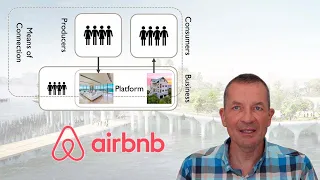
Welcome. Today we will talk about platforms. I will clarify what platforms are, the role of network effects in platform markets and how platforms often challenge existing gatekeepers.
What are platforms, exactly? Let’s start with a definition. Platforms enable direct interactions between two or more user groups.
Think of readers of a news website as one group of users, and advertisers as another group. Therefore, platforms connect two, or sometimes multiple sides of a market. Platforms incentivize participation by setting access fees and designing rules that govern the interactions of affiliated agents.
How do platforms generate value? Well, mostly by reducing frictions such as search costs or transaction costs. eBay is good example of a transaction platform: if I want to sell my collection of obscure collectibles, eBay connects me to people all around the world and therefore makes it more likely that I find someone who really appreciates it.
More likely perhaps than if I were to do a yard sale in front of my house. Hence, a large platform can create value by enabling better matches between agents. The platform significantly lowers search costs and transaction costs, not only for me, but also for potential buyers.
But there are some more interesting features of platform markets. Platforms connect complementors – for example sellers - and end users – for example buyers - and enable direct interactions. On each side of the platform – either on the complementor side or on the user side – there can be network effects.
For example, as an end-user, I get more value from using Instagram when there are more people I can follow. But there can also be indirect network effects. As a seller, eBay is more valuable to me the more buyers are on platform, because I can sell more, or sell even obscure stuff.
As a buyer, eBay is more valuable the more sellers are on the platform, because it creates more variety and lower prices. Let’s look at some more examples. You can think of a newspaper, or a magazine as a platform.
On one side there are advertisers, and on the other side are readers. You can also think of the iPhone – or the AppStore to be more precise - as a platform. Here we have app developers on one side and consumers on the other side.
Let’s see if we can describe the network effects that arise in these examples. In the case of a magazine, there is a direct network effect for advertisers. This one is negative.
As an advertiser, I’d love to exclusively show my ads to consumers. More other advertisers simply just increase the competition for consumer eyeballs. There are also indirect network effects.
As an advertiser, I get more and more value from putting ads in the magazine as the number of readers increases. So this is a positive indirect network effect. What about readers?
Well, one could argue that value to readers decreases more and more as the number of advertisers increases. If consumers buy the magazine for the editorial content, they do not want to see too many ads. Hence, consumers might experience a negative indirect network effect.
Now what about the iPhone? Again, app developers might not like too many other app developers on the platform. At the same time, they would like to sell their apps to many consumers.
In this example, consumers may actually experience a positive indirect network effect. A greater variety of apps makes the iPhone even more useful. Indirect network effects are sometimes called cross-side network effects.
As we have seen in the examples, they can be positive for one side, but negative for the other side. If you want a formal definition, we can say that cross-side network effects arise if the benefit to users on at least one side depends on the number of users joining the other side. Direct network effects are sometimes also called same-side network effects.
They can be positive on one side, but negative on the other side. We can say that same-side network effects arise if there are cross-side network effects in both directions so that the benefit to a user indirectly depends on the number of users on the same side. Platforms are becoming increasingly popular as an organizational form.
Traditionally firms are organized as a pipe, meaning with a linear value chain. The firm buys inputs from complementors to manufacture a final product that they sell to end users. Think of the car industry.
Platforms, on the contrary, have triangularly shaped value chains. Rather than putting the components together, the platform directly connects complementors and end-users. Platform-based business models tend to scale quite well.
Compared to a pipe organization, fixed costs are much lower. The arrival of digital technologies has made it viable to build a business around enabling 1:1 matches between complementors and end users. Most of this is automated, which means that platforms often have very low labor costs compared to the value that they are creating.
This means that marginal costs are often close to zero, meaning that adding a new complementor or end-user to the platform does not cost too much. In addition, network effects provide free marketing. But then, I hear you ask, how come that not everything is a platform?
Well, because it is difficult to make one. There is often a chicken-and-egg problem. Who comes first?
The complementors or the end-users? Here is an example of how digital platforms can change market outcomes. Let’s look at the book publishing industry.
Traditionally, publishers operate on the pipe model. Authors write manuscripts, which publishers manufacture as books and then sell them – through retailers – to consumers. The blue line represents the number of books published in this model in the US.
With the rise of e-reading devices, such as Amazon’s Kindle, also digital publishing platforms became more and more popular. These platforms directly connect authors and readers. As you can see from the red line, the number of books published without traditional publishers skyrocketed.
Going from the pipe-based model to the platform model often means that we are cutting a middle man, we’re removing gatekeepers, we’re removing intermediaries. This is why people sometimes speak of disintermediation when they talk about how platform models are challenging traditional organizational structures. Let’s think about why disintermediation may be a good thing, for consumers and perhaps overall welfare.
What is the problem that the middleman creates? Should we be storming the gatekeepers? Let’s think about a very simple model of the pipe-based organization.
There are two entities: the complementor and the manufacturer. Both are monopolists. Consumers have a certain demand function for the final good.
The complementor produces an intermediary good at marginal cost MC1. And the complementor observes the demand in the final product market, which we denote by D2, and therefore the marginal revenue of the manufacturer MR2. They set price P1 accordingly to maximize profits.
For the manufacturer, P1 is what they have to pay to get the intermediary good. Accordingly P1 is the marginal cost of the manufacturer, or MC2. With these marginal costs, and the demand function, the manufacturer can work out their profit maximizing price P2.
You see that both firms charge a mark-up, which is why economists call this outcome “double marginalization”. Why is this a problem? Pricing above marginal cost yields a deadweight loss – because some consumers, with a low willingness to pay, are left out of the market.
Here this happens twice. You can see this from the white triangles under the demand curve. Also you see that P1 is lower than P2.
Consumer surplus is lower when we have double marginalization. How can we improve this situation? Both consumers and the firms would be better off if the firms merged and didn’t charge each other prices above marginal costs.
This simple model suggests that cutting out the middle man is a good idea. But with a platform aren’t we simply replacing one middle man by another? Yes – to some extent we do.
But the platform will most likely have lower marginal costs. And some other benefits that go beyond this simple model. To sum up, we have introduced some fundamental ideas about platform markets and seen two types of network effects in this context.
Same-side and cross-side network effects. We then thought about pipes versus platforms and whether disintermediation can be a good idea. Thanks for watching!