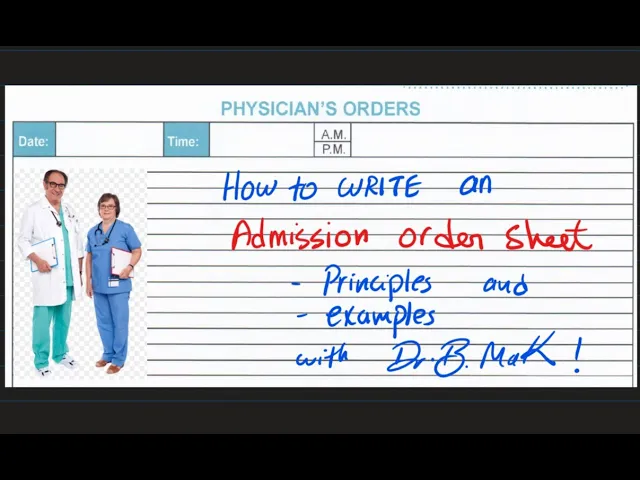
today I'll be discussing with you part 1 of how to admit a patient which includes a general approach but now we're gonna be discussing the admission order sheet now the progress note and not the clinical assessment of course the order sheet will communicate your understanding of what's happening with the patient and your plan and so devising a clear plan is important clarity and clear communication are keys so let's go ahead and talk about the admission order sheet yes there are order sets that some electronic medical record systems have and some hospitals have as an internist
I do recommend that you clearly read all the different protocols and order sets that you have so that you understand if you need to make specific changes or recommendations and so that you're familiar with your hospitals policy culture and as well as actually knowing all the important categories of what is happening there so if you have an order set in an electronic medical record system then why do you need to know how to write an order sheet as I am going to be presenting presenting it to you today a it's for patient safety B to
have a clear plan but see it more importantly is because you need to endorse clearly what is happening with your patient to the next shift to the primary team and to the nursing care to the nursing team to provide care during the for example on-call time or thereafter and so to communicate properly we need to know that there are things such as abbreviations that are ok and abbreviations that are not there is a need for specificity so that you have to define exactly the route the kind of medication use the term that is scientifically acceptable
or acceptable in your community or the community hospital and the staff that you're working with so that everyone knows clearly what you were talking about if you're a handwriting you need to write legibly and you have to make no assumptions that people know a certain diagnosis or know what they have to do should a deterioration happen so for example if I am telling you to monitor vitals then you need to know when to escalate what based on what prognosis you're expecting I am not gonna be expecting you to write and list down every possibility and
permutation and then what to do then there is some room for things to be left to be assessed and ordered later but the things that you leave are those that have room to be left for later so this is how you know if I can if I have to write something clearly or not the answer is would it affect the safety of my patient if the answer is no then you have time to write an order sheet later on I will walk you through a number of things that I believe are absolutely important to be
written every time that you see a patient in the emergency room admitting from an outpatient clinic or writing the admission orders for the first time in the wards all right so what am I here to communicate I'm communicate who is admitting for what reasons or the condition the condition is a descriptive term that is clear as to why the patient is being admitted or the diagnosis if you have already reached the diagnosis many diagnoses are clinical and don't need much investigation and some patients come already pre investigated whether from another hospital or from the outpatient
clinic etc and then you need to mention the disposition so that is the where and for how long including discharge planning which we will come to in a little bit you need to understand what is an order sheet so to define an order sheet I'm going to use a technical definition here it is your plan that is to be carried out for the duration or until the discontinuation of that order sheet or until it's changed by a virtue of new order sheet what this means is once I write an order sheet or replace it in
the system this order sheet will not this order will be carried out until its duration or until discontinued or trumped by a new or you must be aware of your institutions protocols obviously this includes your quality measures and your institutional policies and certainly what your specific team or specialty needs you to add or involve in your order sheet there are certain protocols such as heparin infusion protocol sickle-cell disease pain protocol so here in fusion here you have pain protocol how to use analgesia what kind of safety net sometimes those I remember I worked in a
hospital where the protocol was 17 pages long and yes you have to read those to know what is in them diabetic ketoacidosis hyperglycemic hyperosmolar state intra operated insulin protocols for example or even insulin sliding-scale orders which I definitely will be discussing at a later point I urge you to look at mnemonics for admission orders there are many online I'll show you how I do mine because I kind of put things out of the usual mnemonic place for example I always like to put my investigations prior to the treatment unless the treatment is a life-threatening issue
I usually place an independent order sheet for a treatment that is related to ABCs and then I'll write my order sheet in it clear I try to limit it to single page whenever I'm writing a manual order sheet I worked in hospitals where there are electronic sets and I worked in hospitals where I wrote for years a manual order sheet and so here are suggestions of some mnemonics that can be used your order sheet reflects your plan your understanding of the patient so here's an example because this is early 2020 and we're in the wake
of the 2019 novel coronavirus and because I am currently working in the Kingdom of Saudi Arabia where we actually have pioneered the treatment and confinement of the Middle East respiratory syndrome coronavirus the murska V so this is gonna be a case of community-acquired pneumonia and we're gonna be assuming that this patience meets the case definition for Moscow V and I'm gonna write a specific case scenario in a patient with no previous medical illnesses and maybe exposure to camels for example I'll actually write this specific case out and involve the categories that should be involved in
any case even a hip fracture even something that is completely different and should the patient have comorbidities you will still follow the same system what I'm trying to do here and the purpose of this video is that you have to jolt your brain into thinking of all those things that can happen to your patients and the sort of care that you're gonna be providing to your patient in the inpatient setting so what I do is on top of the order sheet on top of the manual order sheets that I used to always write I'd write
no known allergies asthma eczema or HIV because if a patient has Dixon or asthma or atopic disorder otherwise such as allergic sinusitis for example this patient might develop anaphylaxis for something that you may start to expose them in early admission and then later in the admission they develop hypersensitivity towards it and so I write that at the top even though in some of the mnemonics that you will see it's written somewhere in the middle I think it's important to communicate very clearly other things I'll write at the top is if I'm resuscitating someone who's a
DNR I'll write the DNR at the top so that people know that I want certain resuscitative measures that are in line with do not resuscitate orders I do similar things in similar situations where I think it's paramount to communicate a certain patient background prior to carrying the plan so that I put everyone at the team in the same mindset all right here is how you go always date and time and always identify the patient do not perform anything do not write anything if it's not but if it's not after identifying the patient properly and dating
and timing once this is done I'll go ahead and write admit the patient as a case of community-acquired pneumonia to general ward with airborne droplet and contact precautions notice I do not make any any grand statements about how I diagnosed or whether they meet the definition criteria these are the things that you leave for the admission progress note or the post admission round physician note and then you communicate in the order sheet however you must involve a clear communication of what it is that you're treating because you need to respect the kind of time and
dynamic that is happening with everybody and by doing that we limit the chance that people would be thinking you're treating something else admit under dr. burrow that's me internal medicine team for example and so I just mentioned to where I mentioned the who and of course with this position you are always gonna mention infection control precautions and notice how your monitoring will also be involved immediately after the reason I'd like to do this is because this is a clearer way when someone reads my order sheet they know what kind of urgency I think my patient
has I know to myself and I know that this is also true as for many Hospital policies but if you have to record vitals more than more frequently than q two hours then the patient should be in high dependency unit or an intensive care if I say this patient is really stable and you can record vitals Q for hours or Q six hours then that means the patient is relatively stable but if I write a vitals monitoring that is more frequent and it is associated waive a certain safety net than the patient then the team
will know that this patient needs more attention than another who may be more stable I'm going to mention all risk immediately there because this is something that can be forgotten and that's why my first treatment order will always be DVT prophylaxis but I'll show you that after the investigation and then my number-6 will always be investigation it's very common for me to write the stat investigations in the order sheet and then if I have something that needs to be done daily like a CBC daily or monitoring for renal function I'll write that at the bottom
so obtain an echocardiogram stat CBC with differential stat chest x-ray posterior and lateral stat please always notice that any abbreviation has to be accepted by your hospital policy arterial blood gas and kidney function test and urea and electrolytes to be obtained at the same time so I'm thinking of do of might of having to do for example an anion gap calculation so I have to be very clear about how I place my orders so that things are clear in areas where you think I'm dealing with with for example a trainee who will be obtaining Bloods
I may want to for example even mention how many MLS and what kind of vial sometimes I do that because this is a nice way to actually impart knowledge to your team and your team can be the student the intern the resident or even the nurse because in my experience nurses have always saved me from many problems they have excellent input and they always know what kind of things that need to be done and so I will always consider consider them at the top of my team and this is why I think you have to
learn this order sheet because the moment you finish you're gonna have to communicate by clearly presenting the complete order sheet to the nurse in charge and this I think is the most important aspect of your order sheet and that's why you should write legibly or even type when possible alright so h1n1 and Muscovy swabs as per protocol so the protocol the should be an airborne isolation and it should be done with special personal protective equipment and so because we have a protocol I can write as per protocol otherwise I have to write clearly all the
steps sputum for acid-fast bacilli in TB culture and TB PCR because I'm living in an area where TB is common and may be in the history of this patient this patient was exposed to a TB patient before or previously treated for TB and I may be thinking that this might be a component of reactivation right so this is just an example I'll always use the chance to do something in terms of screaming so assume this is middle aged person maybe I want to screen for diabetes and and this lipid emia if I am allowed and
the patient is covered for such screening and so this is age appropriate screening and then whatever else you would like to do notice that this is one set but it's not stat so I just wrote it at the end then the treatment injection in aqsa purim 40 milligrams of cut daily was Altamira or Tamiflu some 5 milligram pol D for five days and discontinued if the viral screen for corona and h1n1 are negative and then I'm gonna go ahead and give my antibiotics and IV fluids because I know that if I'm giving us all Timothy
rhythm there is a risk of renal impairment if the patient is dehydrated and injection IV fluids as a bolus and as maintenance should be clearly mentioned in two separate lines and then a safety net in terms of o2 saturation which is the only thing I'm prognosticating might drop in this patient who's otherwise stable otherwise you can write a clear safety net as to what kind of deterioration might happen a winter for example activate a rapid response team etc chest percussion therapy incentive spirometry all the things that the patient might need so whenever you're writing treatment
it's pharmacologic intervention and non pharmacologic treatment always mention the three categories then move on to mentioning the specific diet and dietary precautions such as precautions for aspiration if for whatever reason I think this patient might have had pneumonia in relation to aspiration and I still don't have a chest x-ray to look for the classical stereotypical areas of aspiration or cavitation but it's fair game to write a very clear aspiration precaution message or in this case order dietitian review you can place any consultation you want here and write each one in a separate line and in
a separate number I like to number my order some people do not like to number the orders and then you will also go ahead and write what happens if your investigations come back positive or negative and also place your discharge planning because this charge plan is part of your plan and it indicates success of treatment and a clear path to treatment success if you know when you can discharge your patient at the end it's very important to write thank you I was surprised to actually see why like while preparing for this that some people have
mentioned that it's important to appreciate where at a thank you message I've seen some of my seniors do that and I've been running it since I was a junior resident and quite honestly I I felt that it resonates consider adding the weight of the patient at the top of the order sheet even if it doesn't have a place for it many standard ordered sheets do because it's a nice place to have it and you might need to calculate certain doses based on the weight and similar to how you have to write the plan once you
do this plan and this clear structure please present the plan with the clear structure to the people who are going to be receiving your plan so the nurse in charge is my number one person that I want the plan clearly endorsed you because they are the most important person but then that includes your senior your junior the student on the team the respiratory therapist anyone that might be involved and on the scene you will give them the plan directly and then you leave your clearly written note for anyone who comes later to read and they
will be endorsed to aspirin door sment protocols that you will have so that is it for the order sheet I hope that you found this informative you