on this episode of what's going on with shipping. Is the straight of Hormuz safe for shipping right now, Mr Secretary? No.
No, it is not. That's that's one of the objectives at the end of this conflict is to reopen the Straits of Hormuz. But no, it is.
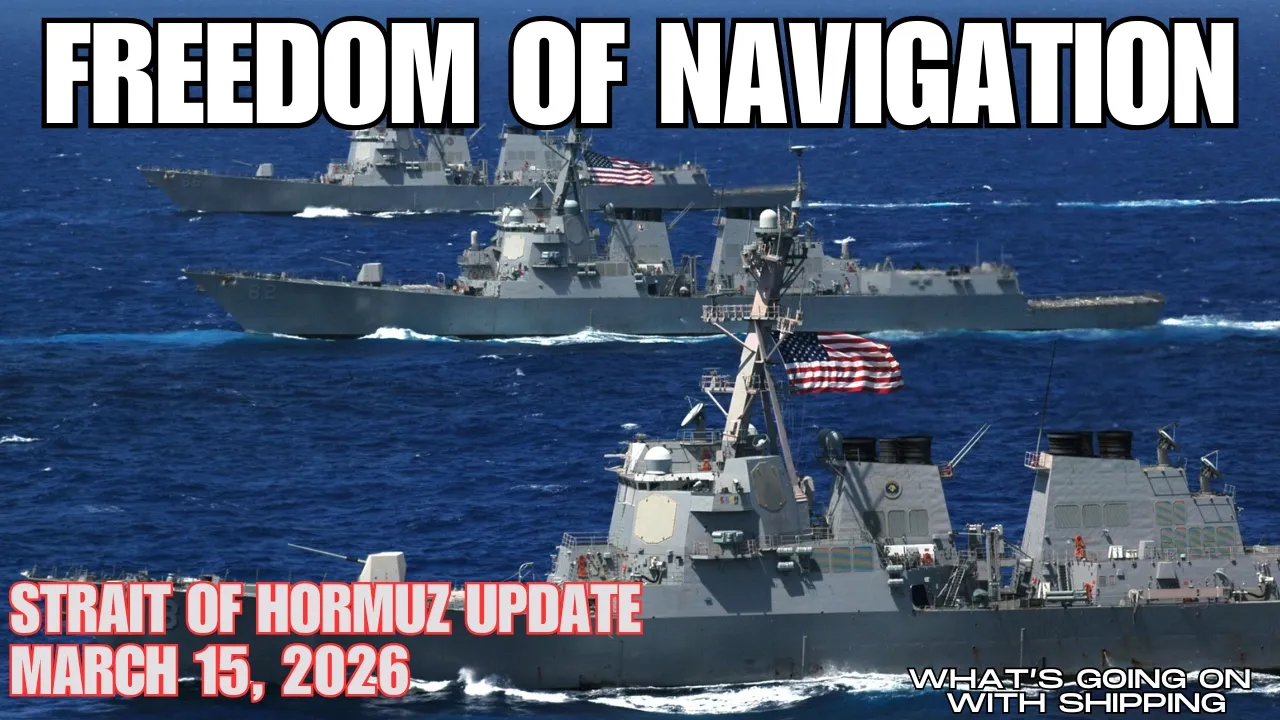
Since the conflict began, Iran has impeded flow through the Straits of Hormuz. Um, and that is still the case today. Looks like time for the US Navy to do some freedom of navigation.
Hi, I'm your host Sal Maglaniano. Welcome to today's episode. So that was energy secretary Chris Wright on MSNBC or NBC I guess it's NBC NBC's Meet the Press talking about the situation in the Straight of Hormuz.
So a couple of things. Number one, right off the bat there, the fact that the Straight of Hormuz isn't a priority is a problem. I mean we're going to handle it later in it.
I mean this should have been upfront an issue. I don't think we need to do everything sequentially. we can do things concurrently and that seems to be a big issue.
But in this episode today, we're going to give you a straight of horror moves update, give you the latest stories about what's happening. We also want to update some other stories going on because believe it or not, this is a channel about global shipping, not just the straight of horror moves. Although, if you watch this channel for the past two weeks, you wouldn't know that, but there are other shipping issues going on.
And quick note, too, yesterday, March 14th, we did not drop an episode. So, my apologies. have been doing pretty much daily episodes on the straight of horror muse, but we did not have one yesterday.
Number one, because I needed a straight of horror muse break. Second of all, it was my anniversary, my 34th anniversary with my lovely wife, and we spent that day together. And more importantly, she got me a great gift, which some of you are probably eyeing right now in the back of the picture right here.
That's right. I got myself a Lego Marque ship. I got the old one up there, got the new one down there.
Going to be putting that together. I'll keep you posted on that as we go along. All right, if you're new to the channel, hey, take a moment, subscribe to the channel, and hit the bell so you can be alerted about new videos as they come out.
So, first, five quick stories from around the globe. Sweden boards a sanctioned tanker suspected of sailing under false flag. So, a lot of interesting stories coming out of the Baltic over the past couple of weeks.
Number one, Baltic had been iced up pretty bad because of the winter situation. Really difficult to get traffic moving. But this is the second ship that Sweden has bor has boarded largely because of false registry, a stateless vessel.
We've talked about this a lot regarding the US seizure of Venezuelan tankers. Under the UN Convention of the Law of the Sea, there's a specific article that allows you to board what are called stateless ships, ships that are not properly registered. So, according to the story, the Swedish Coast Guard, supported by the Swedish police, boarded the 228 m1 approximately 20:30 local time on March 12th in Swedish territorial waters.
Authorities have opened a preliminary investigation into the suspected violations related to the lack of unseaworthiness. The tanker was displaying the Camorian flag, but Swedish officials said the vessel does not appear in the Kamora ship register, raising suspicions they're sailing under a false or unverifiable flag state. This has been a major issue with a lot of nations around the world sailing ships without proper registry.
You have to be registered in a country. If not, you are a stateless vessel. This is where piracy actually came from originally.
Stateless vessels, hence the black flag. Now, what we're seeing is Sweden boarding this. The Baltic has been a big area for this, following a chain of instances where ships dragged anchor and severed cables.
Next, we head down to Panama where Panama flagged detentions at Chinese port spike amid Hutchinson port fallout. So, you may remember that there was an issue early in the Trump administration about Chinese influence down in Panama, specifically the Panama Canal. At both ends of the canal are terminals, container terminals and other cargo terminals.
At each end, there is a terminal that was controlled by a Chinese corporation, CK Hutchinson. The US made a bid along with Panama to get those terminals out of the hands of the Chinese corporation over to another one. Well, China has retaliated.
This is what we're talking about. Chinese ports detained 28 Panama flag vessels between March 8th and 12th, representing 75. 7% of detentions.
That is exceeding historical levels. Nations have the right to board vessels in their port and perform what's called port state control. And you can detain a vessel if it does not meet the required regulations and rules as set by the International Maritime Organization and through a series of conventions.
Safety, life at sea, marine pollution. Well, China has been targeting Panama specifically. Sources say that China's maritime authorities have issued verbal instructions to intensify inspections of Panama flag ships.
Now, the move looks like it's a pure retaliation against Panama's forced removal of CK Hutchinson. Panama is the second largest registry in the world. So, a fight between China and Panama is not good.
It's going to cause disruptions. What we may see is some Panameanian registered vessels start reflagging over to other registries to get away from this problem. Third story comes from Greg Miller over at Lloyd's list.
Next US tariff plan take shape as customs and border protection updates on refunds and two new section 301 investigations target a combined 94 countries as President Trump moves to fully replace tariffs he lost in the Supreme Court. Average US tariff rates fell from 14. 3% under IPA to 10.
5% under these new section 122. The new section 301 levies should bring averages back up later this year under CBP's proposed refund system, which is beyond a work in progress. I think they're trying to figure out how to freak do this and refund millions if not billions of dollars.
US importers will have to consolidate AIPA claims and follow a strict submission process. That's going to be a chore for many companies. Do you remember that Russian liqufied natural gas carrier that got hit by the unmanned surface vessel blew up and then burned and then sank?
Slight problem did not sink. This story from Malt Humphred over at G Captain Arctic Metagas LNG tanker still afloat. Malta warned ships to keep clear.
So you have a vessel that was struck. we believe by an unmanned surface vessel, probably the Ukrainians, hit it in the side, blew out the second tank, caused a massive confilration. I mean, the fire was absolutely tremendous.
The ship is now low in the water, a drift off the coast of Malta. Crew was rescued, they were saved, but now you have this navigation hazard. It's going to be a very difficult ship to try to salvage.
But again, this also goes to highlight the fact that we're seeing attacks on shipping, not just in the Red Sea, the Black Sea, the Straight of Hormuz, the Gulf of Oman, the Persian Gulf, but this is the Mediterranean. We've had several attacks on Russian ships in the Mediterranean. Lastly, do you remember we were sending a hospital ship up to Greenland and all the stories about that?
I did a few of them talking about it. number one talking about the fact that there were no hospital ships available at the time cuz both of them were in a shipyard in Mobile, Alabama. And I said, "Listen, you're not going to get a a hospital ship out.
The Comfort's in till April. The Mercy is getting ready to sail, but she has a six-month dry docking set up in Portland, Oregon. But again, why listen to me?
" Well, here's story from Mike Schuler. Trump's Greenland hospital ship now sailing up the West Coast after a Panama Canal transit. Guess where she's heading to?
you guessed it, Portland, Oregon for her shipyard. So, a quick series of updates here for you on other stories. I thought it was really important to do that.
We haven't done it. It's Sunday. Give you a little bit of an update.
All right, let's jump over to Straight of Hormuz. So, here's the latest joint maritime information center advisory note for 15 March. It just dropped.
We are still at a critical level in the Arabian Sea, Straight of Hormuz, and Gulf of Oman. Confirmed maritime incident so far since one march stands at 20. There were no attacks over the last day.
We have an average rate through the straight of Hormuz of 138 ships prior to the attacks. We are now sitting there yesterday with three vessels through the straight of Hormuz. Uh in terms of global navigation system interference, it's still widespread and consistent.
No vessel incidences over the past 72 hours. However, the targeting of port fuel storage continues to demonstrate the potential for attacks to disrupt bunkering operations, port logistics, and regional energy supply chains. The ability of unmanned systems to strike infrastructure and extend ranges reinforces that maritime risk is not limited to vessel transits or choke points, but may also affect port facilities, offshore energy infrastructure, and maritime logistics hubs throughout the Arabian Sea and Arabian Sea approaches.
This chart shows you straight of Hormuz and Babel Mandab. Cheers. Transits from 8 to 14 March.
On 14 March, we had two ships transit the straight of Hormuz, one east, one west. The vessel that transited eastbound out of the straight of Hormuz was a tanker. Note, this covers vessels over a thousand gross tons and are transmitting AIS.
The operation epic fury sitrep here shows you a density analysis of maritime events that are reported to the UK MTO from 1 to 12 March. Again, you have a couple of areas of kind of high concentration. That is the area in and around the straight of Hormuz and just east and west of it.
The other area of note is all the way up the Persian Gulf near the Kuwaiti Iraq anchorages and we're still getting massive amounts of anomalous AIS positions and jamming in and around the straight of Hormuz. The maritime threat level remains at a critical level over the next 24 to 48 hours. Jitmick assesses the most credible risk to include continued unmanned aerial and unmanned surface vessels and missile activity follow-on strikes near recent maritime event locations attacks against stationary vessels or offshore operations such as shipto- ship transfers.
That's what happened up in the northern Persian Gulf region. And then persistent interference both on navigation and AIS and communication disruption may degrade some navigation reliability and increased congestion related hazards. The maritime security environment across the Arabian Gulf and straight of Hormuz remains at a critical level of kinetic risk.
While there have been no confirmed attacks in the last 72 hours, previous attacks suggest that vessels which are anchored, drifting, or operating predictably may face elevated levels of exposure. This, I think, is crucial. Not sure why it's not highlighted, but it really should be.
There remains no confirmation of mining in the Strait of Hormuz. I don't think there's a better graphic than this that really demonstrates the situation in and around the area with the absolute drop off in the number of ships that have transited through the Straight of Hormuz since February 28th when we started seeing that drop off occur uh down to just a trickle. Just a reminder everybody, I'll have a link to this report in the show's description.
This report has a summary at the end going over all vessel attacks, a nice chart and list for it. Here are the most recent set of attacks right there. You'll also notice they'll have a graph here showing when these attacks take place.
Again, there's really no rhyme or reason to the attacks or who they're attacking. Uh it's pretty disperse over the entire region. The last attack was against the Source Blessing, which is a container ship off the UAE coast.
So, JipMake is a great source to track ships moving through the area on the status. The other one I recommend very strongly is over on X is Tanker Trackers. Again, I know many people have problems with X, Twitter, whatever you want to call it, but there are some great sources to follow over and Tanker Trackers is one of them.
Their most recent post kind of counters something that Brian Sullivan over at CNBC said, you know, still very quiet in the straight. Will that change in the next 24 hours? Uh Sully is over in Paris speaking with folks on the ground about what happens next, but note tanker tracker says, "Well, yeah, but another 2 million barrels of Iranian crude just departed.
" And I think that's the big irony of this whole situation. While tankers are held in the Persian Gulf and container ships and liqufied natural gas and liqufied petroleum gas and bulkers, the Iranians are not only loading vessels, but they're sailing them through the straits. Now the big update was the fact that the United States struck Carg Island.
This is the main export facility for Iran to get oil out of the nation. However, there are other aspects including Jas which is a terminal outside the straight of Hormuz. But Car Island is absolutely essential.
And listen, I know Car Island very well. I played Battlefield 3. I I know Car Island.
However, Car Island was hit, but they didn't hit the oil facilities. Instead, what the US targeted was their military facilities. The story by Mike Schiller over at GC Captain.
Trump warns Iran's oil lifeline at risk after major US strike on Car Island. Now, while there are plenty images from Sentcom showing you these strikes on Car Island, while there are many images showing you the strikes on Car Island and the damage afterwards, I think the most telling came from tanker trackers, which shows not one, not two, but three oil tankers loading at Car Island right now. Iranian oil for export out.
Again, I I keep going back to this. I know I've mentioned this before on the show. We did an earlier episode about this that if you want to target Iran's oil, I mean again, you don't want to hit the infrastructure because again that causes irreparable damage and that raises the stakes in this.
I still think a strategy of grabbing or halting Iranian you don't have to seize them anymore. You just have to stop them from coming out of the straight of Hormuz. I don't understand why Iranian oil tankers are running in and out of the straight of Hormuz and going to India.
There was two that went to India. I I mean it's not like it's it's one. It's not hard to spot a fully loaded Iranian oil tanker.
Really isn't. I'm not exactly sure what is going on here. However, in the meantime, the Iranians are hitting back.
This story, UAE's Fujera port stops some oil loading operations after a drone attack. So the suspension came hours after the US attacked military targets on Iran's Car Island export Fujara outside the straight of Horam moves as the outlet for about 1 million barrels per day of the UAE's Murban crude oil, a volume equal to about 1% of world demand. According to Hale Lima Croft, analysts at RBC Capital, quote, "The IRGC, this is the Islamic Revolutionary Guard Corps, is sending a message that there is no safe harbor in this rapidly expanding conflict.
The fact this comes hours after the US strike on Car Island also signals that tyrron will not let Washington control. All right, so we're not moving tankers out of the straight of Hormuz the Persian Gulf unless you're Iranian. There is that pipeline across the UAE that's a million barrels per day.
There's the pipeline across Saudi Arabia over to the Red Sea that is ramping up to be almost 8 million barrels per day. Long line of tankers coming in across the Indian Ocean through the Bob Mandab. Cheers.
And up to the Red Sea. This is one of the reasons that Gerald R. Ford moved into the Red Sea to provide air cover over Yanbu.
I firmly believe that because if you knock Yam Buu out, that's the terminus of the Saudi Arabian port, that is a big problem. It's a massive problem. But they have disrupted the 1 million barrels coming out of Fujera here consistently.
So again, Iranian oil flowing, everybody else's oil a little interrupted. But S, how can you be so sure about that Iranian oil? Well, let's go to this story right here by Paul Morgan.
India's tanker escape. Rare Hormuz passage signals new political re reality for global shipping. Two Indian liqufied petroleum gas carriers have successfully transited the straight of Hormuz after receiving rare clearance from Iran, highlighting how the world's most critical energy shipping corridor is increasingly being shaped by diplomacy rather than routine commercial navigations.
The ship, the Javalik and the Nandi Davyy, both operated by the stateowned shipping corporation of India, were allowed to pass through. So India is brokering a deal. I should say India's brokered some great deals because they just got access to to Russian oil that was afloat.
Remember the United States had levied very hard against India to prevent them from taking Russian oil, threatening tariffs. Well, guess what? They got their tariffs reduced and now they're getting uh Russian oil.
And the reason we know that, again, Splash 247, good buddy of the show, Sam Chambers. 65 million barrels of crude heading toward India. This is from Russia.
Now the situation in the straight of Hormuz in the Persian Gulf is not great. Another India story we have Indian sailors stranded off Iran just want to go home. So a 26-year-old Indian sailor who's identified just as amju by two Reuters is one of about 23,000 Indians working on merchant harbor and offshore vessels across the wider Gulf region.
Hundreds of tankers and cargo ships are waiting to pass through. The plight of Indian sailors in and around the straight has become a major issue at home with Delhi saying it is coordinating multiple authorities including Iran to ensure their safety. According to AMJU, we know how dangerous it could be to sail without a navy escort or without permission.
So the vast majority of ships in the Persian Gulf are foreign flag ships that have crews. And the vast majority of of mariner crews come from basically six countries. They come from Philippines, number one, India, Indonesia, China, Russia, Ukraine.
There are however other nationalities in there, including five US ships that are still freaking trapped in there that are not able to get out because again, not sure what's happening here with the US, why we're not doing at least getting the five US ships out. I think that's one of the things the Navy should be doing here is protecting US commercial ships. But again, we're not just getting ships running in and out.
There are some other ships running in and out, too. For example, this one right here. Lured by profits, some ship owners brave mines and missiles to sneak oil past Iran.
A handful of Greek ship owners have sent crude oil and drybulk tankers through the straight of Hormuz during this conflict. At least 10 ships operated by Greek companies and at least two Chinese operated vessels have sailed through the straight between Iran and Oman since the strikes on March 28th. Companies involved include shipping magnet George Proupio.
I know I'm not saying that right. I apologize. My Greek is not great.
Dinocom and Inico's family's Oololis management according to six industry sources familiar with the matter. The two companies did not respond to requests for comment. I'm shocked by that.
Iran's military struck several ships moving through the narrow channel, vowing to keep it closed and warned that oil will reach $200 per barrel. At least 16 ships have been attacked, including Greek operated vessels hit by drones. So, a Greek shipping owner who has money at the forefront.
I'm shocked. I am shocked to learn about gamblings going on here from my favorite movie, Casablanca. By the way, absolutely the best movie with the best lines ever in a movie.
I bar none. All right. Greek shipping owners.
Understand Greeks are the largest single nationality of ship owners, 16% followed by China at 14%. Greek shipping owners are unique. Not to stereotype anyone, but Greek ship owners when they see an opportunity for profit are going to run at it.
When you're chartering ships for a half a million dollars a day, they're going to do it. Now, you should be asking yourself, S, what about the cruise? Well, the crews are receiving a 100% bonus to sail through that region.
I should note that the minimum wage for mariners is $680 a month. So, if you're a minimum wage sailor, if you're a wiper oiler, you know, the very low level there, a steward of some kind, you're maybe making $23 a day. So, you're doubling that.
Now, truth, upper level mariners make more than that. We're talking about a thousand to several thousand dollar per month to make that. So, they're making more money.
It is a drop in the bucket for the money these companies are making. But weight against the risk, I'm not exactly sure it's good. Now, the ITF, the International Transportation Federation, has worked out agreements so that if mariners want to not sail through the region, they should be allowed to be repatriated.
However, those in the Gulf are kind of stuck there right now because of air traffic issues. and those who are outside the Gulf who sit there and say, "I don't want to go through the Persian Gulf. " You can go home, but I guarantee you, you will not have a shipping job again in the near future.
Finally, we have this story. President Trump calls for Allied warships to secure the Strait of Hormuz. So, in a truth social post on Saturday, President Trump called for many countries, especially those affected by Iran's attempted closure of the Hormoo Strait, will be sending more ships in conjunction with the United States.
Now again, he repeats that the military capability of Iran has been 100% destroyed, but it's easy for them to send a drone or two, drop a mine, or deliver a close-range missile somewhere along or in the waterway. That doesn't sound like 100%. That sounds a little less than 100%.
I mean, I'm not a mathematician, but I'm telling you 100% means nothing is coming out. This is a little bit less. And when you talk about a little bit less, this is what gets insurance companies and shipping companies a little bit, you know, for clump here.
This is the problem we have. If you tell a military guy you have a 99% chance of success, they're going to run at it. If you tell a shipping company, there's a 1% chance you may get hit by a missile mine or something, they're going to sit there and say, "Where's where's my where's my backside?
How do I defend against this? What's my up upturn here? Should something happen?
" It's a different type of risk management. Story goes on here. Hopefully, China, France, Japan, South Korea, the UK, and others that are affected by this artificial constraint.
I don't think it's artificial. I think it's being created here will send ships to the area so that the Hormoo Strait will no longer be a threat by a nation that have been totally decapitated. Well, President Mark of France says he's not sending ships into the region.
He announced that the other day. India and Pakistan have ships in the area, but they're only escorting from outside the straight through. And it's not clear any of those other ships are other nations are really going to help.
If you go back to the Red Sea scenario that we saw happen with the Houthis from December of 2023 until today, it's still going on. What we're seeing is European nations, the Greeks, the Italians, the French uh escort ships, but only their own ships. That's who they're escorting through the region.
Maybe each other's ships, but they're not escorting really anybody else's. So, it's not clear that this is going to help. President Trump goes on here.
In the meantime, the US will be bombing the hell out of the shoreline and continually shooting Iranian boats and ships out of the water. One way or the other, we will soon get the Hormuz Strait open, safe, and free. So, I want to make you aware of a couple of key things.
We've talked a lot about mines and the potential of mines in the straight of Hormuz. Good friend of the show, Chris Cavis and Chrisll. I've been on their podcast.
Remember was on their podcast last week, the Cavis ship podcast. They have on this week two experts in Navy mind countermeasures. Actually, a former Navy admiral and a former Navy captain who are specialized in this.
I hardly recommend go listen to that episode. I'll have the link right here for you. I was in last week's episode.
Uh they had the former commander of Fifth Fleet, uh Vice Admiral Fuzzy Miller on and then me. Definitely a big huge difference there between Fozzy and myself. But this week, their series on mind counter measures was really good.
Now, granted, there's a little bit of acronym happiness in there, and they do a good job at defining that. But if you want to understand the capabilities of US mind sweeping, that's what you need to go see. On the flip side of that, this got posted over to Instagram today that two of the three latoral combat ship mind sweepers are not near the Persian Gulf.
They're not even near the straight of Hormuz. They're not even up in the Arabian Sea. They're over in Malaysia right now.
Two of the ships, the Santa Barbara and the Tulsa are pictured pierside in Malaysia. Now, that is 4,000 mi away across the Indian Ocean. That's a pretty long distance away.
If you're going to start conducting counter mine, why are two of your three mine countermeasure ships all the way across there? And know before anybody sits there and tells me, "Well, S, they're latoral combat ships. They can sail at 40 knots.
" They can. And they have an grand total range of a thousand miles. When they do that, they they are fuel sucking pigs when it comes to economy.
To get across, they got to sail very slow or they need a freaking gas can halfway across to refuel or more than that actually. They need a couple of times to get across. So, the fact that the LCS's are out of place, the only reason I can think they're over in Malaysia right now is potentially to pick up with the Tripoli amphibious ready group because the US has announced it's sending an amphibious ready group.
2,000 Marines based on board the USS Tripoli along with two other amphibious ships from Japan across. They are probably somewhere in the South China Sea right now getting close to the Straits of Malika. So, maybe these LCS's are going to be escorting them, working them up.
I'm not sure, but that's my estimation of it. Finally, last thing, what should the US Navy be doing? Now, I'll be clear.
There's staff members at US Fifth Fleet in Bahrain and back in Tampa who have this plan. They know how to do this. The fifth fleet war game book has this.
They've planned this for 40 freaking years about what do we do in the case of a closure of the Straight of Hormuz. But right now, as you heard from Secretary Wright at the very beginning, that's not our plan right now. Our plan right now is to degrade Iran and then sequentially we'll start worrying about the straight of Hormuz.
You can't do that. You you can't sit there and worry about one thing without doing the other thing. You're going to damage the global economy.
And I think the US Navy, the US military has got to do something. So I'm a historian. I love historical references, especially when it comes to military and naval.
To me, the best reference I have in this goes back to World War I. May 4th, 1917, six US Navy destroyers of Destroyer Division 8 under the command of Commander Joseph Tuskig arrived in Queenstown, Ireland. Today, it's Cove, Ireland.
These were the first of a vanguard of initially 35 US destroyers that would operate from Queenstown and assist in a campaign against German Hubot. The reason the United States got into World War II was not because of the Zimmerman telegram that talked about the Germans allying with the Mexicans and invading the United States. The US army was on the border of Mexico.
We were invading Mexico. We were in Mexico. The idea of the Mexicans invading the US was ridiculous.
The issue was the sinking of commercial ships. 10 US ships are sunk starting in February 1st of 1917. 64 merchant mariners are killed.
Reed Wilson's speech to Congress on April 2nd, 1917, and he talks about one sentence about Mexico. All the rest is about freedom of the seas and navigation, and particularly the interference of trade. We dispatched 35 out of 68 US destroyers within the first month of our entrance in the war.
We sent over half of the US Navy's available destroyers, and eventually we sent almost all of them across. I think right now the US has to emulate that. We need to send destroyers.
We need a squadron of Arley Burke class destroyers sailing through the straight of Hormuz, American flags flying and daring the Iranians to do something because that is what will make the difference here and reopen the straits. Talk to the crews on the ships. Talk to the commanders.
Talk to any surface warfare officer. They're dying to do this mission. They want to do this mission and show the flag and get back into the Gulf and show the Iranians that they don't control this piece of water.
And so we need a similar kind of return of the Mayflower. That was the imagery you saw before with the six destroyers going into Queenstown. We need that imagery today.
We need to demonstrate that the straight is open. Once you demonstrate the straight is open, you'll start seeing ships start moving. I'm talking the ships.
I'm talking to crews on the ships. I'm talking to people who are talking to people on the ships. Talking to ship company owners.
They need something. What they don't need is Secretary Wright coming on and number one saying the US Navy has escorted the ship and then taking it back and then sitting there saying that there are mines or wait there's no mines. What they need is a clear definition from the United States that the strait is open for business and that the US will be there to respond.
During the height of the tanker war from 1980 to 1988, 411 ships were hit, 55 sunk or constructive total losses. Hundreds of merchant mariners died. Understand the merchant mariners will sail through here.
They're bored right now. They want to go. They want to get things moving.
They want traffic to flow. The US can do two things at the same time. Yes, we can chew gum and walk.
I'm pretty sure about that. The idea that we have to do this sequentially misses a key thing. 25% of global trade goes through the straight of Hormuz.
We have already choked off 10% going through the Bob Mandab. Cheers. because it goes around Africa due to the Houthis.
Two vital choke points are being pinched by the Iranians because the Houthis are the Iranians client in this. What happens if you do the Suez Canal? What happens if you do the Straits of Malika?
Understand this is world trade. World trade is the circulatory system of the world's economy. If you start pinching off femoral arteries, corateed arteries and main, you know, blood vessels, you're going to die.
You're going to kill the global economy. or worse, probably not kill it. You're going to cause severe damage.
You're going to cause damage to the system that could take years, if not decades, to fix it. And the US has borne that that that burden. It is part of this operation along with the Israelis to attack Iran.
They had to have known this was going to happen. If they didn't know, everybody else in commercial shipping knew it was going to happen. That if you attack Iran full force, you're going to get disruptions in the Gulf.
Insurance isn't the issue anymore. That was week one. That's gone now.
It's not insurance that's keeping ships there. Read a post today from someone who's quote unquote an expert. It's not insurance.
I've talked to the insurance guys. Insurance is there. Plenty of insurance out there.
You can get insurance. The issue now is physical security. Demonstrating that you can sail through this region.
And if the US is afraid to sail warships through this region, now that's what the perception is, that the US doesn't want to sail warships through because they might get hit, then why do you think an unarmed tanker bulk carrier or liqufied natural gas carrier, let's call it a floating bomb, is not going to sail through the region? That's it. And worse, if you allow Iran to negotiate with countries like China, India, that the strait is open only if you're, you know, hauling for them, then you are giving Iran control of the straight.
That's what you're doing. You're creating an artificial choke point here where Iran can claim sovereignty over that, which under UN unclaused, the UN convention of the law of the sea, they can't. It's an international seaway.
They cannot claim sovereignty over it, much like the Houthi couldn't do it over the Bob El Mandab. I don't want to talk about the Turks and and and the Black Sea because that's a whole weird thing with that deals with the Montro Convention which should be gotten rid of. But anyway, that's a whole different issue.
I hope you enjoyed today's episode. If you did, hey, take a moment, subscribe to the channel, and hit the bell so be alerted about new videos as they come out. Leave a comment, share it across social media, and if you can support the page, how do you do?
And let me be clear, everybody's supporting this page. I want to thank everybody. I've gotten, it's amazing, about 30,000 new subscribers to the channel.
Thank you so much. I appreciate that. If I don't say that enough, my apologies.
But I do appreciate everybody who watches, subscribes, uh, shares, uh, gives it a thumbs up, likes. Thank you so much. Comments.
I appreciate everybody who comments. I always put at the end of my video a pinned Q&A. I will always go through the pinned Q&A over the next day or two after I post a video to answer the questions as best as I can.
Unfortunately, the comments are such that there are sometimes thousands of comments and I don't have the opportunity to go through them. do my best and especially to my patreons uh patrons over at Patreon. Thank you so much.
You provide direct support. I appreciate you. I post the videos directly to Patreon.
So, if you're a paid member of Patreon, you get them without ads. I've also started posting the videos over to Spotify, so if you want to download it as a podcast, you can do that, too.


![Mix - Star Guardian Poppy | Login Screen - League of Legends [Unofficial]](https://i.ytimg.com/vi/RD9yN_IM_8to4/mqdefault.jpg)