antibody diversity presentation is created by creative Biolabs before one month ago we detailed antibody structure and function if you are interested in it welcome to look at blogs of creative bio labs antibodies are antigen binding proteins present on the B cell membrane and secreted by plasma cell what is antibody diversity there are millions of antigens or epitope our immune system has the ability to produce specific antibody variable region against all antigens this diversification in antibody production is known as antibody diversity but there is a problem in our basic concept one gene only can code each
protein which Fromm's almost all immunoglobulins according to one gene one protein concept our genetic system should contain millions of genes to produce million types of IG in fact there are around 40,000 genes in our genome this genes codes for all kind of proteins in our system like enzymes regulatory proteins immunoglobulins etc there are only a few genes in our genome that code for IG but our immune system apparently produce antibody in the order of 10 to the 10th power how does this become possible there are five kind of source for providing antibody diversity they are
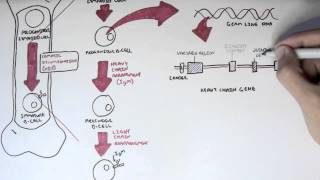
antibody gene rearrangement junctional diversity isotype swifting somatic hypermutation and affinity maturation here we mainly detail antibody gene rearrangement process and basic principle antibody diversity is produced in B lymphocyte development state so before we present gene rearrangement we should learn about these cells development b-cells develop from human boy at extends ELLs HFCS that originated from bone marrow HSCs first differentiate into multipotent progenitor MTP cells then common lymphoid progenitor CLP cells from here their development into b-cells occurs in several stages shown this slide share the cells undergo DJ joining on the h chain chromosome to become early
Pro b-cells joining a VB segment to the DJ h completes the late Pro b-cells page Pro B cells become pre b-cells when they express membrane M chains with surrogate light chains in the pre B receptor circuit light chains resemble actual light chains but are the same on every pre b-cell following proliferation small pre B cells no longer dividing undergo VJ joining on one l chain chromosome one cell chain has been successfully synthesized it is expressed with M chain on the cell membrane and the cell is called an immature B cell immature b-cells are very sensitive
to antigen binding so if they bind self antigen in the bone marrow they die these cells that do not bind self antigen express B chain and membrane IgD with their IgM about the time they leave the marrow and become mature naive resting b-cells be cell activation occurs in the secondary lymphoid organs SLO such as the spleen and lymph nodes after b-cells mature in the bone marrow they migrate through the blood to s ellos which receive a constant supply of antigen through circulating lyb pH mats QB cell is activated by antigen stimulation and differentiates IgM secreting
plasma cells each cellular clone synthesized in a GC produces isotypes of the same class specific for a given antigen during the evolution of immune responses there is a class switching in IG classes for my GM to egg IgA and edge and one fraction of the B cell progeny develops in memory b-cells in this section we detail organization of antibody genes antibody molecules are encoded by three independent groups of genes two genes dictate lambda chains one comprises V lambda and C LaMotta genes Kappa comprises vcap and c kappa genes while the third group dictates h chains
and has v h + CH genes the genetic locus which encodes the Kappa light chain gene is located on the short arm of chromosome 2 the Kappa locus contains a total of 82 genes in two large clusters including 76 to 85 IG K V gene segments v IG KJ segments and a single unique IG k c gene encoding the Kappa constant domain only about 31 to 36 of the IG kV genes which fall into six sequence related groups are considered to produce functional V capitainesj indistinct contrast to the kaepa genes the lambda gene locus is
comprised of multiple distinct C lambda regions each of which may possess its own Associated J lambda segments these lambda genes art and Emily arranged along the long arm of chromosome 22 the lambda locus spans 1050 kb p and has a total of 87 to 96 genes including 73 to 74 IG VL genes 7 to 11 i g LJ genes and 7 to 11 i g LC genes of these it has been determined that 29 to 33 of the IG VL genes which fall into 10 sequence groupings can produce functional proteins additionally 4 to 5 of
the i GL j genes and 4 to 5 of the IG LC genes are thought to be functional the heavy chain variable region is itself composed of three segments v variable chain be diversity chain and J joining chain while the light chain variable region has two segments vnj there are a total of 170 to 134 IgH immunoglobulin heavy chain genes of which 76 to 80 for our thought to be functional the functional genes ie those that can be incorporated into functional IG proteins include 38:46 IG hv genes 39 is the number given by many sources
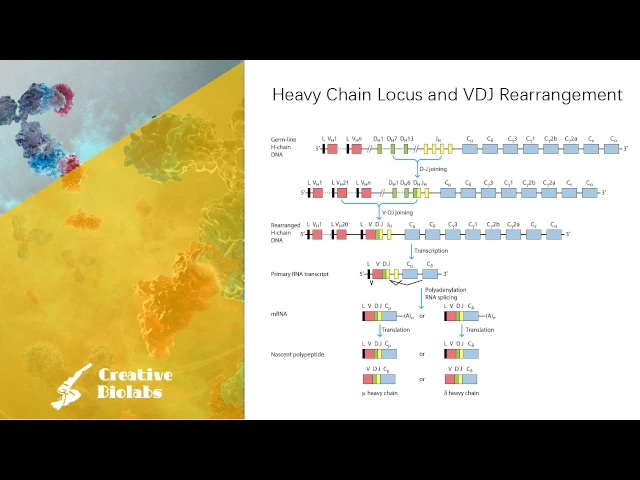
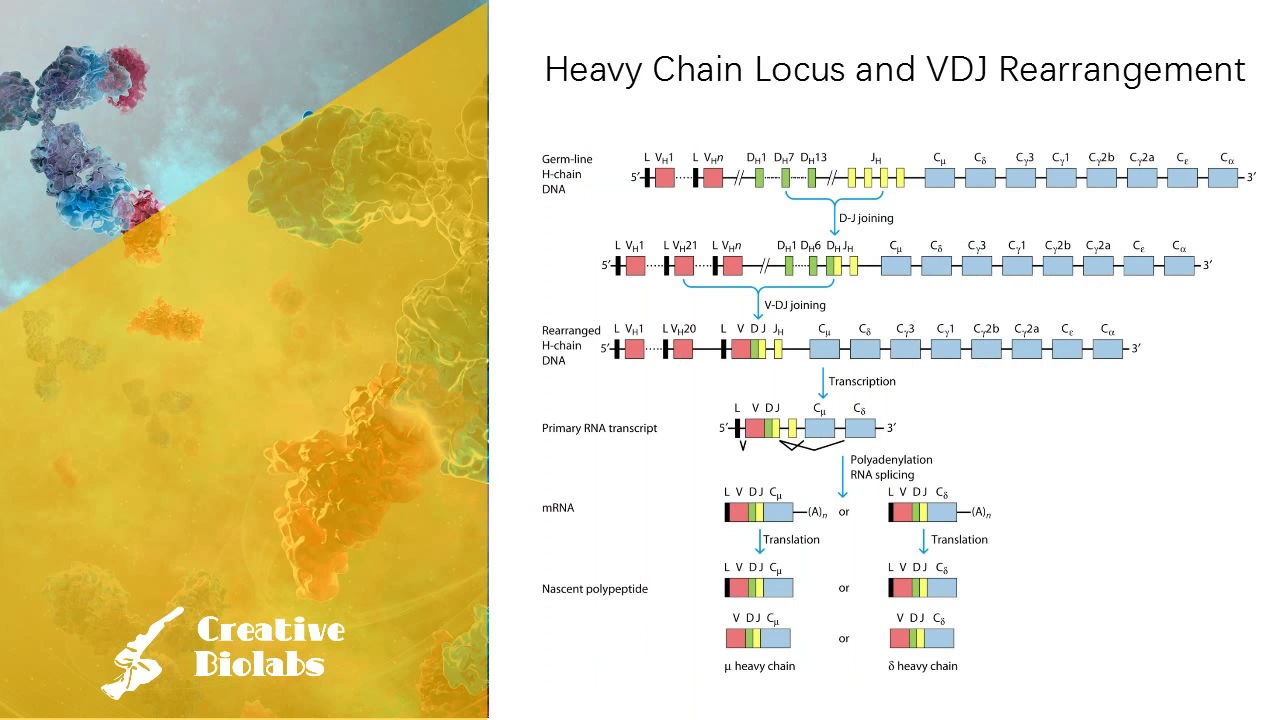
that fall into six to seven families based on sequence similarity 23 IG HD genes 6i g HJ jeans and 9 IG h c immunoglobulin heavy chain constant g the following antigen independent steps and B cell development occur in the bone marrow stem cell heavy chain IgH and Kappa and lambda light chain IG k and IG l genes are in germline configuration early Pro b-cell IgH undergoes VJ gene rearrangement with loss of DNA between the joint D and J segments late Pro b-cell IgH undergoes vvj rearrangement vdj rearrangement with loss of DNA between the joint v
ND segments small pre b-cell VJ rearrangement of light chain genes Kappa chain is rearranged first then if rearrangement of both capital eals is unsuccessful lambda chain is rearranged large pre be self intercellular expression and transient surface expression of m chain with invariant pseudo light chain free b-cell receptor the following antigen dependent steps and b cell development take place in the periphery immature b-cell i GM surface expression in the most common scenario the VD j segment joining me against and subsequently with C lambda C epsilon C alpha jeans with synthesis of a complete hig M chain
etc without an Associated Al chain surface expression is not possible and only cytoplasmic Mew is found pre B cells mature naive b-cell IgG and IgM expressed on cell surface made from Al turn ative ly splice transcripts lymphoblast alternative splicing results in secreted IgM memory b-cell isotypes which Twohig somatic hypermutation of IgH occurs in the germinal center of lymph nodes mutated IG are selected for improved antigen binding in a process termed affinity maturation early during the lymphocyte development rearrangement of one of the D gene segments to one of the J segments takes place regulated by the
recombinase activating genes rag1 and rag2 subsequently rearrangement of one of the V gene segments to the DJ segment occurs the primary RNA transcript is being processed by splicing the vdj segment to a constant region gene segment C based on different constant chain mRNA is translated to different heavy chains forming antibodies various ISO types light chain gene rearrangement principle and process is similar with that of heavy chain genes there is no D genes in light chains Kappa chain is rearranged first end if rearrangement of both capital Eels is unsuccessful lambda chain is rearranged vdj recombination proceeds
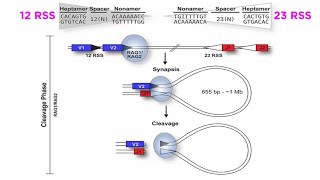
via precise DNA cleavage initiated by the rag proteins rag1 and rag2 at Short conserved signal sequences whatever their precise role the coordinated expression in pre B is essential for the rearrangement divide G genes but reg activity is switched off in mature lymphocytes rearrangements are carefully orchestrated following the principle of allelic exclusion that is in each b-cell is transcribed the gene product of only one of each chromosome pair the gene located on the second chromosome typically is not used to prevent contemporary synthesis of H chains with differing V domains in any given cell it is an
allele a term designating two genes or two or more alternate forms of a single gene occupying the same locus the gene on the second chromosome is not rearranged unless an unproductive rearrangement occurs when rearrangements are non-productive on both chromosomes cell death ensues thereby by clarifying why the same B lymphocytes within their entire lifespan can produce only a single type of valve chain cap error lambda igv B and J gene segments are flanked by conserved recombination signal sequences RSS consisting of a hep tamer and a no-name er separated by a non conserved spacer of either 12
or 23 nucleotides the 12 to 23 base per rule first postulated to explain IG gene rearrangement virtually during a rearrangement a gene with a flanking sequence containing at 12 base / spacer can only join to a gene whose flanking sequence has a 23 base / spacer and vice versa thereby elucidating the precise order of IG gene transcriptions firstly rag1 recognises RSS and form complex of rag 1 rag 2 which cut single sequence of DNA and then a hairpin is formed by addition of copies of last nucleotides of the coding region templated or P additions or
by random nucleotide additions by the enzyme TDP T DT n additions the joining of the coding ends of the rearranged gene segments is imprecise due to base additions base losses and out of frame joining this imprecision of joining generates junctional diversity there is similar gene rearrangement mechanism in T cells T lymphocytes understanding of immunoglobulin diversity and sequence has opened up a new world of possibilities one we can know the sequence of monoclonal antibody for single target which can study the mechanism of related disease to any known human cd-r sequence can be engineered in mice genome
to form humanized or chimeric antibody for clinical use three construct antibody library by antibody sequence knowledge to get more effective antibody for target related some disease principal Levant diversity is completely understood there is very close relationship in amino acid sequence and antibody function as we know there is huge diverse function between two antibodies which have almost same amino acid even if one amino acid is different based on its accuracy of antibody sequencing is very important in related research creative bio labs provides world-class Deneuve antibody sequencing services with 100% accuracy for research diagnostic and therapeutic industries
if you are interested in learning more about how we can help with your projects please don't hesitate to contact us at info at creative - bio labs comm or call us at one six three one eight seven one five eight oh six we will be more than happy to serve you