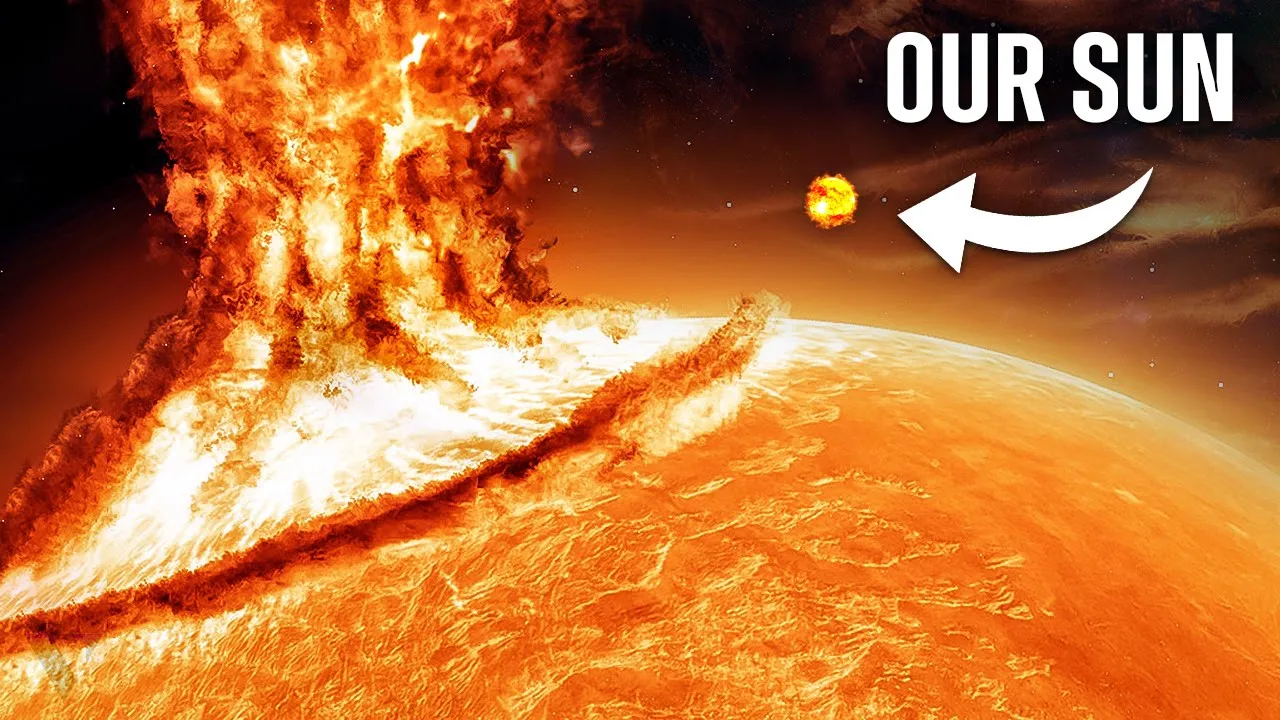
on Earth it's impossible to go very long without seeing the sun this enormous ball of atomic fire rules the sky because it is the largest body in the solar system the sun isn't that enormous for a star in fact it's about average in size yet it dwarfs anything nearby the Sun appears enormous from our vantage point however it does not appear to be as large when viewed from the outer reaches of our galaxy so are there any larger stars in existence absolutely our sun is a yellow dwarf which is a little smaller than the normal star in size the big stars make our sun appear insignificant so what is the biggest star ever discovered in the universe how big and frightening can they really get let's find out [Music] our son receives a lot of attention in terms of stars life on Earth practically revolves around it and from our vantage point at least it dwarfs the other stars in the sky the Sun appears smaller when viewed from the remote reaches of our galaxy though in actuality its size is rather typical first let's talk about stars there are many distinct kinds of stars some are bigger than others however before moving on you must realize that stars don't have neat defined boundaries they do not have a rocky planet or a moon solid surface instead the superheated mass of gas that makes up these Atomic Fireballs slowly thins out into nothingness leaving them with a somewhat dispersed surfaces a star's Photosphere which is the point at which the star turns transparent is what astronomers use in place of a surface I. E where photons can escape the star so from now on be aware that when we refer to a star surface we actually mean it's Photosphere the second crucial point to keep in mind is the fact that we have never directly measured a star nobody went up to one with a ruler and started adding up distances we do however have estimates mostly accurate estimates but nonetheless estimates these estimates can be more or less precise and full within a smaller or larger area of confidence depending on a variety of factors such as distance or structures around stars or between them and Earth I. E we know it's between X and Y miles or kilometers wide you might recall learning in a science class in school that the sun is actually a star rather than a planet the sun can appear enormous when you stand outside throughout the day and look up You can conclude as a result that it is the biggest star in the galaxy however UI scooty is hundreds of times bigger than the sun the Sun appears larger in part because of its proximity to the Earth although the sun is a huge star it is not by any means the largest star in the cosmos what is the largest star that has been discovered in the universe the answer depends on whether you're referring to a star's mass or total volume or how much space it occupies according to Phil Massey an astronomer at the Lowell Observatory in Flagstaff Arizona when it comes to size the heavier stars are frequently unimpressive while the most massive stars are frequently faint Stars that's because older stars have the propensity to expand and lose Mass the tallest people might not weigh the most Massey added comparing it to humans consider that you are discussing Mass the star r136a1 holds the record there it is situated in the large magellanic Cloud a tiny Galaxy that revolves around the Milky Way Around 160 000 light years away from Earth imagine a cherry next to a gigantic yoga ball that is more than 200 times more massive this star is 30 to 40 times the size of our sun in terms of diameter this star is also quite young having lived for only a million years as opposed to our Sun's 4.
5 billion years and hasn't done any cooling off or expanding there are several contenders if the definition of the largest star in the universe is the one with the largest diameter and UI scooty is at the top of that list astronomers at the bond observatory in Germany first noticed it in 1860 and gave it the designation bd-12 5055 after War observations revealed that bd-1250 55 changes in brightness and magnitude over the course of 740 days it was determined to be a variable star the diameter of this red hyper giant is approximately 1700 times that of the Sun remember that supergiants are bigger than giant Stars while hypergiants are bigger still hypergiants are extremely rare and have dazzling lives additionally they lose more mass to Stellar winds than smaller stars do if UI scooty were to replace the Sun as the primary star of our solar system its Photosphere would reach Beyond Jupiter's orbit giving you a sense of its size Jupiter and the sun are separated by 484 million miles or 779 million kilometers a 400 Au long nebula would be formed by gas coming from the Star one astronomical unit AU is the distance between the Earth and the Sun this would effectively extend well beyond Pluto's orbit the average orbiting distance between Pluto and the Sun is 39. 5 Au uy scooty would be a spherical 10 stories tall if the sun were a cherry but measuring the diameter are very far off stars is fraught with uncertainty UI scooty is located in the constellation scutum other words Shield approximately 9500 light years away from Earth give or take one thousand light years biggest stars seem brighter up close and dimmer at a distance astronomers must know how much light the star produces in order to do this you end up with a wide margin of error when you combine that with the fact that red hypergiants like you wear scuti are frequently variable meaning their brightness changes over time variable Stars sizes frequently change as a result of variations in brightness for instance according to research the radius of uy scooty may be up to 192 solar radii greater or smaller than previously thoughts if the lower most value is accurate other stars would be larger than uy scooty by about 30 times its smallest estimated size red hypergiants are difficult to model because of their extreme messiness according to Massey the surfaces are always moving on the other hand wohg64 might be the biggest star in the cosmos if it weren't for uy scooty approximately 170 000 light years from Earth wohg64 that's 1504 to 1730 solar radii is a red hyper Giant in the large magellanic cloud in the constellation Dorado in the skies of the Southern Hemisphere this star's brightness varies over time in part because of a dust cloud in the form of a Taurus that blocks out some of the Stars light the star most likely created the Taurus while it was dying wohg 64 once had a mass greater than 25 times that of the sum but as it got closer to going Supernova it started to lose Mass it has lost between three and nine solar systems worth of material according to astronomers estimates additionally there is VY Canis Majoris which is 8.







![The Largest Black Holes [4K]](https://img.youtube.com/vi/gIvGSW1Mlm8/maxresdefault.jpg)
![UY Scuti - Former Largest Star Ever Discovered [OOTW]](https://img.youtube.com/vi/mPtqmyUGPzw/maxresdefault.jpg)