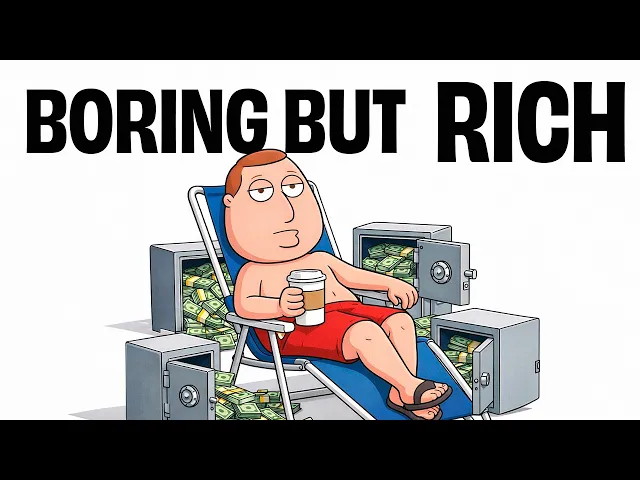
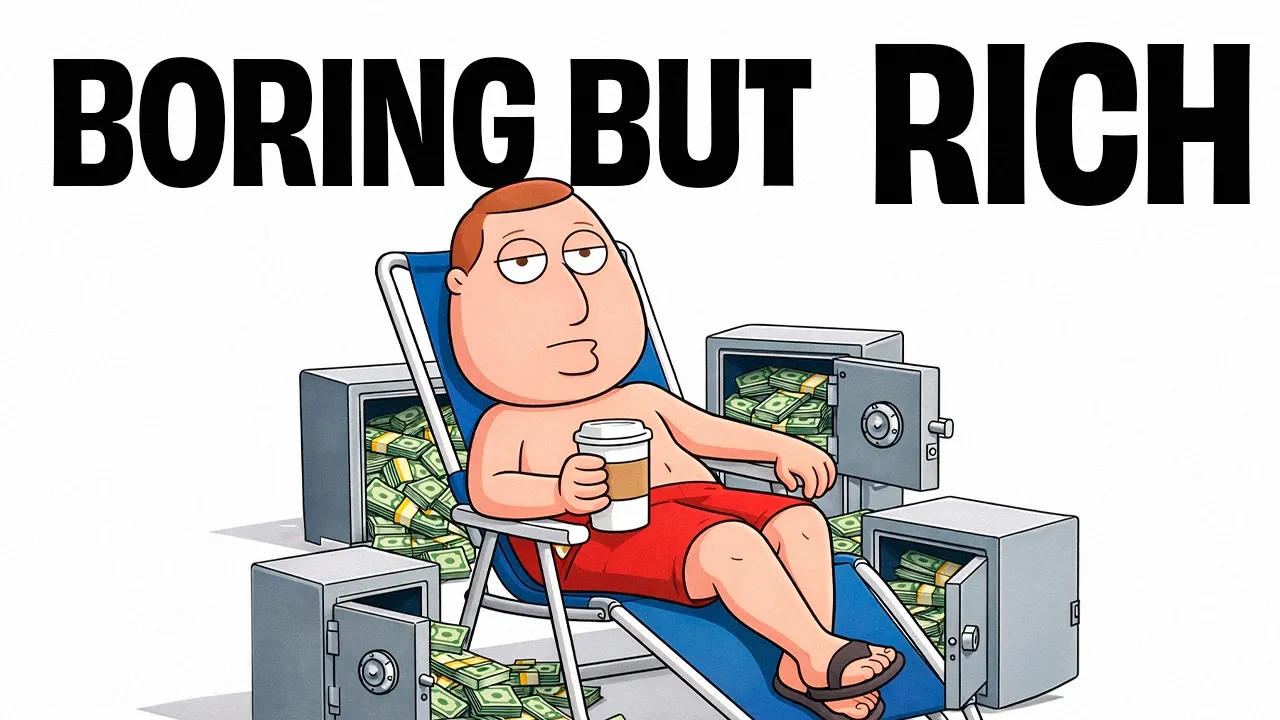
Walk into Marcus' apartment and you'll find a 2016 Honda Civic key on a hook by the door, a slow cooker with something in it, and a brokerage account he hasn't logged into since he increased his contribution last January. His couch is fine. His TV is not new.
There's a half-finish bag of rice on the counter and a calendar on the fridge with 401k + 1% written on the first of every year going back to 2019. Walk into Dererick's place and the first thing you notice is the $3,800 espresso machine still in its box. Black Friday purchase he hasn't had time to set up.
There's a stack of Amazon returns by the door, two Robin Hood alerts on his phone screen, and a parking receipt for the $47 a day spot downtown because the $22 lot is a 6-minute walk. Dererick's been meaning to check his credit card balance since October. He's a little scared, too.
Same city, same job title. close enough in salary that the difference doesn't explain what I'm about to show you. Marcus has $340,000 in investments at 36.
Derek has $11,000 and a $780 a month car payment he talks himself out of regretting every time he gets in it. This is not a story about income. is a story about 10 habits so unglamorous, so deeply unsexy that most people skip them entirely while they wait for the thing that actually moves the needle.
My name is Nick and I spend way too much time running the math on why some people escape the financial hamster wheel and others run on it until they're 70. If you've ever looked at your bank account at the end of a month where nothing went wrong and still felt like something was leaking, make sure to subscribe because today we're going to find the leak. Before the list, let me tell you the lie financial media is selling right now because it is costing people decades.
The lie is this. You haven't built wealth yet because you haven't found the right thing, the right investment, the right moment to get in. The implication is always that somewhere out there is a strategy you just haven't discovered yet.
Ramsay Solutions surveyed over 10,000 regular American millionaires. 79% received zero inheritance. A third never made six figures in a single year.
The top career engineer second accountant not crypto early adopter accountant. It took them a median of 28 years, not of genius, not of finding the thing, just 28 years of doing boring stuff while compound interest did the heavy lifting. Habit one, automate your savings before your brain gets involved.
Grace Groner was a secretary at Abbott Laboratories. In 1935, she bought three shares of Abbott stock for $180, set up automatic dividend reinvestment, and then essentially did nothing. She lived in a one-bedroom cottage, shopped at rummage sales, didn't own a car.
When she died in 2010 at 100, those three shares had compounded for 75 years into $7. 2 million. She left all of it to a college.
Here's why that works better than willpower. Vanguard's 2025 data found retirement plans with automatic enrollment achieve 94% participation. Voluntary enrollment, where you consciously choose to save, gets 64%.
30 percentage points of human behavior disappear the moment saving becomes a decision instead of a default. Because when you make it a decision, you're asking your brain to choose between something real right now versus something abstract in 30 years. In that fight, the future loses almost every time.
what that gap costs. Auto-enrolled employees saved 12. 1% of pay in 2024.
Voluntary enrolles saved 7. 6%. On a $60,000 salary, that $2,640 annual difference compounded at 10% for 30 years is approximately $400,000, not from a better investment.
Because one person made saving the default and the other had to keep choosing it, and some months chose differently. Research shows people demand 277% annual returns just to delay gratification by three months. You are not going to outdisipline that.
So don't try. Automate the four1k. Set up transfers on payday.
The money moves before you see it. Which means your brain never has to fight the urge to keep it. What this feels like when you get it right is a quiet surprise every time you check your balance.
You didn't feel the sacrifice. The number just kept growing. Habit two, drive something paid off and slightly embarrassing.
The average new car payment is now $748 a month. Dealerships make that feel manageable by stretching the loan from 4 years to 6, from 6 to 7, from 7 to we've started offering 10-year car loans, which is a thing that exists now. The monthly number goes down, the total you pay goes up, the asset loses half its value in three years.
By year five of a seven-year loan, you owe more than it's worth, which is when people trade in, roll the negative equity into a new loan, and restart the clock. The truck isn't transportation anymore at that point. It's a personality.
It's $900 a month of identity you'll still be paying for in 2031 while the truck is worth $14,000 and your coffee machine is broken. That $748 monthly payment invested in an SNP500 index fund at 10% for 30 years becomes $1. 69 million.
Instead, most people have a 2024 truck with heated seats and a calendar reminder for an oil change. Ronald Reddd was a gas station attendant for 25 years and a J C Penney janitor for 17. He pinned his jacket shut because it was fraying.
He drove a used Toyota Yaris and parked far from the meter. When he died in 2014, he left $8 million to his local hospital and library. The Yarus wasn't his financial limitation.
It was evidence that he understood something most people don't. The car payment is the most expensive status symbol in America. and most people paying for it can't afford it.
Habit three, cook food at home. Like your retirement depends on it. Let's check in on Marcus and Derek.
Marcus runs his slow cooker twice a week, spends about $80 at the grocery store, eats most meals at home. Derek orders Door Dash four nights a week, hits a restaurant Friday, grabs lunch near the office daily because packing something takes 15 minutes he doesn't have. Dererick spends roughly $900 a month on food.
Marcus spends $420. That $480 monthly gap invested at 10% for 25 years is approximately $630,000 from a slow cooker and a slightly boring Sunday. Americans now spend 55% of their food budget away from home, a record high.
A home-cooked meal averages $5 per serving. A restaurant meal averages $23. Millionaires in the Ramsay study spent $412 a month on groceries and $200 eating out.
A 2:1 ratio favoring the kitchen. The national average is the exact inverse. Nobody frames it as a wealth decision because it feels too small.
It's just dinner. But Tuesday, compounded over 25 years, is $630,000 one slow cooker at a time. Habit four, buy less house than the bank will let you.
The bank's job is not to tell you what you can comfortably afford. The bank's job is to give you the maximum loan it believes you can sustain without immediately defaulting. Those are two completely different numbers.
And the gap between them is where people spend the next 30 years feeling quietly trapped. A household earning $100,000 that keeps housing at 25% instead of 35% frees up $10,000 a year at 10% over 30 years. That's $1.
8 million, not from a better investment. From buying the second best house instead of the best one, Thomas Stanley studied this. For decades, wealthy accumulators consistently lived in neighborhoods where they were not the richest person on the block, houses that left them margin.
The high earners who looked wealthy often had spectacular homes and almost nothing else. The house was the reason, not the reward. What getting this right actually feels like.
The HVAC goes fine. The car needs breaks. Fine.
You don't lie awake running math hoping nothing breaks this month because something breaking doesn't threaten everything. That feeling, being able to absorb a shock without a crisis is what financial security actually is. A lot of people trade it away for a kitchen they love.
We're four habits in, and I know what some of you are thinking. Cook more, buy less house, drive a used car. My parents told me this, and you're right.
It isn't new. But the Federal Reserve's own data shows only 51% of American adults spent less than they earned in 2024. More than half the country is breaking even or going backwards.
Not because they don't know this stuff, but because there's an entire industry worth hundreds of billions of dollars designed to make the opposite feel rational. Habit five is where that industry lives. Habit five, track every dollar like it has somewhere better to be.
86% of Americans say they budget. 84% of those people regularly exceed it. What we've created is a population who have a number, feel bad about it, keep spending past it, and still identify as people who budget.
Like that is not budgeting. That is having a figure you feel guilty about after the fact, which does absolutely nothing. Tracking isn't about restriction.
It's about information. When you see where the money goes, you notice trades you didn't know you were making. The $340 a month in subscriptions.
You forgot about the $600 in miscellaneous. That's entirely convenience fees. The $180 in bank fees on an account.
You should have switched out of years ago. You cannot make strategic decisions about money you're not looking at. Most people aren't looking and they find out because the number at the end of the month is always smaller than it should be and they can never quite explain why.
Tracking explains why. Habit six, invest every raise before your lifestyle knows about it. You get a $5,000 raise, take-home goes up maybe $300 a month.
Within 90 days, your spending has a $300 upgrade. Maybe it's a nicer apartment, a more convenient parking spot, lunch out instead of packed. Maybe it's nothing you can specifically name.
The money just absorbed. The mechanism is hedonic adaptation. The brain makes every new baseline feel like normal in about 3 months.
The $200 dinner is special the first time. By the 15th time, it's just a Tuesday that costs $200, and you can't remember when that became normal. The fix is almost insultingly simple.
The moment a raise is confirmed before your first new paycheck arrives. Increase your automated retirement contribution. Your lifestyle never learns what it was supposed to get, so it can't miss it.
Investing half of a $5,000 raise every year for 20 years at 10% compounds to $157,000. The full raise, $315,000 from telling your bank account before you tell your lifestyle. Derek got a $6,000 raise last year.
He upgraded the parking spot, started buying lunch daily, picked up two streaming trials he forgot to cancel. His savings rate didn't move. His raise is now a slightly more expensive Tuesday.
Marcus got the same raise. He increased his 401k contribution by $200 a month before the first new paycheck arrived. He didn't notice the difference.
His investments did. Habit seven, buy index funds and then do literally nothing. The most boring sentence in finance during the one that statistically beats almost every alternative.
Buy a lowcost SNP500 index fund. Automate contributions. Leave it completely alone.
Here's what happens when people try to be smarter than that. Dalbar's 2025 report found the average equity investor earned 16. 54% in 2024.
The S&P 500 returned 25. 02%, an 8. 48 point gap.
Investors predicted the market's direction correctly only 25% of quarters, worse than a coin flip. not amateurs being careless, the people who were trying and that trying was exactly what cost them. The SPA scorecard found that after 15 years, there are zero categories in which the majority of professional active fund managers beat their benchmark.
Zero. People with Bloomberg terminals, research analysts, and decades of experience, they can't do it consistently. Okay?
The strategy that beats most of them fits on a napkin and it is embarrassing how well it works. The boring choice isn't the consolation prize. It is the strategy.
The market rewards patience and punishes cleverness at a rate that should bother everyone who's ever felt smart about a trade. Habit eight, build an emergency fund like something will go wrong. It will.
A 3 to sixmonth emergency fund doesn't compound. It doesn't make a good headline. Nobody has ever posted about their high yield savings account on Instagram.
It is the least exciting financial product in existence and it is the reason some people's financial lives survive contact with reality and some people's don't. 37% of American adults in 2024 couldn't cover a $400 emergency with cash, a blown tire, a co-ay, a dog that ate something on a Saturday. One in three adults puts that on a credit card at 22.
3% interest. A $1,000 emergency paid at minimums costs $122 in interest just to stay in place. Credit card balances hit a record $1.
28 trillion by late 2025, up 66% since early 2021. Americans are financing emergencies at 22% while trying to build wealth at 10%. You cannot do both.
The emergency is eating the investment. Habit nine, ignore every exciting financial opportunity that finds you. A Brazilian study tracked 1,600 day traders who persisted more than 300 days.
Not casual experimenters, the committed ones. 97% lost money. Only 1.
1% earned more than minimum wage. The FTC analyzed 70 MLM income disclosures and found approximately 99% of participants lose money when expenses are factored in. The brochure shows a beach.
The math shows a bill. But this habit isn't really about day trading or MLMs. It's about the broader pattern.
The crypto play your coworker cannot stop mentioning. The real estate syndication from someone you've met twice. The stock tip from a brother-in-law who is statistically not different this time.
the coaching program that will replace your income in 90 days for $2,997. All of them have the same architecture, a vivid story about the upside and the statistics about the downside left entirely out of the conversation. The mechanism is prospect theory.
Humans are wired to overweight, low probability, high payoff scenarios. Social media supercharges this by making the rare winner infinitely visible and the 99% who lost money invisible. The S&P 500 has never once pitched you on its returns.
It just returns them year after year with zero deck. The rule, if someone is excited to bring you an opportunity, be proportionally skeptical. Genuine wealth building is boring to describe.
If it sounds exciting, that's usually the warning label. Habit 10. Sleep on every major purchase for 72 hours.
The average American spends $282 a month. $3,381 a year on impulse purchases. 68% of social media impulse buyers regret at least one purchase.
They don't regret most of them, just one. They've already forgotten about the other 30. Impulse desire has a halflife.
The emotional urgency of a purchase dropped significantly within 24 to 72 hours. The thing that felt like a need at 11:00 p. m.
Tuesday feels optional by Thursday morning. And 60 to 70% of wishlisted items are never purchased. Most buying impulses don't survive even mild friction.
The 72-hour rule isn't willpower. It's a timer. You're not saying no.
You're saying check back Friday. Most of the time, Friday arrives and the answer is no by default without a fight. Cut impulse spending in half.
$141 saved monthly, $1,690 annually, invested at 10% for 25 years, approximately $180,000 from a calendar reminder, and 3 days of patience. Let's close the loop on Marcus and Derek. Marcus is 36.
He has $340,000 in investments, a paidoff car, a slow cooker, and a high yield savings account he doesn't really think about. He's not wealthy yet, but at his current trajectory, by 55, he'll have somewhere between $1. 2 and $1.
5 million. He won't change careers to get there. He'll just keep doing the 10 boring things and let 19 more years of compounding handle the math.
Dererick is 36. He has $11,000, a car worth less than he owes on it, and a Robin Hood account down 23% from a tip that made complete sense at the time. He's not a failure.
He's not irresponsible. He's just been optimizing for how things feel in the moment instead of what they add up to over time. And the gap between him and Marcus, which started as almost nothing, is now $329,000 and compounding wider every single year.
Here's what none of these 10 habits are actually about. Not restriction, not being cheap. They're about one specific kind of power that most people trade away so gradually they never notice it's gone.
The power to absorb what life throws at you without it becoming a catastrophe. When something goes wrong for Marcus, it's an inconvenience. When something goes wrong for Derek, it's a crisis.
The median retirement savings for Americans aged 55 to 64 is $185,000 against a perceived need of $1. 26 million. That's not a retirement.
That's a runway. 2 years, maybe three before the math stops working. It will happen to a lot of people who made decent money their whole careers and genuinely cannot explain where it went.
Grace Groner did this with $180 in three shares of stock. Ronald Re did it on a janitor's salary with a safety pin jacket. Warren Buffett, worth over $100 billion, still lives in the house he bought in 1958 for $31,500.
They didn't have better information. They didn't find the thing. They just let boring run long enough to become extraordinary.
The habits aren't the point. The point is what they protect. margin, the gap between what you earn and what you need, the option to say no to something you hate, the ability to retire before your body forces you to.
That's what's actually being built here. Not a number, not a portfolio balance. Options.
And options are built one automated transfer, one paidoff car, one slow cooker, Sunday at a time. Pick one habit from this list. Do it this week.
The compound effect doesn't require perfection. It just requires that you stop waiting for the exciting version of this to show up. It won't.
This is the version and it works. If this gave you a different way to think about any of it, hit the like button and subscribe. We do this exact kind of math first breakdown every week.
Drp in the comments the financial trap you want me to run the numbers on next. I will find a way to make it thoroughly unsexy and genuinely useful. Walk into Marcus' apartment and you'll find a 2016 Honda Civic key on a hook by the door, a slow cooker with something in it, and a brokerage account he hasn't logged into since he increased his contribution last January.
His couch is fine. His TV is not new. There's a half-finish bag of rice on the counter and a calendar on the fridge with 401k + 1% written on the first of every year going back to 2019.
Walk into Dererick's place and the first thing you notice is the $3,800 espresso machine still in its box. Black Friday purchase he hasn't had time to set up. There's a stack of Amazon returns by the door, two Robin Hood alerts on his phone screen, and a parking receipt for the $47 a day spot downtown because the $22 lot is a 6-minute walk.
Dererick's been meaning to check his credit card balance since October. He's a little scared, too. Same city, same job title.
close enough in salary that the difference doesn't explain what I'm about to show you. Marcus has $340,000 in investments at 36. Derek has $11,000 and a $780 a month car payment he talks himself out of regretting every time he gets in it.
This is not a story about income. is a story about 10 habits so unglamorous, so deeply unsexy that most people skip them entirely while they wait for the thing that actually moves the needle. My name is Nick and I spend way too much time running the math on why some people escape the financial hamster wheel and others run on it until they're 70.
If you've ever looked at your bank account at the end of a month where nothing went wrong and still felt like something was leaking, make sure to subscribe because today we're going to find the leak. Before the list, let me tell you the lie financial media is selling right now because it is costing people decades. The lie is this.
You haven't built wealth yet because you haven't found the right thing, the right investment, the right moment to get in. The implication is always that somewhere out there is a strategy you just haven't discovered yet. Ramsay Solutions surveyed over 10,000 regular American millionaires.
79% received zero inheritance. A third never made six figures in a single year. The top career engineer second accountant not crypto early adopter accountant.
It took them a median of 28 years, not of genius, not of finding the thing, just 28 years of doing boring stuff while compound interest did the heavy lifting. Habit one, automate your savings before your brain gets involved. Grace Groner was a secretary at Abbott Laboratories.
In 1935, she bought three shares of Abbott stock for $180, set up automatic dividend reinvestment, and then essentially did nothing. She lived in a one-bedroom cottage, shopped at rummage sales, didn't own a car. When she died in 2010 at 100, those three shares had compounded for 75 years into $7.
2 million. She left all of it to a college. Here's why that works better than willpower.
Vanguard's 2025 data found retirement plans with automatic enrollment achieve 94% participation. Voluntary enrollment, where you consciously choose to save, gets 64%. 30 percentage points of human behavior disappear the moment saving becomes a decision instead of a default.
Because when you make it a decision, you're asking your brain to choose between something real right now versus something abstract in 30 years. In that fight, the future loses almost every time. what that gap costs.
Auto-enrolled employees saved 12. 1% of pay in 2024. Voluntary enrolles saved 7.
6%. On a $60,000 salary, that $2,640 annual difference compounded at 10% for 30 years is approximately $400,000, not from a better investment. Because one person made saving the default and the other had to keep choosing it, and some months chose differently.
Research shows people demand 277% annual returns just to delay gratification by three months. You are not going to outdisipline that. So don't try.
Automate the four1k. Set up transfers on payday. The money moves before you see it.
Which means your brain never has to fight the urge to keep it. What this feels like when you get it right is a quiet surprise every time you check your balance. You didn't feel the sacrifice.
The number just kept growing. Habit two, drive something paid off and slightly embarrassing. The average new car payment is now $748 a month.
Dealerships make that feel manageable by stretching the loan from 4 years to 6, from 6 to 7, from 7 to we've started offering 10-year car loans, which is a thing that exists now. The monthly number goes down, the total you pay goes up, the asset loses half its value in three years. By year five of a seven-year loan, you owe more than it's worth, which is when people trade in, roll the negative equity into a new loan, and restart the clock.
The truck isn't transportation anymore at that point. It's a personality. It's $900 a month of identity you'll still be paying for in 2031 while the truck is worth $14,000 and your coffee machine is broken.
That $748 monthly payment invested in an SNP500 index fund at 10% for 30 years becomes $1. 69 million. Instead, most people have a 2024 truck with heated seats and a calendar reminder for an oil change.
Ronald Reddd was a gas station attendant for 25 years and a J C Penney janitor for 17. He pinned his jacket shut because it was fraying. He drove a used Toyota Yaris and parked far from the meter.
When he died in 2014, he left $8 million to his local hospital and library. The Yarus wasn't his financial limitation. It was evidence that he understood something most people don't.
The car payment is the most expensive status symbol in America. and most people paying for it can't afford it. Habit three, cook food at home.
Like your retirement depends on it. Let's check in on Marcus and Derek. Marcus runs his slow cooker twice a week, spends about $80 at the grocery store, eats most meals at home.
Derek orders Door Dash four nights a week, hits a restaurant Friday, grabs lunch near the office daily because packing something takes 15 minutes he doesn't have. Dererick spends roughly $900 a month on food. Marcus spends $420.
That $480 monthly gap invested at 10% for 25 years is approximately $630,000 from a slow cooker and a slightly boring Sunday. Americans now spend 55% of their food budget away from home, a record high. A home-cooked meal averages $5 per serving.
A restaurant meal averages $23. Millionaires in the Ramsay study spent $412 a month on groceries and $200 eating out. A 2:1 ratio favoring the kitchen.
The national average is the exact inverse. Nobody frames it as a wealth decision because it feels too small. It's just dinner.
But Tuesday, compounded over 25 years, is $630,000 one slow cooker at a time. Habit four, buy less house than the bank will let you. The bank's job is not to tell you what you can comfortably afford.
The bank's job is to give you the maximum loan it believes you can sustain without immediately defaulting. Those are two completely different numbers. And the gap between them is where people spend the next 30 years feeling quietly trapped.
A household earning $100,000 that keeps housing at 25% instead of 35% frees up $10,000 a year at 10% over 30 years. That's $1. 8 million, not from a better investment.
From buying the second best house instead of the best one, Thomas Stanley studied this. For decades, wealthy accumulators consistently lived in neighborhoods where they were not the richest person on the block, houses that left them margin. The high earners who looked wealthy often had spectacular homes and almost nothing else.
The house was the reason, not the reward. What getting this right actually feels like. The HVAC goes fine.
The car needs breaks. Fine. You don't lie awake running math hoping nothing breaks this month because something breaking doesn't threaten everything.
That feeling, being able to absorb a shock without a crisis is what financial security actually is. A lot of people trade it away for a kitchen they love. We're four habits in, and I know what some of you are thinking.
Cook more, buy less house, drive a used car. My parents told me this, and you're right. It isn't new.
But the Federal Reserve's own data shows only 51% of American adults spent less than they earned in 2024. More than half the country is breaking even or going backwards. Not because they don't know this stuff, but because there's an entire industry worth hundreds of billions of dollars designed to make the opposite feel rational.
Habit five is where that industry lives. Habit five, track every dollar like it has somewhere better to be. 86% of Americans say they budget.
84% of those people regularly exceed it. What we've created is a population who have a number, feel bad about it, keep spending past it, and still identify as people who budget. Like that is not budgeting.
That is having a figure you feel guilty about after the fact, which does absolutely nothing. Tracking isn't about restriction. It's about information.
When you see where the money goes, you notice trades you didn't know you were making. The $340 a month in subscriptions. You forgot about the $600 in miscellaneous.
That's entirely convenience fees. The $180 in bank fees on an account. You should have switched out of years ago.
You cannot make strategic decisions about money you're not looking at. Most people aren't looking and they find out because the number at the end of the month is always smaller than it should be and they can never quite explain why. Tracking explains why.
Habit six, invest every raise before your lifestyle knows about it. You get a $5,000 raise, take-home goes up maybe $300 a month. Within 90 days, your spending has a $300 upgrade.
Maybe it's a nicer apartment, a more convenient parking spot, lunch out instead of packed. Maybe it's nothing you can specifically name. The money just absorbed.
The mechanism is hedonic adaptation. The brain makes every new baseline feel like normal in about 3 months. The $200 dinner is special the first time.
By the 15th time, it's just a Tuesday that costs $200, and you can't remember when that became normal. The fix is almost insultingly simple. The moment a raise is confirmed before your first new paycheck arrives.
Increase your automated retirement contribution. Your lifestyle never learns what it was supposed to get, so it can't miss it. Investing half of a $5,000 raise every year for 20 years at 10% compounds to $157,000.
The full raise, $315,000 from telling your bank account before you tell your lifestyle. Derek got a $6,000 raise last year. He upgraded the parking spot, started buying lunch daily, picked up two streaming trials he forgot to cancel.
His savings rate didn't move. His raise is now a slightly more expensive Tuesday. Marcus got the same raise.
He increased his 401k contribution by $200 a month before the first new paycheck arrived. He didn't notice the difference. His investments did.
Habit seven, buy index funds and then do literally nothing. The most boring sentence in finance during the one that statistically beats almost every alternative. Buy a lowcost SNP500 index fund.
Automate contributions. Leave it completely alone. Here's what happens when people try to be smarter than that.
Dalbar's 2025 report found the average equity investor earned 16. 54% in 2024. The S&P 500 returned 25.
02%, an 8. 48 point gap. Investors predicted the market's direction correctly only 25% of quarters, worse than a coin flip.
not amateurs being careless, the people who were trying and that trying was exactly what cost them. The SPA scorecard found that after 15 years, there are zero categories in which the majority of professional active fund managers beat their benchmark. Zero.
People with Bloomberg terminals, research analysts, and decades of experience, they can't do it consistently. Okay? The strategy that beats most of them fits on a napkin and it is embarrassing how well it works.
The boring choice isn't the consolation prize. It is the strategy. The market rewards patience and punishes cleverness at a rate that should bother everyone who's ever felt smart about a trade.
Habit eight, build an emergency fund like something will go wrong. It will. A 3 to sixmonth emergency fund doesn't compound.
It doesn't make a good headline. Nobody has ever posted about their high yield savings account on Instagram. It is the least exciting financial product in existence and it is the reason some people's financial lives survive contact with reality and some people's don't.
37% of American adults in 2024 couldn't cover a $400 emergency with cash, a blown tire, a co-ay, a dog that ate something on a Saturday. One in three adults puts that on a credit card at 22. 3% interest.
A $1,000 emergency paid at minimums costs $122 in interest just to stay in place. Credit card balances hit a record $1. 28 trillion by late 2025, up 66% since early 2021.
Americans are financing emergencies at 22% while trying to build wealth at 10%. You cannot do both. The emergency is eating the investment.
Habit nine, ignore every exciting financial opportunity that finds you. A Brazilian study tracked 1,600 day traders who persisted more than 300 days. Not casual experimenters, the committed ones.
97% lost money. Only 1. 1% earned more than minimum wage.
The FTC analyzed 70 MLM income disclosures and found approximately 99% of participants lose money when expenses are factored in. The brochure shows a beach. The math shows a bill.
But this habit isn't really about day trading or MLMs. It's about the broader pattern. The crypto play your coworker cannot stop mentioning.
The real estate syndication from someone you've met twice. The stock tip from a brother-in-law who is statistically not different this time. the coaching program that will replace your income in 90 days for $2,997.
All of them have the same architecture, a vivid story about the upside and the statistics about the downside left entirely out of the conversation. The mechanism is prospect theory. Humans are wired to overweight, low probability, high payoff scenarios.
Social media supercharges this by making the rare winner infinitely visible and the 99% who lost money invisible. The S&P 500 has never once pitched you on its returns. It just returns them year after year with zero deck.
The rule, if someone is excited to bring you an opportunity, be proportionally skeptical. Genuine wealth building is boring to describe. If it sounds exciting, that's usually the warning label.
Habit 10. Sleep on every major purchase for 72 hours. The average American spends $282 a month.
$3,381 a year on impulse purchases. 68% of social media impulse buyers regret at least one purchase. They don't regret most of them, just one.
They've already forgotten about the other 30. Impulse desire has a halflife. The emotional urgency of a purchase dropped significantly within 24 to 72 hours.
The thing that felt like a need at 11:00 p. m. Tuesday feels optional by Thursday morning.
And 60 to 70% of wishlisted items are never purchased. Most buying impulses don't survive even mild friction. The 72-hour rule isn't willpower.
It's a timer. You're not saying no. You're saying check back Friday.
Most of the time, Friday arrives and the answer is no by default without a fight. Cut impulse spending in half. $141 saved monthly, $1,690 annually, invested at 10% for 25 years, approximately $180,000 from a calendar reminder, and 3 days of patience.
Let's close the loop on Marcus and Derek. Marcus is 36. He has $340,000 in investments, a paidoff car, a slow cooker, and a high yield savings account he doesn't really think about.
He's not wealthy yet, but at his current trajectory, by 55, he'll have somewhere between $1. 2 and $1. 5 million.
He won't change careers to get there. He'll just keep doing the 10 boring things and let 19 more years of compounding handle the math. Dererick is 36.
He has $11,000, a car worth less than he owes on it, and a Robin Hood account down 23% from a tip that made complete sense at the time. He's not a failure. He's not irresponsible.
He's just been optimizing for how things feel in the moment instead of what they add up to over time. And the gap between him and Marcus, which started as almost nothing, is now $329,000 and compounding wider every single year. Here's what none of these 10 habits are actually about.
Not restriction, not being cheap. They're about one specific kind of power that most people trade away so gradually they never notice it's gone. The power to absorb what life throws at you without it becoming a catastrophe.
When something goes wrong for Marcus, it's an inconvenience. When something goes wrong for Derek, it's a crisis. The median retirement savings for Americans aged 55 to 64 is $185,000 against a perceived need of $1.
26 million. That's not a retirement. That's a runway.
2 years, maybe three before the math stops working. It will happen to a lot of people who made decent money their whole careers and genuinely cannot explain where it went. Grace Groner did this with $180 in three shares of stock.
Ronald Re did it on a janitor's salary with a safety pin jacket. Warren Buffett, worth over $100 billion, still lives in the house he bought in 1958 for $31,500. They didn't have better information.
They didn't find the thing. They just let boring run long enough to become extraordinary. The habits aren't the point.
The point is what they protect. margin, the gap between what you earn and what you need, the option to say no to something you hate, the ability to retire before your body forces you to. That's what's actually being built here.
Not a number, not a portfolio balance. Options. And options are built one automated transfer, one paidoff car, one slow cooker, Sunday at a time.
Pick one habit from this list. Do it this week. The compound effect doesn't require perfection.
It just requires that you stop waiting for the exciting version of this to show up. It won't. This is the version and it works.
If this gave you a different way to think about any of it, hit the like button and subscribe. We do this exact kind of math first breakdown every week. Drp in the comments the financial trap you want me to run the numbers on next.
I will find a way to make it thoroughly unsexy and genuinely useful.