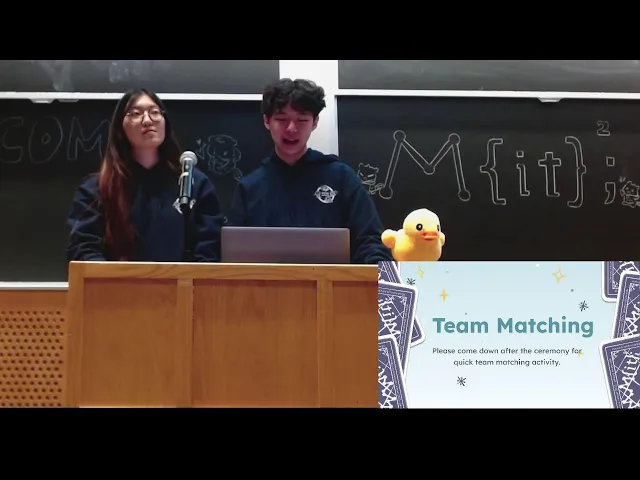
second get get you no like can tell jie the AR [Music] welcome everyone to the MIT informatics tournament my name is Alex fan and I am the president of MIT squar and I am Diane the art director of MIT squar and it is an honor for us to commence the MIT informatics tournament winter contest [Applause] 20125 standing here today I still can't believe I'm here with all of you just 8 months ago we were at a conference table debating with either Domino's or Costco pizza would be a better option look at us now with a full-blown tournament with all of you here today and actual lunch options I mean let's not forget all those countless late night debates we had about what to do at activities night whatever happened to bouncy castle we do not talk about the bouncy castle Jokes Aside real effort has gone into making this an event that will be meaningful for all of you and it's not just us us organizers have been working day and night for the past eight months Logistics team have sent thousands of emails personally congratulating and inviting each and every one of you today and the software team has been running dozens of experiments even as we speak to make the judge ever bit more consistent ever bit more stable we've truly poured our heart into this event it's been an incredible journey so organizers please stand up and be recognized and let's give it up a round of applause to Logistics Team Art committee so committee and problem [Applause] committee but the real Spotlight today is on you for some of you this will be your first ever competitive programming experience for others your years of experience might exceed the age of others but don't let that intimidate you today it's about growth today it's about learning today it's about Community look around around you you're sitting in a room filled with Brilliant Minds and a sheared passion for computing so today it is just as much as it is about competition as it is about collaboration so please take this opportunity to compete collaborate and most importantly have fun and that really is the mission of the MIT informatics tournament we are a group of undergraduate students who strive to build a community of competitive programmers anchored here at MIT for some of you you will be meeting friends known for years online but never met in person and for others you might be making friends that might just last a lifetime for me I met my best friend even to this day at a competive programming event just like this now a little bit history about our contest our actual um first event actually happened one day short just a bit of a year ago on January 20th looking back we definitely came a long way the problems back then might have been a tattoo hard and the classrooms definitely could have been closed to each other however you all came through and supported us anyways then came the spring Invitational contest in the spring we invited um 20 of the world's top rated coders um to fly in and join us to compete um and share their coding experiences now one year later I'm standing here with the room with all of y'all today over 2,000 contenant both in person and online spanning 71 countries will be here some of you even flew all across the globe from France and China to join us it's been a worldwind with growth filled with trial and error but the one thing that hasn't changed is the support and energy from this community exactly and none of these could have been possible without our amazing sponsors and we are so grateful for their continued support for the competitive programming community so let's please give it up to our sponsors non- trival Jam Street Citadel HRT GSA capital de X Park and last but certainly not least jump trading who is kind enough to join us today in person and take the stage so please give it out to our speakers arnov and [Applause] Robert good morning everybody uh really excited to be here uh we were at last year's competitions and they were awesome so thank you to the Alex's and the rest of the organizers for putting this on um going to talk briefly about what we do at Jump uh some of you might know what we do some of you might have no idea that's okay we'll also be around at lunch um to talk more so uh jump Story So Far actually you know we're we're a very technical place that's why we're here we have lots of competitive programs on the team but when we started back 25 years ago all trading happened in person so no algorithmic strategies just people in a room packed together yelling across the room jumping up and down to get trades in very different world than the world we live in now where uh things are very algorithmic so when the trading world made the shift from in-person Trading pits to electronic matching engines that's where jump got it start um and very early on the tech innovation of the day was headsets so one person would be looking at a uh electronic trading screen one person would be in person and they were W drum's Founders were walking-talking to each other that was the low latency way to exchange information back in the90s um you can see this at early jump office wires running overhead uh and when trading went fully electronic click trading was still the first way that they traded so still still not using algorithms but starting to become more and more electronic and then as the 2000s really got going jump found its Edge in uh high frequency trading so that's one of the reasons we're here today is because we care a lot about making things go fast we care about writing high performance C++ and we think this is a good room to be in for that so uh high frequency Futures was really our first edge here but we expand it all over the world and getting uh Edge by basically trading really fast so something happens on the exchange process that information make a decision um it requires software to be fast it also requires networking to be really fast we have microwave Towers all over the world we're running Fiber Optic Cables between cities under oceans all these things uh that really matter even the links of the cables and the data centers are important to uh to optimize this whole thing um as we grew we expanded not just into trading fast but also trading smart so building out more of a machine learning capability and um I'm sure many of you in this room are thinking about what you want to do and competitive programming is one thing writing software is one thing but um also might be interested in the research side the statistical side uh and Jump's a great place for that as well we built out our own high performance Computing grid to support all this uh so lots of resources there and and lots of room to come to jump and figure out what is most interesting to you so um where are we now high level we do a lot of things we trade in a lot of ways um some of our trades like I mentioned we get edged through that that speed Advantage others it's because we're making a better more predictive model um we have offices all over the world so Chicago is where we were founded but also have offices in New York in London in Singapore in Shanghai in Hong Kong and Amsterdam um we're about 1,500 people at this point globally um and it kind of feels like anything liquid in electronic even some things that aren't so liquid we will trade um and that means you know high frequency medium frequency low frequency and if you don't if these words don't mean anything to you no worries we can uh happy to chat more uh during lunch and whatnot lots of really interesting Tech stuff we're all you know building our own custom Hardware um we are you know thinking about the networking stuff we have our own high performance Computing grid so all these things that are just super interesting and make for really uh fun Technical and research experience and also just like very hard problems and uh really great people to solve them so on that note of really great people to solve them uh one of the things you're probably wondering is like hey I like competitive programming well I find my people at Jump we've hired lots and lots of competitive programmers they've done awesome uh lots of folks who have done II Lots folks who have gotten medals at II whether yo Platinum yo training camp uh and then ICPC World finalists and we're also proud to have two ICPC World Finals winners on our team um so you know if if you want to find people you know who also enjoy competitive programming Jump's a great place to do that then on the competitive math side some of you might be interested in that world as well um lots of folks on our team who have done that so um I'm going to turn it over to Arnav now who software engineer at jump you can introduce himself but he's in this competitive programming world and share a bit about his experience awesome thanks [Applause] Rob hey everyone my name is arnov nice to meet you um like Rob said I'm a software engineer here at Jump I've been here for about 5 years uh before that I spent a lot of time sitting in auditoriums just like this listening to sponsor speeches uh if you've done any ICPC contests in the last 5 years I've helped out with probably 50 of them um and being a sponsor is the least stressful uh role I can imagine so I'm very grateful to be on this site uh be sure to thank your organizers after the contest um yeah so why why jump why are we here well uh like Rob mentioned uh we are a Trading Company a lot of high frequency trading is about spotting patterns and data and the useless but true answer is we've noticed a pattern competitive programmers do very well at Jump uh they tend to come there they tend to enjoy their time there um but at a deeper level why is that the case I think there's a couple of key reasons the first is think about what happens when you look at a competitive programming problem you read the problem you come up with an idea of how to solve it maybe you write a brot force algorithm to sanity check your ideas maybe you test on the samples you guys do test on the samples right um that's that's my one tip for today make sure you test on the samples uh and it's actually a fairly similar process to research uh you the difference is instead of you know 100,000 integers on a single line you're dealing with nanc level tick data from financial markets all over the world uh that but the competitive programming doesn't stop there it's not enough to just look at a problem and say I know how to solve it uh the judges aren't reading proofs that you write down by hand uh they're automatically evaluating your code and they're your implementation matters a lot um it's one thing to know what as far as table is it's another thing to know if you flip the order of the dimensions you can get a 4X speed up for free just because you have better cach locality and I think that blend of theory and practice is what makes competitive programming so appealing to jum and then finally I'll add that whatever part of the competitive programming experience you enjoy most certainly exists at jum if your favorite thing is writing uh really high performance libraries once so you don't have to do it again in all of the online contests we have people who do that if your favorite part is finding new patterns doing math uh uh like being on The Cutting Edge of research we have people for that if you just like being on a team with smart people we definitely have people for that so uh now I would like to get to know you better but this does not seem like the appropriate venue for that so come chat with me and Rob outside afterwards thank [Applause] you no that's all thank you guys we'll have this uh we'll be at lunch and we'll have this up again but feel free to just SC announce them thank you guys thank you arnov and Rob for such an incredible speech on applications of competitive programming in Jump let's give another round of [Applause] applause all right now we're moving on to the logistics part we've already completed the first two items on the schedule above right after this opening ceremony volunteers will kindly show you to your respective classrooms if you are competing in the advanced division you will head straight into battle for a round one of competition if you are going to be in the beginning beginner's division we have prepared an enrichment workshop for you with more details to come very soon after the morning rounds you will get to take a break have lunch discuss with your friends and talk to our sponsors before going back into your classroom for round two at 1:30 p. m. well our um competition off officially ends at 4 p.
m. but after that you can always join us for the social activities we prepare for you and this will also be our protest period this means that if you find an error where you think something went wrong during the contest you can bring it up to us and finally last but certainly not least at 5:00 p. m.
we all gather back to attend the awards and closing ceremony to celebrate y'all's marri success and now onto the actual Contest rules to ensure everyone here has a fair and enjoyable experience we've divided our contest into two divisions for those who are currently in ucod gold division or below or equivalently whose rating is 1900 or below on code Force we encourage you to join the beginner Division and if otherwise we encourage you to go to our advents division uh if you unsure which division you should go to do not worry you can always ask us on Discord uh you can make a ticket in our clarification channels or ask one of our volunteers later and for the beginner division candidates you will head to 32223 to do a workshop on input and output ad hoc lectures and many practice problems organizers have been working really hard to make this a really enriching experience for all of you so we're really excited now the part where everyone's looking forward to prizes we will be awarding winners in seven divisions for Onsite candidates top three teams in both beginner and advanced divisions will receive reward for our high schoolers the top three beginner teams and top Advanced teams will be recognized for online participants the top three Advanced teams who are joining remotely will also receive surprises and um in honor of the MIT it course that we actually been um teaching and put together with the course number 6.