hello and welcome to this edition of joint action [Music] this podcast is dedicated to all those out there who have osteoarthritis on the show we unpack the truths and demystify the myths about the disease and its management if you have joint pain and want to know more about how to manage it from the world's best experts you've come to the right place without further ado it is time to welcome your host david hunter hello and welcome to this week's edition of the joint action podcast where we have the opportunity to talk about online resources for
osteoarthritis now i've just come out of three weeks of home isolation done on the back end of about a hundred days of lockdown online resources and in particular this particular podcast were set up to try to facilitate remote delivery of care try to put in the hands of those people who have osteotoids tools to assist them with their management so covert 19 has really sharpened our focus and forced us to shift how we deliver care for people living with ourselves there's been an increasing number of online resources including websites decision aids remotely delivered programs and
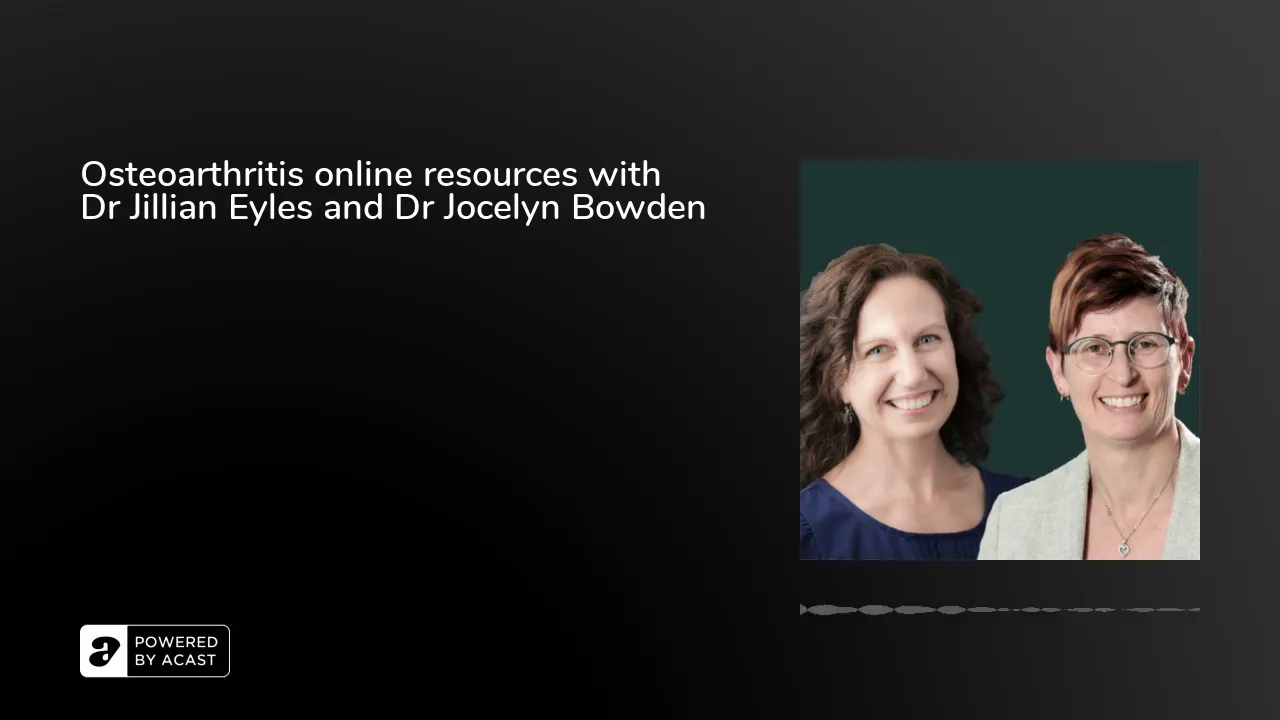
podcasts like this one at join action which have become increasingly popular in the past couple of years with the numerous resources available how do we know which programs are suitable and evidence-based the aussie joint effort initiative is a collaboration between international clinicians and researchers with an interest in the implementation of osteoarthritis management programs their aim is to improve overall care with a focus on core interventions such as education exercise and weight management and on this episode of joint action we're joined by jillian isles and jocelyn bowden to discuss the aussie joint effort initiative and online
resources for osteoarthritis our guests today are dr julian isles who's a physiotherapist and postdoctoral researcher whose main areas of interest lie in clinical and implementation research related to the non-surgical management of osteoarthritis a recent work is focused on the implementation and outcomes of osteoarthritis management programs that deliver recommended first-line management to people living with symptomatic osteoarthritis gl is joined by dr jocelyn bowden who's also a postdoctoral research fellow with an interest in rehabilitation and management of musculoskeletal neurological or age-related conditions she obtained a phd in 2013 from neuroscience research australia and the university of new
south wales she has coordinated integrated research programs that aim to address key questions in these areas and trial innovative interventions for clinicians patients carers and their families joss's current research aims to optimize best practice care for osteoarthritis and ensure successful implementation of osteoarthritis management programs hello joss and jill welcome to the show thank you it's a pleasure to be here it's great to be here uh it's great to have you along it's been a long while since i've seen both of you face to face as much as that sounds probably a little bit silly but
irrespective i think part of this is really about remote delivery and we've learnt a lot about remote delivery of various things this year and last year next year as well but i'm just wondering in the first instance we're going to learn a little bit about the joint effort initiative can you just tell the listeners a little bit more about the aussie joint effort initiative and why it was established sure so the joint effort initiative is really a group of researchers and clinicians and consumer representatives and we're committed to ensuring the best possible osteoarthritis care is
really delivered across the globe so we have a focus on ensuring that this care is delivered in accordance with what the research tells us works how it can be implemented and how it can really be adapted to suit different countries and the healthcare settings that it's being used in so the joint effort really began when researchers with an interest in this area started to meet at the aussie world congress in 2016 and we really got together to share ideas and experiences and to give some tips and tricks on what worked for each other in our
home countries we really formalised the group in 2017 and in 2018 we undertook an international survey and consensus exercise to develop some research and action priorities that we could undertake as a group we started with about 20 members and we currently have more than 122 countries in six continents and we're still continuing to grow so we have meetings every year that any members can attend and we have workshops and working groups on different topics that's a wonderful explanation josh and just i just want to pick up on one of the points underpinning the rationale as
to why joint effort initiative started in the first place and it's really with regards you know the proportion of people who are receiving appropriate care so what we would consider evidence-based care do you have an estimate as to what proportion of people out there in the community with osteoarthritis are actually getting the type of care that they would receive and the impact and implications of them not receiving that care on them as individuals oh yeah well that's well over half people aren't receiving the care that they deserve for their osteoarthritis we know full well what
the major treatments are education for self-management and exercise and physical activity and maintaining a healthy weight but we know that you know more than half of people don't receive this care which is just terrible yeah and it obviously has a huge downstream implications for the individuals that are affected in terms of their pain their function their disability their ability to participate mood sleep and so on now joss is part of setting up the joint effort initiative the group and jill particularly identified some priorities about work that should be started in the first instance can you
just give me a little bit of a sense of what work is currently underway sure so we've got three main themes that came out of our survey with our researchers and our clinicians and we're working on different projects under these three themes at the moment so our first theme is really looking at how to implement osteoarthritis management programs so how this care can be implemented in different countries or different types of healthcare settings for example what would you do if you wanted to implement it in a hospital compared to what you would do if you
wanted to implement it in a community setting we're also looking at how we can share resources amongst ourselves and amongst other people who might want to run these programs and how we can reduce that unproven or unsafe care that joel was talking about our second theme is really looking at how to measure the clinical outcomes of osteoarthritis management programs so this is how can we make sure that what we are delivering and what people are receiving translates into good outcomes for them so do they still have a good quality of life is their pain reduced
for example so we have to be able to measure what we're doing to ensure that it's working and our third one is around education and training so we're looking at ways to deliver this both people with osteoarthritis and also the clinicians who deliver their care so this theme has already developed a core competencies framework which is basically guidance on different aspects of care that should be included in any osteoarthritis training program for clinicians and we're now working on developing an education and training program to build on that wonderful it sounds like superb work and hopefully
ultimately will make a big difference to the people who are out there who have osteoarthritis and how they're managed one thing we probably should have started with and that's probably my fault rather than anybody else's but what is an osteoarthritis management program and what components should an osteoarthritis management program consist of so that that's a really good question david we really developed a definition of an osteoarthritis management program because we just really wanted a term we could use to describe these programs that had started emerging across the world that delivered coordinated evidence-based care for osteoarthritis
so this is the definition it's a model of evidence-based care for osteoarthritis that doesn't include surgery that has been implemented in a real world setting and has the following really important components so the first one is that it has care that's really individualized to the patient to the needs of the patient the second one is a it's a program that goes over time and there are follow-ups so it's not just one appointment but there are several follow-ups over time to to progress the patient through the program the third one is that it has two or
more components of what we actually call core oa care core osteoarthritis care which were the components i mentioned earlier education for self-management exercise and weight loss and the fourth part of being an osteoarthritis management program is you can actually also offer other treatments as needed and they might be things like walking sticks and knee braces and and possibly psychological support something like that so basically overall the objective of these programs are to help individuals to improve their pain and their other osteoarthritis symptoms and really support people to get back to doing the things that they
want to do and that's that's the crux of what an oamp is or an osteoarthritis management program sounds phenomenal now if i were a health clinician and looking to implement one of these programs can you tell me a little bit about what that actually involves sure now it's um it's actually really complicated and very hard to do which is really a big part of the reason why the joint effort initiative was established in the first place so i guess first you need to think about money and who you're going to talk to whether it's people
in government policy makers and industry partners who might be working with health insurance and and things like that to see how you're going to manage to pay for the program next you really need to consider where your osteoarthritis management program is going to sit so is it best to sit in primary care with gps and physios or is it better to sit in orthopedic clinics at the hospital and that's going to differ between different settings and and different types of healthcare systems another really important thing to think about is what are your overall goals for
an osteoarthritis management program so there's some very particular goals you might have because of something the government wants to do say if they're trying to reduce the money spent on joint replacement surgery so maybe a goal of your program might be to reduce unnecessary surgery for osteoarthritis and importantly you need to think about who you're going to target for your program so probably the most common joints for osteoarthritis are knee hip and hand so who who is this program targeted at and how will they be referred to your program so then you really start getting
into the mechanics of how you get your patients into your clinic and then a really important aspect is actually knowing about out-of-pocket costs that might actually be necessary for people to access the program and whether that cost will actually become a barrier to people using the program so it's really important to talk to consumers as well and work out where those barriers are i would say it's really important to work with a willing workforce so healthcare professionals that are really ready and able to roll out the care but also consider that they might need some
training so you might need to provide some sort of a training program for the healthcare professionals that are going to provide the care and lastly it's probably a big pie in the sky wish but also really consider how you might be able to include some multidisciplinary care so having different sorts of health care professionals that offer different services and different things to people with osteoarthritis so they can address the different needs of people with osteoarthritis so you might be thinking about getting a doctor or a nurse to help with medications you might be thinking about
an occupational therapist to help with everyday activities at home if needed you might want to be thinking about a dietitian to help with some weight loss and how you're going to integrate those sorts of skills into your program too so it's not a small undertaking at all it does sound like a lot of work but obviously most things that are worth while going after take some effort how will we know if you're actually making a difference what will you measure to see whether there's been any improvement by virtue of instituting that style of care yeah
that's a really really important point and people with osteoarthritis usually tell us that pain is a really big factor for them in dealing with their condition but also the functional limitations that osteoarthritis can bring and being able to actually do what they want to do so those two outcomes are really important to track we try and track them in everybody so pain and function and they're often through surveys asking patients about how they feel and and rating um how they feel on a scale but there are also some functional tests walking tests sit-to-stand tests those
sorts of things that can be really really informative as well and really show people's progress through a program over time and there are other aspects that are also important to people with osteoarthritis such as mood and sleep and we also know that those things we hope that those things will change for the better but sometimes they can change for the worse over time too so again it'd be great to have a few of these core sorts of pain and function outcomes but there's probably more to the picture than just pain and function and if you're
actually collecting all of this data from a um a healthcare professional level and from a more healthcare systems level it'd be great if you can actually evaluate the program overall so not just at looking at the individual level but looking overall at what the program is doing for people with osteoarthritis and and seeing what those effects are so that you can argue then for more funding for these sorts of programs and and make improvements and be able to show them so electronic data collection has just been a game changer for this and and is really
important to any osteoarthritis management program i was just going to say just a couple of things to to add to what you just said was quality of life is also a really important aspect to measure for people and some of the broader aspects like can the people still get out into the community and do what they wanted to do and still can they engage with family and friends and things like that it's really important to what we do sounds like incredibly important work and making great strides to measure things that are very patient or consumer
centered as well which is which is critical now when joint effort first started this was very much in its newborn state in terms of osteoarthritis management programs internationally but since that period of time a number of developed around the world can you just tell me a little bit about some examples of the more common osteoarthritis management programs and who they might be appropriate for sure so i might start with our favorite program it's only favorite because it's sort of our baby here in new south wales which is the osteoarthritis chronic care program it's available in
every public hospital in new south wales it's led by physios but generally has a multi-disciplinary team meaning that patients get access to lots of different types of healthcare professionals it covers off those really important things such as um education physical activity exercise and weight management if needed plus a whole host of other sorts of interventions as well and that's usually run through the outpatient programs in public hospitals the healthcare system in in the uk is very coordinated like it is in australia and they do have public general practice service that they've actually rolled out some
really great innovations and osteoarthritis management programs through the uk and through europe so there's one that again covers those core treatments we were talking about that involve a gp and a nurse and sometimes physiotherapists and pharmacists and they're based in in outpatient in primary care so that's the jigsaw e program and then just for something a little bit different in totally well not always in the in the private sphere but often in the private sphere is the glad program and that's for people with hip and knee osteoarthritis and i should say the other programs are
too except jigsaw does do hands and foot but um glad has actually ran out of physio practices and they are glad physios in australia that have rolled out the program that originated in denmark so there again it's a physiotherapy led program but i believe in different parts of the world there can be a few other different healthcare practitioners involved particularly in i'm going to say hong kong but i might be wrong where they've got some more orthopedic surgeons involved with it and there's also a very large group of physios who run glad canada and that's
more of a um a public health system there too so another really interesting one is the boa better care for osteoarthritis program in sweden it's been going for quite a long time um probably since about 2010 i believe it was one of the earlier ones to get started again is for people with hip hip knee and hand osteoarthritis but they can actually see people with shoulder problems now too again similar sorts of treatments that are offered to patients and is physiotherapy or occupational therapist led there is a there has been a private online version of
boa that's been rolled out called the joint academy and the joint academy is actually is all available online and you do get face-to-face dialogue with a physio or other healthcare practitioners but you can actually do a lot of it outside of real time so that's a an example of an online osteoarthritis management program that really got up and started before covert came along so that's been going great guns and i believe has has spread throughout a few international places as well across the world so that's just a bit of a flavor for some of the
osteoarthritis management programs there are lots more that i haven't mentioned particularly in scandinavia and and in the us there's a few programs as well so it's really exciting that these international programs are popping up in lots of different places they really are following best evidence care for osteoarthritis and which is the most important thing for everyone that's a marvelous description jill now obviously a lot of information but if someone was really interested in this topic and they wanted to get more information on osteoarthritis management programs and other resources where might they go we've just launched
the joint effort initiative website and this has a lot of information on who we are what we do links to our work but also links to other people's work it's a really great starting point for anyone who'd like an introduction to both us and also osteoarthritis management programs another site that we've recently set up this was set up last year in response to covert 19 which obviously presented a really major barrier for people attending in-person osteoarthritis management programs so the implementation theme of the joint effort which is led by our colleagues at keele university in
the uk they set up an online repository and it has lots of links to existing online programs many of the ones that jill just described and it's also got some links to some training resources so its focus is mostly towards clinicians but many people with osteoarthritis have found it particularly useful as well that's brilliant and what we'll do is we'll include links to both of those sites that joss just mentioned in the show notes along with a number of other links that joss will likely get into in a couple of minutes time but for all
of you who want more information that should include a lot of information pertaining to holistic osteoarthritis management now joint effort initiative sounds wonderful what are you planning to do next so the next steps for the joint effort initiative is basically trying to cover off the very big problem that a lot of healthcare professionals actually don't have the training they need to deliver their recommended osteoarthritis care and so we have the absolute privilege to be currently developing and evaluating an e-learning program which will be available for healthcare professionals and we're hoping to make some of these
resources freely available and another really important aspect of what we're doing at the moment is we're really trying to reach out and improve our collaborations with consumers so with people with osteoarthritis so we've got very close links with some wonderful people at the osteoarthritis foundation international or aofe and with the arthritis foundation in the us and the oa action alliance but we really really need to increase our collaboration working with getting brains together of consumers to make sure we continue this work in a way that's really helpful and most helpful for people with osteoarthritis and
the last thing that we're really really interested in doing as well is finding out what's happening in low and middle income countries so we're very very lucky where we are here in australia and obviously in europe in the us and canada there's there's a lot of new programs coming and have been established but we still don't know what's happening in low middle-income countries but we do know that there's a lot of people there with osteoarthritis it's very very prevalent and we really want to find out about what people there need and and what they want
and get more people involved from those countries so that we can can start to help make recommended care more accessible to people with osteoarthritis great effort and hopefully something that will bring markedly better outcomes to people out there who have osteoarthritis now obviously we started the show with a little description about the challenges people who have osteoarthritis face in getting appropriate care which to a large extent has probably been accentuated made worse uh by the whole coveted experience over the last couple of years and so i think one of the huge parts of what both
of you are really trying to do is provide better access to sources of information out there for people who have austere throughout it so they can implement better care but i'm just wondering if you could just give me a little bit of a description about what some of those resources might be and some of their pros and cons certainly so david the first thing i'd recommend to anybody who's looking for information especially if it's information online is to really make sure that it's provided by a trusted organization and sometimes that's that's hard to tell so
really question what you see on social media or mainstream media some of it's accurate and some of it's less so and some of it's out of date so who is promoting it and how recent is that information so sometimes it's a bit of a judgment call if the information itself is not promoting exercise and physical activity as a primary treatment then you should probably question the rest of the information that's been provided it's it's the key information that any site should sort of have we obviously have the the joint action website of which these podcasts
are part of the site itself includes links to a range of education materials and osteoarthritis these are based on the most current research there's also some interesting links to exercises any osteoarthritis developed by our colleagues around the world particularly the university of melbourne and some tips to walking and exercising outdoors for our older people they're really interesting resources we also have some links on that site to resources in spanish that have been provided by our colleagues at the osteoarthritis foundation international which is in spain uh so if anyone sees uh spanish out there there's some
great resources in that language for you another fantastic site is the my joint pain site and it's hosted by arthritis australia arthritis australia is a consumer and patient advocacy group for all types of arthritis in australia not just osteoarthritis the myojoic pain site has a lot of different videos and resources on how to live well with arthritis it also has some tools that you can use to undertake your own risk assessment for your osteoarthritis and another tool that allows you to develop your own management plan it's got lots of readings on there as well most
of the australian states have similar arthritis organizations and their websites often have more local information as well so they're worth a look a more broad website is the mps medicine wise site this is another australian site it discusses both lifestyle treatments and also some of the pharmacological treatments for osteoarthritis and it has some good discussions on the pros and cons of using both of those so if you're really thinking about using medications that's a really great site to go and have a look at so any of our listeners who are outside of australia look for
the arthritis foundations or organizations in your own country they usually have local links on their websites a few examples are the osteoarthritis action alliance in the u.s the osteoarthritis foundation international in spain which i mentioned previously arthritis canada and versus arthritis in the uk many other countries have arthritis foundations um so look them up in your country and and they'll have some fantastic information in your languages just a couple of others there's some weight management ones for healthy eating the csiro total wellbeing diet and the healthy weight for life have weight management support programs to
help you with any resources you may need also the dietitian association of australia website is another excellent online resource and uh we'll send a list around of some others for people who are interested in in other aspects spectacular summary joss and again just to really reinforce that all of those links that joss is just alluding to will provide in the show notes so hopefully that provides a lot of helpful information now for people who are out there who've been really inspired by what both of you have had to say today who want to get more
involved in the joint effort initiative how might they go about doing that ah well this is where we get to say have a look at our website the new joint effort initiative website you'll find there are emails for joss and myself there on the website we're very happy to hear from you whether you're a clinician or a researcher or you're somebody that's living with osteoarthritis and you want to be more involved with this work we'd love to hear from you great andre and really a huge thanks to to both of you but particularly to also
to to the members of the joint effort initiative for all of the work that they put into this over a long period of time and to aussie so aussie for those of you who've listened to that acronym as we've spoken today is the osteoarthritis research society international it's a large international grouping of researchers but they've been kind enough to support the work that we do and also to host the website so i guess in closing any final words jill or joss any commentary for patients who are out there with osteoarthritis you want to leave behind
i just say keep moving don't stop try and do what you love even if you have to do it at a slower pace but don't stop great advice joss yeah i think that is great advice and and i think on the other hand if you feel like you really need help and you need some guidance there are people around that know exactly what to do and and how to help you and if you don't get the answer that you think and and when jos said if exercise isn't on the list of things to do you
probably need to speak to somebody else and um and get some some good advice from somebody else so keep asking yeah similarly good advice and as you say don't live in isolation there's plenty of people out there who wanting to help you willing to help you so you shouldn't need to suffer silently and go and reach out so this week is got a lot of bone and joint celebrations happening and today specifically is world arthritis day and when this gets released next monday those celebrations will still be going on but this is really an effort
to try to highlight one important initiative that's going on in this space specifically joint effort initiative and the wonderful work that's being driven by both joss and jill and thank you both so much for the time for the insights for the thoughtful commentary on really important piece of work and and obviously your time today it's been a pleasure thanks thank you very much for having us really hoping that you found the content of today's show helpful as mentioned we've put plenty of links in the show notes that should provide valuable resource for you with regards
repositories for osteoarthritis management programs sources that you can go to to seek information about exercise about weight loss diets about assistance for mood sleep and a whole host of other information resources again your care is in large part your responsibility the better informed you are about your own care and its management the better off you will be longer term by all means seek help and get help from health professionals who are out there but again the more engaged the more informed that you are the likelihood is that your outcomes will be better thank you so
much for the opportunity to speak with you i really appreciate that opportunity and really looking forward to the opportunity to speak to you again in the very near future do take care of yourselves and hopefully someone else see you soon thanks for listening to joint action with david hunter if you like our show and want to know more visit www.jointaction.info if you have any questions you can email us at hello at jointaction.info and follow us on twitter at jointactionorg this podcast was hosted by david hunter edited by vicky dwong music produced by jordan hunter the
information posted on this podcast is not intended to diagnose treat cure or prevent disease anyone seeking medical advice should consult a health professional [Music] you