hello everyone welcome to the fourth lecture on the topic written communication and this lecture shall cater to meeting agenda and minutes of the meeting let us get started and know as to what exactly does the word meeting means so a meeting is an organized occasion that when several people come together in order to discuss or decide something so what is a meeting whenever you're meeting with people it could be two or more than two people you're meeting them to decide upon something to deliberate upon something and finally to reach to a certain conclusion so that
process of discussions and coming to a conclusion is nothing but a meeting success of a meeting depends upon each member of a group to communicate how does a member in a meeting communicate with the other people on that very fact depends the success of a meeting if the people are participative would mean that they'll be good kind of quality deliberations will be happening good discussion will be happening if the people are bad listeners then the meeting will tend towards an argument and we will not have any fruitful kind of outcome to the meeting therefore the
success of the meeting depends upon each and every individual who is a part of the meeting and how that each member is interacting or communicating with the other person whenever we are planning to convene a meeting before the meeting is planned there is a certain process of planning that goes behind it planning like why at all have a meeting what type of a meeting is called for who should be asked to participate in that meeting where should the meeting be and when should be the meeting held all these things are very important for a meeting
to be a success like for instance why why have a meeting at all in general a lot of meetings are happening periodically with no motive as such so when suppose an organization says that every monday we'll have a review meeting so for the participants it's all all of a it's more of a burden for the participants because one it is a monday and uh they would not be able to enjoy their weekend because they will have that kind of an anxiety that on monday we have a meeting so why have a meeting at all is
something that is very important the convener of the meeting should be very clear with the purpose and the objective as to why does he want to call for a meeting and then depending upon what kind of a meeting the person wants will the audience be asked to participate we have different kinds of and or types of meetings depending upon the type will be decided as to who should be called and where should the meeting be kept who should be called for a meeting you should be very thoughtful while you are planning a meeting because you
cannot for every kind of a meeting you cannot call just each and every individual that group of participants who are a part of the meeting it has to be chosen very wisely because if you are allowing a lot of people who would not be able to contribute into the meeting then the purpose they sense of the meeting of calling that meeting is dissolved therefore it it has to be very accurately planned as to who should be asked to participate and where should the meeting be this where component of it will be seen in the latest
site slides when we discuss as to how the when you or the seating arrangement makes a difference in the outcome of the meeting and then when should it be held this is again a very important thing meetings should never be kept on either on saturdays or on mondays because saturday happens to be a weekend so people have their own kind of reservations during the day either they're in that kind of a holiday mood or vacation board monday they have enjoyed and they'll be in a hurry to reach the office therefore the meeting the outcome of
the meeting might get affected therefore it is ideal not to keep the meetings on saturdays or on mondays and in case you plan a meeting on a saturday or a monday then you should be keeping it on saturdays in the morning and on mondays in the times maybe after lunch so post lunch hours for monday and morning hours for saturday this should be the ideal way of planning a meeting because when you are convening a meeting you want participants to participate you people want people to participate and participation would only be maximum when you give
them a certain suitable time wherein they are comfortable attending the meeting so while we are or convening a meeting organizing a meeting there is a lot of planning that goes behind on why the meeting the purpose what type of a meeting depending upon what type will be decided the number of participants or who has to participate where the meeting would be and when it should be so this is a very important phase the planning process of a meeting is something that is very important if we understand it then it will be easier for us to
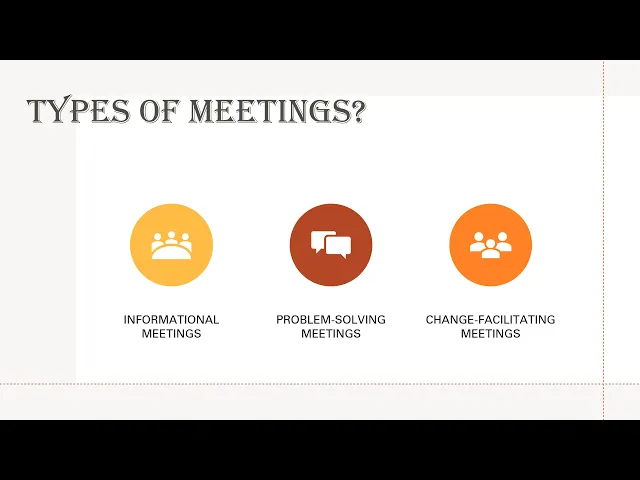
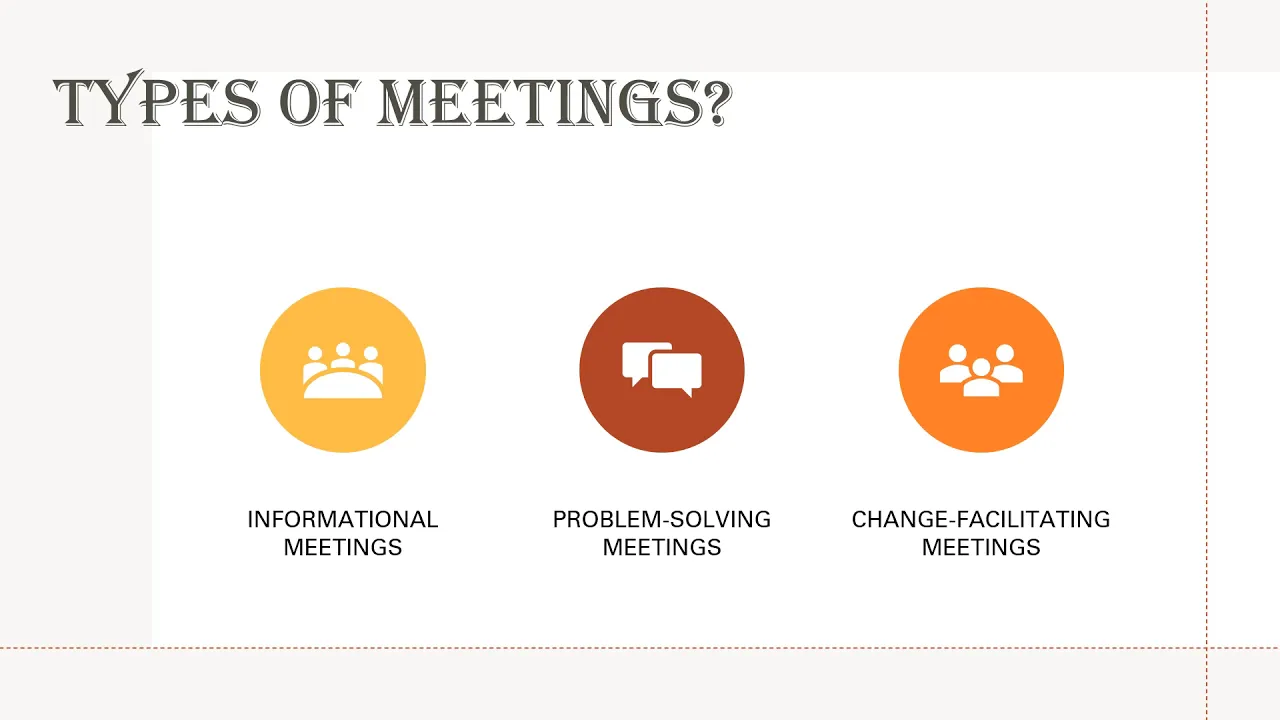
carry forward the meeting coming to the types of meetings we have three kind of meetings one is is an informational meeting wherein the people are asked to participate only for giving them a certain information you do not want any participation from the audience's side so for these kind of meetings even if you are inviting people for the meeting at a very short notice it would do because you don't want the people to prepare something because you don't want any of their inputs so informational meetings are convened whenever you have a certain piece of information that
is to be shared with a lot of people you will call a meeting which is informational and you can give the information about that meeting at a very short notice problem solving meetings wherein you want people to deliberate upon something and whenever you are inviting or you're convening a problem solving meeting you don't want all a lot of people to participate you only would want to target an audience who would be able to contribute to that problem solving in the maximum way so therefore the problem solving meetings would have the minimal audience or attendees and
then change facilitating meetings again if you if there is something which is not worth carrying forward or if at all you want to bring about a change again you want deliberations over that so you can call a meeting wherein it may have a larger audience or it might not have a larger audience because again you want people to deliberate upon something and come out to a conclusion so when it comes to informational meetings then the size of the audience attendees would be big when it comes to the problem solving meetings or the change facilitating meetings
you would not want to call a lot of people only the people targeting what kind of a objective you have or purpose you have for calling the meeting depending upon that you will be calling only the selective people in these two kind of meetings now the venue of the meeting where the meeting is to be held is something that is very important we have meeting room seating arrangement like theater style classroom style u-shaped style deformation style now what are these styles in a theater style we have the container or the conveyors of the meeting the
leaders of the meeting and like the way we are seated in a theater in a movie hall the same way the audience is sitting so this would mean that the people are sitting one behind the other and therefore if at all you give an idea of the meeting room seating arrangement to the people before the meeting they will know that whether any participation from their site is required or sort or not for example if you have put a venue that that has a theater style of a seating the people will know that because they would
not be facing each other therefore the participation from their side will be leased they will not be interacting they they will be only required to listen to what the leaders or conveners of the meeting have to say so likewise a classroom style wherein in the classroom style again the leaders are placed at the center and then at one side center other leaders the other side would be the desk and chair arrangement again the people sit are sitting uh one behind the other but then they do have something to rest their hand on or maybe to
write so this this is a classroom style which is a style that a classroom or normal classroom follows in the way you are sitting in a classroom this is the same kind of a style so whenever you have a venue where which is having a classroom style of seating arrangement in that case you would know that maybe you're required to take down some notes or there is some information that is to be passed on to you which you would want to retain for a longer period of time therefore the aid for writing the support for
writing is given to you so these two styles the theater style and the classroom style these two styles are appropriate for larger groups whenever you want to call a meeting that has a lot of participants in it you may go ahead with the theater style of the classroom style these are these kind of styles the both these theatre style and the classroom style these are used to used in meetings to inform that means for the informational kind of meetings we will offer theater style of the classrooms by style because this these kind of styles would
accommodate a lot of people in one room here in both the styles the leaders or the leader does much of a talking so whosoever is convening the meeting those leaders or that leader does much of the topic the part of the talking the participation is limited because again owing to the fact that you're sitting sitting uh you're sitting one behind the others because you're not facing each other therefore there is limited scope of any participation from your side only if asked to contribute you will otherwise there'll be no discussions happening so these kind of styles
will not allow you to discuss on any of the points coming to the u-shaped style this may also be called as a banquet style wherein the leader or the conveyor of the meeting is sitting at the center and the other people are surrounding the center in u-shape uh surrounding the leader or the convener in a u-shape so this kind of a style that is a u-shaped style allows the members to see each other and because it is allowing you to see each other therefore such kind of seating arrangements may be used for problem solving or
may be used for meet facilitate change facility facilitating meetings coming to the tea formation style of a meeting now for a tea the sleeping side of the tea will have the leaders and the standing side of the tea will have all the participants facing each other so this kind of a style brings the members close to each other but the focus is still on the leaders because leaders are separately sitting and at a very prominent kind of a space and close together therefore the the focus is mainly on the leaders but it allows you to
interact both these formats the u shape style and the deformation style these style of seating arrangements will be used whenever we have any problem solving meeting or a change facilitating meeting now how far the members are expected to participate in a meeting that depends upon how the leader positions himself or herself in relation to the other participants so this slide will discuss the confidence table seating arrangement what kind of a table arrangement do you have in the previous slide we discussed about the seating that is there in a room now we will discuss that if
you have a table what kind of a table and what kind of an arrangement that we have will define the participation whether the past participation is required or not what what level of participation is required who does major talking who's controlling the meeting everything will be decided depending upon what kind of conference table seating arrangement are we following so we have like four styles of conference table seating arrangement one is overtly directive the other is covertly directive the third is equalizing and the fourth is participative so when we when i talk of overtly directive overt
means very prominent which would mean that the leader in such a style is very prominently visible to everybody and because the leader is prominently visible therefore this kind of style focuses attention on the leader and enables the leader to maintain control of the agenda so the leader does most of the talking and the leader controls the agenda whatever points that you have to discuss in a meeting every of that point will be controlled by the conveyor of the meeting that is the leader of the meeting and because the position of the leader is very open
therefore this kind of a seating arrangement is termed as overtly directive the second is covertly directive covert means like the way we call it as covert operations wherein the identity of the people is not revealed likewise for a seating arrangement which is covertly designed or covertly directive the conveyor of the meeting will be sitting at a at a certain corner he would be visible but not very prominently visible so the person is not mixing up with a lot of people is sitting in a corner but not a very prominent kind of a places taken by
the convener so this is covertly directive it the the speaker the con the leader is somehow hidden this kind of arrangement allows or enables the leader to retain control but is more democratic why do we say that it is bond democratic because the position is not a very prominent kind of a position therefore because the person who is convening the meeting is sitting together with the lord with the other people not showing his authority taking a certain specific seat is more it more seems that he's or he or she is a part of the team
or the group of people therefore this kind of a seating arrangement allows a more democratic kind of discussions by democratic because everybody would be allowed to participate equalizing style wherein this kind of a style would indicate the leader wants all members to participate by speaking their minds out so we may or may not have any leader of the meeting maybe the meeting is overlooked from some remote place or even if the leader of the meeting is there then the position will be such that the people will not even get to know that who the leader
of the conveyor of the meeting is therefore therefore this is called as equalizing people will get equal share of time to participate or contribute in the meeting and the last kind of style that we have is a participative style participative style uses a round table so that the status differences whatever there be are minimized and all the participants feel free to express their views now more or less equalizing style and participative styles are common but then the only difference would be that in the participative styles there is more chances of having a good discussion because
everybody is able to see each other when it comes to a rectangular kind of tabular seating which we call as an equalizing style there because there are a few participants who are directly sitting across each other and there are few participants that are sitting in on the other side of it so maintaining eye contact with each other because it is a long table that you're using so maintaining eye contact with each other is not possible therefore i one-on-one talking is restricted here wherein in the participative style you may appreciate people you may interject in between
looking at the person and it is very convenient therefore participative kind of meetings will be participative kind of seating style can be used when you want the maximum people to participate contribute in a meeting let us now discuss the agenda of the meeting so the very first thing that you should be made clear with here is that agenda means the points that you want to be discussed in the meeting so the meeting has not yet taken place you are now first drafting the points or the purpose or the objective for calling a meeting so this
agenda is a document that lists the topics or the points that are to be taken up at a meeting which again reiterating on the fact agenda is written when the meeting has not taken place before the con before the schedule of the meeting you will share the agenda with the people whom you wish to invite it presents an outline of what the meeting will address it will have all the points on which you want to have a discussion on and this agenda should be distributed to all the attendees well before the meeting and in case
you want people to participate or maybe present then minimum one week prior to the date of the meeting the agenda should be given to the people because you want them to give them time also to prepare for it if you if it is only an informational kind of a meeting then you can give it in a short notice if you want to have a problem solving or of change facilitating meeting then of course you would want people to be notified quite early so that they have ample of time to prepare for the meeting so that
they know what exactly will they be contributing and how exactly will they be contributing so this is an agenda of the meeting discussing the format of the agenda it it goes like we would not be writing agenda within the box like we did it for memorandum and notice so agenda is never written in the box because it could be a lengthy document as well we do not have any kind of word limit here depending upon the points that you wish to discuss in the meeting with the people will be the length of the agenda so
agenda does not have any kind of word limit the first thing that you write while writing the agenda is you will be center aligning the word agenda and you'll be writing it in big bone letters so that whosoever comes across that document knows that yes this is an agenda which would mean that they need to put their attention on the facts that will be that the convener wants to discuss then next after agenda will you be writing the title of the meeting that is in brief you will write why the meeting purpose of the meeting
objective of the meeting then you will write down the date of the meeting which would mean the date on which you want the meeting to be held place where you want the meeting to be held time of the meeting now whenever you by writing the time you must not write only the commencement time you always have to write the duration because if you're calling people and suppose it is a problem-solving meeting and if suppose you haven't given the duration and you only have given the commencement time say 10 am so the person people who are
coming for participating in that meeting would not have a time by when will the meeting be concluded therefore they will not be able to plan the activities the other activities that they were to do during that day so just to have that kind of ease to facilitate or help them schedule their own kind of tasks in a better way you need to mention the duration that maybe a tentative duration will do here that the meeting will start at 10 and will go up to 12 000 or 1 pm whatever so that the person who's coming
for the meeting does does have an idea of how much long the meeting would go and also will the person have an idea of how would he or she be scheduling the other rest of the thing that the person had in mind to be done for that particular day then the agenda also has a mention of who the leader of the meeting is the convener here is who is proposing the meeting who's leading the meeting who will be leading the meeting so the name of the person has to be written also if the designation of
the person is a reputed deputy designation people know him him or her then you can only be you can only write the designation without writing the name so that is at your discretion you wish you can write the name only if the person is a well-known person you can only write the designation or you can write both the things then agenda will also have a list of people who are attending the meeting if you're calling the or some department and every individual of that department you need night you need not write the names of each
and every individual only writing the department's name will do if you want specific people from different departments or one department to come then in that case you may write the people's name or and or designation then finally we'll write down the agenda which will be the purpose of the meeting what all things do you want to discuss in that meeting will be written here and it is preferred that you write the agenda or the purpose in bullet so if you have multiple agendas to be discussed you will have to write it in bullets without expanding
because if you've expanded things here then people will not there is absolutely no need for calling the people then right therefore write the agenda in bullets but it should be in a way that it is self-explanatory because if you want people to prepare and if you're not giving enough clarity in the purpose of the beating then people will be confused as to whether they are they their desire to plan or come prepared for the meeting or not or what kind of an agenda is this that will be a very confusing and ambiguous kind of thing
for them therefore whatever the purpose of the meeting be you need to write that in bullets very precise concise lines or sentences and do not ever write the agenda in paragraphs because it tends to become very confusing so let us take an example of how do we write an agenda the question is you are the head boy of san diego school you wish to convene a meeting of all the prefix to inform them about the activities you're planning to for the upcoming academic year write the agenda of the meeting so the very first thing that
we do is write the word agenda center line underneath that will be the title of the meeting here it is plan for the upcoming events and then we write the date of the meeting place of the meeting time of the meeting again time has to have the duration for the start time and the tentative end time convener of the beating has to be listed and then you will write the attendees now because you want all the prefix the question says you have to invite all the prefix so either you can write just write all prefix
or you can name all the prefix along with their designations like the way i've written mr vishal gupta school coordinator which will be mithal head girl mr mishra captain responder house likewise and then you have to state the purpose of the meeting wherein you are writing in bullets activities to be organized that means that you are you are asking people to come prepared with what kind of activities can be kept for the upcoming obsession and then when do you want to organize those kind of activities you will have to have a discussion on that and
and who all will be coordinating with those kind of events so this is how an agenda is written now reading this particular document whosoever is coming to attend the meeting would know that we are required to do this kind of task in the meeting now the next document related to the meeting is the minutes of a meeting minutes means the gist the summary of what all was discussed in the meeting so this minute of the meeting is nothing but a document that specifies what was dealt with and decided on during a meeting it acts as
a permanent record of the meeting for future reference in case you wish to refer to the discussion that that were held in a certain specific meeting so this kind of a minutes of a meeting document so it functions as a permanent record now what do minutes contain now having discussed the previous slide we know that agenda is a document that is given to the people who are attending the meeting prior to the meeting minutes of a meeting is a document that is prepared for all the people who were invited once the meeting has occurred so
what all things that were discussed deliberated upon concluded in a certain meeting you will write down the summary of it and give a copy of that summary of that meeting to each and every individual who was invited please make sure that you have heard the term correctly the people who were invited not the people who attended so all the people that you invited you will have to give the minutes of the meeting to each and every individual irrespective of the fact that who attended it and who did not so minutes of the meeting is a
document that is prepared after the meeting is done and is circulated to all the people it contains the key points of the discussion that was held during the meeting what are the actions that are to be taken what assignments were given or tasks that were allocated and to whom were the tasks allocated and if at all we have any deadlines then it should also have a deadline to the completion of the event that was discussed now coming to the format of the minutes again like the agenda will be very first thing that we write is
minutes of the meeting then we'll write the title of the meeting then date of the meeting when the day when the meeting was held where the meeting was held duration from what time to exact what time did the meeting last conveyor of the meeting then you will be writing the attendees people who attended the meeting who were part of the meeting either you can write down then only their names or their designations or both that is again at your discretion then the people who were absent it is an option that you may add this particular
tab here that the people who were absent you can write down the name of the absentee so that because we are saying that it is a document that is acting as a future reference therefore if at all in any given point of time you want to know that who all attended a meeting and who all did not you should have a clear idea therefore absentees is optional anyways if you're writing the attendees and the people who did not come you would not be writing their names in that particular section so it is in a way
obvious that who did not but then to make it more clear you can have this particular option tab here which is absentees though it is optional and then you will write down apologies received from this would mean that of say suppose you invited six people and of those six people two were not there in the meeting and of those two who were absent during a meeting one had already prior to the meeting notified about his or her absence so this is what it means apologies received from would mean that who apologized that i would not
be able to wake up for the meeting so people who informed about their absence prior to the meeting their names or designations will be written here so that again you know and the other people know that who cared for notifying about their absence prior to the meeting and who did not and then whatever the agent of the meeting was you will be writing that agenda here what discussion happened in the meeting will be written this this could have details like responsibilities that were located to whom was it allocated and what is the deadline if at
all any and any other remark any other additional extra information that you wish to give which was discussed upon and dealt with you can write that in this particular section and finally if you want if the topic on which you have for which you had called the meeting is is done is complete is finished then you need not have any kind of a follow-up meeting but if you have just discussed upon something which is yet to be done then you would like to have a review meeting or a follow-up meeting so for that follow-up meeting
you can always mention the date again this is optional only if you have had a meeting which would want you to give or to have a haul up meeting in that case you can for write this follow-up date otherwise you can very conveniently ignore it now let us discuss a sample for minutes of the meeting you're the head boy of xavier school you had convened a meeting of all the previous to discuss with them the activities to be planned for the upcoming academic year right minutes of the meeting so this is the minutes of the
meeting related to the meeting that we had mentioned in the agenda again while writing it we will write very first thing that we write is minutes of the meeting then we write the title of the meeting date of the meeting place of the meeting time of the meeting convener everything has to be written who all attended it who could not attend it who all apologized for not attending the meeting everything has to be written very precisely purpose of the meeting will be the agenda that was there in the agenda activities to be organized uh date
and duration even coordinators and then discussions what what discussions were held suppose you people finalize that activity one will be induction program that is the conduction of induction program the date and the duration would be starting from april 28th to april 8th timings would be from 9 am to 1 pm and even coordinator the person who will be looking after and coordinating with the activity will be say as mentioned misharshita yoshi captain ganga house and then the second activity that you've planned maybe is annual fest of the school so date and time would be starting
from june 2nd till june 5 so it will be multiple days of an event then timings would be 7 pm to 10 p 10 pm and even coordinator for this particular event will be say the head girl this should be mithal and then because this is such a meeting wherein you have allocated the tasks so before the activities are conducted you would want to have a follow-up just to know that whether the people are coordinating well whether are they facing any concerns or problems or whether things are functioning normally and smoothly any kind of challenges
that the people are facing just to discuss that in case you want to have a follow-up meeting then you can give a follow-up meeting scheduled on date which for such cases could be at least two weeks prior so that in case you have any challenges you have ample of time to sort those challenges resolve those challenges and then reach out to a normal conclusion so that the event is a success so this is how we'll be writing the minutes of the meeting with this we come to the topic written communication and also we come to
the end of the syllabus now just to reiterate whatever we have discussed during this particular lecture we have discussed about two written documents one is the agenda and the other is the meeting agenda is written before the meeting minutes of the meeting is written after the meeting these documents that we've discussed the template and the format that we've discussed this is this goes for the internal communication but we can also have the same documents written for external communication also if at all you are making any external communication that means if you are inviting people outside
your organization to attend a certain meeting in that case it then becomes mandatory for you to write down your organization's name so the very first thing above the minutes of the meeting or above the agenda you will be in that case writing the name of your organization so that people know that who has invited you to the talk or to the meeting and from where whether was the meeting held so there you will have to write the opening thing that you write is in in the external communication you write down your organization's name followed by
agenda or the minutes of the meeting followed by the title of the meeting and then in that case if at all you're writing an external document external communication then this document needs to be duly signed as well so the conveyor of the meeting will sign off this document also before sharing it with the external people so this is how we'll be differentiating between internal and external internal will not have the name of the organization neither will have will that document have an authorized signatory because it is floating getting floated to the people internal to the
organization the moment that a document of yours is going outside you want to authenticate it how would you authenticate it by first writing the name of the organization and then by signing it off so that people know that yes it is coming from an authenticated source so this is how we'll be differentiating between agenda moment and uh minutes of the meeting also we'll be discu differentiating between the internal communication and the external communication hope the concepts that were discussed here are clear to you in case you have any doubts you can get back to me
thank you so much have a good day ahead wish you a happy learning