okay let's talk about what we'll cover in the class so this course goes through a variety of deep reinforcement learning methods construed very broadly but we'll start with some Basics we'll start by talking about how we can take a journey from supervised learning uh methods to decision making methods provide some definitions and generally come to understand the reinforcementing problem then we'll have a unit on model 3 reinforcement learning algorithms where we'll cover Q learning policy gradient and actual critic methods and you'll have some homeworks where you'll Implement each of these then we'll have another unit
on model based algorithms we'll talk about planning optimal control sequence models images and things like that and then we'll have a variety of more advanced topics we're going to cover exploration algorithms we're going to cover algories for offline reinforcement learning which are methods that can use both data and reinforcement learning methods we'll talk about inverse reinforcement learning which deals with inferring objective functions from behavior and have some discussion there about the relationship between reinforcement learning methods and things like probabilistic inference and then we'll have a few Advanced topics like metal learning and transfer learning maybe
hierarchical RL and a set of research talks and invited lectures so that's the overall overview of the class you're going to have five assignments uh there will be an assignment of limitation learning policy gradients Q learning and after credit algorithms model based RL and the last one will be on offline RL and there will be a final project the final project is a research level product project of your choice you can form a group of up to two to three students and you're more than welcome to start on this project early the students every year
have some questions about our expectations for the scope of this project roughly speaking you should think about it as roughly the level of a paper that you might submit for example to a workshop if you're not sure about the scope of your project definitely come into office hours to talk to the Tas or to myself we will have multiple rounds of feedback for you for your project so we'll have a project proposal deadline and our project Milestone report these are really meant for you we strongly encourage you to write up your plan to describe potential
concerns you know about your plan and so on and we'll give you feedback on those so the proposal and the Milestone are not greater very strictly they really meant much more as a way for you to get feedback on your project Plan before the final report at the end of the semester you'll be great at 50 on the homeworks 40 on the project and ten percent on quizzes after every lecture and you'll have a total of five or eight days for your homeworks don't exceed those five late days those five late days total uh if
you exceed them then we uh you know unfortunately cannot give you credit for that homework uh you also have a little bit of homework for today uh make sure that you're signed up for Ed uh UC Berkeley cs285 all of you who have been signed up for the enrolled in the course officially would have receive an invitation for this we strongly encourage you to start forming project groups unless you want to work alone which is fine and take the lecture one quits so the lecture one quizzes post Seven Grade scope the lecture one quizzes uh
very much a practice quiz it's not a there's not a real quiz there uh and it's really to be familiar with a great scope interface however what I want to focus on mainly in today's lecture is discussing why we should study reinforced learning what it is and a little bit of context for why I myself like to teach this class but let's start with some Basics what is reinforcement learning well reinforcement learning is really two things it's a mathematical formalism for learning based decision making and it's also an approach for learning decision making and control
from experience and it's important to keep in mind these are somewhat separate because we could imagine taking the formalism and then applying all sorts of different methods to it so it's important not to confuse reinforcement learning the problem from reinforced learning the solution okay how does this differ from other machine learning topics well the kind of machine learning that most of you are probably familiar with is supervised learning supervised learning is fairly straightforward to Define you have a data set of inputs and outputs we refer them typically as X and Y and you want to
learn to predict y from X so you want to learn some kind of function f of x which outputs values y that are close to the Y labels in the data set so for example F might be represented by a deep neural network that you would train via classificational regression to match the labels y and while the basic formulation of supervised machine learning is very straightforward supervised machine learning methods make a number of assumptions that we often don't even think about because they're so natural but that are important to bring up if we're going to
discuss how this difference from reinforcement learning supervised learning typically assumes what is called independent and identically distributed data this is such an obvious assumption in some ways especially for someone who studied machine learning that we often don't make it explicit but what it means is that all of these X Y pairs in your data set are independent of one another in the sense that the label for One X doesn't influence the label for another X and they're distributed identically in the sense that the true function that produced the label y from X is the same
for all the samples it's almost an obvious statement but it's something that is important to keep in mind supervised learning also assumes that our data set is labeled in the sense that every X we've seen in D also has an accompanying Y and that Y is the true label for the X this is very natural if you're doing things like image classification with labels obtained from humans but remember how we discussed in the grasming example this can actually be pretty unnatural if you want a robot to learn how to grasp objects it's actually a very
strong assumption to assume that you're given a set of images with ground truth optimal grasp locations reinforcement learning does not assume that the data is independent identically distributed in the sense that previous outputs influence future inputs things are Arrangement temporal sequence and the past influences the future typically the ground truth answer is not known it's only known how good a particular outcome was whether it was a failure or a success or more generally what its reward value was so in reinforcement learning you might collect data but you can't simply copy that data that doesn't actually
lead to success the data might tell you which things were successful and which things fail although even those labels are difficult to interpret properly because if you have a sequence of events that led to a failure you don't know which event which particular choice in that sequence was the one that precipitated the failure this is not unlike human decision making perhaps you've got a really bad grade at the end of a course well it wasn't the fact that you looked looked up your grade on Cal Central that caused you to get the bad grade it
was something you did earlier in the class perhaps the fact that you did poorly on an exam at the time perhaps you didn't realize that this would lead you to fail the course so this is very much an issue that we have in reinforcement learning referred to as credit assignment where the decision that actually results in a bad outcome or a good outcome might not itself be labeled with a higher low reward the reward might only happen later so we need to take this data which is not labeled with crunch with optimal outputs and might
involve these delayed rewards run reinforcement learning on it and hopefully get a behavior that is better than the behavior we saw before so that's really the challenge in reinforcement so let's try to make this a little bit more precise in supervised learning you have an input X and you have an output Y and you have a data set that consists of X Y pairs the goal is to learn a function that takes an X and approximates Y and typically this function has some parameters which we refer to as Theta these might be for example the
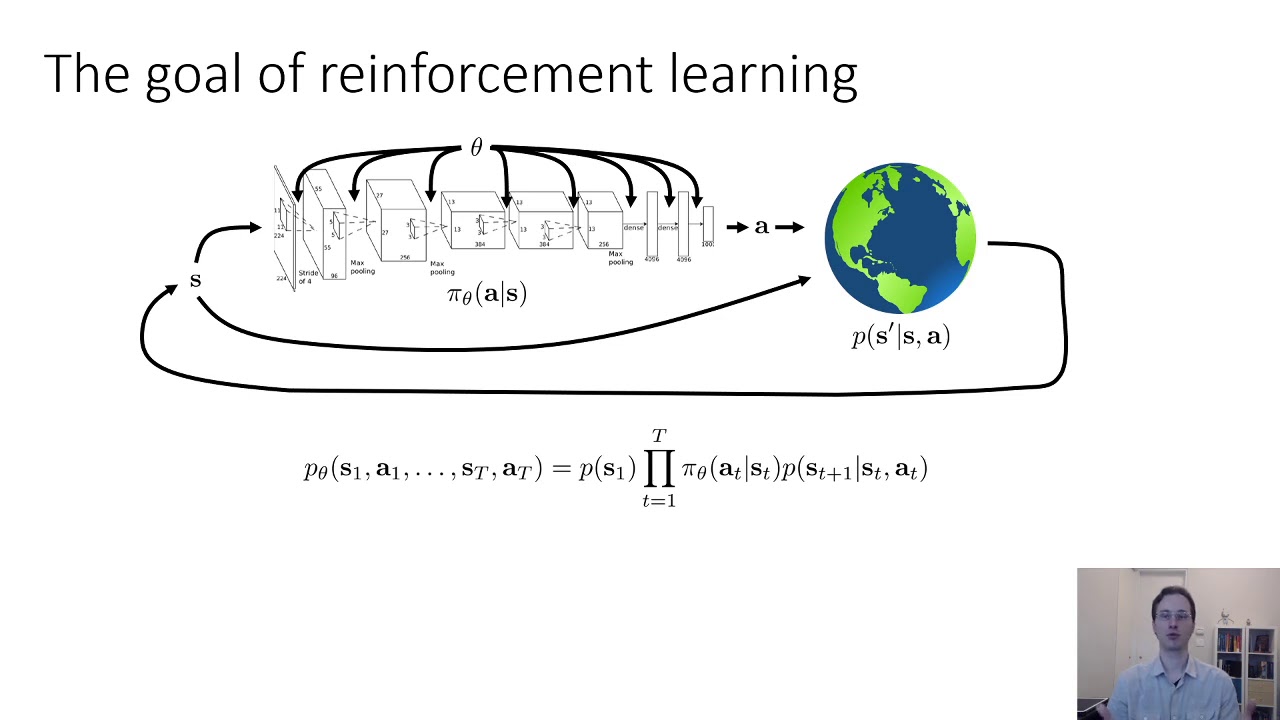
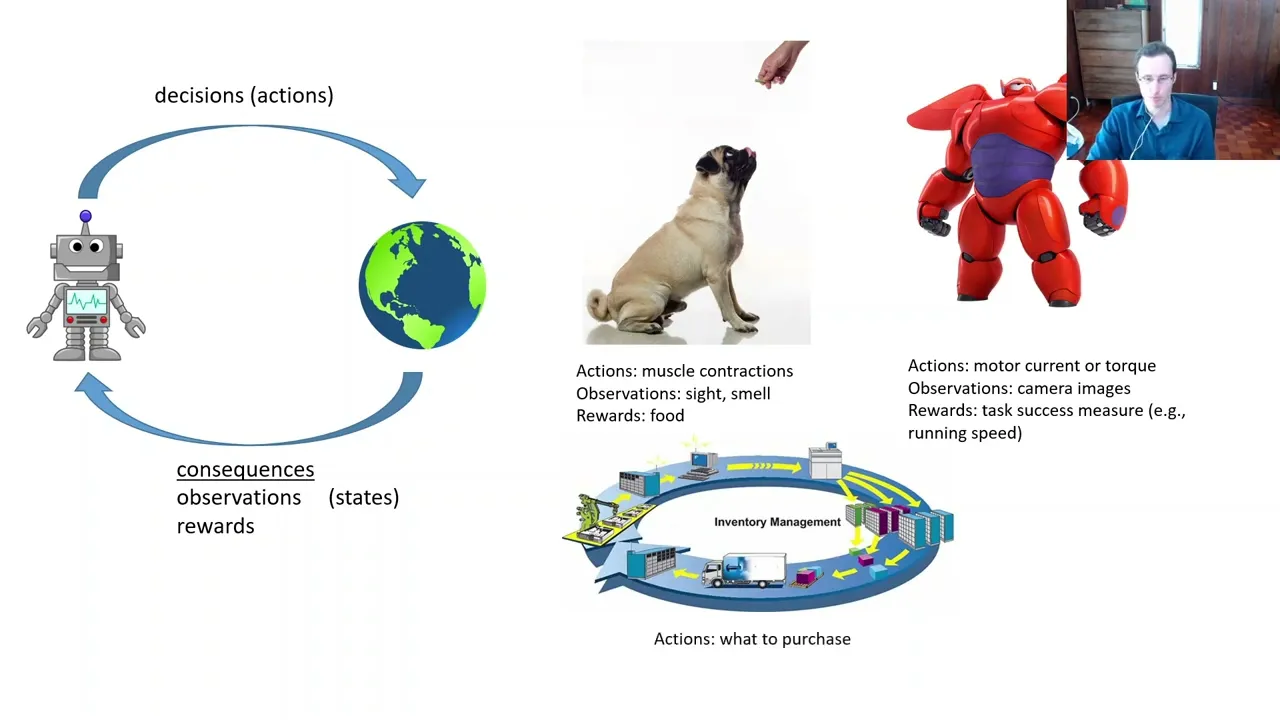
weights in a neural network in reinforcement learning we have a kind of a cyclical online learning procedure where an agent interacts with the world the agent chooses actions a t at every point in time and the world responds with the resulting State s t plus 1 and reward signal and the reward signal simply indicates how good that state is but it doesn't necessarily tell you if the action that you just took was a good or bad action perhaps you got lucky and landed in a good state or perhaps you did something really good earlier that
caused you to get into a good State now the input to our agent is going to be the state St at each time step so this kind of the analog of X the output is 80 at each time step the data which is collected by the agent itself classically consists of sequences of States actions and rewards rewards are numbers scalar values and whereas in supervised learning the data is given to you you don't have to worry about who gave you the data it's just provided to you as a set of XY tuples in reinforcement learning
you have to pick your own actions and collect your own data so not only do you have to worry about the fact that the actions in your data set might not be the optimal actions you have to also actually decide how that data will be collected and your goal is to learn a policy Pi Theta which Maps States s to actions a and just like f Pi has parameters Theta so those might again be the weights in a neural network and a good policy is one that maximizes the cumulative total reward so not just the
rewarding the point in time but the total reward the agent receives so that involves strategic reasoning maybe you might do something that might seem unrewarding now to attain higher rewards later so let's talk about some examples of how problems could be cast in the terminology of reinforcement learning let's say that you'd like to train a dog to perform some trick right so in this case the actions might be the muscle contractions of the dog's muscles the observations might be what the dog perceives through its sense of sight and smell the reward might be the treat
that it gets and the dog will then learn to do whatever maximize that reward which might be the trick that you want to perform because you're rewarded with food when the dog performs the tree the trick successfully okay here's another example maybe you have a robot its actions might be the motor current or pork some kind of actuation command sent to its Motors its observations might be the readings from its sensors like camera amateurs and its reward might be some measure of test success maybe this robot needs to run as fast as possible to reach
your destination so its reward function might be the running speed or it might be the whether it reached the destination or not just maybe it receives a plus one when it reaches the destination successfully and a minus one otherwise here's another problem let's say you want to manage inventory route goods between different warehouses in order to maintain stock levels perhaps the actions are which inventory to purchase the observations are the current inventory levels and the reward might be the profit you make perhaps you have to pay if you want to store inventory for a long
time so your profits will be lower so you can see that this formulation is very general many different problems can be cast into the framework of reinforcement we'll of course make all this a lot more precise later so this is a very high level introduction don't worry yet if the particular details aren't very clear will make us a lot more precise in later lectures but for now let me just give you some examples of the kinds of things that reinforce some learning methods could do one of the things that reinforcement learning is very good at
is learning policies for physically complex tasks tasks where it might be very difficult for a person to describe precisely how the tasks should be performed but much easier to find the reward like in this case the rewards that the nails should be hammered in and the reinforced learning algorithm figures out how to control this robotic hand to move the hammer to hammer in the nail here's another complex physical task here this quadrupedal robot needs to be able to jump over different obstacles now coding up manually a skill for jumping like this is very tough but
reinforcement one can learn the actuations that will allow the robot to jump in different locations to various distances and so on it can even perform more physically complex tasks so here this in the next clip the quadrupedal robot uh this is a baseline method so don't worry about this share this quadrupedal robot needs to figure out how to stand on its hind legs and balance and that's also very difficult to do manually but with an appropriate reinforced morning method that's actually possible impact reinforcement learning has been applied very very widely to robotic problems here's a
an even more recent work and this is from eth Zurich showing a robot using reinforcement with a combination of simulated optimization to learn various agile skills and you can see that it might clamor onto obstacles and things like that now the other thing that reinforced learning is great at is coming up with unexpected Solutions I alluded to this before with the alphago example here's another example which you'll actually Implement in your homeworks where a key learning algorithms learn to play Atari and discover the strategy that if you bounce the ball up over the bricks then
it will bounce around you'll get lots of points reinforcement can also be applied at larger scale in the real world this is a project that was done at a company called Everyday Robots versus alphabet company where the robots learn to sort trash so the idea is that if people put trash into recyclables that should actually go into the compost then the robot can come and sort it the robots here learn in the real world in both in these classroom environments where they can practice and in like actual Office Buildings and these vision-based skills that are
kind of similar in spirit to the ones that I mentioned in the beginning uh can then pick up and move objects in real world Office Buildings so that's pretty neat that you can actually practice these things you can practice them on the job you can practice them in the real world and it's of course not just for games and robots um I I really like this next example this is work that was done by Kathy Wu who's now a professor at MIT and was previously a PhD student here at UC Berkeley and what Kathy was
working on his reinforcement learning algorithms for controlling traffic um this is a kind of a toy example where these cars drive in a circle and what tends to happen even in a simple circular environment like this if you have a very uh reasonable a very accurate model of what human drivers behave you'll actually get traffic jams forming spontaneously so cars will kind of bunch up and when they Bunch up like this they'll actually have spontaneously form traffic jams even though they drive in a circle so what Kathy then did is she optimized the reinforced learning
policy which will be shown next for the car shown in red to not optimize its its own speed but to optimize the speed of the entire circle and you can see that what this car in red is going to do is going to actually slow down and wait for everybody to resolve the traffic jam and by going a little bit slower it'll actually avoid the formation of traffic jams in the entire circle Kathy also experimented with this in other settings this is a a figure eight kind of intersection and as you might expect cars will
Bunch up at the center section and cause delays so if there's an autonomous car that is trying to optimize the uh driving speed of all the cars the autonomous car will actually slow down a little bit and regulate the traffic so that everyone passes through the intersection at exactly the perfect time now this example maybe is a little bit synthetic but there's a considerable follow-up work to this showing that in fact autonomous regulation of traffic with reinforced money can be quite a powerful tool reinforcement has also been used very widely with language models uh many
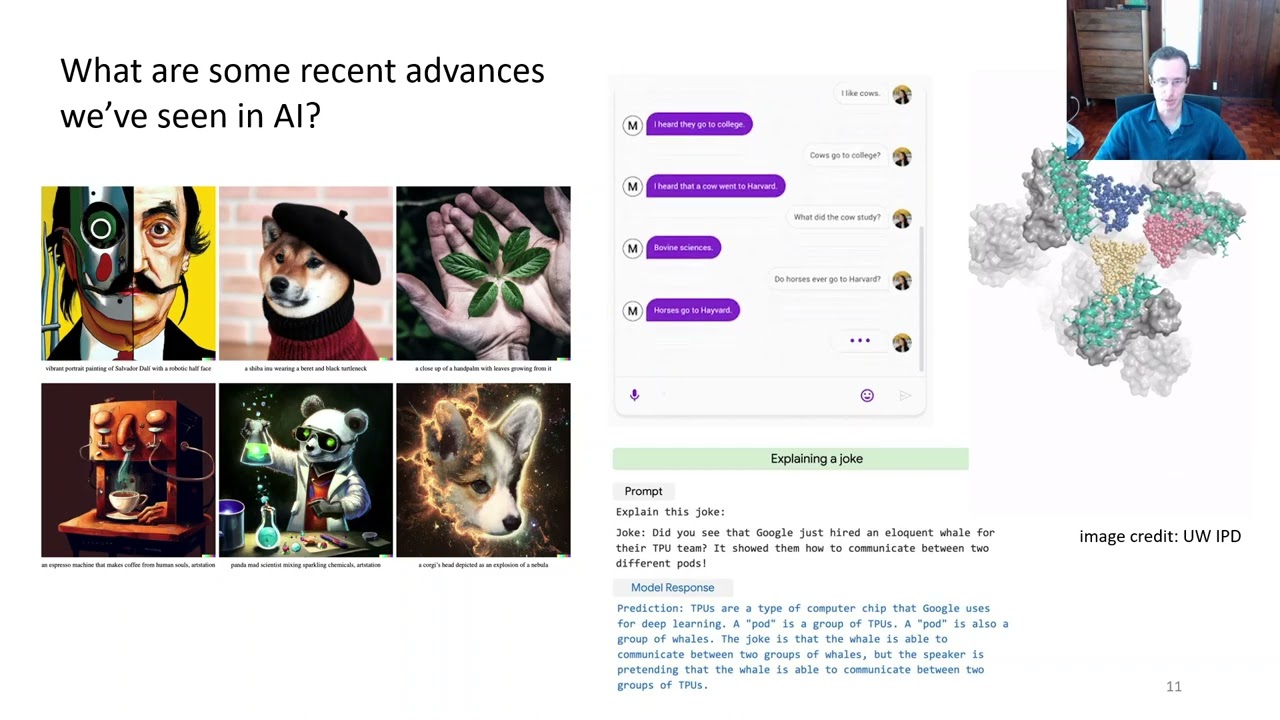
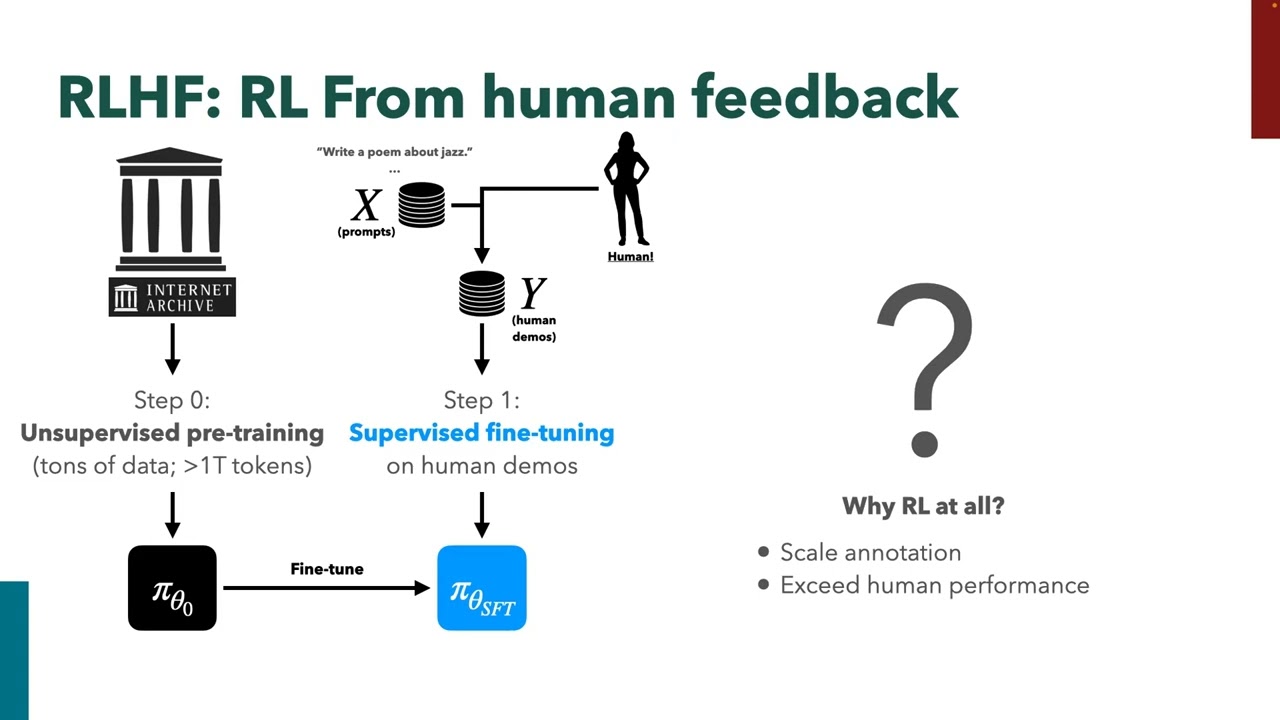
of you are probably familiar with the advances in recent language models of things like chat GPT and many other systems like anthropics Claude or Google's Bard which use large amounts of data to train models that will fulfill user requests and this is an example on the right where someone asks child should be T to explain how RL with human feedback works for language models and it produces some kind of explanation now by themselves large language models train on lots of internet data can solve their sophisticated problems but it's quite difficult to persuade them to do
this because these models are basically trying to complete text based on what they learned from internet data so you have to prompt them in a way that kind of indexes into the right context reinforcement learning can be used to make this a lot easier by essentially training these models based on human scores so instead of just asking them to provide the kind of completions that are most likely from internet data they can actually be trained to respond to queries in ways that human readers find to be desirable and reinforced learning is actually a very important
part of this reinforcement learning has also been used with image generation here's an example with a stable diffusion 1.4 if you ask it to generate a picture of a dolphin riding a bike it actually generates a picture that is not very good for this what you can do is you can take this image and you can give it to a captioning model in this case lava to produce a description of the image and then use RL where the reward function is given by the similarity between the description from lava and the original prompt so when
lava looks at this picture it might say oh this is a picture of a dolphin above the water which is not very similar to Dolphin riding a bike so that so it receives a bad reward for that if we then optimize the image generation model with RL to maximize this reward it'll gradually make the image more appropriate to The Prompt so now there's both a dolphin and a bicycle although the dolphin is not writing the bicycle just yet with a few more iterations now there's a dolphin like creature that is in fact on a bicycle
and with some more iterations the creature begins much more clearly a dolphin apparently putting some waves in the background makes it extra dolphin-like and then eventually there's a full-fledged picture of a dolphin riding a bicycle so reinforced learning can be used to optimize image generation models reinforcement one can also be used for other things this is an example on chip design where the actions correspond to placement of Chip parts per layout and the reward has to do with various chip design parameters like the cost or the congestion or latency of the chip so rainforcement can
actually be applied By plot so I'll pause here and in the next section I'll discuss why we should study deep RL today

![[AUTOML23] A Tutorial on MetaReinforcement Learning](https://img.youtube.com/vi/XUQ9jLOZqGc/maxresdefault.jpg)