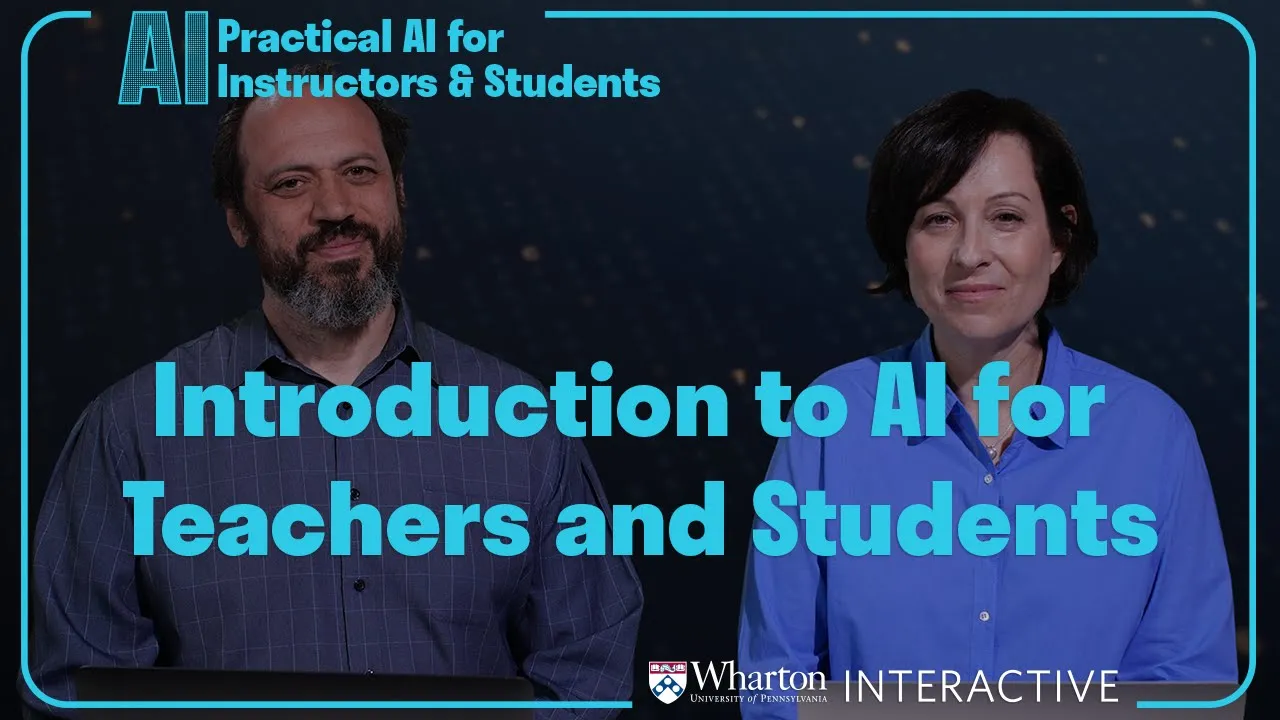
[Music] hi I'm Lita Malik and I've been working on interactive pedagogy and AI research at the Wharton School and I'm Ethan Malik a professor at Wharton and together along with Wharton interactive the organization that we help run we have been really passionate about how you can democratize access to education so how do we get everybody the kind of education that we give at the University of Pennsylvania and one of the really exciting things that's happened in the last year has been the Advent of practical AI so our goal in this video series is to show
you some of what we've learned and some of what our research has shown about how AI can be used in classrooms both the upsides and the downsides because we're in the middle of a very big transformation probably one of the largest in recent history that is going to affect every part of what we do as teachers as Learners as workers and we wanted to give you a little bit of a preview of how that world works and some practical tips in the course of the video is about how to make it work for you foreign
before we get started here are a few things you should know first it's that AI is everywhere everyone has access to the most powerful AI model in the world and students are using it in all kinds of ways including to cheat and we just can't tell if they're doing so AI is undetectable and continues to be so AI is our first general purpose technology since the internet and it touches everything we do it transforms how we live how we work and how we teach so we're going to spend a lot of time talking about how
to get access to these systems what they mean for teaching how to use them but before we do that I think it's worth talking a little bit about what we mean when we talk about AI because ai's had many meanings over the years and a lot of them are not very precise right you might think of the Terminator robot as AI or the computer Hal in 2001 or you might think about AI for self-driving cars and those are all different meanings than when we talk about AI for today prior to the last couple of years
what AI meant was usually about machine learning algorithms and prediction that meant we were trying to use machines to predict data based on past Behavior so when you went to an Amazon website it would try and guess what products you might want to buy based on your pass buying behavior and analyzing tons of data about how people make buying choices or when you're using a self-driving car it was trying to predict where to drive on the road based on lots of data and what the data came from its cameras but these systems were very bad
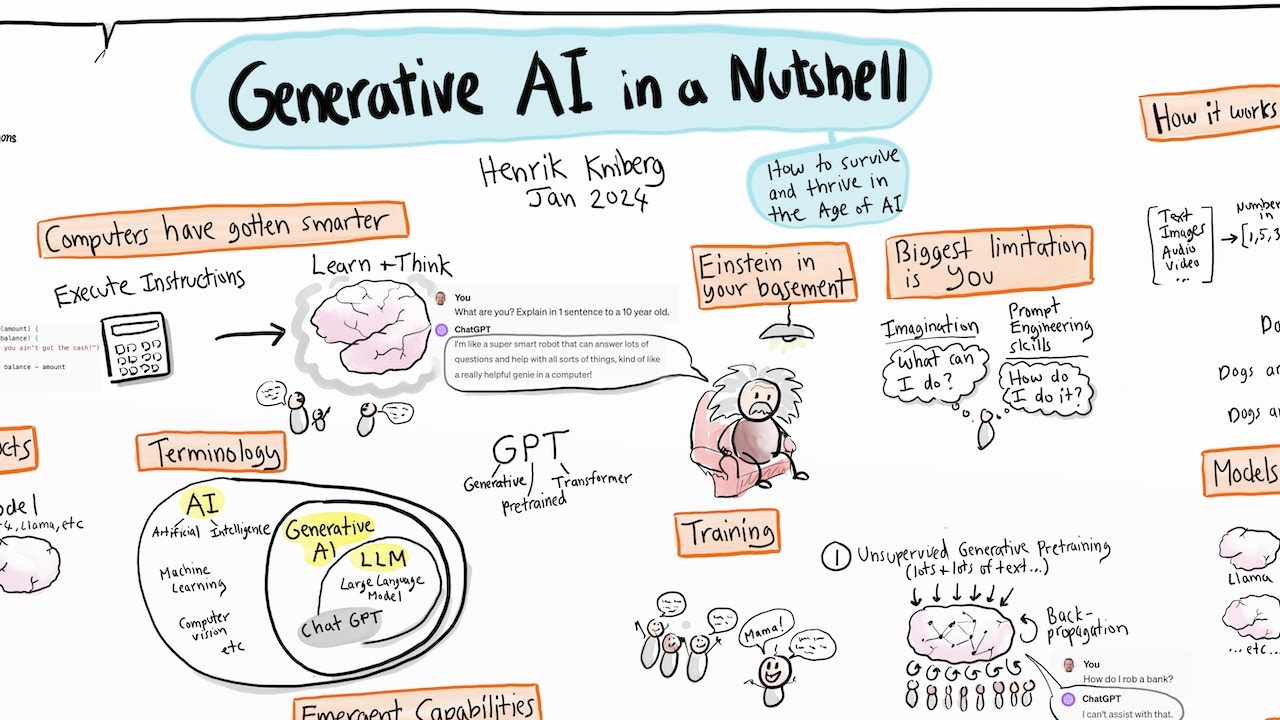
at human things human language human creativity until a breakthrough in 2017 a famous paper called attention is all you need came out that suggested a new way of creating AIS they were good at working with human language these models used processes called Transformers and attention mechanisms and what resulted with something called a large language model so when we talk about AI now we often talk with these large language models so chat CPT Bing was barred anthropics Claude all of these are large language models at the same same time there's also been new models that are
very good at creating art video and all sorts of other kind of creative tasks including audio and all of these things together we consider generative AI so large language models art based models video based models this is this new category of AI that's very different than before so when we talk about AI in these talks and when you hear AI being used mostly we're talking about this kind of generative AI about creating new content and we should spend a second talking about how large language models work because it can be helpful to both understand what
we do know and we don't know about their advantages and disadvantages all AI models are based on prediction trying to predict what happens next large language models are a little different because they're about predicting what word or part of a word comes next in a sentence and the way they've done that is through a training process they have ingested all the information on the internet billions of documents and over the course of months of a heavy computer time have come up with a model for how language Works they found secret connections between different words they
found some words are closely associated with each other like you know Fox and dog might be closely associated or banana and papaya and it's but it's also found other connections about how these words operate across many different dimensions that we can't even fully understand using all of that knowledge then the AI tries to predict what word comes next in any sentence so if you say I like to use AI because it's very good at it will try and guess the next word after at maybe it's prediction maybe it's lessons maybe it's yesing and it will
try and predict what's next and then give you that next word so it's like a fancy version of autocomplete and that's basically how AIS work they have additional forms of training on top of them there's other mechanisms but they're essentially an autocomplete mechanism on steroids so large language models first started to actually appear in the wild in 2019-2020 and they were interesting but not particularly amazing to work with you wouldn't actually think that these were good writers they were writing a sort of Middle School level and you know they were interesting but mostly ignored something
happened though with the release of chat CBT in late 2022. Chachi BT ran on a new version of an older language model it worked just the way other large language models worked but it was much larger and that seemed to create a new kind of AI something was far more cable than we ever had expected before and one of the ways you can see this is by looking at test scores so previous large language models couldn't do tests at all and then chat CBT started to score really well we were getting something like you know
at the 25th percentile of the GRE The Graduate exam in quantitative testing 66 percentile beating 66 percent of humans in the GRE qualitative doing really well on the AP exams doing very well on sats completely unexpectedly and GPD 3.5 the chat gbt model was just the start gpd4 which was released just a few months later with scoring in the 99th percentile in the GRE exams in verbal and scoring at the 85th percentile in the law exam and this was a completely unexpected thing we didn't expect these AI models to be as capable as they are
as powerful as they are as quickly as they become and we didn't expect this trend to keep continuing and it's not just test scores AI makes us all more powerful and more productive in a series of recent studies workers had higher productivity gains in terms of writing tasks and coding tasks they were faster they were better and produced higher quality work across the board using chatgpt the jobs and skills that are most affected by AI are probably not the ones that we thought would be affected early on so when we talked about AI in the
you know early days before large language models we thought our AI automating difficult repetitive dangerous tasks you know driving a truck or doing mining but it turns out that more recent work has shown that AI is actually most disruptive and most connected to higher paying higher educated more creative work so generally the more you're paid the more educated you are the more creative freedom you have in your work the more generative AI is going to affect your job that doesn't mean it's going to replace your job but it does mean that it will have a
big impact and one of the groups that's most impacted is actually teachers and instructors at all levels which is part of why we want to make this video to talk about how you can use this to help you rather than something is just to be nervous about but we have to think about how we're preparing students in the future for this kind of world as well there's a lot of different ethical concerns we might be worried about with AI and some of those will be getting better over time some more so and I want to
just make you aware of a few of these kind of concerns so they start with how these models are trained they're trained on everything on the internet so not all that is paid some of that's copyrighted so how do you feel about the fact that these models have all of this information in them now you can't directly reproduce in most cases copyrighted material so if you ask the AI to give you the first paragraph of a famous novel it will almost certainly not give it to you correctly you can't directly ask for someone's data and
get it from the AI but it is trained on everyone's information and that raises concerns about copyright and about fair use that are still being resolved by both courts and you know people discussing it and then because these models are trained on everything on the internet they also exhibit biases that can be very human biases and additional biases are put in place as these AIS are trained and reinforced in different ways so if I type into an image creation software something like show me an entrepreneur I'm more likely to see male entrepreneurs than female entrepreneurs
which can be a real problem because it's reflecting bias in society and bias of how these things are trained and so that's something you want to be aware of too as you use these systems and then moving up an additional level we start to consider well what does it mean to ethically use these systems right is it okay for us to replace human effort and not tell people about it do we expect people to show their work and we'll talk more about plagiarism but plagiarism concerns become a real issue where we're copying AI use and
then at the highest level what does AI mean we have a device that sort of thinks it acts like a human in some ways could be could it be smarter than a human's at some point what does that mean for society what does it mean when we start passing over some of our thinking and work to Ai and stop thinking and doing that work for ourselves these are all questions that we don't have easy answers to so we have a tool that's immensely powerful that is very useful that can transform teaching and learning and will
certainly do that but it also raises a bunch of concerns and I think we need to be balancing those things out and thinking about them as we continue to work with AI this is the first of a series of videos that we're creating and Next Step you'll hear about a variety of large language models how to prompt and the right way to talk to the AI and how to use AI as a teacher and as a student to further your learning [Music]



![[1hr Talk] Intro to Large Language Models](https://img.youtube.com/vi/zjkBMFhNj_g/maxresdefault.jpg)