Today, we're going to talk about relative time, and we're going to learn the stratigraphic principles that help us figure that out. So, what is relative time? It has to do with the order that things are in.
For example, Bob is older than Joe and younger than Harry. We don't know how old Bob, Joe, and Harry are, but we know the order in which they were born. That's what relative time addresses.
The first principle of relative time is the principle we call original horizontality, and that simply says that sedimentary rocks are laid down in horizontal layers. Now, that might seem unduly simple. Why do we bother defining such a thing?
Well, mainly because not all sedimentary rocks stay in horizontal layers. So, this tells us how everything started. The second principle of relative time is the principle of superposition, and that says that older stuff is on the bottom, and younger stuff is on the top.
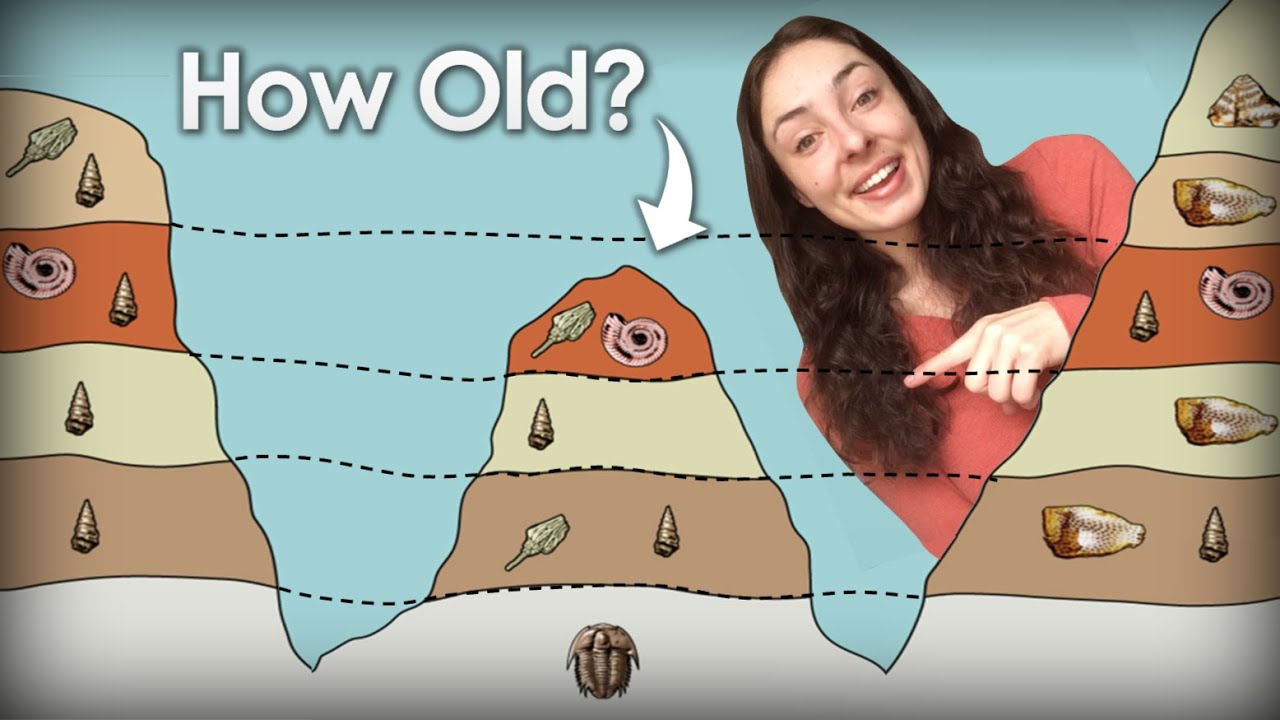
That's pretty straightforward, right? Just like your laundry. The third principle is the principle of lateral continuity, and what that tells us is this: if you happen to be somewhere where a river or perhaps even an ocean has cut through a layer, if you have the same sequence in one place and another, and if those rocks are the same age and the same type, then you can conclude that they were once a continuous layer.
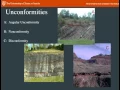
So, in the top, you see a sandstone layer with shales, and down below, erode it away. But we know that this layer is equal to that layer, which is equal to the sandstone that you see over here by the law of lateral continuity. Now, many times in sedimentary sequences or rock sequences in general, you will get disruptions in the layer called unconformities.
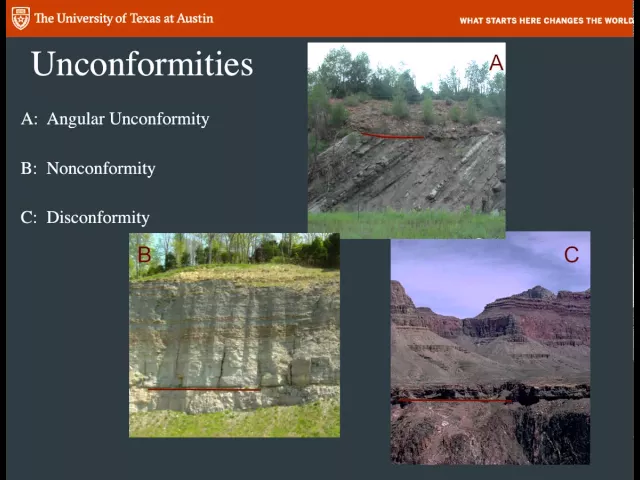
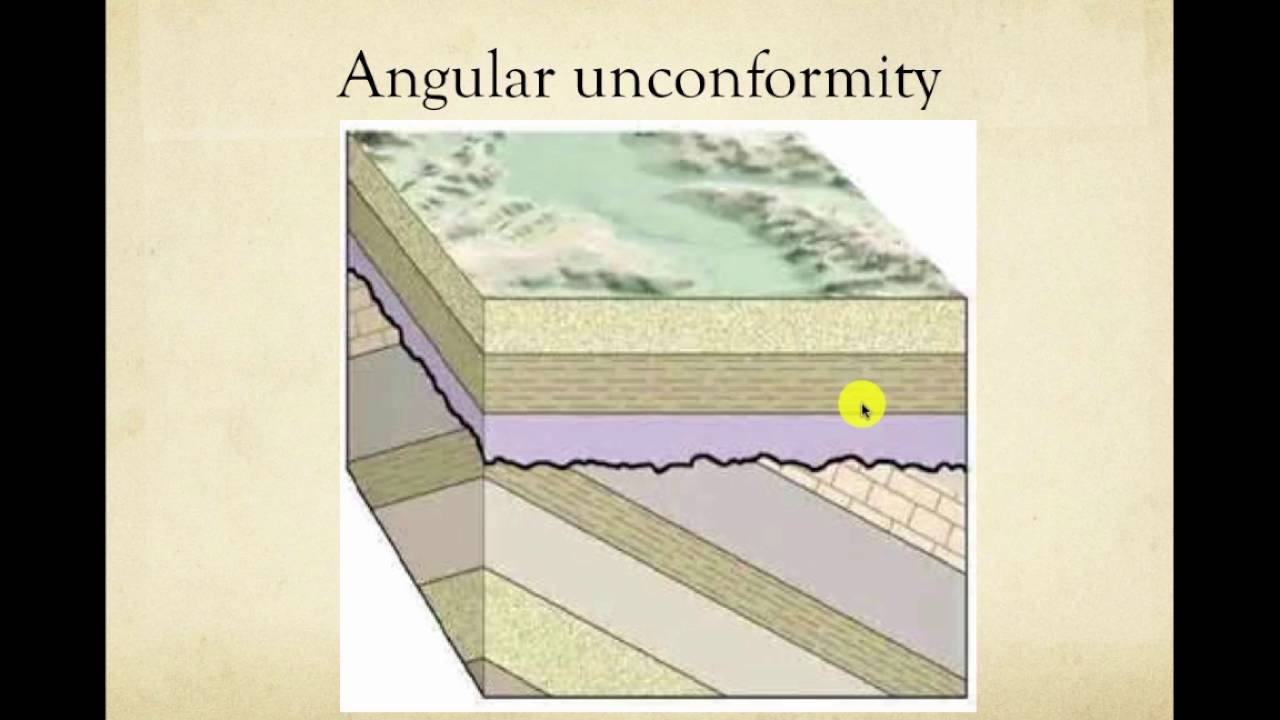
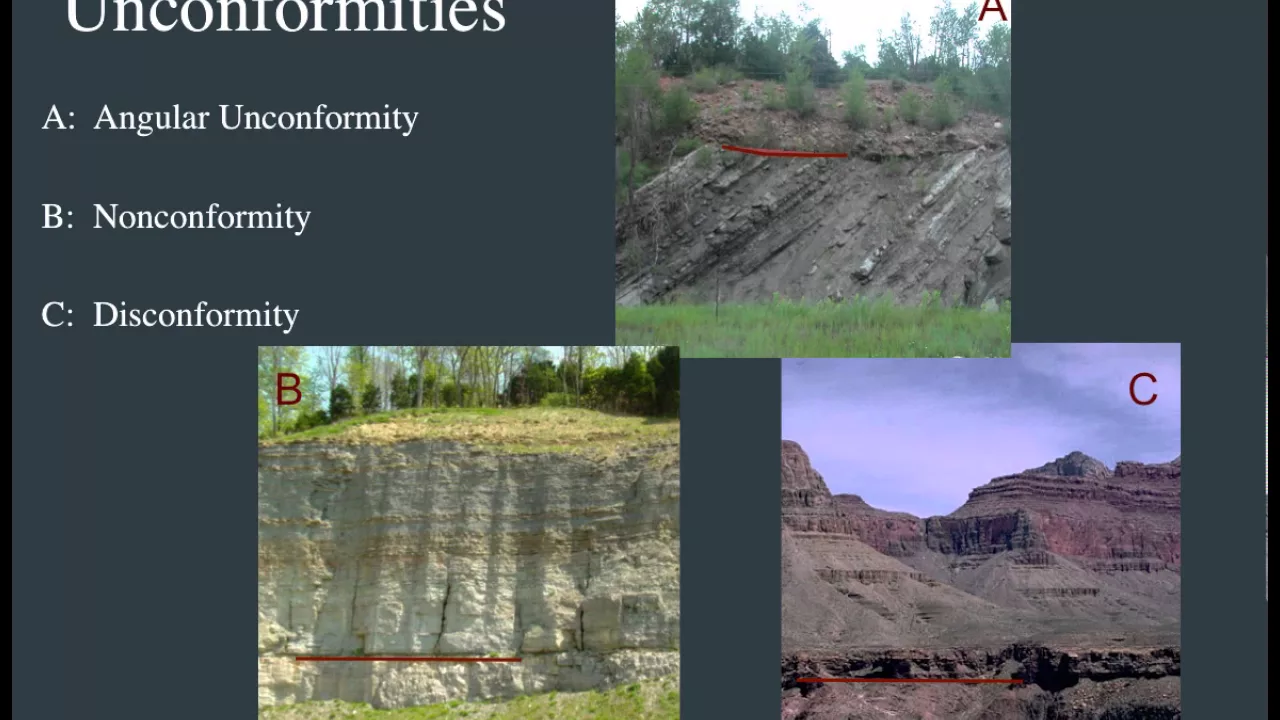
An unconformity is simply an area that shows missing time. There are several kinds; we're going to look at three right now. An angular unconformity, like here in picture A, where you have one set of rocks that have been tilted and are at a pretty high angle, and above it, another deposit of rocks that are nearly [ __ ] that's an angular unconformity because the two rock layers are at a very different angle.
In B, here we have a picture of a nonconformity. In this case, just looking at it looks like a regular sedimentary sequence—layers upon layers upon layers. But if you get up close, if you look at the fossils, you'd find here that there's missing time, that millions, perhaps, of years are gone from the geologic record.
And that's a nonconformity. Then, a disconformity happens when you have sedimentary rocks on top of another kind of rock. In this case, metamorphic rocks underneath at the bottom of the Grand Canyon.
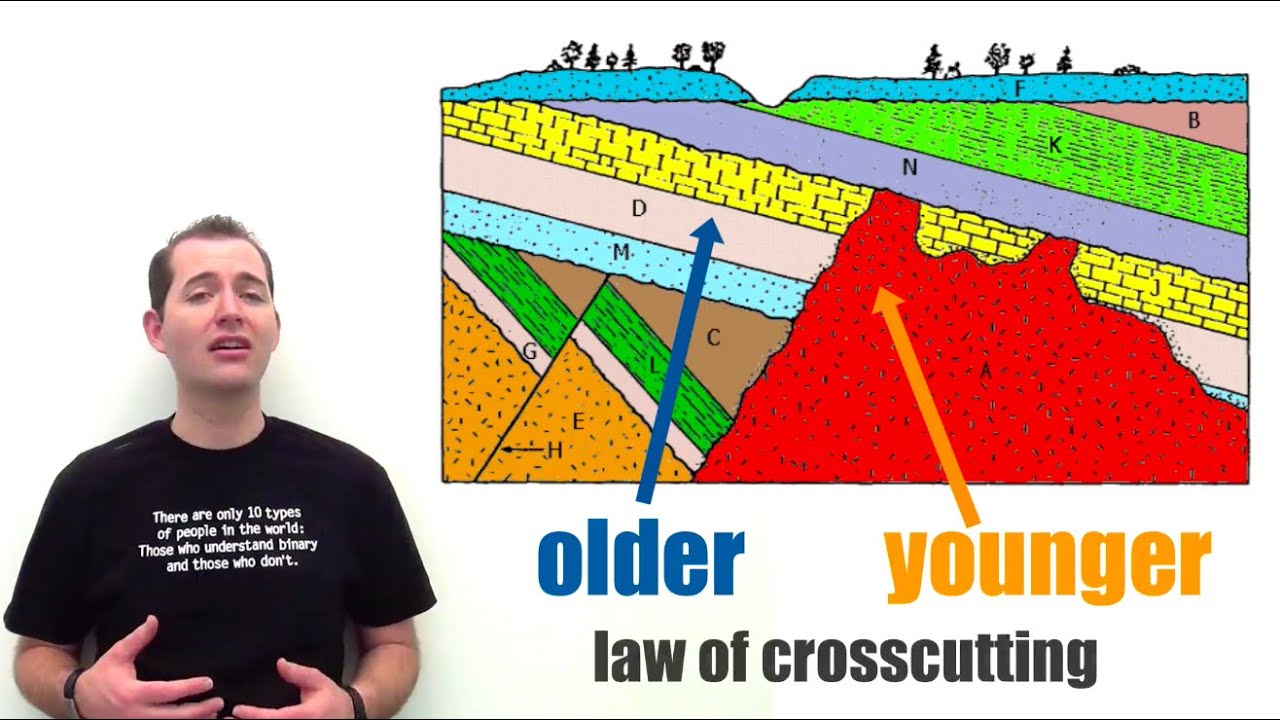
All of these represent some time where the rock was exposed at the surface, and erosion was happening instead of deposition. And so, time is missing. Another law of stratigraphy is the law of cross-cutting relations, and it says quite simply that if something comes cuts across something, it must be younger than it.
You know that, of course; you can't cut a cake before you make a cake. So, in this case, you can see this dike cutting across the red layers. This black igneous dike has to be younger than the red layers that it cuts across and younger still on top of that, another unconformity, and then more sediment on top of that.
So, the red layers first, then the dike, then the unconformity marked by the Green Line, and then more sedimentary layers. Another principle is called the principle of inclusion, and it says that if there is a hunk of one kind of rock caught up inside of another rock, that a hunk that's caught up inside has to be older. Obviously, you have to make the cookie dough before you put it in the cookie dough ice cream.
That's the principle of inclusion. So, what do you see here? Here is a sketch of several different things going on in a rock.
In this case, you've got some layers, you've got a dike cutting across it with some inclusions in it, and then you have a fault cutting across that. So, let's look at rock X and rock F. What principle tells us which one is older?
Did you say superposition? Sure, and who's on top of rock X? How about another one?
What's the principle that tells us the age relationship between the fault marked by the letter F and the dike? I'm sorry, the fault marked by the letter B and the dike? Well, the fault cuts across; it can offset it, right?
So, the fault has to be younger, and we call that cross-cutting relations. And finally, here's your opportunity. Put these things in order.
Which came first, second, third, fourth, fifth, and sixth? Oh, wait.