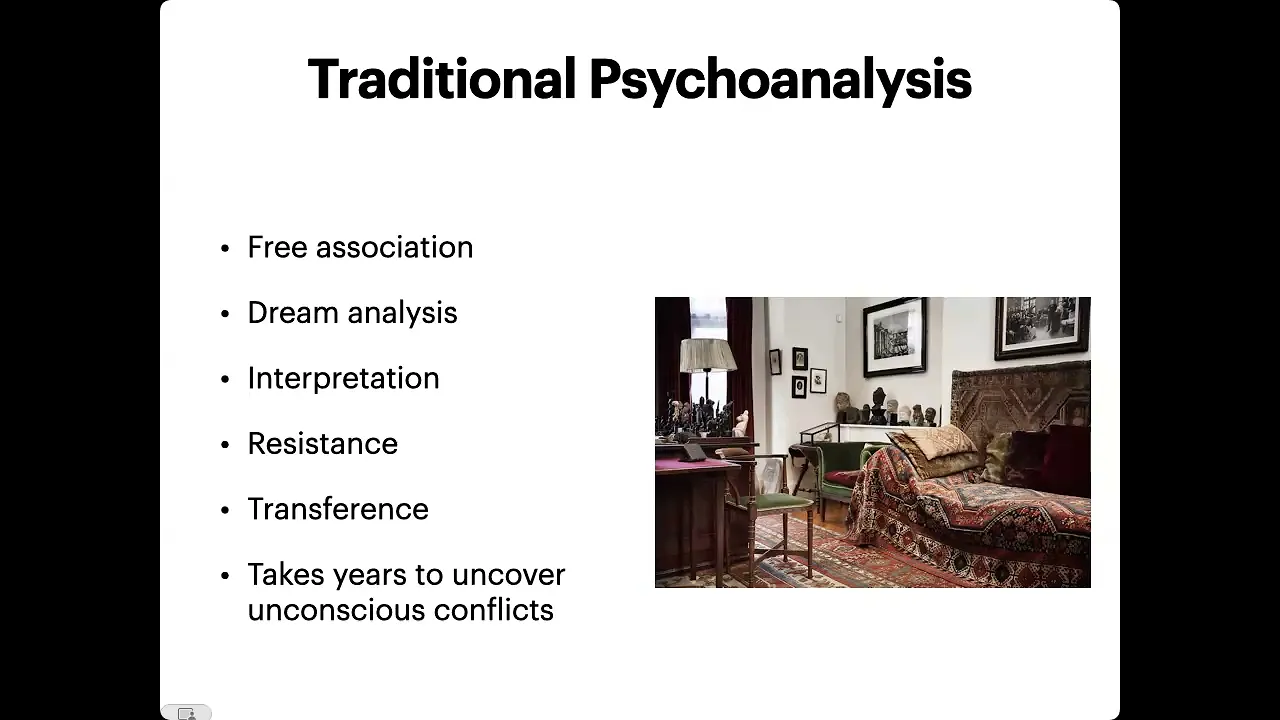
uh chapter 14 mental health therapies therapies are techniques to help clients deal with their mental health or interpersonal struggles by changing their behaviors all right so section 14. 1 providing psychological assistance according to the textbook there are two different types of therapy techniques one is psychotherapy and the other is biomedical therapy these techniques are often combined Psychotherapy uses psychological principles and techniques it is for mental health disorders such as major depressive disorder or interpersonal problems psychotherapists consider psychological factors such as emotions cognitions behaviors or inter personal relationships as the root cause of the problems on the other hand biomedical therapy uses medications or other medical interventions this type of therapy treats the symptoms of mental health problems biomedical therapists consider biomedical factors such as brain anomal or brand chemistry uh imbalance as the root cause of the problems more Americans feel less embarrassed if uh the people find out that they have mental issues that need to be addressed so who is qualified to provide therapy uh first let me give you a background uh during World War II there was a growing number of psychologically and physically wounded soldiers returning home during World War II it was abundantly clear that psychiatrist could not handle many patients so the US government asked the APA American Psychological Association to develop a model to train practitioners in 1949 a new PhD training model the boulder model was proposed at a conference at the University of Colorado Boulder this PhD model trains clinical psychologist to be uh competent in three general areas diagnosing mental disorders completing effective research and conducting competent Psychotherapy the model emphasizes 50% research and 50% practice and a PhD dissertation must be research-based by the 1960s dissatisfaction with the boulder model began to emerge a criticism of the boulder model is that there was too much training emphasis on research and not enough training on practice so in 1967 an APA committee recommended a program focusing on clinical training an alternative to the scientist practitioner Boulder model one year later the University of ill Illinois created the first Sidi program uh doctor of psychology program based on the APA recommendations schools not associated with traditional universities such as the California School of Professional Psychology also opened focusing on clinical training the need for at least some standard standardization of the Sidi training program led to the veil conference in Veil Colorado in 1973 um I guess the APA loves the state of Colorado this Veil model emphasizes more on practice and less on Research although the S program based on the veil model is a doctoral program accredited by the APA the acceptance rate is pretty high it's 50% uh one out of two applicants can get in in contrast the acceptance rate for the traditional PhD program is only 10% therefore it is way more competitive than the S program this difference raises a question about the quality of the Sid program so to become a clinical psychologist you are required to obtain a PhD or SID a doctoral student goes through supervised research and training in Psychotherapy techniques psychological training uh psych psychological testing and diagnosis of mental health disorders uh some PHD programs emphasize research more than practice in contrast s programs Focus almost exclusively on practice to become a counseling psychologist you must obtain a PhD Sid or Ed Ed stands for Doctor of Education a doctoral student goes through supervised training and uh assessment counseling and therapy techniques psychiatrists are different from psychologists because they are medical doctors psychiatrists obtain an MD with uh training and the diagnosis and prevention of mental health disorders and pharmaceutical treatment doctoral programs may include training and Psychotherapy methods as well to become a licensed professional counselor you must obtain a ba or ma according to the textbook however I'm not sure if you can be licensed only with a ba my understanding is that you have to get a a master's degree students of the program receive supervised training and assessment counseling and therapy techniques to become a licensed social worker you will need uh an MSW or master of Social Work students receive supervised training in a Social Service Agency or a mental health center MSW programs may not include training in Psychotherapy to be a couple or family therapist you need an MA or uh PhD the programs offer supervised training in family and aou therapy these programs may also include training in individual Psychotherapy methods now it appears psychologist and psychiatrist do not necessarily get along this is because psychologists have been pressuring Congress to gain uh prescription privileges according to the textbook authors only five states Louisiana Illinois Iowa Idaho and New Mexico currently Grant prescription privileges to clinical psychologists who have completed additional training uh similarly the armed forces the Indian Health Service and the National Health Services corpse all give psychologist prescribing uh uh pre privileges after they complete specialized training in Psycho pharmacology psychiatrists do not like this because they want to be the only one who have prescription privileges as psychotherapist completing training and education are not enough they must follow the ethical standards that are established by the APA the violations of these standards are reported to uh professional review boards okay so let's take a look at uh four essential ethical principles one competent treatment therapist must provide appropriate inadequate treatment that follows standard therapy techniques they must be sensitive to diverse cultural backgrounds race gender ethnicity uh socioeconomic status religion sexuality disability and language two informed consent clients must must be informed of what they can expect from the therapy sessions risks and outcomes clients must be given enough information so they can decide if they want to proceed with the uh the proposed treatment plans three confidentiality uh my iPhone just again activated activated because I said uh something sound like Siri uh where is it uh confidentiality communication between the therapist and the client must be kept confidential unless the therapist determines that the client or others are in danger the last one appropriate instuctions therapist must know the boundaries between them and their clients they are not allowed to be sexually or romantically involved with their clients okay next section 14. 2 psychoanalytic therapies uncovering unconscious conflicts sigon Freud hypothesized that mental health issues come from unresolved conflicts so psychoanalytic therapies try uh therap uh therapist tried to uncover these conflict in the unconscious mind in psychoanal analytic therapy therapy uh therapists use a variety of techniques in free association a therapist asks clients to express their thoughts and feelings as they occur freely therapists are just uh there to listen and hope that they can uncover unconscious thoughts and feelings the picture on the slide is from Frey's museum in London uh but this Museum recreates uh the Freud's office uh during the session a client lies on the couch and the therapist sits behind the uh the chair uh so they cannot see each other um yeah the therapist set on a chair behind the couch that's what I meant uh in dream analysis uh IST interprets the symbolic meaning of a client's dreams because psycho analysists believe dreams are highly linked with the unconscious mind interpretation is a psychoanalyst view on issues that may influence behavior therapists connect the dots of events and behaviors that a client did not even recognize resistance uh occurs when a client may not be ready to open themselves when a psychoanalyst interpretation is too close to the truth a client may become defensive to hinder the pro uh progress of therapy in transference a client relates to the therapist in ways similar to cre uh the critical relationships in their lives for example a cent May treat a therapist as if they are a parent a friend or a partner the therapist can use transference to uncover how the client's relationship with a loved one contributes to their behaviors in traditional psychoanalyst it takes years to uncover unconscious conflict with sometimes five sections per five sessions per week however health insurance companies hate such a long-term treatment on top of that there is little scientific evidence to support their techniques as Freud's ideas have been challenged and refuted by a wide range of empirical evidence today's psycho dynamic therapy or short-term dynamic therapy is consistent with Freud's views and psychoanalytic approach which relies on therapist interpretations of of clients's feelings and behavior however modern psychoanalysis focuses Less on the client's past rather they focus on current problems and interpersonal relationships are considered more important they also focus on a very limited set of problems psycho analysis uh still exists today because there is some empirical evidence that shows that their approach is effective section 14.
3 humanistic therapy facilitating self-actualization human humanistic uh therapist Focus Less on the unconscious mind or the past rather they focus more on the conscious mind and the present Sigman Freud believed that therapists are responsible for clients change he thought therapist should lead the therapy session in contrast uh KL Rogers the humanist thought therapist should be facilitators or coaches to help the clients so he developed Client Center therapy or also known as person Center therapy which focuses on the client and current events in this approach therapists do not try to interpret the true meaning of unconscious Behavior because Rogers believes that the the client should decide what to talk about without being judged by the therapist he claims that this requires empathy uh genuiness and unconditional positive regard empathy is understanding without judgment involving active listening eye contact and assuming an interest uh um assuming an an uh interested and uh attentive pause genuiness refers to openly sharing thoughts and feelings which allows clients to see a therapist as a real living person unconditional postive regard refers to accepting and valuing someone for who they are regardless of faults it is about reflecting on thoughts not agreement today the concept of Rogers has been widely accepted as a gold standard for all therapists regardless of their disciplines section 14. 4 Behavior therapies learning healthier behaviors both psychoanalysis and humanistic approaches focus on internal reflection by the client Behavior therapist on the other hand focus on changing behaviors using learning principles such as classical conditioning and oper conditioning behavior therapy or behavior modification focuses directly on changing current problem behaviors behavior therapy techniques rely on three classical conditioning principles the first one is systematic desensitization this was developed by Mary cover Jones a student of Joan Watson the uh who who was the early promoter of behaviorism now you guys remember him right he was the professor who dated and married his students uh and who also conducted the uh the study on little Albert systematic desensitization is to treat phobias and anxiety by using the principle that you cannot relax and feel anxiety at the same time in the therapy the therapist trains the client in progressive muscle relaxation then an anxiety hierarchy is developed the rank of a degree of fear from the lowest degree the least distressing situation to the highest degree the most distressing situation this technique should have been used to eliminate or reduce little arber's fear of furry animals which was implemented by John Watson but he didn't second uh flooding also known as prolonged exposure therapy in this type of therapy the virtual reality exposure technique is uh also utilized flooding is an application of the concept of Extinction in which a client is exposed to a feared object or situation for 1 to two hours until they uh their anxiety goes away the therapy session starts with the most feared item or situation anxiety subsides quickly but relapses are common so flooding is usually administered with another type of therapy the third one is aversion therapy in this type of therapy an unpleasant stimulus is paired with a specific undesirable Behavior the same idea of aversion therapy occurs frequently in everyday life such as uh food poisoning uh let's take a look at some examples of aversion therapy a therapist May prescribe uh anti abuse it's a substance that causes vomiting and and nausea when mixed with alcohol to a person with alcohol use disorder here's another example if you want uh your dog to stop peeing on a carpet apply red pepper powder on it uh the last example is that if you want your toddlers to stop biting their nails apply bitter tasting ointment or some sort to their fingers uh related to verion therapy there is a therapy called covert uh covert sensitization therapy in which graphic imagery is used to create unpleasant associations with specific stimuli for instance smokers are instructed to imagine tooth decay blackened lungs and amputation repeatedly next operant conditioning uh oper conditioning techniques are are also used in therapy we know positive reinforcement encourages or maintains a behavior for example I give a treat when my dog sits on my command this encourages him to listen to my command non reinforcement and ex uh Extinction on the other hand discourage unwanted Behavior by removing reinforcers or for example when my child throws uh Tantrums I walk away and ignore them children throw Tantrums usually because they want attention so walking away is a good strategy to discourage their unwanted Behavior punishment is used to decrease undesirable behaviors for example I tell my kids that they cannot use iPads or iPhones if they fight with each other shaping refers to positive reinforcement of successive attempts at behavior for example shaping is used to teach how to throw a ball or pronounce a foreign language in a toen economy the desired behavior is reinforced with symbolic rewards that are then exchanged for desired prizes for example you will get one smiley face sticker every every time you complete a chore you get to play a video game for 10 minutes after 20 stickers another example is uh the points at retail stores once you have enough points stores let you exchange with an item or uh in some cases you can use points as U just like money all right section 14. 5 cognitive therapies changing thoughts we learned in the previous chapters uh that individuals with depression and anxiety tend to focus on negative events and have recurring negative thoughts cognitive therapies aim to adjust such maladaptive patterns of thoughts and perceptions we will discuss two types of cognitive therapies in this section one is Albert Ellis's rational emotive therapy and the second is Aaron Beck's cognitive therapy according to Albert Ellis mental health problems stem from people's thinking and interpretation of events rather than actual events he thought common irrational beliefs often impede functioning here are some of the irrational assumptions according to Ellis uh I must be loved by or approved by everyone I must be competent and achieving in all things I do or I am worthless some people are bad uh and should be severely blamed and punished for it your past will always affect your present life uh reinterpreting and adjusting these irrational beliefs help helps to improve psychological conditions according to him Aon Beck's cognitive therapy uncovers negative automatic thought patterns that impede mental health be thought cognitive distortions or distorted and automatic thinking patterns lead to depression anxiety and low self-esteem here are some examples of cognitive distortions by the way these distortions are related to each other uh and many if not all of them are jump to basically jump to conclusion thinking um All or Nothing thinking concrete thinkers seek each event as completely good or bad right or wrong a success or failure for example uh if you are an Italian you must be eating past every day and of course the reality is far from this statement arbitrary interference of negative events without any evidence you conclude that something negative will happen or is already happening an example statement may be something like if my grandson did not call me that means something bad must have happened to him disqualifying the positive experience refers to rejecting a positive experience an example statement may be something like my kid plays cello and gets the first chair but I dismiss it as nothing special emotional reasoning is when negative emotions are assumed to be accurate without questioning them an example statement may be if I feel ill I must have cancer labeling refers to placing a negative Global label on a person or situation an example statement may be he did not reply to my text immediately therefore he is an magnification of negative events and minimization of positive events people overestimate or exaggerate the importance of negative events and underestimate the impact of positive events for example individuals with depression May exaggerate their poor performance on the test while underestimating the fact that they receive a passing grade nonetheless in overgeneralization people apply a negative conclusion from one event to an unrelated event an example statement would be my right elbow gave up it hurts so bad I should stop working out altogether personalization refers to attributing negative events to oneself an example statement would be we had to cancel the trip because I got flu selective abstraction refers to focusing on a single aspect while ignoring more relevant aspects an example statement would be my physician told me I need to have a surgery but I but I refuse it because I hate needles it sounds just like my kids all right uh section 14.
6 uh group therapy strength strength in numbers so far when we talk about therapy we are talking about one to one individual psychotherapy but you can also have a therapy session with a group uh group therapy is administered to more than one person at a time it has many advantages over individual psychotherapies for instance it is less expensive than individual therapy on the flip side a client receives less attention from the therapist however group therapist can see the client social interactions with others therapy also provides a safe mini environment to explore new social behaviors finally clients can see they are not the only ones with difficulties there are three types of group therapy according to the textbook the first one family therapy family therapists treat the family unit as the group the purpose is to balance and restore Harmony by improving family functioning for example let's say there is a troubled teenager it is important to observe not just the teenagers behaviors but also family Dynamics such as family members interact with each other the teenagers troubled behaviors May simply be a reaction to his or her parents certain verbal behaviors second couo therapy uh couo therapy uh couo therapy focuses on improving communication and intimacy emotionally focused therapy or EFT is a specific form of Cal therapy the focus is to identify and manage reactive emotions the last one is in self uh is uh the self-help groups in self-help groups people share the same problems and meet to help one another this form of group therapy became popular in the United States such as alcoholics anonymous and recovering from religion all right next section 14. 7 effective Psychotherapy do treatments work this is actually one of the most important questions do Psychotherapy treatments actually work and if uh they do which approach is the best now just like any scientific questions answer is not simple data shows that Psychotherapy has positive effects and is better than the placebo treatment or n treen at all however there is no such thing as one size fits all Psychotherapy although different approaches produce relatively equivalent results in terms of client Improvement certain forms of therapy work better for certain mental health disorders now let's quickly recap the basics of an experiment experimental method in an experiment researchers must identify the population of Interest this is the group of people whom they want to study right now because the population is almost always too large they randomly select uh individuals from the population and assign one of uh assign them uh one of the uh three groups or conditions in this way statistically speaking characteristics are stat are equal across different groups as well as the population one is the um uh the experimental group the people in this group receive the therapy another is the control group people in this group do not receive any therapy now by the way on the screen it says TX but the TX means treatment so people in the control group do not receive treatment finally people in the placebo group receive some kind of treatment but it is nothing to do with the therapy uh they may be instructed to check with the therapist on random topics during the session uh conducting research on therapy is very very complex researchers must juggle many variables in their study for example they must find people with the same mental issues but they have to use a standardized method to classify mental conditions they are also uh uh commodity issues for example individuals may be diagnosed with more than one disorder there are many types of treatment to administer there are many demographics of clients and therapists such as gender age ethnicity intelligence educational background uh religion sexuality Etc the duration of the treatment can be another variable that needs to be considered what about the depending variables do researchers rely on the therapist judgment do they rely on the client's self report or do they rely on their significant other reports maybe some of these judgments or reports should be combined but how do they combine them unlike physics or chemistry experiments in which uh defining variables are relatively easy experiments using humans can be extremely challenging especially when dealing with mental disorders and interpersonal issues um therapists usually integrate different methods from different types of therapies this is called an Eclectic therapy for example cognitive behavior therapy or CBT is combined with the techniques of cognitive therapy and behavior therapy mindfulness-based cognitive therapy or mbct utilizes utilizes mindfulness Med uh meditation and breathing exercises with cognitive behavior therapy techniques mbct prevents relapse in people with recurrent depression and is effective as uh medication uh it can also be used as a treatment for anxiety disorders chronic pain and substance abuse disorders eye movement desensitization and reprocessing or EMDR is recommended as an effective treatment for trauma in EMDR a client is directed to notice negative thoughts feelings or uh images that come to mind while he or she is is instructed to follow a waving pencil or uh fingers of the therapist the client may also be instructed to alternatively tap each of his or her own shoulders um as shown on the slide uh Prince Harry talks about his experience with EMDR these therapies are evidencebased for example the uh emdr's rational is that revisiting a traumatic event activates the same specific parts of the brain that are activated during that event however following a pencil with your eyes or tapping a shoulder uh requires activations in different parts of the brain so when revisiting a traumatic event while following a pencil or tapping your shoulders simultaneously different parts of the brain are activated this helps to alleviate the emotional pain associated with the traumatic event uh by the way I'm not a clinical or counseling psychologist so I have trouble with the fact that the term evidencebased therapy exists I feel all psychotherapies must be evidence-based no psychotherapies that cannot produce uh objective scientific data should not exist wait did I say right no psychotherapies uh that cannot produce so what I'm saying is that all psychotherapies should be able to produce the objective scientific data okay so uh what are the factors that contribute to the effectiveness of psychotherapy the Therapeutic Alliance means an interactive and collaborative relationship with a client a good relationship with the client contributes to the effectiveness of psychotherapy effective therapies uh therapists must establish positive relationships based on mutual respect and Trust be empathetic and warm and have a caring attitude and listening ability effective therapists also provide a culturally sensitive treatment by adapting to the client's cultural background and offering a clear explanation or interpretation of why the client is having a problem psychologists have been using computers to improve Effectiveness in delivery of psycho therapies behavior intervention Technologies such as computer-based programs can be used to administer assessments like mmpi mmpi 2 smartphones are also used to collect data on thoughts behaviors and moods there are text therapy apps available such as talk space and better help iPhone's iOS 17's mental well-being is another example you can go to the health app then select mental well-being to access it uh if you have an iPhone cyber therapy and ealth interventions are realtime online counseling services that have gained popularity uh especially due to the covid-19 pandemic uh there's also an email counseling however there are problems with online psychotherapies one obvious problem is that these Services lack personal face to-face interactions but a more serious issue is that not all online counselors are are licensed this is kind of surprising right another serious concern is that confidentiality is at significant risk despite these uh despite these issues online therapies have been found to be uh found to effectively reduce depression anxiety uh substance abuse and insomnia as per empirical data as long as therapies are conducted by qualified professionals and confidentiality is protected online therapies can be useful and effective all right the last section 14.