Your sales team is working harder than ever. There's more calls, more emails, more demos that you're asking of them, yet they're still missing quota. But here's the brutal part.
It's probably not their fault. The game has changed. And I'm about to show you exactly how.
42. 69%. So that is the average quota attainment across B2B sales right [music] now.
So, not 60%, not 50%, about 42%. Which means more than half your team is failing every single quarter every single year. And here's what keeps me up at night.
This number hasn't really moved that much for eight consecutive quarters. I mean, we've been stuck in the low 40s since like early 2023 as an overall sales industry. So, if you're a CRO or VP of sales watching this, you have probably tried adding headcount, tweaking comp plans, uh running another training initiative, uh hiring better reps, and on and on and on, and nothing is actually working.
And I'm going to tell you why. And more importantly, I'm going to give you the exact playbook to fix it. If you don't know who I am, I'm Marcus Champ.
I led 195 million sales organization. I've closed over 700 million in my career. And I just finished analyzing 15 different research reports covering tens of thousands of salespeople across hundreds of companies.
And what I found is going to make some people uncomfortable because the problem isn't your reps. The problem isn't effort. The problem is that your buyers have fundamentally changed and most orgs are still running a 2019 playbook in 2026.
In the next few minutes, I'm going to show you the five uncomfortable truths about B2B sales and nobody wants to admit why 86% of dealers stole the exact same point and how to fix it. in a $ 36 trillion opportunity sitting right in front of you and the five strategic moves you can implement starting tomorrow. And if you stay until the very end, I'm going to give you access to our full 17page state of B2B sales report with all the data and resources.
So, let's get into it. So, the first uncomfortable truth quota attainment isn't broken, it's systematically collapsed. And I want you to internalize something.
Gong has analyzed 7. 1 million opportunities from over 3600 companies. Quota attainment dropped from 52% in 2024 to 46% in 2025.
Rep's cloud sales index shows essentially the same thing. That's low 40s for eight straight quarters. And 74% of salesers now say closing deals has become more difficult.
But here's where it gets really interesting. When you dig into the data, you find something most people miss. Reps aren't necessarily closing worse.
They're working fewer opportunities. I'm going to say it again. They aren't closing worse.
They're working fewer opportunities. The problem isn't necessarily conversion. The problem is that there aren't enough atbats, meaning the demand pool has shrunk, but most companies have kept the same headcount.
So, what does that mean for you? It means chances are pretty good you have over capacity. Too many quota carrying reps fighting over a saturated market and adding more reps makes it worse, not better.
Revenue growth is actually down to 16% annual average. That's down three points year-over-year. So the old playbook of hire more, grow more is officially dead.
But that's just the first problem. The second uncomfortable truth is your buyer has changed completely. And here's a stat that should terrify every sales leader watching this.
70% of the buyer's journey happens before they even talk to your rep. Let that sink in for a second. By the time your rep gets on a discovery call, 70% of that decision is already made.
And it gets worse. 91% of buyers arrive at the first meeting already knowing who the vendor is probably going to be. 85% have already established their purchase requirements.
So buyers spend only about 17% of their entire journey actually mean with the salespeople. So here's a question. If your reps aren't in the room for 70% of the decision, what are they actually influencing?
This is why so many deals go dark. Your rep thinks they're in a sales process. The buyer thinks they're just valid in decision they have already made.
Now add in the buying committee explosion. The average B2B buying group now includes six to 10 decision makers. For enterprise deal, that's like 8 to 11 stakeholders.
And 79% of the time, the CFO holds final decision power. And CFO involvement in software purchase has increased 40% in the last 2 years. And here's the number that matters the most.
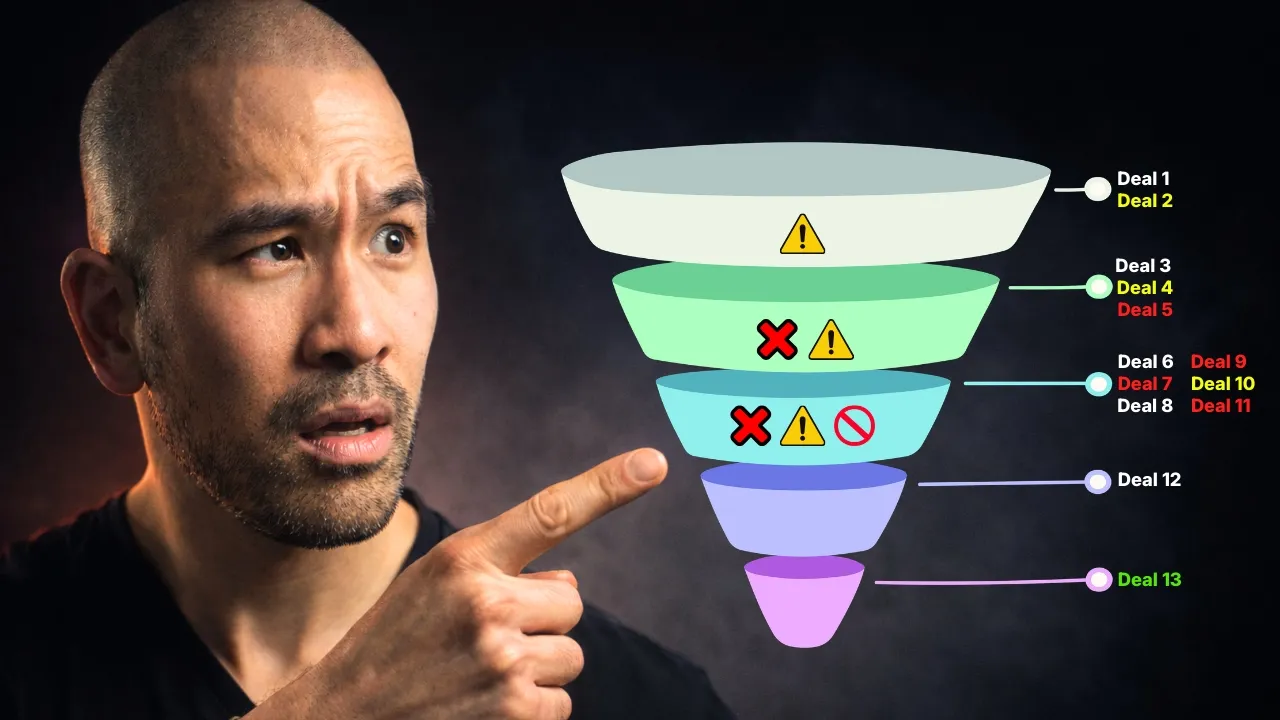
86% of B2B purchases stall during the buying process. Not lose to a competitor, but stall like die on the vine. No decision.
And 77% of buyers describe their last purchase as very complex or difficult. And sales cycles, they've lengthened 22% since 2022. The average BB sales cycle is now 84 days.
And for deals over 200K, you're looking at 230 days or more. So, let me translate this into what it actually means for your revenue. Your reps are entering the game late.
They're selling to committees they can't see. They're competing against do nothing. and the deals they do work are taking 22% longer to close.
That's a big reason why coattainment is stuck. But here's where it gets really interesting because the third uncomfortable truth is also the biggest opportunity. The third uncomfortable truth is this.
AI isn't optional anymore and most sales or using it wrong. 96% of revenue leaders expect their teams to be using AI by the end of this year. 87% of organiz are.
But here's what separates the winners from everyone else. It's not whether you adopt AI, it's how deep you go. And Gong's research found something really fascinating.
Organizations where AI is a core strategic pillar saw 31% higher revenue growth, 65% more likely to increase win rates, 2. 6x higher commercial impact scores, and 77% more revenue per rep. But the organizations running, you know, limited pilots, they saw almost none of those gains.
Depth beats breath every time. Here's another insight most people miss. Revenue specific AI massively outperforms general purpose tools.
So teams using AI built specifically for sales, not just like chat GPT, reported two times more likely to adopt strategic use cases like forecasting and predictive modeling. 13% higher revenue growth and 85% higher commercial impact. Why?
Because generic AI doesn't understand your sales language, your workflows or your performance metrics. Domain specific AI does. So let me tell you where this is all headed.
2026 is the year of agentic AI. If 2025 was about co-pilots, you know, AI assisting your reps, 2026 about AI agents autonomously plan, decide, and act. And 95% of seller research workflows begin with AI by 2027.
The AI agent market is projected to grow from 7. 5 billion today to 199 billion by 2034. So what does this actually mean for you as a sales leader?
This means you need an AI ops function. Someone accountable for making sure your AI agents have the right data, follow compliance standards, and don't duplicate or contradict each other. Like if you don't build this, you'll have chaos.
Different tools doing different things, no single source of truth. Reps drowning in these AI powered tools, they don't talk to each other. But AI isn't the whole story because the fourth uncomfortable truth is about you.
And here's what it is. There's a massive leadership gap and it starts at the very top. I hope you're ready for this.
Only one in 10 CEOs believe their chief sales officer or revenue officer is AI savvy. 1 in 10. Yet only 23% of the CSO and CRS report being accountable for driving AI initiatives.
This is a leadership crisis hiding in plain sight. But it gets deeper. For the first time ever, productivity and efficiency rank as the number one priority for revenue leaders.
Not customer expansion, not market expansion, productivity. Leaders have finally figured that growth won't come from adding headcount. It has to come from getting more output per rep.
But now here's where the opportunity lies. Gardner identified three traits that make sellers 3. 7 times more likely to hit quota.
Number one is growth mindset. Number two is tactical flexibility. Number two is AI partnership skills.
So 3. 7 times more likely to hit quota. So what are companies looking for when they hire?
Now Gardner has analyzed nearly 40,000 job postings. Only 6% mention AI related skills, but 98% still require years of sales experience. So, a lot of them are hiring for the past, not the future.
And it's not just hiring, it's your frontline managers as well. 40% of revenue execs report their managers are not consistently meeting expectations. And here's a really painful part.
Managers can improve seller performance by up to 6x, but most aren't set up to succeed. And there's really three barriers. First, a lack of role clarity.
Over half of managers say their daily work doesn't even match their job description. Second, flawed promotion practices. 75% of companies promote high performing sellers into management even when they lack the right skills or mindset for leading.
And third, insufficient support. 46% of managers lack datadriven coaching insight. So, here's a fix.
Managers with clear expectations are 3. 2 times more likely to have a strong team performance. Managers with proper technology support are 5.
9 times more likely to drive results. You can't fix quality by pressuring your reps. You have to fix the system they operate in.
Starting with the managers. And let me show you why all this matters more than ever which is the fifth truth. The opportunity has never been larger.
$36 trillion. That is the projected B2B ecommerce market by 2026. 80% of B2B interactions will happen through digital channels.
75% of buyers prefer rep-free purchasing for routine decisions. Now, here's a paradox. Despite all that digital presence, the human element still matters for complex deals.
75% of buyers will choose persontoperson interaction over AI only when making major decisions. 87% of sales people believe inerson connections are critical to closing. And companies with hybrid models, so AI for scale, humans for trust, see 50% higher revenue growth.
Outside sales achieves 65% quote versus 55% for inside sales. So AI isn't replacing your reps, it's reshaping their role. When Gong asks about AI's three-year impact on revenue headcount, 43% expected to transform jobs without reducing headcount.
21% see AI creating new jobs and 28% anticipate some job eliminations. 8% predict minimal impact. So AI is shaping jobs, not necessarily taking them.
So the question isn't whether AI will change your sales or it's whether you'll be the one leading the change or reacting to it. So what do you actually do about this? Now I have worked with hundreds of sales exeacts.
So let me give you the five strategic moves to make in 2026. Number one, elevate productivity to a board level priority. Stop treating productivity as a midyear initiative.
Treat it like you would treat a product launch. That means define the metrics, build the systems and measure continuously. Growth isn't coming from expansion alone.
It's come from output per rep. Make that a seuite conversation. Number two, move beyond AI experimentation.
Pilots are over. It's time to commit. Organizations that make AI strategic pillar are seeing 30% plus higher revenue growth.
Organization running experiments see almost nothing. So build an AI roadmap that spans from tactical automation like email generation to strategic decision intelligence like forecasting deal prioritization. Half measures don't work here.
Number three, invest in domainspecific revenue AI. Like generic AI tools are fine for like writing emails, but for like forecasting, coaching, decision support, you need AI to understand sales. Revenue specific AI accelerates insight delivery, improves forecast accuracy, increases seller capacity.
General tools don't. So, audit your tech stack. Ask, "Does this tool understand my sales workflows?
" If not, replace with one that does. Number four, build your RevOps foundation. 75% of the highest growth companies will have formal RevOps function by the end of this year.
Organizations with RevOps alignment see 19% faster growth, 15% higher profitability, 36% more revenue, 71% higher stock performance. And yet 58% of companies site process alignments as a primary growth barrier. You can't layer AI on top of a broken foundation.
So fix the foundation first. Align your people, processes, and technology around unified data. That's what RevOps does.
And number five, redesign your talent strategy for AI partnerships. Stop hiring for just experience alone. Start hiring for that actual potential.
Look for people with a growth mindset. Are they adaptable? Tactical flexibility.
Can they adjust to changing conditions? AI partnership skills. Can they work with AI tools effectively?
And of course, simplify your role so AI handles the busy work. In humans, focus on what humans do best. Building trust, navigating politics, and closing complex deals.
So that's the state of B2B sales in 2026. Traditional playbooks are dead. Quota attainment is stuck at 42%.
Sales cycles stretch 22%. Deals sell the same stages quarter after quarter. But the opportunity $36 trillion and it's going to be to the teams that adapt.
The teams that embrace AI [music] deeply that rebuild their buyer engagement models that redesign their talent strategy for the new world. Those five strategic compar shared elevating productivity move beyond experimentation invest in domain specific AI build revops and redesign talent strategy. That's your road map.
Now, if you want the full state of B2B sales 20 times report with all the data, all the sources and deeper analysis each of these sections, I put together the 17page strategic health report, you can download right below, links in description below. And of course, if you are a CRO or VP sales running an organ at least 25 million up to 150 million and you're realizing your team is stuck in the low 40s because you don't have a system that new buyer journey, I want to offer you something. My team and I run what we call an executive revenue leak snapshot.
It's about 45 minutes. We look at your pipeline data, identify your top three revenue leaks, and give you a one-page finding number you can take straight to your CEO or the board. And here's my guarantee.
If you don't rate this working session a 9 out of 10 for usefulness, we'll pay your hourly rate for the time you spent. That's how confident I am you'll walk with more clarity you didn't have before. Link is in the description below.
Until next time, I'll see you in the trenches.











![HARVARD Negotiators: How to Get What You Want Every Time [Getting to Yes]](https://img.youtube.com/vi/BLBRRNwMZNE/mqdefault.jpg)