Good evening! Apologies. There are several ways to apologize.
The most common way today is to create a selfie video apologizing to those who felt offended, after all, "it wasn't my intention, and those who know me are aware that I've never harmed anyone. " There's a formula for apologies nowadays. My favorite so far was from Mauricio Souza, not the illustrator but the volleyball player, who, after making a homophobic post, said: Hey, everyone.
How's it going? This is Mauricio Souza. I'm here to apologize to everyone who felt offended by my opinion, you know.
. . for standing up for what I believe in.
. . It wasn't my intention.
Just like you all defend what you believe in, I also have the right to defend what I believe in. I'm sad about everything that's happening because, unfortunately, we can't express opinions anymore, we can't prioritize values above all, family values, personal beliefs. Thanks to all who supported me and think like me.
And today I saw that I'm not alone in this fight. Yes: it's an apology that gradually turns into a hint, then it turns into a scolding. "I'm sorry if I offended someone by being right, but I'm deeply sorry for being so right, what matters is that I'm very sorry for being so awesome.
" But I don't want to talk about this kind of apology, but rather excuses, which are a kind of pre-apology, something we invent to avoid doing something we really don't want to do. I often use my daughters as an excuse. For example: "Well, I'd love to drive twelve hours to go to your gender reveal party, but we don't have childcare arrangements.
" In fact, I think that's the main reason people have children, so they have no one to leave them with. Not having arrangements is the best reason to have kids because you get a preemptive habeas corpus. Yes, a child is a kind of Gilmar Mendes in your life.
Everyone uses the excuse that's most convenient. Excuses are like the wild card in the deck of intentions, and they can be used in any situation. For example, the governor of Minas Gerais, Romeu Zema, under the pretext of advocating for the prominence of the southern and southeastern states, has increasingly been supporting a South-Southeast alliance, as in this interview from last month, where he calculated how many representatives a president from the south or southeast would have in the chamber: Today we have there half of the federal deputies minus one.
Half of 513 is 561. . .
So we have 561 deputies there. . .
Five hundred and. . .
I think I made a mistake. . .
My mental math is failing me here. . .
556! Now it's the right number, right? If he were a stoner, they'd blame the weed.
If he were. . .
If he were a heavy drinker, it'd be the alcohol. But what's Zema's excuse? Did he eat too many Brazilian cheese breads?
What justifies this? He has no alibi! He's an heir.
And if there's one thing an heir should know, it's how to divide things in half. That was the only thing I expected from you, a division in half, but no! And dividing has been Zema's obsession.
Yes, in a move that has been seen as a pretext for him to make his candidacy for the presidency in 2026 viable, Zema advocated for a coalition of the southern and southeastern states against the northeast. And indeed, with his statements, he has managed to bring together a lot of people against him! That's a true broad coalition!
From Flávio Dino to Aécio Neves, from Marina Silva to Rodrigo Pacheco, who said Zema should apologize, and Zema responded to these criticisms like this: There's my interview. I think we had a very unfortunate headline, so I have a clear conscience. I'm here working, and there are people stirring up trouble.
So I think Brazil will benefit more if we have politicians working instead of making this kind of comment, which, in my opinion, is not very appropriate. "There are people stirring up trouble. " This is the first time I've seen someone dropping a hint to themselves.
Maybe Zema has a split personality. If we divide his personality in half plus one, what's left? 561 neurons.
What's left? No, 556! Five hundred.
. . Sorry about my mental math.
But Zema hasn't only received criticism. After all, the separatist movement in the south loved the idea. The president of the movement "The South is My Country" praised the initiative.
It's quite curious because they wanted to separate from Minas Gerais too, considering the group's name isn't The South and Southeast are My Country. So, there's going to be a separatist movement within the separatist movement. And probably, there will be people from Minas wanting to split the state in two as well.
And if Zema is left in charge, Minas will stop being "General" and become "Specific Mines. " And why am I talking about pretexts, Zema, southern protagonism, and separatism? Well, if you've ever watched Greg News, you know that the first few minutes of the show are always used as a pretext to introduce the episode's theme.
We always talk about trivial matters before diving into a challenging subject. It's like. .
. It's like borrowing money, this show. And that's why we used Zema as a pretext to talk about the southern states and then to focus on one specifically: Santa Catarina.
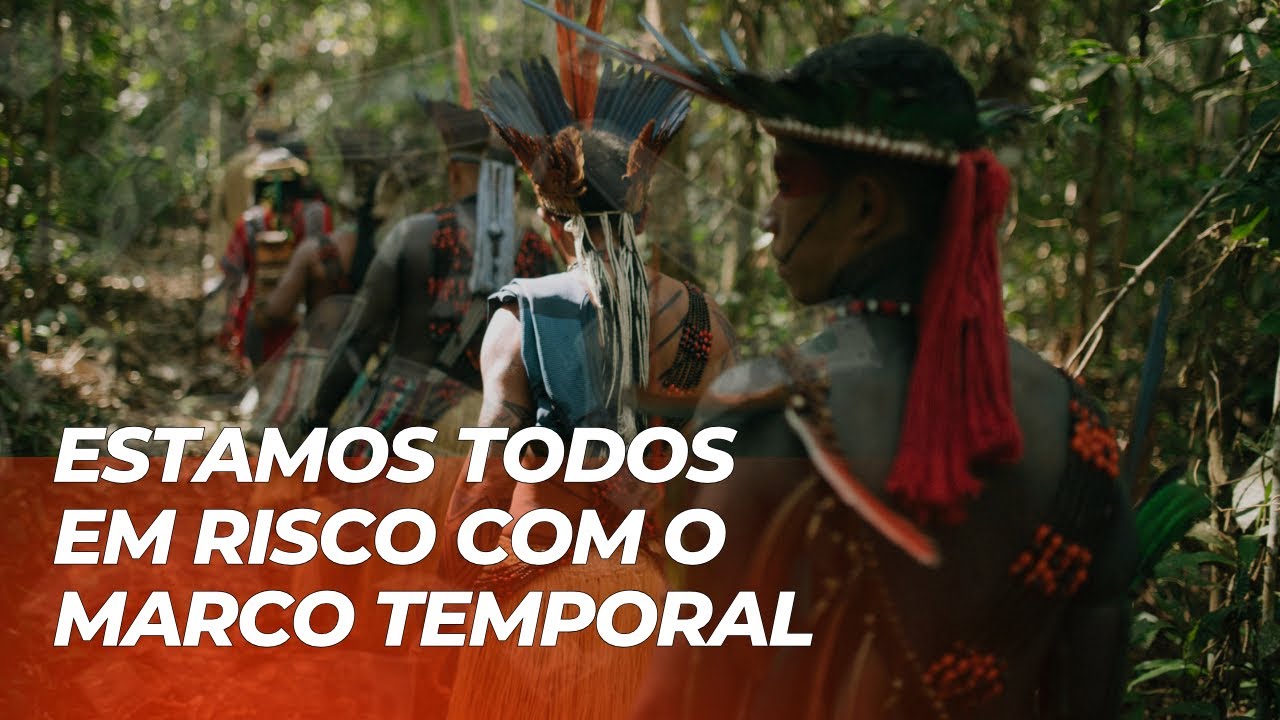
No, today's show won't have anything to do with a Nazi cell in Blumenau, snow in Bom Jardim da Serra, or Jair Renan's nightlife in Balneário Camboriú. It's related, as strange as it may seem, to the fate of indigenous territories throughout Brazil. The demarcation of any indigenous land that hasn't been homologated yet, whether in Pará, Acre, or Amazonas, directly depends on a judicial action that will decide the fate of an indigenous land in Santa Catarina.
And yes, there are many indigenous people in Santa Catarina, and no, they don't resemble Cláudio Heinrich in Uga Uga at all. They are real indigenous people, not a pretext for Carlos Lombardi to write a shirtless men-filled soap opera. Yes, he was the same author of the soap opera Kubanacan, set on a Caribbean island with a shirtless Marcos Pasquim, or Quinto dos Infernos, where Brazil's independence is declared by a shirtless Marcos Pasquim.
He invented an entire dramatic genre known as "shirtless story. " But seriously: I'm talking about the Supreme Federal Court's judgment of an extraordinary appeal known as the "marco temporal" thesis. And no, the "marco temporal" thesis isn't the conclusion of an Italian named Marco Temporal's doctorate.
It could be, because we found out there is an Italian named Marco Temporal. Just as there is a Brazilian named Marcos Temporal. You can look them up on Facebook.
And if the STF were debating the "Marcos Temporal" thesis, in that case, they would truly be referring to Marcos's thesis. You can see the difference a single letter makes: the "s," in this case. Yes, I studied Literature.
This term "marco temporal" emerged in 2008 during a trial about the boundaries of the Indigenous Land Raposa Serra do Sol, in the highlands of Roraima, near the borders of Brazil, Guyana, and Venezuela. Raposa Serra do Sol had been demarcated three years earlier through a decision made during Lula's first term as president. However, its size, 4.
3 million acres, nearly the size of the state of Sergipe, led to the removal of many illegal miners and farmers who were exploiting the land. This land, obviously, had been occupied illegally. In response, a senator from the PT party, from Roraima, decided to challenge the demarcation in the Supreme Court.
Yes, it was a PT senator who first questioned the demarcation by the PT government. The PT was so dominant in the early 2000s that it played the roles of both the government and the opposition. The case was tried, and the demarcation was upheld, but with a side effect: the vote of former Minister Ayres Britto, the rapporteur, inadvertently hatched the serpent's egg.
And here I'm making a self-critique, as "serpent's egg" is a speciesist term. Speciesism, for those who don't know, is prejudice against other species. I confess, I'm afraid of snakes, but that's me.
For a raccoon, for example, a snake's egg is a delicacy. I have a lot of respect for raccoons, because they do this: Yes, the raccoon does what the PT was incapable of doing: teamwork. Getting back to the subject, To be more precise, what Ayres Britto hatched was an egg of the ruralists.
Because he said that the demarcation of the indigenous land Raposa Serra do Sol makes sense for complying with the constitutional timeframe, as these indigenous people were there on October 5, 1988. So, he voted in favor of the indigenous people, but used a criterion for demarcation that was not in any law and that ended up being a legal gift for the ruralists. Yes, he wanted to help, but he increased the conflict, typical Aries.
. . Maybe that's why he's called Aries Britto, right?
No? It's not that? Now, why was the timeframe.
. . No, that was terrible, let's not applaud this.
For fuck's sake! Show some respect. Goddammit.
. . So lacking in judgment today?
Applauding this kind of pun? Come on! Now, why was the timeframe thesis a gift for the ruralists?
Because the 1988 Constitution states that indigenous peoples have "original rights over the lands they traditionally occupy," and then explains that "traditionally occupied lands" are those "where they live, work, or those necessary for their physical and cultural reproduction, according to their uses, customs, and traditions. " It says nothing about indigenous people having to be in that territory at the moment of the Constitution's promulgation, especially because when the Constitution was promulgated, many indigenous people no longer lived in their own territory, or lived there, but in a much smaller part. Because they had been expelled, or fled to avoid being decimated, especially during the dictatorship, which had just ended.
And one of these peoples were the Xokleng, from Santa Catarina. The Xokleng lived in an area that extended across the three southern states. Yes, long before it became a trend, they could already say: "the south is my country.
" But they didn't say it, because they had other things to do. They occupied this vast land until the beginning of the 20th century, when the national policy of populating the region with European immigrants intensified. These immigrants were attracted here with the promise of free or cheap land.
However, these lands had owners: the Xokleng, the Guarani, the Kaingang, the Xetá, and many other indigenous peoples who lived there. That's right, the Brazilian state was born as a real estate agency for stolen land. The Brazilian state has always been a bit like Mauro Cid, selling things to foreigners that weren't his.
To fulfill the promise made to immigrants, the state then undertook an official policy of exterminating the indigenous population. Darcy Ribeiro recounted this in the book "Indians and Civilization," where he talks about the "bugreiros. " This was the name given to the militiamen paid by the state to exterminate the indigenous people.
And this wasn't in the 16th century: this policy lasted until the 1940s and was endorsed by the local press. A newspaper in Blumenau called "Der Urwaldsbote" daily advocated for the massacre, under the argument that indigenous people "were incapable of evolution and of building a civilization in those woods," and therefore "had to be exterminated. " And if you want to know what "Der Urwaldsbote" means, it means "Jovem Pan" in German.
Crazy, right? No, I'm kidding. It means "messenger of the forest.
" It sounds more like a website that sells mushrooms than a Nazi newspaper. But, with this, the indigenous population was being decimated. Yes, the Xokleng, who had already left Rio Grande do Sul to escape genocide, ended up settling in an area in the country, 62 miles from Blumenau, called Vale do Itajaí.
There, they stayed in an area of 34,600 acres until 2003, when FUNAI demarcated the indigenous land Ibirama. Now the judicial case begins. The decision by FUNAI in 2003 determined, based on research conducted with three indigenous peoples of that region, that the demarcated territory would encompass 91,429 acres, roughly a quarter of the size of the city of São Paulo.
It's not that there were indigenous people occupying the entire area. However, FUNAI understood that historically, this was the area corresponding to the culture of the Guarani, Kaingang, and Xokleng, even though at that moment they only occupied 34,600 acres. Yes, because for indigenous people, land is not just territory, it gives meaning to cosmology, traditions, and culture in the broadest sense, which is why demarcation doesn't rely solely on geographical criteria.
It's understandable. The logic is that a person doesn't need to be physically present in a place to feel a part of it. A person from Rio hardly ever visits the Corcovado or the Sugarloaf Mountain, no one from Rio lives there, but none of them can imagine Rio de Janeiro without the Sugarloaf or Christ the Redeemer, as they are part of our culture.
And they have our culture: after all, there you'll face endless lines and pay R$20 for a cold cheese bread. That's Rio de Janeiro. Bolsonaro himself, it's the same thing.
He doesn't need to be in jail to already feel like a part of jail. Got it? But.
. . getting back to the point, the demarcation of 91,429 acres posed a new problem for the Xokleng, because a portion of this territory, 1,000 acres, ended up overlapping with an environmental reserve of the State of Santa Catarina, the Sassafras Reserve.
So far so good. There are over 60 similar cases of overlap between environmental reserves and indigenous land, just in Brazil. However, in 2009, the Santa Catarina Environmental Foundation decided to sue FUNAI, claiming that around a hundred indigenous people had cut down trees in the reserve, which in this case were also trees from the indigenous land, meaning that limited and rule-bound cutting was allowed.
And yes, Santa Catarina is such a pro-Bolsonaro state that even its environmental foundation opposes the indigenous people. In the lawsuit, the Foundation demanded the restitution of the acres of indigenous land that were within the reserve. But if this restitution happened, it would set a legal precedent against the demarcation of the 91,429 acres.
And a lot of people were interested in this precedent, because the demarcation had already been contested, with a request for total annulment in another Supreme Court case, opened by a rural producer from the region and 308 other plaintiffs, including the Odebrecht wood company. Yes, Odebrecht screws you in every corner and with every element of the periodic table. It's a kind of reverse Captain Planet.
Cement, wood, bribery, rock salt, plea deals! It's something. .
. wherever you look, there's a creative way to screw you over. But back to the Xokleng: the cut trees were just a pretext.
What everyone seemed to want was for the indigenous people to return to the 34,600-acres area, the one they occupied at the 1988 timeframe. And the worst part is that FUNAI and the indigenous people lost in the first instance and in the TRF 4, that very same court that upheld most of Moro's decisions in the Car Wash operation. Yes, they are the Odebrecht of the courts.
In 2016, the case reached the Supreme Court, and since there were several similar cases pending in the court, Minister Edson Fachin suggested that it be considered of general repercussion, meaning that whatever was decided there would become the rule for any dispute over indigenous land being judged in any court in the country. Yes, a case initiated by the State of Santa Catarina will decide what happens to the indigenous peoples of the Amazon. It's like Havan, a shitty idea someone had in Brusque, and suddenly, there's a Statue of Liberty in Acre.
But that's why this case is so important. Because if the Xokleng win, it establishes that the criterion for demarcation is a cultural one, based on the history and customs of each people. But if they lose, as they have already lost in two instances, then the physical criterion is what really matters.
The expression "physical criterion," it sounds like Claudio Heinrich in "Uga Uga" is going to be granted land. But in this case, the criterion used is that of physical presence. And with a precise date.
They only have rights to the land they were occupying on October 5, 1988, when the Constitution was promulgated, the so-called timeframe. Here's a thing to note: there are some "people" who think that if the timeframe thesis is rejected, indigenous people will be able to reclaim half of the country, because the whole of Brazil belonged to them. And when I say "people" in quotes, I mean Bolsonaro: If the Supreme Court decides for the new timeframe, it means that today we already have an area the size of the southeast region marked out for indigenous land, 14% of the national territory.
If the Supreme Court decides for the new timeframe, all these hundreds of requests to demarcate indigenous land. . .
Legally, I'll have to do it. . .
This means that if we demarcate for these new hundreds of indigenous reserves, it will be equivalent to a region the size of southern Brazil. Imagine adding an area the size of Rio Grande do Sul, Santa Catarina, and Paraná. Adding to the existing area of São Paulo, Minas Gerais, Espírito Santo, and Rio de Janeiro.
First of all, I was impressed that he got the southern states right. He's doing better than Zema. Zema would have mentioned Mato Grosso do Sul, too.
"Well, isn't it in the south? Isn't Mato Grosso do Sul in the south? Why not call it Mato Grosso in the Middle?
If it's in the South, it's in the South. . .
" But no, Bolsonaro! What you're saying is a lie. Because indigenous lands will continue to occupy the same area if the timeframe is rejected.
Because the percentage he mentions, 14%, already includes lands that are being demarcated, even in the initial stages. For example, this year, Lula homologated six indigenous lands, and that didn't change the percentage at all. And it's worth remembering that the indigenous people aren't asking for half the country back, nor are they asking for economic compensation, or for the descendants of Europeans to sail back to where they came from, or for Xuxa to apologize for the song: "let's play Indian.
" After all, they know that she would just blame Marlene. Indigenous people are only asking for one thing: that if a land meets all the criteria for demarcation, which are numerous, that demarcation shouldn't be vetoed if they can't prove they were exactly on these lands, and exactly at the end of the military dictatorship. If the timeframe is defeated, the whole of Brazil will not become indigenous land: demarcating land will continue to be a long, complex process with many stages.
On the other hand, if the timeframe is approved, we will lose indigenous land: lands that have already been homologated will be legally contested, and it will become very, very difficult to demarcate more lands. And this isn't just a disaster for indigenous peoples: it's a disaster for everyone. In the last 30 years, indigenous lands have only lost 1% of their native vegetation area, while in private areas, the loss has been 20.
6%. Yes, while politicians and companies debate sustainability, transition, and carbon emissions, indigenous people have long been at the forefront of environmental protection, often safeguarding the largest reserves of standing forests in the world. The judgement of the timeframe has already begun and has had three votes so far.
The first was from Minister Edson Fachin, the rapporteur, who voted for maintaining the rights of indigenous people, thus, against the timeframe thesis. Then came Nunes Marques, who obviously voted to revoke indigenous rights. Xandão, on the other hand, voted for the indigenous people, which he had a moral obligation to do after this scene: Minister Alexandre de Moraes Minister Alexandre de Moraes I had this song stuck in my head all day.
Minister Alexandre de Moraes. . .
Anyone looking at me must think I'm completely crazy, and I am. I believe that this was the exact moment when Xandão's journey of redemption began. This was the timeframe of his transformation.
And I think instead of going through an interrogation, every minister should go through a shamanic ceremony. It should be mandatory. I really want to hear: "Minister Cristiano Zanin.
. . " But seriously now: Xandão's vote is against the timeframe thesis.
Great. But life is not just flowers. There's also a lot of boof weed.
Alexandre de Moraes's vote creates a new problem. And a problem so bad, but so bad, that legal experts have nicknamed it the "third way. " I swear.
Currently, when a landowner vacates a piece of land due to the establishment of indigenous territory, they can only be compensated afterwards, and only for the value of the improvements made on that land. This makes sense, as the land wasn't theirs, it belonged to the State, and the State can't compensate a person for expelling them from an area they didn't even own. It's the famous: "you shouldn't even have been here, dear.
" So, what Xandão proposes, in an attempt at compromise, the so-called third way, is to overturn the timeframe criterion, but in return the government compensates the farmers for the land they occupied, for the price per acre, not just the expenses of the improvements, even on lands that were invaded and already belonged to the government. In theory, this accounts for the landowner who acquired the land in good faith in the past. But in practice, Alexandre de Moraes's vote is a bomb.
Firstly, because there are many invaders who claim to be legitimate farmers. Secondly, because the government can't compensate everyone who claims ownership of land that was already government-owned. And thirdly, because Xandão insists it has to happen beforehand, that is, before demarcation.
And if the government can't compensate, the indigenous people won't have the right to their land. In short, Xandão's third way is as harmful as the timeframe itself, as it could render any future indigenous land demarcation unfeasible. Like any third way, it's a vote that seems progressive but, in practice, is conservative as fuck.
It's like family constellations. Apart from that, there's another parallel issue with Xandão's vote. An issue called André Mendonça.
In June, the minister requested an extension on the case, and it's been over two months of stagnation. Big deal! Except it's not a great deal for us.
The problem with that is that Rosa Weber is retiring at the end of September, and she said that she intends to vote in favor of indigenous rights. However, for this vote to take place, André Mendonça needs to return the case for judgment promptly, before her retirement. In other words, Brazil has to rely on the goodwill of a man who was a minister in a government proud of not demarcating a single inch of indigenous land.
Why is Rosa Weber's vote important? André Mendonça is expected to vote in favor of the timeframe thesis, meaning against indigenous rights. Barroso and Carmen Lúcia are expected to vote in favor of indigenous rights.
Gilmar Mendes, based on his history, is likely to choose the side of ruralists or perhaps even the third way, since it financially rewards ruralists. In theory, it's expected that Fux, Dias Toffoli, and Zanin will oppose the timeframe thesis, but we can't be sure. Hence Rosa's urgency.
She knows her vote could be pivotal, crucial, and she doesn't want to retire before casting it. Then I ask: if Rosa Weber, reaching the age of 75, insists on taking a stance on this matter, what are we, who are mostly younger than the minister, supposed to do? I'm being quite serious.
Because up to now, very few people outside the indigenous movement have been mobilized to support it. And this silence, this apathy, is as serious as the timeframe thesis itself. What the indigenous people are asking for is just some respect for their history, some recognition and territorial dignity so that they don't lose even more of their original relationships with this land.
Those who agree with this need to mobilize, and quickly. When we recorded this show, the judgment was stalled, and André Mendonça had not yet returned the case to the plenary. In the worst-case scenario, it should happen by the final deadline, which is September 5.
From then on, the judgment needs to be resumed. And by one of those coincidences of fate, September 5 is Amazon Day. The indigenous territorial issue concerns the entire country, but it's in the Amazon where it becomes most clear that the fate of the indigenous people is fully tied to the fate of the forest, and consequently, of the whole world.
And if even the survival of the species isn't enough to mobilize you, there's an even more important reason. We have to do this because it's the minimum. We have to do this because the indigenous people have been fighting for centuries for the right to continue existing.
Amidst so many separatist movements and attempts to divide Brazil, we should be united to guarantee the rights of those who were here before us. After centuries of extermination, demarcation serves not as an apology, but to offer something much more valuable: justice. That's why, at the beginning of September, we need to mobilize.
And there's a way to do it: indigenous and non-indigenous organizations are creating events all over Brazil to take to the streets and pressure the Supreme Court to do the right thing. "Oh, but Greg, September 5 is a Tuesday, I have to work. " That's a lie, that's an excuse!
No, I know it's not, I know you have to work, I also record this show on Tuesdays. But there will be events happening the entire week, from September 2 to September 10, just before and just after the judgment is resumed. And you can also create your own event in your city and invite others to participate.
In other words, don't even say you don't have childcare arrangements. You can organize an event with the kids. All the events are listed on this website: virada.
amazoniadepe. org. br.
To find one, or to register your own, or to get ideas of what to do, or to know where to send photos and videos of your event, just go there now. Yes, this applies even to those in Santa Catarina. Or Minas.
Let's show that, just like raccoons, we know how to work as a team. This was Greg News! See you soon!