Hey guys, fair value gaps form great trading opportunities on the chart. However, not every gap is a good one to trade. In this video, we're going to explain what makes a fair value gap highquality and worth trading.
We'll also share a strategy we've developed using smart money concepts called fair value gap in fair value gap. Additionally, we'll provide multiple real chart examples. If that sounds interesting to you, make sure to hit the like button to support us in making more videos and subscribe to our channel if you're new.
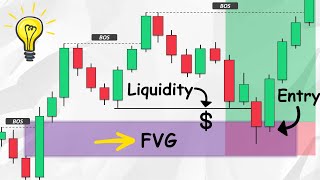
Starting with the basics, we all know that a bullish fair value gap is a space between the upper wick of the first candle and the lower wick of the third candle in a three candle sequence. Similarly, a bearish FVG is a space between the lower wick of the first candle and the upper wick of the third candle. The color does not matter and they can be in any shape or size.
But what do fair value gaps show in terms of price action? A bullish FVG shows a buy side imbalance, meaning buyers were stronger than sellers, often because of big institutional orders. This creates an inefficient move in the market and the price will usually return to the fair value gap area to fill or mitigate it.
The same concept applies to the bearish scenario. As smart money traders, identifying the fair value gaps is one of the first things we do when we open the price chart. But why do we even need to mark them on the chart?
Fair value gaps show where big players have entered the market and push the price strongly. When price returns to these gaps, we often see reactions that can give us a good trading opportunity. Here on the pound dollar 1 hour chart, price tapped into the bearish fair value gap and moved to the downside.
Then it formed another FVG and rejected to the downside again. On the Euro Dollar 1 hour chart, you can see how many times the price reacted to the fair value gap before the reversal happened. We can apply this concept to all time frames.
Even on the daily chart, you'll see that the price also forms FVG areas. This particular gap was created by strong buying pressure and continuous upside momentum during the day. We expect the price to eventually return to this FVG and give us a long opportunity.
However, for a day trader, this zone is too large to trade. So, we need to zoom into lower time frames and refine it. Refining a fair value gap means zooming into a lower time frame to find a more accurate FVG inside the larger area.
For example, if we zoom into the 4hour chart, we can mark a 4hour FVG inside that large daily zone. This way instead of a large daily imbalance we get a tighter and more precise zone to work with. Now this refining method is not limited to fair value gaps.
You can use it to refine order blocks, supply and demand zones and more. Now we reach the next important topic. Which fair value gap should we choose to trade?
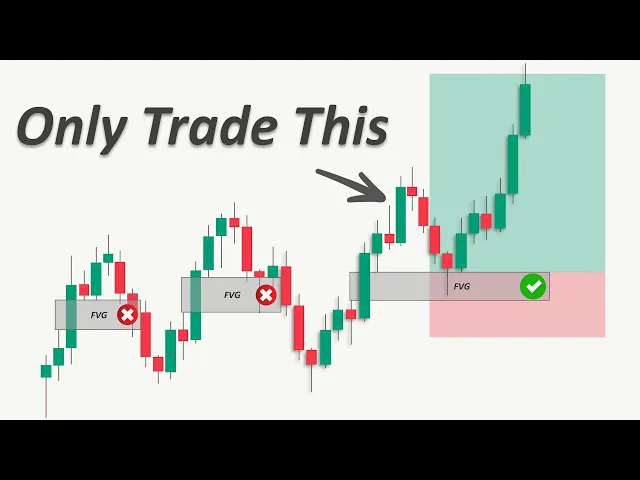
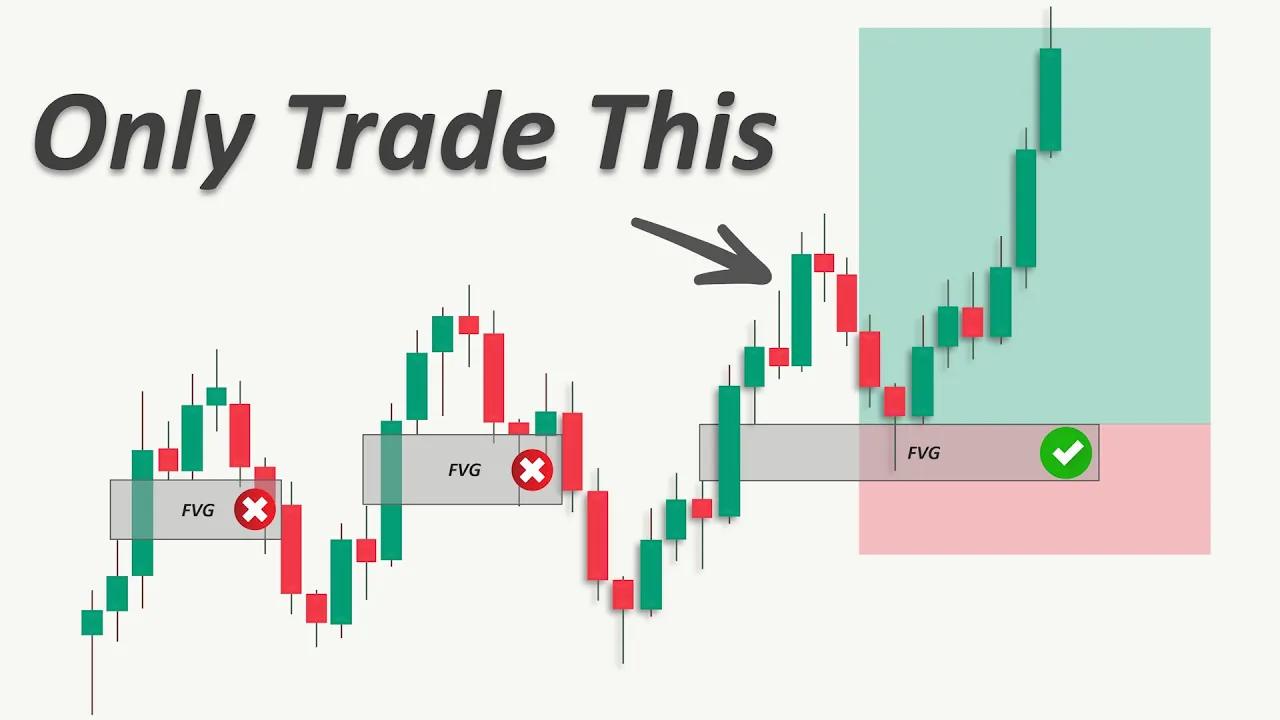
In this trading example, we have multiple fair value gaps marked on the chart. The trading idea is to wait for the price to enter these zones and look for buying opportunities. However, we are only interested in buying when the price taps into the middle one.
So, why are we not interested in trading the others? If we take the start and the end of the latest impulsive move and apply the retracement tool, you'll notice that the second FVG is located below the 50% level, which is the discount zone. While this FVG is located above the 50% level, which is the premium side of the range, we are only interested in buying in the discount zone for multiple reasons.
Usually the market loves to take out early buyers. So a safer way to enter a long trade is to wait for the price to enter the discount area. This increases the chance of success and reduces the risk of becoming a liquidity target.
Also, wherever we buy, the safest level to place the stop loss is below the swing low. Therefore, we want to keep our stop close to that level. Additionally, our first target would be the recent high.
So if we enter at the first FVG, there is simply not enough room for a proper reward. This method works best when the market makes deep retracements. The reason we are also not interested in buying at the lower FVG is that if price breaks below the swing low, the market structure shifts bearish and a long trade would go against the trend unless we identify this break as a liquidity grab, in which case price might still move higher.
The same concept applies to a bearish scenario. Here we have two fair value gaps. But if we apply the retracement tool from the start of the move to the end, we can see that only the higher one is located inside the premium zone.
So we are only interested in selling in the premium area. This ensures a safer stop-loss placement and allows for a higher reward. There are additional concepts that can be applied to the chart to improve fair value gap accuracy such as market direction, breakouts and reversals, liquidity, and more.
For the purpose of this video, we'll use the price action toolkit indicator to apply all of these concepts automatically on the chart. This indicator comes with a 30-day money back guarantee. So, if you ever purchase it and decide it's not for you, you can cancel and get your money back.
Later in this video, we will show you how we use it. But for now, let's continue with the second part of this video. The fair value gap in a fair value gap trading setup.
This trading plan consists of two major time frames. First, we have the higher time frame where most of the general analysis takes place. We will study the market structure to determine direction, key levels, liquidity areas, and most importantly, fair value gaps which serve as optimal trading zones and can potentially provide highquality setups.
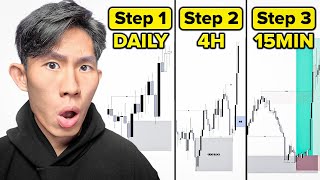
In the second part, we will zoom into the lower time frame to look for confirmations and execute entries. Remember, this trading plan is not limited to any specific chart or time frame. However, your entry time frame must be two time frames lower than your higher time frame.
Here are three time frame combinations you can use based on your trading style. For example, if your higher time frame is the 4hour chart, you should zoom into the 15-minut chart to execute the trade. As I mentioned, we have simplified this trading plan into two major parts.
So, let's begin with the first one, analyzing market structure on the higher time frame. In this general analysis, we apply smart money market structure concepts to determine market direction and key levels. To identify the direction, we look for breakouts, reversals, and liquidity sweep patterns.
Like I mentioned, today we're going to use the price action indicator. So, let's apply the break of structure chalk, chalk plus, and also liquidity sweep from the indicator settings. Now we can see that we have multiple breaks of structure to the upside indicating that the overall direction is bullish.
Then the market forms a liquidity sweep above the previous high signaling a potential reversal. This reversal is later confirmed once we get a break and close below this low which is called a change of character plus. It happens when price fails to create a new high and then breaks the swing low to the downside.
This tells us that buyers have failed to defend their positions and sellers are now in control. A bullish liquidity sweep happens when price moves below the area and triggers the stop losses and then quickly comes back above the range. When this happens, we expect a push to the upside.
Similarly, a bearish liquidity sweep happens when price engages liquidity above a swing point and then quickly returns below the range. When this happens, we expect a push to the downside. Bullish and bearish liquidity sweeps are marked respectively with green and red circles on the chart by the price action indicator.
Now remember, if you cannot clearly identify the market structure and direction on your selected time frame, it is better to move on to another asset. When market direction is unclear, the probability of making poor trading decisions increases. Switching to a pair with a clearer trend helps you stay disciplined.
The final step in analyzing market structure on the higher time frame is to identify highquality fair value gaps to trade. So let's mark the fair value gaps using price action indicator. The indicator does a good job of marking the latest FVGs without making the chart look too messy.
In the settings tab, increasing the sensitivity filters out smaller gaps and only shows the larger ones. After identifying the optimal trading zone, we wait for the price to tap into that area and then move to a lower time frame to look for reversal confirmations and execute the trade. This is the general approach of the trading plan.
Here is the checklist of concepts that we apply to the higher time frame. Now, the second part of this trading plan is to look for confirmations and execute the trade on the lower time frame. After waiting for price to enter our trading zone, we must see some form of confirmation that the short-term uptrend has ended and that price is ready to move downward.
To identify this reversal, we focus on liquidity sweep patterns and changes in market character. A valid liquidity sweep above the previous high indicates that a potential reversal may be forming. You can enter a short position at this point, place your stop loss above the high of the liquidity sweep candle, and target the key levels ahead of price.
However, for a more conservative approach, you can wait for price to break below the recent low to confirm the change in character. Once the reversal is confirmed, we wait for price to form new fair value gaps. This is why the strategy is known as FVG and FVG.
However, this does not mean that the lower time frame fair value gap must be located exactly within the higher time frame gap. The key point is that the higher time frame gap defines the optimal reaction zone while the lower time frame gap provides precise entry timing after confirmation. After spotting an FVG in the lower time frame, we set our sell limit at the start of the FVG zone and put our stop above.
For the first target, we make our trade break even by closing half our position when the price reaches our one to one target. The next target will be the first important zone in front of the price in the higher time frame. Now, before looking at real chart examples, I want to explain some common scenarios that happen on the chart and how to handle them.
In the first scenario, we have a very small fair value gap. When this happens, you should consider using a larger zone for your stop loss. So, it is protected from normal market fluctuations.
In the opposite scenario, we have a large fair value gap on the lower time frame. And the issue here is that placing the stop below this zone would result in a very large stop-loss. In this case, we can either use a smaller zone below the FVG as our stop or place our buy order in the middle of the zone.
By doing this, our risk-to-reward ratio improves significantly if the trade ends up being a winner. Now, let's move on to some real chart examples. On the Euro Dollar 1 hour chart, we were in a clear downtrend until we saw a liquidity sweep followed by a change of character.
Both of these signals indicate that sellers are no longer in control and that our directional bias has turned bullish. On this chart, we can identify two fair value gap areas, but only the one located on the discount side of the range is considered a valid trading zone for us. After identifying this area, we simply wait for price to return into the FVG and then zoom into a lower time frame to look for long trade opportunities.
When we move to the 5-minut chart, we can see that price creates a change of character by breaking above this level, which acts as our confirmation and reversal signal. At this point, we identify a new fair value gap on the 5-minut time frame and place our buy order at the beginning of the zone. Let's set our stop loss below it and target the next important zone in front of the price.
Let's see how this trade plays out. Next, on the CADEN 1 hour chart, we see a clear downtrend with multiple fair value gaps. But after applying the retracement tool, only one of these zones is a valid supply according to our rules.
Once we mark our trading zone, we wait for price to retrace back into the area and then zoom into a lower time frame to execute the trade according to our plan. On the 5-minute chart, price forms a change of character along with a fair value gap, giving us our entry setup. We place a sell order at the beginning of the FVG zone and set our stop loss above it.
As you can see, this trade ends up being a win. However, loss is part of trading. No matter how good your strategy is, losing trades are unavoidable and a loss does not mean that your analysis was wrong.
The most important thing is to clearly define your rules, stick to them, and follow proper risk management. As long as you do that consistently, you will be fine in the long run. So, that's it for this video.
I hope it provided value to you. If it did, please go ahead and hit the like button to show your support. And if you're new to the channel, consider subscribing.
I'll see you in the next episode.