Welcome class to video lecture number five in which we're going to look at the book of Romans. Today we turn to what is without exaggeration the theological heart of the New Testament. The Apostle Paul's letter to the Romans. If Galatians confronts us with urgency and sharpness, Romans invites us into the depth and deliberation of Paul. Galatians is written at the [snorts] heart of controversy. Romans is written with calm confidence of a mature apostle reflecting the gospel that has been preached for decades. Galatians is reactive. Romans is constructive. Galatians is Paul defending the gospel. Romans is
Paul displaying the gospel. Romans is the longest of Paul's letters. But length alone does not explain its importance. What makes Romans so central is that here Paul sets forth the most sustained, coherent, and comprehensive explanation of the gospel that's found anywhere in the scriptures. It is not merely a collection of theological insights or thoughts. It is a carefully structured argument that moves from human predicament to God's saving action, from justification to sanctification, from individual salvation to the cosmic purpose of God, and from doctrine to an embodied Christian living. The letter has shaped the church in
profound ways throughout all of history. Austinon was converted while reading Romans. Martin Luther wrestling with Romans ignited the Protestant Reformation. John Wesley's heart was strangely warmed through the book of Romans. Yet it Romans is not a museum piece preserved for its historical influence. It remains a living word because it addresses enduring questions such as what is wrong with the world? How can sinners be made right with a holy God? What place does Israel have in God's saving purpose? What is the role of faith, law, and obedience? And what does it mean to live as the
people of God in a broken world? Romans insists that the gospel is not merely a message about how individuals get saved. It is the announcement that God's righteousness has been revealed. that Jesus Christ is Lord and that God is putting the world right through him. It is about salvation, yes, but salvation understood as participation in God's redemptive purposes for all of creation. As we approach Romans today, it is essential that we read it not as a detached theological essay, but as a pastoral letter written to a real church in a real city facing real tensions
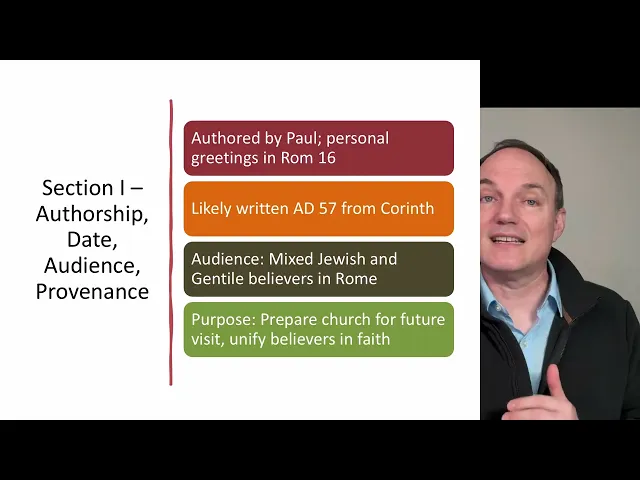
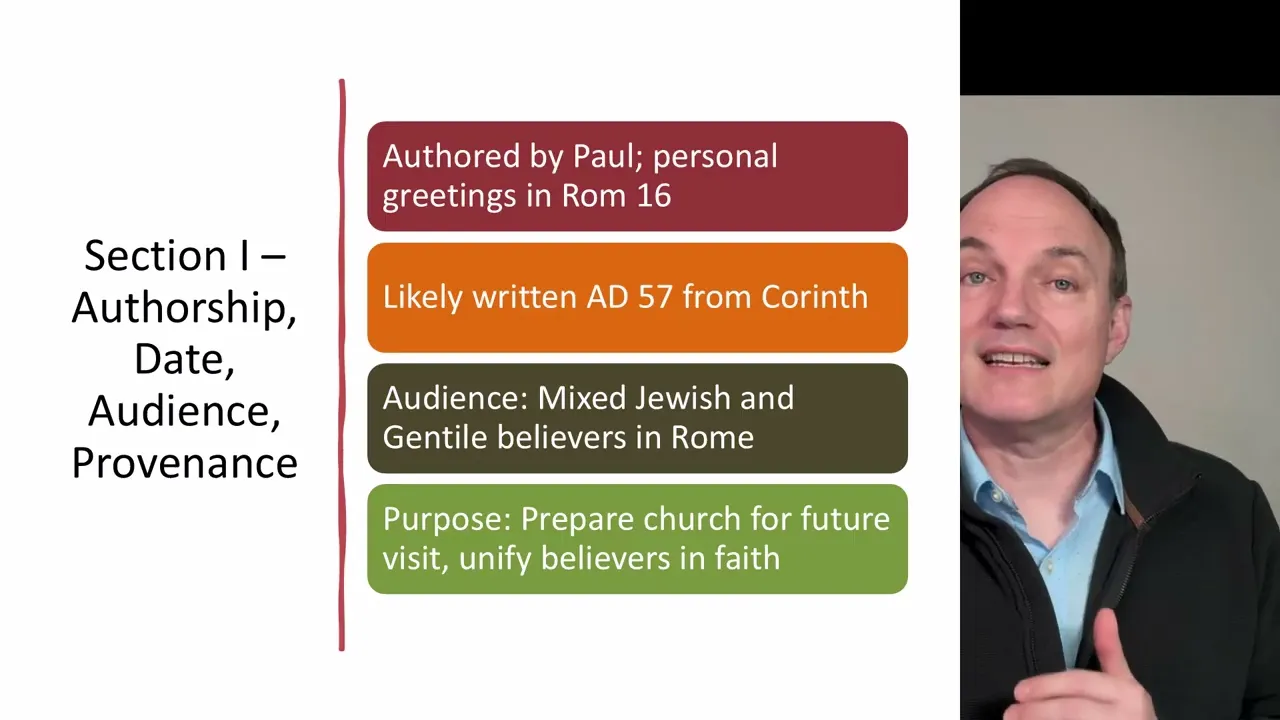
and challenges. Paul is not writing to satisfy abstract curiosity. He is writing to form a people to shape a community that embodies the gospel in its worship, unity, holiness, and mission. With that in mind, we begin where Paul himself begins by situating the letter historically and pastorally by asking who wrote it, when and where it was written, and to whom it was addressed. So, let's start with authorship, date, audience, and prominence. In terms of authorship, we believe that Paul the Apostle wrote Romans. The letter to the Romans is universally recognized as the work of the
Apostle Paul. Among the 13 letters traditionally attributed to Paul, Romans belongs within the group known as the undisputed Pauline epistles alongside 1 and 2 Corinthians, Galatians, Philippians, First Thessalonians, and Fleiman. From its opening words, the letter bears the unmistakable marks of Paul's authorship. Romans 1:1 reads, "Paul, a servant of Christ Jesus, called to be an apostle set apart for the gospel of God." The introduction is both modest and weighty. Paul identifies himself first as a servant, likely a slave of Christ, emphasizing his total allegiance to the risen Lord. Only then does he assert his calling
as an apostle. Unlike Galatians, where Paul must vigorously defend the apostolic authority against uh critics, Romans reflects no such anxiety. Paul writes with calm assurance. His authority is not contested here and therefore it is not aggressively asserted. Throughout the letter we encounter Paul's characteristic theological vocabulary, rhetorical strategies and pastoral instincts, the complex argumentation, the use of diet tribe, anticipating and responding to objections, the integration of scripture and the deep concern for the unity of the church. all align seamlessly with what we know of Paul from his other letters. Moreover, Romans fits coherently within Paul's missionary
career as recorded in Acts. The letter reflects a seasoned apostle who has labored effortlessly among Gentiles, wrestled deeply with the implications of the gospel for Jews and Gentiles alike, and now stands at a turning point in his ministry. What would be the date and writing location? Most scholars date the writing of Romans to approximately AD56 or 57, near the end of Paul's third missionary journey. At this point, Paul has spent years establishing churches across Asia and Greece. His missionary work in the Eastern Mediterranean is largely complete, and he is preparing for a new phase of
ministry. The internal evidence of the letter strongly suggests that Romans was written from Corenth during a three-month stay mentioned in the book of Acts chapter 20:es 2 and three. Several details support this conclusion. First, Paul commends Phoebe whom he identifies as a deacon of the church of Sincare. Sincare was the eastern port of Corenth making it highly likely that Phoebe carried the letter from Corinth to Rome. We see her name in Romans 16:1. Second, Paul refers to Gaes as his host in Romans 16:23. This is a name associated [snorts] with Corenth in 1 Corinthians 1:14.
Third, Paul mentions his imminent journey to Jerusalem to deliver the uh the collection to the saints, a journey that aligns precisely within the timeline in the book of Acts for when Paul was traveling through Corenth. This dating is significant. Romans is written after Galatians and before Paul's arrest in Jerusalem. It represents the mature theological reflection of an apostle who first preached Christ across the Roman world and now seeks to articulate the gospel in its fullest scope. The audience is clearly the church in Rome. Unlike most of Paul's letters, Romans is addressed to a church that
Paul did not found and has never visited. This alone sets the letter apart. Paul writes to a community he knows only indirectly through reports and personal connections. The church in Rome was composed of both Jewish and Gentile believers. And evidence within the letter suggests a complex and sometimes strained relationship between these groups. The historical background is crucial here. Around 49, the year AD49, the emperor Claudius expelled Jews from Rome due to disturbances related to Crest, likely a reference to disputes about Christ. Jewish Christians were therefore forced to leave the city. When Claudius died and that
edict was lifted, Jewish believers returned to Rome to find a church that is developed largely under Gentile leadership. This created tensions over the rule of the law, Jewish identity markers such as circumcision and dietary practices, and the meaning of God's promises to Israel. Paul writes Romans with these dynamics clearly in view. His extended discussion of justification by faith, the place of the law and the role of Israel is not theoretical. It is pastoral and unifying. Let's look at the provenence and significance of the letter. Then providence means where was it written from and why? Rome
was the political center of the Roman Empire. But the church there had no social power. The believers in Rome were a marginalized minority living under the shadow of imperial authority. They were vulnerable to suspicion and persecution. Paul's letter, therefore, prepares them to live faithfully under pressure to resist conformity to the world and to embody a gospel that proclaims Jesus, not Caesar, as Lord. In short, Romans emerges from a specific historical moment, yet speaks with enduring theological clarity. It is the gospel explained by the apostle who preached it most widely, written to a church at the
heart of the empire and intended to shape a people who will live for the glory of God among the nations. So, what's the purpose and occasion for the letter? Let's expand on that just a little bit. Having situated the letter historically by talking about who wrote it, when and where, and to whom it was addressed, we now turn to the critical interpretive question of why did Paul write Romans? What occasion prompted this most careful reasoned letter? It is tempting to treat Romans as a timeless theological essay detached from its circumstances. But Paul wrote Romans, like
all of his other letters, as an occasional document. It is theology written for pastoral reasons at a specific time. Paul is not merely thinking aloud. He is writing with intent, strategy, and concern for a specific community at a specific moment in salvation history. In fact, Romans is driven by multiple overlapping purposes, all of which converge around Paul's understanding of the gospel and his calling as an apostle to the Gentiles. So, there are at least three major purposes that shape the letter and together they explain both its content and its structure. The first is to introduce
himself and his gospel to an unfamiliar church. Unlike Corinth or Galatia or Philippi, the Roman church does not know Paul personally. They know his reputation but not his presence. This alone explains why Romans is so expansive and carefully argued. Paul is in effect introducing himself not by recounting his conversion story or missionary exploits but by laying out the gospel that he proclaims. Romans functions as a kind of theological self-introduction, an apostolic statement of faith written not as abstract terms, but as a coherent narrative of God's saving action in Christ. This explains why Romans move so
deliberately from sin to justification, from justification to life in the spirit, from individual salvation to the fate of Israel, from theology to ethics. Paul wants the Roman believers to understand not only what he preaches, but how his gospel accounts for the whole sweep of scripture and human history. This purpose also explains Paul's tone. Romans is measured, patient, and explanatory. Paul anticipates objections. He raises questions and then he answers them. He shows uh clarity by slowing down and clarifying key terms such as righteousness, law, faith, justification, and grace. He is not correcting a crisis so much
as establishing a foundation. In Romans, Paul is saying in effect, before I ever arrive to you, you need to know the gospel that I preach, the God that I serve, and the vision of the Christian life that flows from it. A second purpose is to secure partnership for a future mission further west. This is a second and equally important purpose which is missional. Paul writes Romans as he prepares for the next stage of his apostolic calling. By the time Romans is written, Paul believes his work in the Eastern Mediterranean is largely complete. Churches have been
established. Leaders have been trained. The gospel has taken root. Now Paul sets his sights westward towards Spain, the far edge of the known world. He writes in Romans 15:24, "I hope to see you in passing as I go to Spain and be helped on my journey thereby you once I've enjoyed your company for a while." This single verse reshapes how we read Romans. The letter is not only theological, it is strategic. Paul hopes that the Roman church will become a sending base for the mission to Spain. Just as Antioch once served as a sending base
for missions in the east, Paul knows that partnership requires trust, and trust requires clarity. The Roman believers must be confident that Paul's gospel is faithful to Israel scriptures, faithful to the work of Christ, and faithful to the transformative power of the spirit. Romans then is not merely a doctrinal explanation. It is a missionary support letter written by a seasoned apostle who wants the church at Rome to stand with him in the advance of the gospel to the nations. And finally, a third reason, a third purpose for the writing of the letter is to address tensions
between Jewish and Gentile believers. This third purpose is pastoral and unifying. The Roman church composed of both Jewish and Gentile believers was experiencing real tensions that touched the heart of the gospel itself. At stake were questions such as who truly belongs in the people of God? What role does the law now play? Has God abandoned Israel? Are Gentile believers secondass citizens in God's kingdom? Or has God replaced Israel altogether with these gentile believers? Paul's response to these questions shapes the entire argument of Romans. From the very beginning, Paul insists that all humanity stands on equal
footing before God. Both Jews and Gentiles are under sin. Neither possession of the law nor ignorance of it grants immunity. Salvation therefore cannot be grounded in ethnic identity or moral achievement, but only in God's gracious action. At the same time, Paul is careful to affirm the unique role of Israel in salvation history. The promises of God to Israel are real, irrevocable, and meaningful. This tension reaches its climax in Romans 9:10 and 11, where Paul wrestles openly with Israel's unbelief and God's sovereign mercy. Romans is therefore written to heal divisions, not minimize differences, but by reentering
the church on the righteousness of God revealed in Christ Jesus. Unity for Paul does not mean uniformity. It means shared dependence on grace. He also writes the letter to defend the faithfulness and righteousness of God. Underlying all of Paul's purposes is a deeper theological concern. It's the character of God himself. If God justifies the ungodly, is he still righteous? If Gentiles are included apart from the law, has God contradicted his own promises? If Israel has largely rejected the Messiah, has God failed? These are not academic questions. They go to the heart of whether the gospel
can be trusted. Paul writes Romans to demonstrate that the gospel does not undermine God's righteousness. It reveals it. God is shown to be just because sin is dealt with at the cross. He's shown to be faithful because his promises to Israel remain intact. He's shown to be merciful because salvation is offered to all. Romans 1:17 sets the agenda for in it the righteousness of God is revealed for faith, excuse me, from faith for faith. The entire letter unfolds this claim. Romans is at its core a defense of the faithfulness of God in the face of
human unfaithfulness. And so therefore he wants to form a gospel-shaped community. Paul writes Romans not only to inform the mind but to transform a community. The extended ethical section in Romans 12-16 is not an afterthought. It is the necessary outworking of the gospel that go that Paul has proclaimed. Right belief must lead to right living. Justification must give rise to sanctification. Theology must become embodied worship. Paul envisions a community that presents itself as a living sacrifice, that loves without hypocrisy, that welcomes the weak, that lives at peace with all and bears witness to Christ in
a hostile world. Romans is written to shape such a people. people whose lives testify that the gospel is not merely true but it is also powerful. So on a summary for this part, the occasion of the writing of the letter, Paul writes Romans to introduce his gospel to a church he's not yet visited, to secure partnership for future mission, to unite Jewish and Gentile believers, to defend the righteousness and faithfulness of God, to form a community shaped by grace. Romans then is not accidental or abstract. It is deliberate, pastoral, and missionary. A letter born out
of Paul's calling, the church's needs, and God's unfolding purposes in history. So, let's look at the problem in Romans of universal sin. What I want to do in the next few sections is look at the book of Romans section by section, starting with chapters 1, 2, and three, where we see that the problem is universal sin. Paul begins not with salvation but sin, the wrath of God. In Romans 1:18, he says, "For the wrath of God is revealed from heaven against all ungodliness and unrighteousness of men." God's wrath is not emotional. It's not volatile. It
is God's settled opposition to evil. Paul describes a downward spiral that humans undergo, a rejection of God's truth, idolatry, disordered desires, and social breakdown. Three times Paul says God gave them over, meaning he let them go the direction their hearts wanted. The Jew is also guilty according to Paul. In Romans 2, Paul turns to the morally upright, especially the Jew who possessed the law. He says, "Possessing the law does not equal obedience to the law. Circumcision without faith becomes empty. Therefore, there is a universal verdict summed up in Romans 3:es 10-12. None is righteous. No,
not one." Paul's conclusion is devastating. Gentiles are guilty. Jews are guilty. The law silences every mouth. The entire world stands accountable before God. So there's a problem there. The righteousness of God therefore is revealed. Whenever this problem can't be fixed, God provides a solution. And that's through justification by faith. And we see that positioned in Romans 3:es 21-31. After this relentless exposure of universal sin in Romans 1 uh 2 and 3, Paul brings us to what is arguably the theological center of the entire letter, perhaps the New Testament as a whole. Having closed off every
human avenue of self-justification, Paul now announces the divine solution. The transition is marked by two of the most hopefilled words in scripture. But now with these words, Paul signals that something decisively new has entered the story. Humans are broken. Jews are not justified. Gentiles are not justified. But now, this is not a modification of an old system, nor an attempt for humans to do better. This is a revelation, an act of God that changes everything. But now begins a redemptive moment in the book of Romans. Starting uh we see this verse Romans 3:21, Paul writes,
"But now the righteousness of God has been manifested apart from the law." Although the law and the prophets bear witness to it. This phrase but now is not merely logical. It is redemptive historical. Paul is announcing a turning point in God's saving work. The righteousness of God, long anticipated, promised, and foreshadowed, has now been made manifest to humanity. Crucially, this righteousness is revealed apart from the law. Yet, it is not disconnected from Israel's scriptures. The law and the prophets testify to it as well. In other words, the gospel is not a break with the Old
Testament, but its fulfillment. This balance is essential. Paul insists that what God has done in Christ is both new and faithful. New in its historical manifestation, faithful to everything God has promised before. What is the meaning of the righteousness of God? At the heart of this passage is this phrase that has generated centuries of theological reflection, the righteousness of God. This phrase does not refer merely to a moral attribute of God, nor simply to the righteous status granted to believers. It accompanies both. The righteousness of God is God's faithfulness to his covenant promises, God's saving
action in the world, and God's gift of righteousness to sinners. In Romans, God's righteousness is not passive. It is something God does. It is revealed as God's act to set the world right through Jesus Christ. Thus, justification is not an abstract legal fiction alone. It is the concrete expression of God's covenant faithfulness made effective in the lives of those who put their trust in Christ. So, we move through uh chapter 3 into verses 22 and 23 and we see that faith in Jesus Christ is for all who believe. The Apostle Paul continues by saying, "The
righteousness of God through faith in Jesus Christ for all who believe. For there is no distinction. All have sinned and fall short of the glory of God." Here Paul draws the necessary conclusion from his earlier argument. Because all have sinned, salvation must be available apart from ethnic distinction. Jew and Gentile stand on equal footing both in their need and in their access to grace. Faith is the means by which this righteousness is revealed. Faith is not notorious work. It is trust, reliance on God's actions rather than one's own achievements. Paul is careful to emphasize that
righteousness is for all who believe, not all who perform. The gospel levels the ground at the foot of the cross. So let's see what it means to be justified freely by grace in Romans 3:24. Paul now introduces the language of justification explicitly and all. He says this in Romans 3:24 and are justified by the grace as a gift through the redemption which is in Christ Jesus. Justification is a forensic term drawing from the courtroom. To justify is to declare righteous, to pronounce a verdict of a quiddle. Importantly, Paul does not say that believers are justified
because they are righteous, but that they are declared righteous because of God's gracious action. This justification is free. It cannot be earned. It is by grace means it flows from God's generosity and it is a gift. It is received, not achieved. The basis of this justification is redemption. Language drawn from the marketplace of slavery. Christ's death secures freedom from bondage to sin. Christ is the atoning sacrifice. Paul says in Romans 3:25, he widens his explanation of what God's work looks like by saying, "Whom God put forward as a propitiation by his blood to be received
by faith." This verse brings us to the heart of the cross. The term translated propitiation evokes the image of the mercy seat inside the tabernacle, the place where atonement was made for Israel as a people. Paul's point is that in Christ, God himself has provided the means by which sin is dealt with. The cross is not a human attempt to appease God. It is God's own gracious provision for sin. At the cross, justification is made through God himself. It's done by God's justice being upheld, God's mercy being displayed, and sin is still condemned. Sinners, though,
are forgiven. This is not a divine compromise, if you will. It is divine coherence. And so, continuing in this chapter, we see God's justice and forbearance. Paul addresses a crucial theological concern in verses 25 and 26. This was to show God's righteousness because in his divine forbearance, he had passed over former sins. The question is implicit. How could God forgive sins prior to Christ without compromising his justice? Paul's answer is that the cross demonstrates that God was not indifferent to sin. Rather, he was patient, waiting for the moment when sin would be decisively judged in
Christ. Thus, God is shown to be just, meaning that sin is truly punished and the justifier that sinners are truly forgiven. This balance lies at the heart of the gospel. God does not justify by ignoring sin, but by dealing with it fully in the death of the son. Staying with chapter 3, this is an important chapter. It's why I'm spending a lot of time in it. Let's look at verses 27 through30 where he talks about boasting being excluded. Paul draws out the implications. He says, "Then what was then what has become of our boasting? It
is excluded." Justification by faith leaves no room for human pride. There's no spiritual hierarchy. No one can claim superiority. Because God is one, he justifies both Jews and Gentiles by the same means, faith. The unity of God leads to the unity of his people. The law is upheld, not overthrown. Paul anticipates a final objection and in verse 31 where he says, "Do we then overthrow the law by its faith?" By no means. On the contrary, we uphold the law. Justification by faith does not render the law meaningless. Instead, it fulfills its true purpose. The law
exposes sin and points beyond itself to the grace that alone can save. Let's look at the theological significance of this important passage. Then, Romans 3:21-31. It is not merely one section among many. It is the hinge upon which the entire letter turns. Here Paul articulates the gospel. God justifies the ungodly through faith in Jesus. Christ apart from the works of the law. This righteousness is not achieved. This is a revealed righteousness. It is not earned. It is forgiven. It is not deserved. It is received. And yet Paul is not finished. Justification by faith raises a
pressing question. Is this a new idea or has this always been God's plan? To answer that, Paul next turns to Abraham, the father of Israel, as the paradamic example of faith. So, let's look at Abraham as the model of faith, justification apart from works in Romans chapter 4. Having articulated justification by faith in Romans 3:21-31, Paul turns to the scripture itself to demonstrate that this gospel is neither novel nor innovative. If Paul's claim is that God's justifies sinners by faith apart from the works of the law, then the crucial question becomes, is this how God
has always worked? Or is Paul introducing something new? To answer this question, Paul appeals not to a marginal figure in Israel's story, but its foundation, Abraham, the patriarch of Israel, the recipient of the promises and the ancestor of the covenant. If God can show Abraham himself was justified by faith, then his entire argument stands firmly within the stream of Israel scriptures. Why does Abraham matter? He is the founder of the Jewish identity, the father of the nation, the recipient of the promises. By choosing Abraham as an example, Paul is not seeking an easy case. He
is addressing the most strongest possible argument he can find. In Romans 4:1, he says, "What then shall we say was gained by Abraham, our forefather according to the flesh?" This is not speculative inquiry. It is a theological test case. So Paul uses Romans 4:2-5 to show how Abraham was justified by faith, not by works. In Romans, he quotes Genesis 15:6, saying, "Abraham believed God and it was counted to him as righteousness." He then moves in verses 6-8 of chapter 4 to discuss David and the blessing of forgiveness to reinforce that it's not just Abraham, but
his offspring that that indicate this. He then moves in chapter 4:ES 9-12 to talk about faith existing before circumcision saying that Abraham as father of all who believe therefore creating a better understanding of the relationship between faith and circumcision. He follows that up with a discussion on the promise and the law. How do they interact with each other in verses 13-1 17 clarifying the relationship between the promises to Abraham and the laws of Moses? In the following verses after that, chapter 4 18-22, he looks at the nature of Abraham's faith. How that it was not
a naive optimism, but it was a trust in God for how God was going to work. It's a confidence in God's character. Abraham's faith rests not in circumstances but in God's power to bring life out of death. And then he relates that to his readers telling us it's a faith for us also. In verses 23-2 he says but the words it was counted to him were not written for his sake alone but for ours. Romans 4 ends by anchoring faith in the resurrection. He says the Jesus who was delivered up for our trespasses and raised
for our justification. Faith therefore is resurrection faith. Trust in a God who brings life where there is none. Romans 4 therefore demonstrates that justification by faith is not appalling invention, but it's the consistent pattern of God's saving work from the beginning. Abraham's story shows that righteousness is credited, not earned. Faith precedes obedience. God's promises extend to all who believe. Having established the biblical foundation for justification by faith, Paul now turns to its effects. What does it mean to live as those who have been justified? What kind of relationship with God does this new status create?
To answer these questions, Paul moves to the results of justification and our union with Christ, beginning in Romans chapter 5. Now, in the previous section of the ones coming before it, I may summarize some things on the video with more details in the manuscript notes that you should find helpful in understanding these questions. Romans is such a profound book that we will be covering it at too quick of a pace to cover all of it. So, there'll be more ready for you in the notes when you're ready to read. Let's look at justification and union
with Christ, peace, life, and new allegiance in Romans chapters 5 and 6. Having established that justification comes by faith and that this has always been God's way, starting with Abraham, Paul now turns to the results and implications of justification. Romans 5 and six answer a question. What does justification actually accomplish in the life of the believer? and how does it reshape our relationship to sin, death, and God? And Paul answers in two directions at once. On the one hand, justification changes our status before God. On the other hand, it creates a new existence in Christ.
These chapters, therefore, introduce one of Paul's most important theological themes, which is union with Christ. And so he talks about the immediate result of justification in the first part of chapter 5 saying therefore since we have been justified by faith. We have peace with God through our Lord Jesus Christ. Justification brings peace. The hostility of sin has been removed. It gives us access. He says through him we have also obtained access by faith into this grace in which we now stand. This standing produces hope, not a wishful thinking, but confident expectation of sharing in God's
glory. And so we see God's love demonstrated in Christ in Romans 5:6-11. Paul grounds assurance not in a believer's faithfulness, but in God's love. God shows his love for us and that while we were sinners, Christ died for us. Justification is not rooted in human improvement. God did not send Jesus to die for the righteous, but for the ungodly. God's love precedes repentance and obedience. Paul argues from the greater to the lesser. If God reconciled us to himself while we were enemies, how much more will he save us that we have been reconciled? Assurance flows
from the cross. So Paul then talks about Adam and Christ as two forms of humanity. Through Adam, sin enters into the world and death spreads to all. Humanity is bound together in the shared condition of sin and mortality. But Adam does not have the final word. Paul introduces a second representative, Christ. Where Adam's act leads to condemnation, Christ's obedience leads to justification and life. Grace and the question of sin are addressed in chapter 6. At this point, Paul anticipates a serious objection. What shall we say then? Are we to continue in sin that grace may
abound? He says, "By no means. Justification by grace does not lead to moral indifference. On the contrary, it creates a new relationship to sin. Grace is not permission to sin. is a power to change and this comes about through a union with Christ in the death and resurrection that he speaks about in Romans 6 3-11. He introduced this profound theological claim that believers are unified in Christ. We are united in fact with Christ. He says, "Do you not know that all of us who've been baptized into Christ Jesus were baptized into his death?" Baptism symbolizes
participation. To be in Christ is to share his death and resurrection. The old self is crucified with him. The new emerges with him. Union with Christ means that sin's domination has been broken. Therefore, there is a new allegiance and a new obedience that comes about. Paul writes, "Let not sin therefore reign in your mortal body. Grace does not eliminate obedience. It reorients it. Believers are called to present themselves not to sin, but to God as instruments of righteousness. Therefore, there's now a slavery to righteousness, not to sin. Paul returns to the language of slavery, emphasizing
that everyone serves some master. And he says, "You're either going to be a slave to sin or a slave to God and holiness." He says, "The wages of sin is death, but the free gift of God is eternal life with the Lord Jesus Christ." Romans 5 through6 teaches that justification is never isolated from transformation. To be justified is to be united with Christ, to share in his death, resurrection, and reign. Paul is not finished. A difficult question remains. If believers are united with Christ, why does the struggle with sin persist? To answer that, Paul turns
next to the law and the inner conflict of the human heart in Romans chapter 7. Uh Romans 7 describes this life of the law without the spirit. The law is good, but it is powerless to save. He says, "I do not do the good I want, but the evil I do not want is what I keep doing." This chapter exposes the inadequacy of moral effort apart from divine empowerment. But he contrasts this with Romans chapter 8 where he talks about life in the spirit, one full of victory, freedom, and assurance. Having exposed the reality of
sin in Romans 7, Paul now brings the believer to the triumphant pinnacle of his letter, life in the spirit. Romans 8 is one of the most profound theologically rich chapters in all of scripture and it forms the heart of Paul's practical and pastoral instruction. It answers the critical question, how does God's grace in Christ transform the believer's daily life, especially in the face of sin, suffering, and uncertainty. Romans 8 does three things simultaneously. It proclaims freedom from condemnation. It identifies the spirit as the source of new life and it assures believers of God's love and
ultimate victory. In this chapter, Paul moves from theological exposition to pastoral exhortation, inviting believers to live as though uh those who have been truly liberated. He starts off by saying there's no condemnation in Christ. The law of the spirit in Christ has freed us from the law of sin and death. And therefore, Romans 8 introduces empowerment, victory, and hope. The spirit then is the source of life. He says in Romans 8:5-11, Paul describes the spirit's transformative work in the life of the believer. He contrasts two mindsets. The mind set on the flesh that leads to
death versus the mind that's set on the spirit which leads to life. Life in the spirit is both cognitive and ethical. It is a way of thinking, a way of living and a way of being oriented toward God. It dwells in believers and gives life to those who were once powerless. It gives life to our mortal bodies, says Paul, and it gives it in through his spirit that God pres makes his own presence within us and therefore allows us to be adopted and become sons and daughters of God. Paul shifts to this relational dimension of
life in the spirit. He says, "Believers are no longer merely lawbound subjects. We are the children of God. For all who are led by the spirit are sons of God, the scriptures say, and we're able to cry out, abba, father." A term of deep personal trust, affection, and confidence. This is not a distant, formal relationship. It is a familial, intimate, and transforming one. The spirit unites believers with Christ in suffering and in glory. There is hope therefore in suffering according to Paul in chapter 8 18-2. He does address the reality of suffering. The spirit does
not remove trials from life but it reorients our perception and our experiences of them. Paul writes, "For what I consider that the sufferings of this present time are not worth comparing with the glory that is going to be revealed to us." He frames suffering as temporary, educational, and purposeful. It's part of the creative process itself. Uh through this, he talks about trust in God's redemptive plan mediated by the spirit and guaranteed by the promise inheritance of glory. So the spirit plays an active role according to Paul. He even goes so far as to talk about
how the spirit intercedes on behalf of believers. He emphasizes the spirit's practical role in prayer and daily life by writing likewise the spirit helps us in our weaknesses. For we do not know what to pray for as we w ought to but the spirit himself intercedes for us with groanings too deep for words. This reminds us that believers are never alone in our spiritual journey. Nor are our weaknesses barriers to God's plans or God's action. God has a sovereign purpose that he reveals in Romans 8:28 through30. Paul anchors our life in the assurance of this
providence of God. He says,"For we know that for those who love God, all things work together for good." This is not naive optimism. Paul does not claim that all things in life are good in themselves. Rather, God works through the complexities of life, through suffering, trials, and even opposition to accomplish his redemptive purposes for those who are united in Christ. Paul articulates the golden chain of redemption through fornowledge, predestination, calling, justification, and glorification. Each step demonstrates that believers are secure and fully embraced by God from beginning to end. Nothing can separate them from the love
that motivates this plan. And therefore, he gives us an assurance of God's love in Romans 8:31-39. The assurance at its highest is rooted in Christ and mediated by the spirit. Romans 8 is simultaneously theological exposition, pastoral encouragement, and doxology. It frames life as a journey of trust in God's love and power even in the face of suffering, sin, and uncertainty. Romans 9 through11 will explore election, mercy, and God's ongoing faithfulness to his covenant people. Having expounded on justification by faith and the life of the spirit, Paul turns to a deeply pressing question that weighed on
him and the Roman believers. What about Israel? If salvation is available to all through faith, and if Jews and Gentiles alike are justified by Christ apart from works through faith, what becomes of God's promises to Israel? And Romans 9 through11 addresses this tension headon, combining theology, pastoral concern, and pastoral honesty. It's a profound section of this letter. Paul demonstrates first and foremost sorrow for Israel, talking about he how he wishes they could come to faith. He enumerates Israel's privileges of adoption, glory, covenants, the giving of the law, worship, and the prophets. These gifts were unparalleled.
Israel's current rejection of the gospel demonstrates that privilege alone does not guarantee salvation. He talks about God's sovereign choice, his ability to choose as he saw fit. He states that if God chooses some and not others, is he unjust? His answer is clear. God's mercy and justice are beyond human judgment. Paul draws examples from human history. He talks about Isaac, not Ishmael, as part of the covenant promise of God. And is Jacob versus Esau. Paul's point is that God's choice is based on divine purpose, not human achievement. This is not favoritism. It is God's plan
to fulfill the covenant plan. He talks about God's mercy and human responsibility at the end of chapter 9 and through chapter 10. He moves from historical examples to a reality, noting that Gentiles did not pursue righteousness, but yet they've attained it through faith. Israel who pursued righteousness by works failed to achieve it. Paul emphasizes the necessity of faith expressed in confession. He says, "If you confess with your mouth that Jesus is Lord and believe in your heart that God raised him from the dead, you will be saved." Salvation is accessible to all who call on
the name of the Lord. Israel's failure is not due to lack of God's promises, but because of their lack of faith, because of their unbelief. God's law and the prophets have not failed. Israel simply failed to accept that righteousness comes by faith. He uses an imagery in chapter 11 of an olive tree where Gentiles are grafted in. Uh they're not superior. Uh they have been built on the base of the Jewish people and inclusion is not replacement. And then he addresses what does it mean for the future of Israel? Closing it with this remarkable esqueological
and theological reflection. There's a mystery involved in all of this that at some point all Israel will be saved. And this gives us hope and awe that God will work at the end times to bring his people back to himself. So Romans 9 through11 provides several enduring truths. It talks about God's sovereignty and election. God chooses according to his purpose, his mercy. It talks about the necessity of faith. Historical privilege or righteous observance does not save. Faith in Christ alone does. It talks about the inclusion of Gentiles. God's plan for salvation extends to all who
believe, fulfilling God's promises beyond Israel's borders. The future hope of Israel. He talks about God remaining faithful to his covenant and the ultimate redemption awaits his timing. And he speaks about humility in awe that all human boasting is excluded. Only God is wise, just and merciful. Romans 9 through11 bridges the doctrinal truth of justification and union with Christ with the pastoral realities of ethnic, communal, and covenantal identity. Let's look at the last section of Romans chapters 12-6 where ethics of worship, community and mission or living out the gospel are the major themes. Having developed it
a thorough understanding of sin, justification and union with Christ, life in the spirit and God's faithfulness to Israel, Paul turns to practical outworking of these theological truths. The theological foundation laid in Romans 1-11 finds its ethical expression in the believer's conduct, love for others, and faithful witness to the world. Romans 12-16 is often called the ethical climax of the letter because it demonstrates what salvation looks like in a dayto-day practice of believers. The Christian is empowered by the spirit, called to live a life of sacrifice in humility, love, and obedience. He talks about how worship
is transformational, that it ought to be sacrificial worship, that there is a connection between the mercies of God and the total orientation of a person's life toward God. He tells us to not be conformed to this world, but be transformed by the renewal of our minds. There's an inner transformation that must take place which are both cognitive and moral. How we think and how we live. Ethics in Romans 12 moves beyond individual behavior to community life. Paul urges humility. Humility recognizes that every believer is part of one body, the church, and that every member has
a function. That there should be unity in diversity. that there are spiritual gifts that all have that are meant to serve the body, not the person who possesses the gift for the purpose of mutual edification. He addresses the relationships that we ought to have with others, including love others sincerely, abhore evil, hold fast to what is good, bless those who persecute, do not repay evil for evil, live in harmony, associate with the lowly, do not be proud. This is a section of radical ethic of love rooted in Christ's example. It is countercultural emphasizing service, humility,
and reconciliation. In chapter 13, he addresses submission to the authorities and one's neighbors, talking about respecting government authorities. Now, remember this is the Apostle Paul who is often persecuted by Roman authorities. But he's talking about that we should respect these Roman governors that have been given to us. He talks about one's conscious freedom and unity in chapters 14 and 15, addressing tensions within the Christian community, particularly among strong and weak believers. Some believers exercised freedom in dietary matters or festival observance that were others were constrained to do by conscience. Paul teaches that liberty must be
exercised with love, not judgment. He says, "Let each of us please his neighbor for his good to build him up and that one's love should guide one's freedom in the faith." There should be a mutual forbearance, patience, and encouragement that demonstrates the gospel that produces a community harmony through love. So if you have some objections or some feelings about how to live in a certain way as a Christian, you shouldn't force that on somebody else. Unity is grounded not in uniformity but in shared devotion to Christ. Romans concludes with practical guidance for the mission of
the church and the maintenance of Christian relationships. Paul highlights several points supporting mission. Gentile believers are called to support and spread the gospel to Jews and Gentiles alike for a partnership in prayer for a recognition of fellow workers and as a warning against division within the church. The key themes and theological integration of this section see some practical ethics that ethics flow from theology. Love fulfills the law, community is central, ethical living is missional, and that there's an integration of all aspects of a spiritual life. So, how do we live out the Gospel of Romans?
As we bring our journey through Romans to a close, it is vital to pause and reflect on the arc, depth, and practical implication of Paul's argument. From beginning to end, Romans has been both theological exposition and pastoral guidance. It begins with the stark reality of human sin, moves through the miracle of God's justification, explores the life of the spirit, wrestles with the place of Israel, and finally culminates in ethical exhortation for worship, community, and mission. So, let's recap some of the major themes. Number one is universality of sin. Humanity is universally fallen. Sin is not
merely outward behavior, but an inward condition. But that is met with justification by faith. God declares the ungodly righteous through faith in Christ apart from the works of the law. He used Abraham as a model. Talked about union with Christ and life in the spirit. Paul addresses God's faithfulness to Israel and then ethics and community uh as a Christian. Living as a Christian is never solitary. The gospel transforms worship, relationships, and mission. Love is fulfilling of the law and the spirit enables a life of humility, service and reconciliation as an integration of theology and practice.
The assurance of salvation calls us to peace with God. Union with Christ empowers freedom from sin. Life in the spirit creates hope amid suffering. God's faithfulness to Israel reminds us to practice humility and forbearance. An ethical exhortation calls for love, service, and mission in the community, and in the world. As we close, I want to highlight several practical takeaways. Number one, let's trust in God's mercy. Number two, embrace union with Christ. Three, let us be willing to live by the spirit and practice humility and love while engaging in mission. Romans is a letter of theological
depth, pastoral concern, and ethical clarity. It calls us to see ourselves honestly in the light of God's holiness. To trust fully in God's mercy and the work of Christ, to live faithfully in the power of the spirit, to love others sacrificially in community and mission. Nothing can separate us from the love of God in Christ Jesus according to Romans 8:38-39. This is the foundation, motivation, and assurance for every aspect of our life and witness. As we leave this lecture, may the truths of Romans shape our hearts, minds, and actions so that we might live lives
worthy of the gospel. God bless.