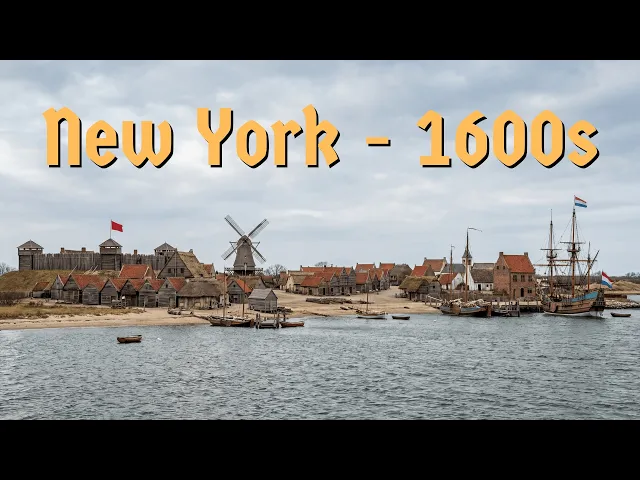
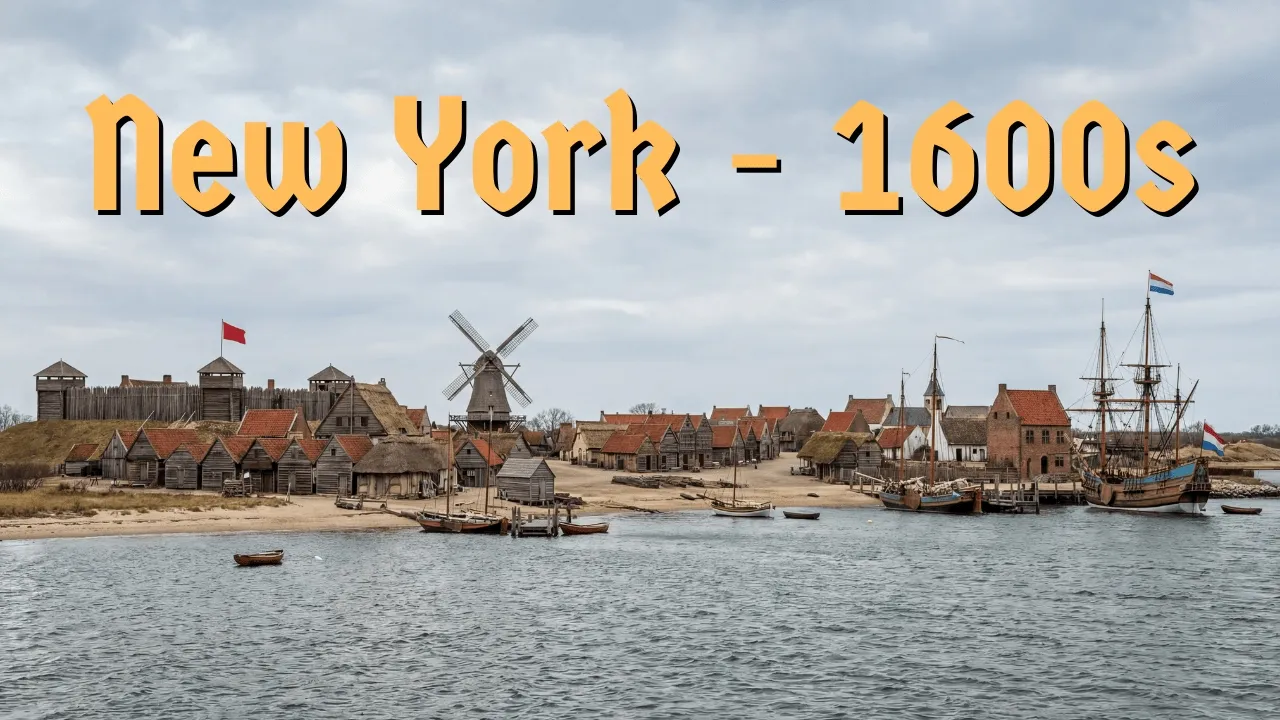
In the 1600s, the island at the mouth of the Hudson shifted like a frontier wind. First a modest [music] Dutch trading post called New Amsterdam. Then a coveted foothold for rival empires.
Wooden houses, [music] muddy lanes, and a stout little fort framed its early life. When English ships loomed offshore, the colony [music] changed hands without a battle. Its Dutch speech giving way to a new authority and a new name.
By century's end, the settlement stood restless and growing, a crossroads of ambition on the edge of a vast continent. This is New York in the 1600s. In6009, Henry [music] Hudson's landing marked the first European foothold along the river that would take his name.
His crew stepped onto a wooded [music] tidal shore alive with lenipede trade routes. A quiet moment that soon drew merchants, settlers, and competing empires. A modest arrival, uncertain, unadorned, but it opened the door to everything that followed.
In 1626, Dutch officials [music] secured Manhattan from the Lapi in an exchange later valued at 24 gilders worth of trade goods. The deal was quiet, [music] practical, and deeply misunderstood across cultures. Yet, it gave the Dutch a foothold [music] they quickly fortified.
In the early days of New Amsterdam, building the settlement meant [music] relentless, backbreaking labor. Settlers felled thick Manhattan forests with hand axes, dragging heavy logs through mud to raise [music] homes, palisades, and warehouses. Wood smoke, sweat, and the crack of splitting timber filled the air as [music] the small colony carved itself out of wilderness.
One beam, one plank, [music] one hard-earned day at a time. In 1626, Fort Amsterdam rose [music] at the southern tip of Manhattan, a rough palisade of timber and earth [music] guarding the young Dutch colony. From its ramparts, soldiers watched over the harbors shifting tides, [music] the warehouses of the West India Company and the fragile beginnings of New Amsterdam.
It was the colony's shield and its statement [music] of intent, a foothold meant to last. In 1644, Dutch leaders and native nations forged a series [music] of fragile treaties meant to quiet years of bloodshed. Around council fires and makeshift tables.
Envoys traded wampom [music] promises and uneasy concessions. The agreements brought a brief hard one piece, less trust than exhaustion. Yet they allowed New Amsterdam to breathe and rebuild.
In 1655, enslaved Africans [music] were brought into New Amsterdam in growing numbers, their forced labor [music] woven into the colony's docks, farms, and households. Sold as property by the Dutch West India Company, they lived under harsh rules and constant supervision. It was a quiet but brutal [music] turning point, bondage becoming a fixed part of the city's early economy.
Inside a [music] new Amsterdam home in the mid-6th century, life unfolded in a single crowded room warmed by a brick hearth. Light [music] filtered through small leaded windows falling across rough huneed tables, wool blankets, and puter [music] dishes stacked neatly on shelves. Families rose early to the smell of porridge and the scrape of wooden stools.
children [music] helping grind grain or fetch water, while adults tended to chores, mending nets, cutting firewood, [music] preparing salted meats for winter. The air carried a mix of wood smoke, drying herbs, and the damp scent of river winds [music] slipping through the cracks. Evenings were quiet but full, candles guttering low as stories were told, prayers whispered, and tools laid out for the morning's work.
Life was [music] modest, disciplined, and communal. Every task, cooking, sewing, sweeping, tending livestock, [music] held the steady rhythm of survival in a growing but still fragile settlement. In 1664, [music] English warships drifted into the harbor.
Their guns trained on the fort that still bore the Dutch lion. Outnumbered and divided, [music] New Amsterdam offered little resistance. Styverent's protests faded [music] beneath the colonist's desire for calmer rule.
With a quiet surrender, the city passed to English hands and gained a new name, New York. Its future redirected without a single shot fired. In 1667, [music] the Treaty of Brada formally sealed what force had begun.
The Dutch [music] seeded New Netherland to England in exchange for distant gains in Surinam. The agreement confirmed New York as English [music] territory, ending Dutch hopes of reclaiming the colony. With a stroke of diplomacy, the city's new identity, [music] its laws, loyalties, and future became fixed on the English side of empire.
In [music] 1673, Dutch ships swept into the harbor and reclaimed the city with sudden force, renaming it New Orange and restoring old banners for a single restless year. But diplomacy moved faster than cannons. By the next treaty, the colony was returned to England.
A new orange once again became New York. The moment was brief, a flicker of the old Dutch world before the English future closed firmly around it. By 1679, the old [music] Dutch Statis served as New York's city hall, a leftover of New Amsterdam, [music] now beating under English rule.
Merchants, magistrates, [music] and clerks moved through its cramped rooms, settling disputes and recording the business of a growing cosmopolitan port. The building stood as a reminder of the city's Dutch past, still useful, still central, even as New York pushed into its new identity. Around 1680, New York was [music] expanding quickly under English rule.
The population [music] topped 4,000. New brick houses rose along the streets, and the port grew busier [music] with Atlantic trade. At the same time, the enslaved population increased sharply, shaping the colony's labor [music] force and daily life.
By 1679, [music] New York's Great Dock stretched into the East River as the colony's busiest gateway. Merchants, sailors, and laborers crowded [music] its planks, unloading barrels of sugar, furs, and tobacco while new ships pressed in from [music] the Atlantic. The dock's constant creek and roar signaled the city's [music] growing ambitions.
A small port rapidly becoming a vital link in the [music] empire's trade. By 1680, New York's homes still showed strong Dutch influence, steep gables, brick [music] facades, and thick wooden beams. Despite years of English rule, newer buildings added English touches like sash windows or broader chimneys, but the streets remained visibly [music] Dutch in shape and style.
The city, like its people, [music] was still a blend in transition. The old defensive wall still marked the northern edge of the settlement. [music] Running along the line that would become Wall Street, its timber ramparts aging but intact.
Where the wall met the East River stood the Watergate. A modest fortified passage where carts, travelers, and river goods entered [music] the town under watchful guard. In 1689, New York's train band, the Citizen Militia, mustered amid [music] unrest after the Glorious Revolution.
Merchants, artisans, and laborers drilled on the Commons. A mix of Dutch, English, and colonial-born men caught in shifting loyalties. In the [music] turmoil, many officers signed a declaration backing Jacob Ller and refusing the old royal appointees.
But the rebellion proved brief. For all their moment of resolve, they ended the year once [music] again under royal authority. In 1689, New York was tense and unsettled.
News from [music] England spoke of kings rising and falling, leaving the colony unsure whose authority truly ruled. Merchants argued in taverns, [music] soldiers drilled on the commons, and ordinary residents watched the harbor for ships that might bring orders or upheaval. [music] The city lived in a state of uneasy waiting.
Caught between rumor, uncertainty, and the shifting [music] tide of empire. By 1893, New York policemen patrolled a city roaring with [music] industry and overcrowded streets. Clad in dark blue wool and brass buttons, they walked [music] fixed beats through saloons, tenementss, and gaslit avenues.
Trying to keep order in a metropolis [music] growing faster than the law could follow. Their presence was steady but strained, caught between rising crime, political pressure, and the restless energy of Gilded Age New York. By 1699, Pearl [music] Street had become one of New York's busiest lanes, curving [music] along the old shoreline, where traders, craftsmen, and sailors crowded [music] its wooden shops.
The scent of tar, spices, and [music] river wind drifted through the street, a reminder of how close the city lived to the sea that sustained it. >> That's all for now.