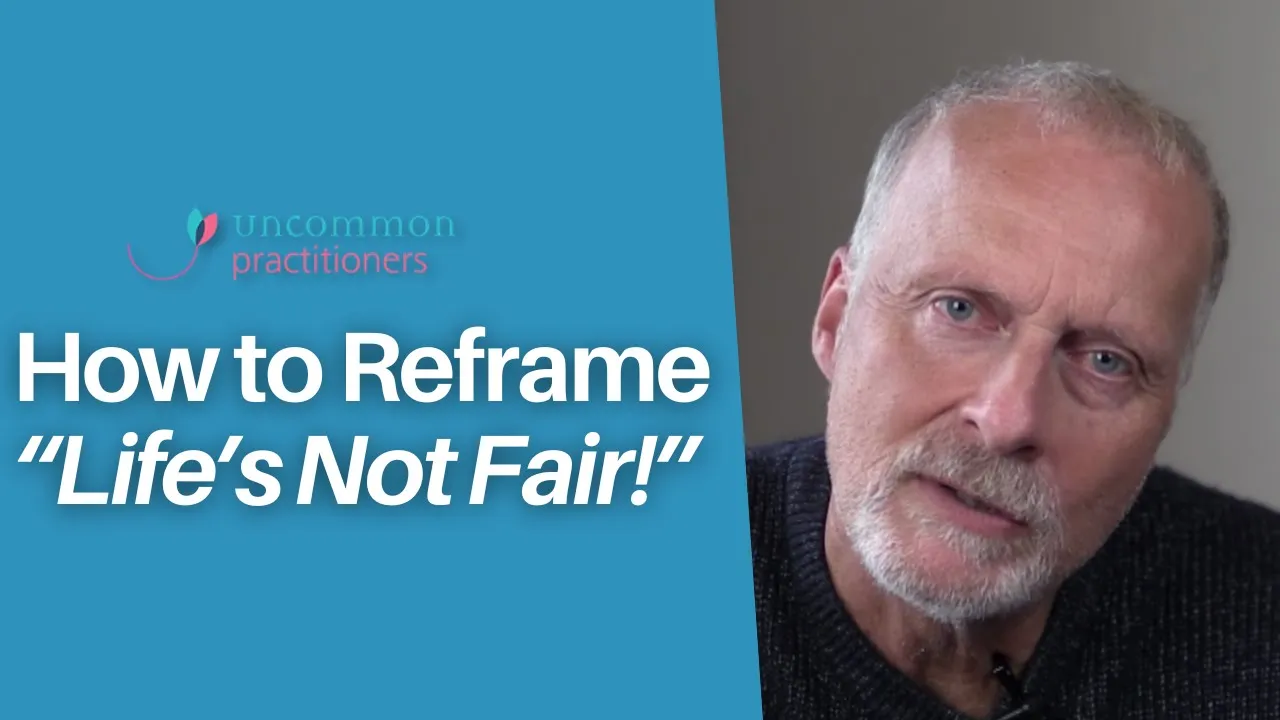
hi I'm Mar Turell of uncommon knowledge and welcome to how to reframe life's not fair three reframes to help your client Escape The Quagmire of self-pity so recently diagnosed with a devastating illness and cheated on her by now ex fiance Andrea certainly had cause for lament Andre Andrea was a client of mine so her entirely understandable reaction of why did this happen to me is one that I've heard many times in my career and as therapists and counselors we'll sometimes hear clients focusing on how a particular situation or even their lives generally is or has
been unfair so this unfairness idea is pretty common in people now we could point out that life isn't fair or that fairness is an entirely human construct that the universe takes no no notice of what we humans think we've earned or deserve or even that a lot of life is luck we only need to look at the news or hear about friends of friends who've been fought low in some way to get a sharp reminder about the prevalence of Misfortune that seems entirely disconnected to whether the person deserves The Misfortune or not but of course
this isn't a particularly he helpful or kind approach when we're faced with clients who feel injured or damaged or cheated by life's faites so how might we reframe this perception in ways that don't invalidate how the client feels but instead offers a sense of wider perspective and greater hope so first off you can align yourself with their perception of fairness rather than saying something like who says life should be fair we we can maintain and build rapport with our client perception of the need for fairness while putting a hopeful spin on it so for example
I said to Andrea these past few months life has seemed unfair to you with all the things you've told me about all the ways you've found to strive and continue despite all that and I'm starting to really feel very strongly that you're now well overdue some lasting good good luck so language like this connects with the client's sense that life should have some sort of rules of fairness but then extends that idea but in a positive way so now she's overdue some good luck she's not just a victim of bad luck and because researchers found
that when people start looking out for good luck they'll start to actually find it step number two using other people's metaphors so drawing a direct conscious comparison with someone obviously worse off seldom works you know so telling other people that they people starving you know or you know people worse off than you doesn't necessarily help them so I definitely didn't tell the suffering Andrea that there there are people out there who have it worse than her and that would have broken Rapport and been dismissive of her serious troubles however when our clients feel life has
treated them unfairly we can offer anecdotes or stories of more helpful role models without directly linking these to our client's worries so you can talk about anyone your client would most easily relate to but if no one else seems a better fit I often find it useful to talk about Milton Ericson the great 20th century clinician who suffered severe polio and chronic and acute pain throughout his life I might paraphrase his words about luck by quoting such pearls as um life is much better if sometimes it rains and sometimes it doesn't and I might go
on to relate how Erikson often talked about adults who had such perfect lives and have been such model children that they' never learned the realities of life I might talk about the effect of such a life and how Ericson described it you know the diet of Social Development and health must include a reasonable amount of roughage in life I relate Ericson's story almost as an afterthought or unrelated tangent after my client and I have talked about their unfair situation and many other things in between so just interpolating these these ideas these anecdotes here and there
not always such an obvious connection to the client situation I personally found it most effective to do this while my clients are in hypnosis that that you know the most receptive State of Consciousness number three we can ask them what they've learned when reframing the unfairness of life with my clients I don't let the focus stay on what the clients's done or suffered with whom and where and how bad it's all been of course we focus on that to some extent but not just on that instead I encourage them to consider instead what they've learned
from the experience and I keep coming back to this so to Andrea I said now all that bad luck and Misfortune has been a breeding ground for learning just as the most interesting trees are those that have faced storms being lashed by rain and wind buffeted and grew greater because of all that unlike the spoiled saplings in their protective little plastic cones that just go straight up you know or just as a sailor's skill can only increase by weathering the challenge of capsizing weather and waves and overcome that and over the next day or so
you can begin to notice more and more all the different things you've learned from everything that's happened how that's already and deep within you making you a greater person the Deep learning is going to help you immeasurably in your future ultimately we all have to take and make from Life what we can with the materials that are handed To Us by life and Andrea I'm pleased to say recovered fully from her illness and months later told me that she had learned to truly treasure the friends who weather the storms with her rather than Racing for
the lifeboats so I hope you found that useful and if you did please hit like And subscribe and if you want to hear when my next video is published hit the notification Bell below this video I'm Mark Turell of uncommon knowledge and if you'd like to subscribe to my email newsletter you can find it over at an.com blog that's un nk.com blog and thanks for watching